
Rotary Evaporator Chiller Sizing: Why Flask Volume Determines Your Cooling Needs
A rotary evaporator is only as effective as the condenser keeping its vapor contained. Without adequate cooling at the condenser, solvent vapor escapes into the vacuum pump, recovery rates drop, and the lab fills with fumes nobody wants to breathe. The variable that ties everything together is the evaporating flask volume — it dictates the solvent load, the evaporation rate, and ultimately the watts of cooling power your chiller must deliver.
Yet many labs select a chiller based on price or brand familiarity alone, only to discover months later that their 20-liter rotary evaporator overwhelms a unit rated for benchtop distillation. This guide walks through the thermodynamic reasoning behind rotary evaporator chiller sizing, provides quick-reference tables for common flask sizes, and explains how solvent choice shifts the calculation.
The Thermodynamics Behind Chiller Sizing for Rotary Evaporators
Rotary evaporation works by reducing pressure inside a sealed system so that solvents boil at lower temperatures. The vapor travels from the evaporating flask into a condenser — typically a coiled glass tube surrounded by cold fluid pumped from a recirculating chiller. The chiller must remove heat at least as fast as the heating bath adds it; otherwise, the condenser cannot fully liquefy the vapor stream.
Three factors control how much heat the chiller needs to handle:
- Evaporation rate — measured in liters per hour. Larger flasks with more surface area and higher bath temperatures push more vapor per unit time.
- Latent heat of vaporization — different solvents carry different amounts of energy per gram when they change phase. Water, for example, requires roughly 2,260 J/g, while ethanol needs about 846 J/g and dichloromethane only around 330 J/g.
- Temperature differential — the gap between the vapor temperature entering the condenser and the coolant temperature circulating through it. A wider gap means faster heat transfer but demands more refrigeration power from the chiller.
In general, the higher the evaporation rate and the higher the latent heat of the solvent, the more cooling power is needed. A 20–30% safety margin on top of the estimated heat load is recommended to account for ambient heat gain through tubing, imperfect insulation, and temperature fluctuations.
The Rule of 20: Setting Your Condenser Temperature
Before sizing a chiller’s wattage, you need to know the target condenser temperature. The widely used “Rule of 20” provides a practical guideline: the condenser coolant should be set approximately 20°C below the boiling point of the solvent at your operating pressure. This delta ensures efficient vapor condensation without over-cooling, which can cause blockages in the condenser coils.
For example, if you are evaporating ethanol at reduced pressure where it boils at roughly 34°C, your chiller should supply coolant at about 14°C — well within the range of most laboratory chillers. But if you are working with diethyl ether, which boils near 7°C under moderate vacuum, you need coolant at approximately -13°C, pushing you into sub-zero territory.
The following table lists common rotary evaporator solvents, their boiling points under typical vacuum conditions (approximately 100–150 mbar), and the recommended condenser temperature using the Rule of 20.
| Solvent | BP at ~100–150 mbar | Latent Heat (J/g) | Recommended Condenser Temp (Rule of 20) |
|---|---|---|---|
| Water | ~46°C | 2,260 | ~26°C |
| Ethanol | ~34°C | 846 | ~14°C |
| Methanol | ~28°C | 1,100 | ~8°C |
| Acetone | ~22°C | 534 | ~2°C |
| Dichloromethane (DCM) | ~15°C | 330 | ~-5°C |
| Diethyl Ether | ~7°C | 353 | ~-13°C |
| Hexane | ~25°C | 365 | ~5°C |
| Tetrahydrofuran (THF) | ~24°C | 410 | ~4°C |
Notice how solvents with low boiling points push the condenser deep into sub-zero ranges. Your chiller’s minimum achievable temperature matters just as much as its wattage rating. A unit that delivers 1,000 watts at 20°C may only deliver 400 watts at -20°C — and that distinction is critical for volatile solvents.
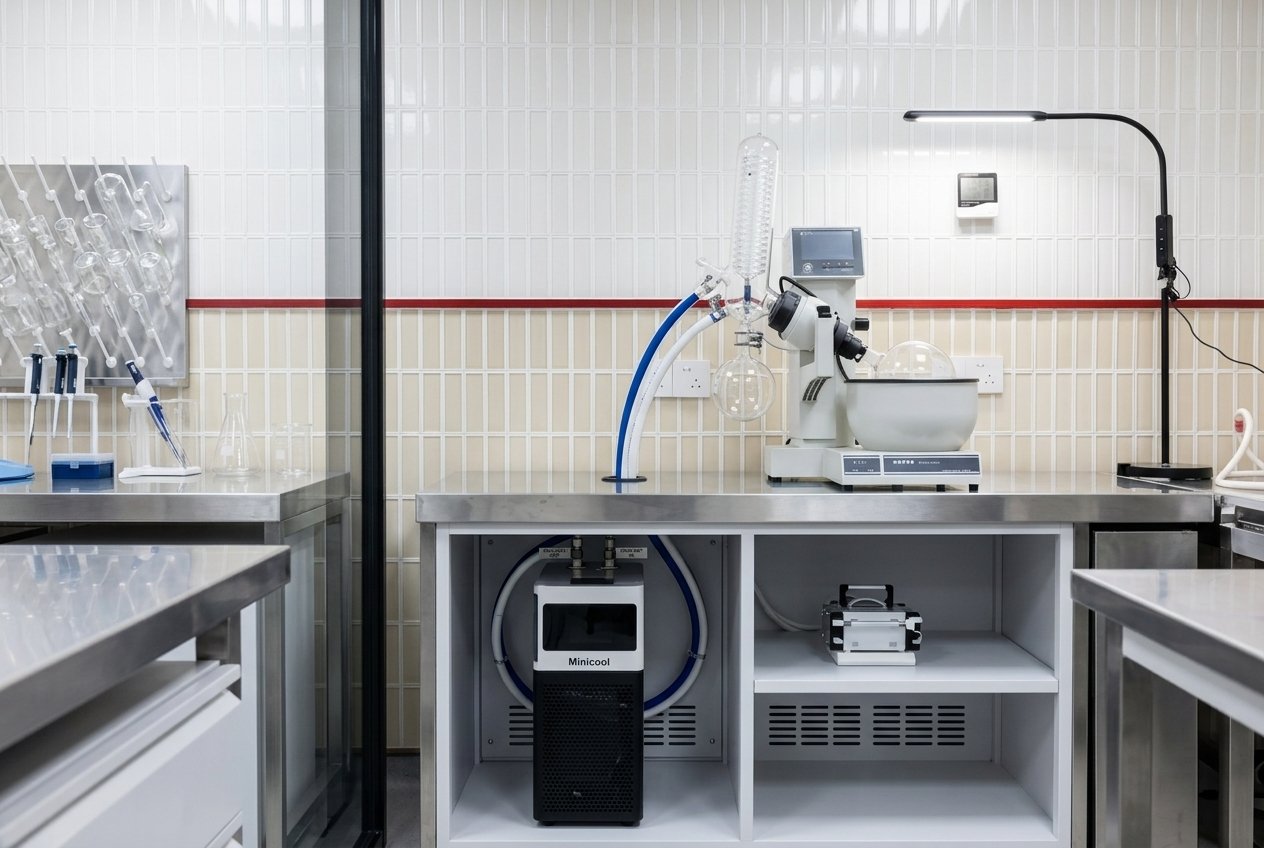
Flask Volume vs. Cooling Power: The Quick-Reference Sizing Table
The table below maps common rotary evaporator flask sizes to approximate cooling power requirements. These estimates assume a moderate evaporation rate using ethanol or similarly common organic solvents, a standard glass condenser, and the Rule of 20 applied for condenser temperature. For water-based solvents, cooling demand increases substantially due to water’s high latent heat.
| Flask Volume | Typical Evaporation Rate | Approx. Cooling Needed (Organic Solvents) | Approx. Cooling Needed (Water) | Recommended Chiller Class |
|---|---|---|---|---|
| 5 L | 1–2 L/hr | 300–600 W | 700–1,300 W | Compact benchtop (450W–1kW) |
| 10 L | 2–4 L/hr | 500–1,100 W | 1,200–2,500 W | Mid-range recirculating (1,300W–2.5kW) |
| 20 L | 4–7 L/hr | 1,000–2,000 W | 2,500–4,500 W | High-capacity recirculating (2kW–4.6kW) |
| 50 L | 7–12 L/hr | 2,000–3,500 W | 4,500–7,500 W | Industrial recirculating (4kW+) |
A few notes on reading this table:
- Organic solvents like ethanol, methanol, acetone, and hexane cluster in the 300–1,100 J/g latent heat range. This makes them comparatively gentle on chiller capacity.
- Water is the outlier. Its latent heat of 2,260 J/g means roughly 2.5 to 4 times more cooling power per liter evaporated compared to most organic solvents. Labs doing aqueous distillation need to size up aggressively.
- The “Recommended Chiller Class” column provides general power ranges. Your specific application may sit at the lower or upper end depending on bath temperature, vacuum depth, and ambient conditions.
Sizing Walkthrough: A Practical Example
Suppose your lab runs a 10-liter rotary evaporator primarily for ethanol recovery at a bath temperature of 40°C. Under moderate vacuum (around 120 mbar), ethanol boils near 34°C. Applying the Rule of 20, you set the chiller to 14°C.
At a typical evaporation rate of 3 liters per hour for a 10 L flask running ethanol, the estimated cooling requirement (including safety margin) lands around 700 W. A chiller rated at 700–1,000 W at 14°C would handle this workload comfortably.
However, if the same lab occasionally switches to water-based samples at the same evaporation rate, the cooling demand jumps to approximately 2,300 W — because water carries roughly 2.7 times more heat per gram than ethanol during phase change. That same compact chiller would be overwhelmed.
This illustrates why knowing your solvent mix is essential before committing to a chiller size. The table below shows approximate cooling requirements for common scenarios:
| Flask Size | Solvent | Evaporation Rate | Estimated Cooling Need (with margin) |
|---|---|---|---|
| 5 L | Ethanol | 1.5 L/hr | ~350 W |
| 10 L | Ethanol | 3 L/hr | ~700 W |
| 10 L | Water | 3 L/hr | ~2,300 W |
| 20 L | Ethanol | 5 L/hr | ~1,500 W |
| 20 L | Water | 5 L/hr | ~4,000 W |
Factors That Shift Your Sizing Calculation
The quick-reference table provides a starting point, but real-world conditions introduce variables that can push your cooling requirement higher or lower.
Bath Temperature
Higher bath temperatures accelerate evaporation exponentially, not linearly. Raising the bath from 40°C to 60°C on a 20 L flask can nearly double the evaporation rate, which doubles the heat load on the condenser.
Vacuum Depth
Deeper vacuum lowers the solvent boiling point further, which means a lower condenser temperature is needed (per the Rule of 20). Since chiller capacity decreases at lower temperatures, you may need a more powerful unit than the wattage alone would suggest.
Ambient Temperature
A chiller sitting in a 30°C room works harder than one in a 20°C room. Heat gain through tubing and the chiller’s own condenser (the refrigeration condenser, not the rotovap glass condenser) both increase with ambient temperature. Plan for summer peaks, not average conditions.
Condenser Geometry
Vertical coil condensers, dry-ice cold fingers, and reflux condensers each have different heat exchange efficiencies. A condenser with larger surface area is more forgiving of slight under-sizing, while a compact cold finger demands precise chiller matching.
Duty Cycle
Continuous operation for eight hours straight places sustained demand on the compressor. If your chiller is sized right at the edge, it may struggle to maintain temperature over extended runs. Build in headroom — 20 to 30 percent above calculated need is a reasonable rule of thumb.
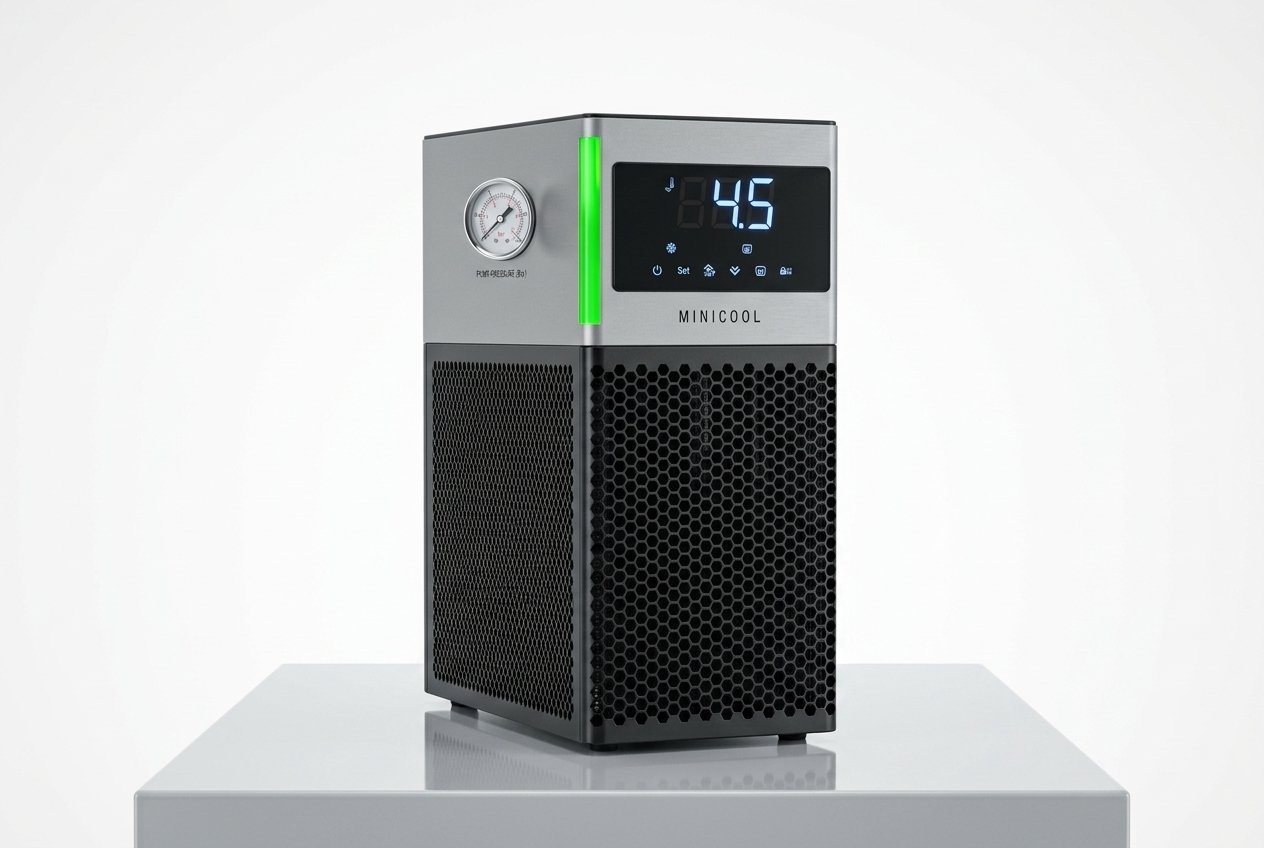
Matching RIGID Chillers to Your Rotary Evaporator
When mapping the sizing table above to specific hardware, two product lines from RIGID cover the range from benchtop 5 L units to full-scale 20 L rotary evaporators — and address many of the variables discussed.
The MiniCool series delivers 450W to over 1kW of cooling capacity with a temperature range of 0°C to -40°C and ±0.1°C stability. Its compact footprint fits beside a benchtop rotovap without monopolizing counter space. For a 5 L flask running common organic solvents, the MiniCool sits squarely in the required cooling range. It handles ethanol, methanol, acetone, and similar solvents at moderate evaporation rates without strain. The closed-loop liquid cooling design eliminates the mess and inconsistency of ice baths or tap water cooling, and the DC power option makes it adaptable for mobile or field laboratory setups.
For 10 L and 20 L rotary evaporators — or any application involving water-based solvents — the MidiCool series steps up with 1,300W to 4.6kW of cooling capacity. It shares the same 0°C to -40°C range and ±0.1°C precision control as the MiniCool, but with substantially more thermal headroom. A 20 L flask evaporating ethanol at 5 L/hr generates roughly 1,500 W of heat load with safety margin — well within the MidiCool’s 4.6kW upper capacity. Even aqueous distillation on a 10 L flask (requiring upwards of 2,300 W) falls comfortably within this range.
Both product lines use environmentally conscious refrigerants — R290 and R1234yf options reduce global warming potential compared to older refrigerants like R404A, though R404A configurations remain available in the MidiCool line for facilities that require them.
Common Sizing Mistakes to Avoid
Even experienced lab managers make sizing errors. Here are the most frequent missteps:
Confusing Cooling Capacity with Electrical Power Input
A chiller labeled “1,000W” on the nameplate may be stating its electrical consumption, not its cooling output. These are fundamentally different numbers. Always confirm whether the specification refers to cooling capacity (thermal watts removed) or power draw (electrical watts consumed). A well-designed chiller can remove significantly more heat energy than it consumes in electricity, thanks to the refrigeration cycle’s coefficient of performance.
Ignoring Temperature-Dependent Capacity
Chiller manufacturers typically rate cooling capacity at 20°C. At -10°C, the same compressor may deliver only 40–60% of that rated power. If your application demands sub-zero coolant temperatures — common with volatile solvents like DCM or diethyl ether — you must check the capacity curve at your target temperature, not just the headline number.
Sizing for Average Load Instead of Peak Load
Labs rarely run at a steady state. A researcher might increase the bath temperature to speed a distillation before lunch, or switch from ethanol to a water-based fraction mid-run. Size your chiller for the peak scenario you can reasonably expect, not the median one.
Overlooking Tubing Losses
Long, uninsulated coolant lines between the chiller and the condenser can lose 5–15% of cooling capacity to the surrounding air. Keep lines short, insulate them with foam sleeves, and route them away from heat sources like heating baths or ovens.
When One Chiller Is Not Enough
For 50 L rotary evaporators — common in pilot plants and scale-up labs — cooling requirements for aqueous solvents can exceed 7,000 W. No single benchtop or mid-range unit handles that load. Options include industrial recirculating chillers, parallel chiller configurations, or pre-cooling stages that use a secondary heat exchanger to bring coolant temperature down before it enters the primary chiller loop.
At this scale, additional considerations come into play: flow rate becomes as important as temperature, since the condenser needs sufficient volume of coolant passing through per minute to carry heat away. Pump pressure ratings must overcome the head loss in longer tubing runs and potentially elevated condenser positions. Consult with your equipment supplier for configurations beyond the 20 L threshold, as system integration becomes project-specific.
Putting It All Together: A Decision Framework
Use this step-by-step approach to select the right chiller for your rotary evaporator:
- Identify your flask volume and typical fill level (most labs fill to 40–60% of nominal flask volume).
- List your solvents and find their boiling points under your operating vacuum. Apply the Rule of 20 to determine the required condenser temperature.
- Estimate evaporation rate based on flask size, bath temperature, and vacuum depth. Manufacturer data sheets for your rotary evaporator usually provide this.
- Estimate the heat load based on your solvent type and evaporation rate using the sizing table above. Add 20–30% safety margin for real-world conditions.
- Check the chiller’s cooling capacity at your target condenser temperature — not at 20°C — to ensure it meets the calculated load.
- Verify that the chiller’s minimum temperature rating covers your lowest-boiling solvent with the Rule of 20 applied.
- Confirm flow rate and pump pressure are adequate for your condenser and tubing setup.
For 5 L flasks with organic solvents, a compact recirculating chiller in the 450W–1kW range typically suffices. For 10–20 L systems or mixed solvent work that includes water, a mid-range unit delivering 1,300W–4.6kW provides the headroom to handle variable workloads without thermal compromise. Beyond 20 L, consult directly with manufacturers for custom or industrial solutions.
Proper chiller sizing is not a luxury — it protects your solvent recovery yield, extends vacuum pump life, and keeps your lab environment safe. Spend the time on the calculation upfront, and the equipment will repay you in reliable, efficient operation for years.