
For OEM engineers and system integrators designing for harsh environments, thermal management is rarely a standalone challenge. It is a conflict of interest. You are tasked with sealing sensitive electronics against dust, moisture, and corrosive elements—often to NEMA 4X or IP65 standards—while simultaneously rejecting the significant heat load generated by those same electronics. The better you seal the enclosure, the harder it becomes to cool.
In controlled indoor environments, simple ventilation or filtered fans might suffice. However, in outdoor telecom cabinets, mobile defense units, or remote industrial monitoring stations, ambient air is often the enemy. It carries contaminants, humidity, and heat that can exceed the operating limits of internal components. This is where rugged enclosure cooling transitions from a simple accessory to a critical subsystem.
This guide provides a technical overview of active cooling strategies for sealed enclosures. We will examine the engineering constraints of mobile and off-grid applications, analyze the thermodynamics of closed-loop cooling, and provide a framework for selecting DC-powered thermal management solutions. The goal is to equip you with the data needed to make informed decisions for your next high-reliability deployment.
Get A Sample Online

Product Link: https://rigidchill.com/3.8cc-twin-cylinder-micro-dc-aircon


The Context: Where Passive Cooling Fails
The demand for higher processing power at the edge has pushed thermal densities beyond the capabilities of passive dissipation. In many application scenarios, the traditional approach of oversizing the enclosure to increase surface area is no longer viable due to weight and space restrictions.
1. Remote Telecom & 5G Infrastructure
Telecom cabinet cooling faces a dual threat: high internal heat flux from rectifiers and active equipment, combined with high solar loading. These cabinets are often located on rooftops or in open fields where ambient temperatures can spike above 45°C (113°F). In these conditions, the temperature inside a sealed cabinet can rapidly exceed the 55°C limit common for battery health and equipment reliability, leading to thermal shutdown or accelerated aging.
2. Mobile & Vehicular Applications
Defense and emergency response vehicles require cooling systems that can withstand constant vibration and shock. Standard AC-powered panel air conditioners often rely on large, heavy reciprocating compressors and require inverters to run off the vehicle’s DC bus. This adds weight, complexity, and points of failure. A native DC solution is preferred to minimize the power conversion chain.
3. Off-Grid Industrial Monitoring
Solar-powered monitoring stations for oil and gas or environmental sensing operate on tight power budgets. Every watt consumed by the cooling system is a watt that must be generated by PV panels and stored in batteries. Efficiency is not just a cost-saving measure; it dictates the physical size of the power infrastructure.
Failure Modes & Environmental Constraints
When designing a sealed enclosure cooling strategy, engineers must account for specific environmental stressors that lead to system failure. Understanding these modes is essential for selecting the right architecture.
- Contaminant Ingress: In dusty or sandy environments (e.g., desert deployments), open-loop cooling systems like fans or direct air heat exchangers require frequent filter maintenance. A clogged filter reduces airflow to near zero, causing catastrophic overheating. Sealed systems eliminate this maintenance loop.
- Humidity & Condensation: High humidity environments pose a risk of condensation on internal PCBs, leading to short circuits and corrosion. Passive cooling cannot actively dehumidify the air. Active vapor compression systems naturally remove moisture from the internal air volume, lowering the dew point.
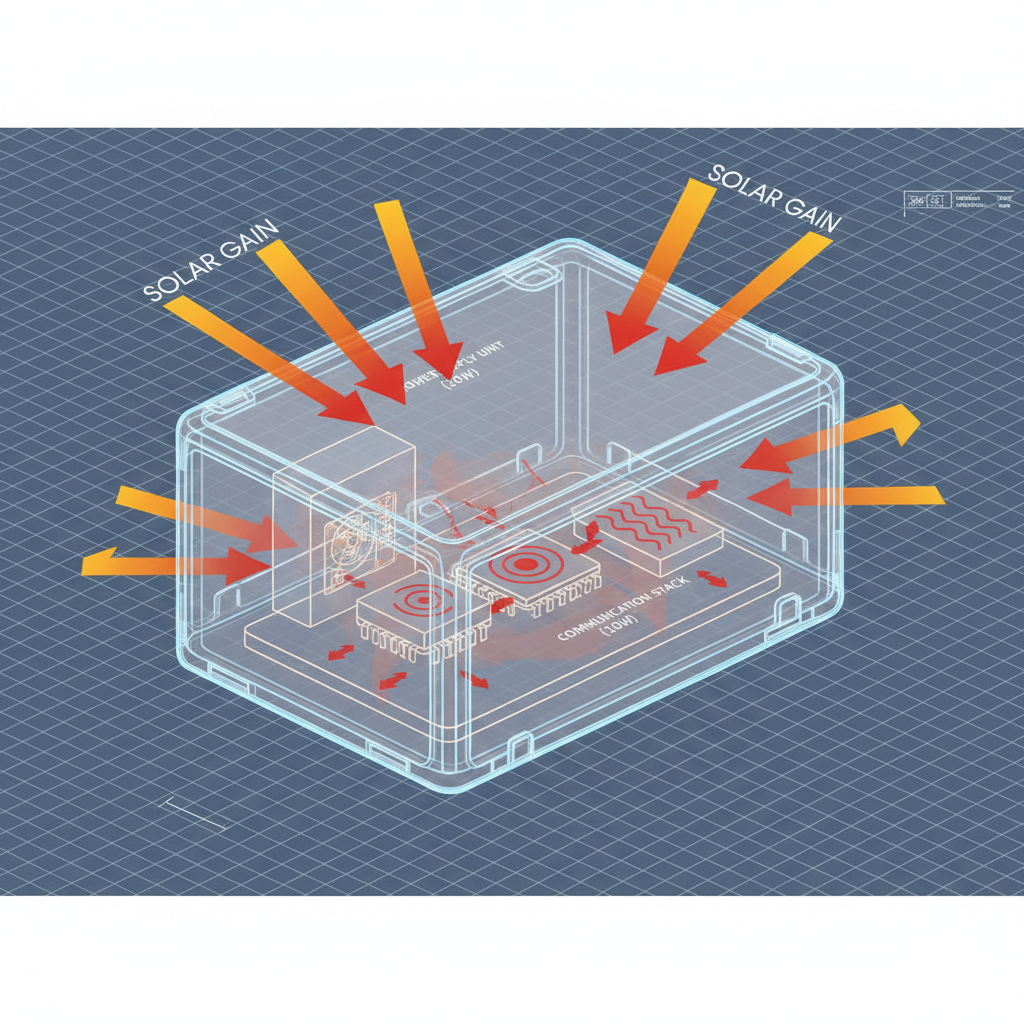
- Solar Loading: For outdoor enclosures, the sun acts as a massive external heater. A “NEMA 4X enclosure air conditioner” setup must be sized not just for the internal wattage (Qinternal) but also for the radiant heat absorbed by the cabinet walls (Qsolar). Neglecting this often leads to undersized units.
- Power Instability: In mobile and remote sites, power quality fluctuates. Voltage drops in 12V or 24V systems can cause standard compressors to stall. Specialized DC compressors are designed to handle wider voltage input ranges without seizing.
Engineering Fundamentals: The Micro DC Advantage
To solve the heat density problem in compact, mobile, or off-grid enclosures, the industry is shifting toward miniature vapor compression technology. Unlike thermoelectric (Peltier) coolers, which are inefficient for loads above 100W, or large AC air conditioners, which are bulky, the Micro DC Aircon utilizes miniature rotary DC compressors.
Closed-Loop Architecture
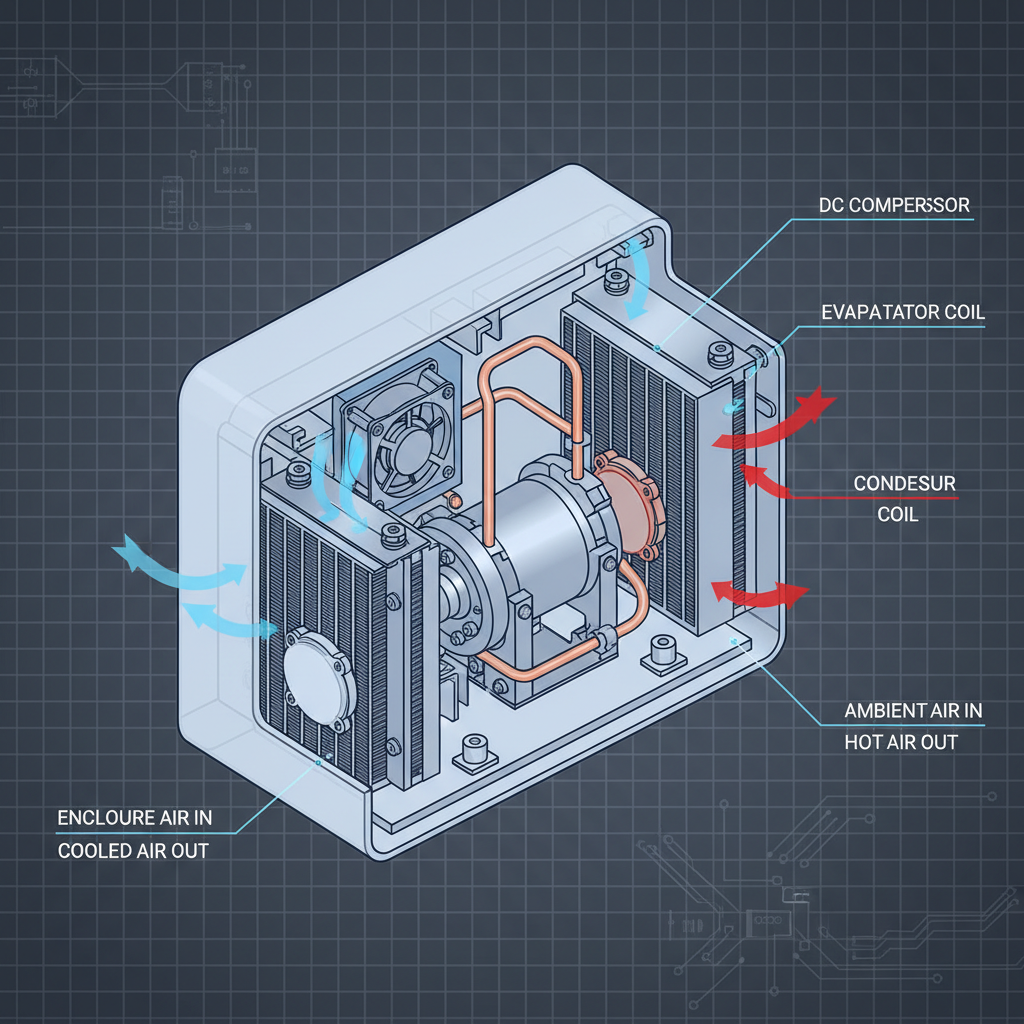
The fundamental requirement for harsh environments is isolating the internal air from the external environment. A closed-loop system circulates the same internal air repeatedly, passing it over a cold evaporator coil to remove heat, and then redistributing it over the hot components. The heat is transferred via refrigerant to a condenser coil, where it is rejected to the ambient air. This ensures that dust, moisture, and salt spray never enter the electronics compartment.
Direct DC Drive Efficiency
In many rugged applications, the primary power source is a battery bank (12V, 24V, or 48V). Using an AC air conditioner requires an inverter to convert DC to AC, typically incurring a 10–15% efficiency loss. Furthermore, the AC compressor usually operates at a fixed speed, cycling on and off (bang-bang control), which creates current inrush spikes.
By contrast, a Micro DC Aircon connects directly to the DC bus. The compressor speed can often be modulated (variable speed) to match the cooling load, significantly reducing average power consumption and eliminating inrush currents that can trip sensitive breakers.
Vapor Compression vs. Ambient Air
It is critical to distinguish between cooling to ambient and cooling below ambient. Heat exchangers and fans can only cool the enclosure to a temperature slightly above the outside air. If the ambient air is 45°C and your electronics must stay below 40°C, active refrigeration is the only viable physics-based solution. This is where the DC enclosure air conditioner becomes mandatory.
Verified Specifications: Micro DC Solutions
When selecting a cooling unit, verified performance data is paramount. The following table outlines the specifications for the Arctic-tek Micro DC Aircon series and Miniature DC Compressors, designed for integration into ruggedized systems.
| Product Series | Model (Example) | Voltage | Cooling Capacity / Rating | Key Application |
|---|---|---|---|---|
| Micro DC Aircon | DV1910E-AC | 12V | 450W | Compact Mobile Enclosures |
| Micro DC Aircon | DV1920E-AC | 12V | 450W | Vehicle Cabins / Electronics |
| Micro DC Aircon | DV3220E-AC | 12V–24V | 700W | Mid-sized Telecom Cabinets |
| Micro DC Aircon | DV3820E-AC | 24V | >650W | Industrial Control Panels |
| Micro DC Aircon | DV3830E-AC | 48V | >650W | Telecom / 48V DC Grids |
| Miniature DC Compressor | QX1901VDL | 12V | Variable (Component) | Custom Thermal Loops |
| Miniature DC Compressor | QX3202VDL | 24V | Variable (Component) | Custom Thermal Loops |
| Liquid Chiller | KVB150Z | 24V/48V | Depends on Config | Laser / Medical Cooling |
Note: Cooling capacity varies based on ambient temperature and airflow conditions. The values above represent nominal performance ratings.
Selection Framework: A 4-Step Process
Selecting the correct rugged enclosure cooling solution requires a systematic approach to ensure the thermal budget is met without over-specifying the power draw.
Step 1: Calculate Total Heat Load
The total heat load is the sum of the internal heat dissipation and the external heat transfer.
- Internal Load: Sum the wattage of all active components (CPUs, FPGAs, power supplies, rectifiers).
- Solar/Ambient Load: Calculate the heat transfer through the cabinet walls. This depends on the surface area, insulation value (k-factor), and the temperature differential (Delta T) between the outside and inside. For outdoor cabinets exposed to direct sunlight, the solar gain can add 200W–400W of effective load depending on cabinet color and size.
Step 2: Define Temperature Constraints
Determine the maximum allowable internal temperature. Batteries often require cooler temperatures (e.g., 25°C) than industrial PCs (e.g., 50°C).
Rule of Thumb: If your target internal temperature is lower than the maximum expected ambient temperature, you must use active refrigeration (an air conditioner or chiller).
Step 3: Establish the Power Budget
Identify the available voltage rails.
– 12V: Common in automotive and small solar setups.
– 24V: Standard for industrial automation and trucks.
– 48V: The standard for telecom and larger off-grid storage.
Select a unit that matches your native voltage to avoid DC-DC conversion losses.
Step 4: Validate Physical Integration
Check the physical footprint. In retrofits, space is often limited. Micro DC Aircon units are designed to be significantly smaller than traditional AC panel coolers, but airflow clearance is still required for both the condenser (hot side) and evaporator (cold side) to function correctly.
Implementation Checklist
Successful deployment of a DC enclosure air conditioner involves more than just bolting the unit to the door. Follow this checklist to ensure long-term reliability.
Mechanical Integration
- Sealing: Ensure the mounting cutout is sealed with a high-quality gasket (often neoprene or EPDM) to maintain the enclosure’s IP or NEMA rating. A poor seal will allow moisture ingress, negating the benefits of the closed-loop system.
- Orientation: While rotary compressors are robust, verify the maximum allowable tilt angle if the equipment is mobile. Most compressors have a limit (e.g., 30 degrees) for continuous operation to ensure proper lubrication.
- Drainage: Active cooling removes moisture. Ensure the condensate drain line is routed correctly to the outside of the enclosure and includes a trap or valve to prevent air ingress.
Electrical & Thermal
- Fusing: Install appropriate fusing on the DC input line to protect the wire harness. DC motors can have startup currents that differ from steady-state operation.
- Airflow Management: Do not block the intake or exhaust vents. Short-cycling occurs when cold air from the AC is immediately sucked back into the return vent without cooling the equipment. Use baffles or ducting if necessary to direct cold air to hot spots.
Maintenance Plan
- Condenser Cleaning: The external side of the air conditioner (condenser) is exposed to ambient air. In dusty environments, schedule periodic cleaning of the condenser coil or filter to maintain heat rejection efficiency.
Frequently Asked Questions (FAQ)
Q: Can I use a standard fan if I add a filter?
A: Only if the ambient temperature is significantly lower than your target internal temperature. If the air outside is 40°C, a fan can never cool the inside below 40°C. For sub-ambient cooling or sealed protection, you need active refrigeration.
Q: Why should I choose a DC air conditioner over an AC model with an inverter?
A: Efficiency and reliability. Inverters add weight, cost, and a point of failure. They also consume power (conversion loss). A native DC system runs directly off your battery or DC bus, maximizing runtime in off-grid scenarios.
Q: Are these units NEMA 4X certified?
A: The air conditioner itself must be designed to mate with a NEMA 4X enclosure without compromising the enclosure’s rating. While specific model certifications vary, the closed-loop design is inherently compatible with the requirements of sealed, wash-down, or corrosion-resistant applications. Always verify the specific IP/NEMA rating of the unit in the datasheet.
Q: How do these units handle vibration in vehicles?
A: The Miniature DC Compressor technology used in these systems is originally derived from mobile applications. Rotary compressors are generally more resistant to vibration and inclination than the reciprocating compressors found in stationary AC units.
Q: What happens if the voltage drops?
A: Most Micro DC Aircon units have built-in low-voltage protection. They will cut out to protect the battery from deep discharge and automatically restart when the voltage recovers. This is a critical feature for solar and battery-powered sites.
Q: Can these units heat the enclosure as well?
A: Some models may offer reverse cycle or resistive heating options, but the primary function discussed here is cooling. If heating is required for freeze protection, a separate small heater is often the simplest solution.
Q: What is the expected lifespan of a Micro DC Aircon?
A: With proper maintenance (keeping coils clean), these units are designed for continuous industrial operation. The DC compressors are brushless, eliminating brush wear as a failure mode.
Conclusion
As electronics are deployed in increasingly hostile environments—from the scorching heat of a desert telecom tower to the vibrating chassis of an off-road vehicle—the cooling strategy must evolve. Passive methods and consumer-grade fans are no longer sufficient for high-value, mission-critical hardware.
Rugged enclosure cooling requires a shift toward dedicated, closed-loop thermal management systems. By leveraging Micro DC Aircon technology, engineers can achieve high cooling capacity in a compact footprint, maintain the integrity of sealed enclosures, and operate efficiently directly from DC power sources.
When designing your next outdoor or mobile cabinet, consider the total cost of ownership: the risk of downtime, the cost of battery power, and the longevity of the internal components. A purpose-built DC cooling solution is often the most prudent investment for long-term reliability.
For assistance in sizing a cooling solution for your specific heat load and environmental constraints, contact the Arctic-tek engineering support team.