
Why Small 12V Air Conditioners Matter for Mobile Cooling
A small 12V air conditioner provides true refrigeration cooling in space-constrained mobile environments, operating directly from vehicle batteries or solar power systems. Unlike evaporative coolers that only work in dry climates or ventilation fans that provide no actual cooling, small 12V air conditioners deliver 15-20°C temperature drops regardless of humidity—making them essential for van conversions, truck sleeper cabs, and other confined spaces where traditional AC systems cannot fit.
The distinction matters because mobile applications face unique constraints that stationary cooling systems never encounter. A camper van has limited battery capacity, restricted ceiling height, and constant vibration from road travel. A truck sleeper cab offers minimal space behind the seat and must operate without idling the engine. A pet transport crate needs cooling that fits within cargo dimensions while preventing heat stress during summer travel.
Small 12V air conditioners serve applications where both physical compactness and DC power operation are non-negotiable. Van life enthusiasts use them to maintain comfortable sleeping temperatures without installing bulky rooftop units or running generators. Long-haul truck drivers rely on them for rest period cooling without draining starting batteries. Pet owners depend on them to ensure safe transport temperatures during hot weather travel.
The core advantage of compact 12V cooling is installation flexibility combined with true refrigeration performance. These units mount in locations impossible for larger systems—under seats, in overhead compartments, or integrated into custom cabinetry—while delivering consistent cooling that evaporative or passive systems cannot match.
RIGID Micro and Portable DC Air Conditioner Models
RIGID offers two primary product lines for small-space 12V cooling, each designed for specific installation and capacity requirements:
Micro DC Aircon Series: The most compact option measures approximately 350×260×180mm and weighs around 5kg. These units provide 450-550W cooling capacity (1,535-1,876 BTU), suitable for personal cooling zones, small van sleeping areas, or truck cabs up to 3-4 cubic meters. Available in 12V and 24V configurations. Typical applications: camper van sleeping areas, truck sleeper cabs, small boat cabins, pet crates, motorcycle sidecars.
Portable DC Air Conditioner Series: Larger portable models measure approximately 500×300×250mm and weigh around 11kg. These deliver 700W cooling capacity (2,387 BTU), adequate for larger van interiors or small RV spaces up to 5-6 cubic meters. Available in 12V, 24V, and 48V configurations. Maximum operating current: 16A (12V model). Typical applications: full-size van conversions, small travel trailers, off-grid cabins, outdoor work shelters.
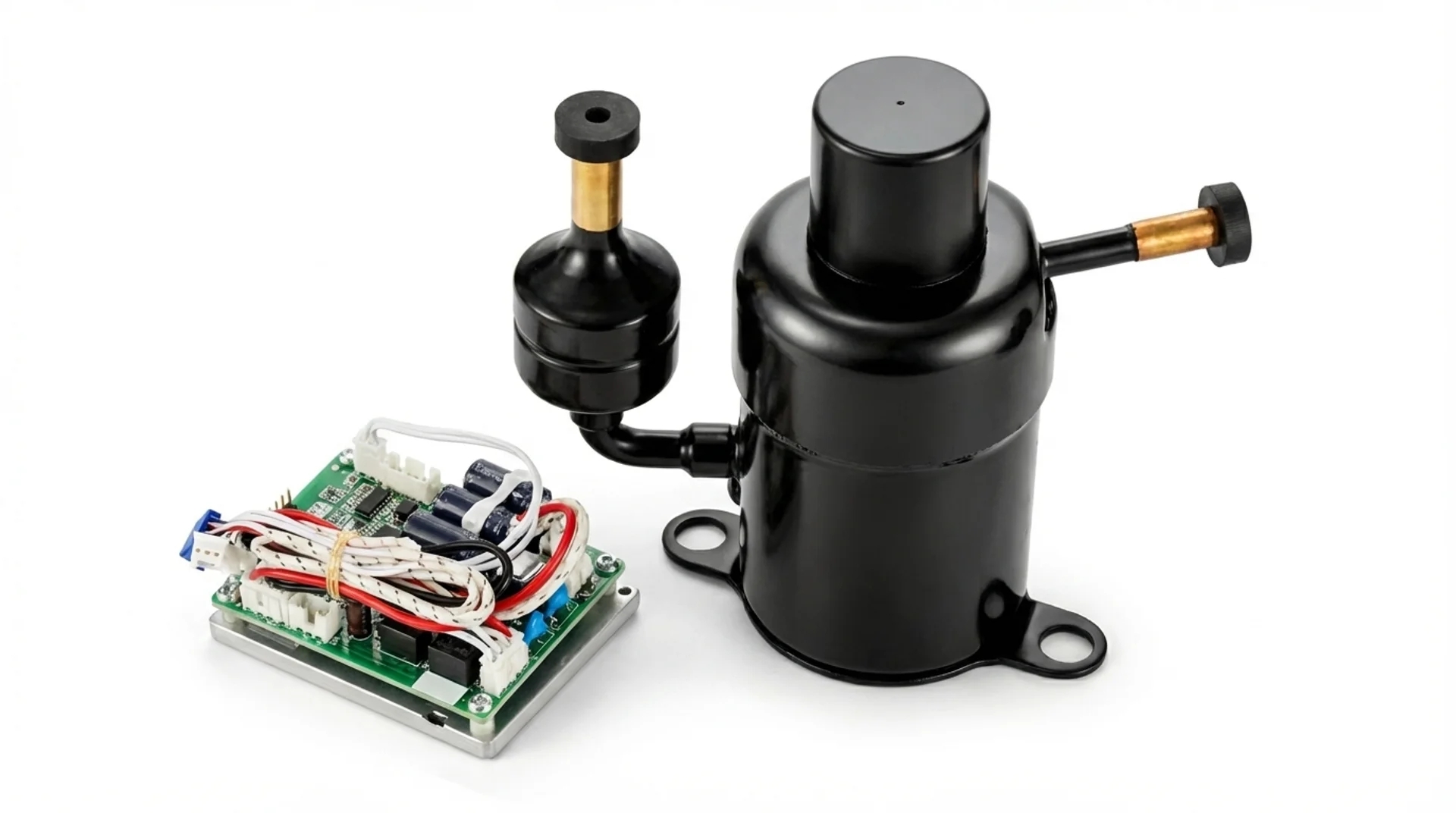
Both product lines feature RIGID’s miniature DC compressor technology, enabling compact dimensions while maintaining reliable cooling performance. The key difference lies in cooling capacity and physical size—Micro units prioritize minimal footprint for the tightest installations, while Portable units offer higher capacity for larger spaces.
Sizing for Your Space: Cooling Load Calculation
Proper sizing ensures adequate cooling without excessive power consumption or oversized equipment:
Space Volume: Calculate the volume of the area requiring cooling. A van sleeping area measuring 2m × 1.5m × 1.2m high = 3.6 cubic meters. A truck sleeper cab measuring 2m × 1.8m × 1.5m high = 5.4 cubic meters. Small spaces typically require 150-200W of cooling capacity per cubic meter in moderate climates, or 200-250W per cubic meter in hot climates (35°C+ ambient).
Insulation Quality: Well-insulated spaces retain cooling and reduce capacity requirements significantly. Spray foam insulation in van walls reduces heat gain by 50-70% compared to uninsulated metal. Reflective window covers block 60-80% of solar heat gain through glass. Poor insulation may double cooling requirements—a 4 cubic meter space needing 700W with good insulation might require 1,400W without.
Occupancy and Heat Sources: Each person generates approximately 100W of body heat during rest. Electronic devices add 20-50W per device depending on type. Cooking or other heat-generating activities temporarily increase cooling load. A van with two occupants, a laptop, and LED lighting adds roughly 250W to the base cooling load.
Example Calculation: A 4 cubic meter van sleeping area with good insulation in moderate climate: Base load = 4m³ × 175W/m³ = 700W. Add occupancy (2 people × 100W) = 200W. Add electronics (laptop + phone charging) = 50W. Total cooling requirement: 950W. A Portable DC Air Conditioner (700W capacity) would provide adequate cooling for this scenario, while a Micro DC Aircon (450-550W) would be marginal and better suited for smaller spaces or single occupancy.
Understanding Power Consumption and Battery Requirements
Small 12V air conditioners consume significant electrical power, requiring careful battery system planning:
Electrical Input vs. Cooling Output: It is critical to distinguish between cooling capacity (measured in watts or BTU) and electrical power consumption (measured in amps at 12V). A unit with 450W cooling capacity does not draw 450W ÷ 12V = 37.5A. Instead, electrical input depends on compressor efficiency, ambient temperature, and operating conditions. For example, RIGID’s Portable DC Air Conditioner provides 700W cooling capacity but draws a maximum of 16A at 12V during peak operation—equivalent to approximately 192W electrical input at full load.
Actual Current Draw: Small 12V air conditioners typically draw 8-16A during compressor operation, depending on model and conditions. The Micro DC Aircon series draws approximately 8-12A at 12V. The Portable DC Air Conditioner draws up to 16A at 12V. These values represent maximum current during active cooling; actual consumption varies with duty cycle as the compressor cycles on and off to maintain setpoint temperature.
Duty Cycle and Runtime: Once a space reaches the desired temperature, the compressor does not run continuously. Typical duty cycles range from 40-60% in well-insulated spaces—meaning the compressor operates 24-36 minutes per hour. In a poorly insulated space or extreme heat, duty cycle may reach 70-80%. Calculate battery consumption based on duty cycle: A unit drawing 12A at 50% duty cycle consumes 6A average over time.
Battery Capacity Sizing: Lithium batteries should not discharge below 20% capacity for longevity. Lead-acid batteries should not discharge below 50%. To run a Portable DC Air Conditioner (16A max, assume 50% duty cycle = 8A average) for 8 hours overnight: 8A × 8 hours = 64 amp-hours consumed. Lithium batteries need minimum 80 amp-hours usable capacity (100 amp-hours total). Lead-acid batteries need 128 amp-hours usable (256 amp-hours total).
Charging Requirements: Batteries must recharge fully between discharge cycles. Solar panels provide 4-6 hours of effective charging per day in summer, less in winter or cloudy conditions. A 200W solar panel generates approximately 10-12A in full sun—requiring 6-7 hours to replace 64 amp-hours consumed overnight. Alternator charging while driving provides 30-50A, recharging 64 amp-hours in 1.5-2 hours of driving.

Installation Considerations for Mobile Applications
Compact installations in vehicles require careful planning to maximize cooling effectiveness and ensure reliable operation:
Mounting Location: Position units where cold air reaches occupants without obstruction. Overhead mounting provides downward airflow that naturally circulates and saves floor space. Under-seat mounting preserves overhead clearance but may require ducting to direct airflow effectively. Wall mounting works in vehicles with vertical surfaces but may interfere with windows or storage compartments.
Airflow and Circulation: Small spaces need good air circulation to prevent hot spots and ensure even cooling. Position cold air outlets to create circulation patterns—typically directing flow across occupants then allowing return near the floor. Avoid mounting units where furniture, cargo, or cabinetry blocks airflow. Consider adding small circulation fans (1-2W consumption) to improve air mixing in dead zones.
Condensate Management: Air conditioners generate condensate water that must drain properly to prevent water damage. In vehicles, route condensate outside through floor drains or existing body penetrations. Ensure drain lines slope continuously downward to prevent water backup. In stationary applications, collect condensate in reservoirs for periodic emptying or route to external drainage.
Electrical Connection: Wire units directly to battery banks using appropriately sized cables to minimize voltage drop. A unit drawing 16A maximum requires minimum 10 AWG wire for runs under 3 meters, or 8 AWG for longer runs. Install inline fuses rated 25-50% above maximum current draw (20-25A fuse for 16A load). Use Anderson connectors or similar high-current connectors for reliable connections that resist vibration.
Vibration Isolation: Vehicles experience significant vibration that can damage poorly mounted equipment or create noise transmission. Use rubber isolation mounts to absorb vibration and prevent noise from transferring to vehicle structure. Secure all mounting hardware with thread-locking compound to prevent loosening. Inspect mounting bolts periodically for tightness, especially after rough road travel.
Comparing Small 12V AC to Alternative Cooling Methods
Understanding trade-offs helps select the right cooling approach for specific applications:
Evaporative Coolers: Swamp coolers consume only 1-2A but provide limited cooling (5-10°C temperature drop) and only work in dry climates (below 40% humidity). They add moisture to air, which can cause condensation problems in sealed vehicles. Best for desert climates and daytime cooling. Not suitable for humid climates, overnight cooling, or sealed spaces.
Ventilation Fans: Roof vents and circulation fans consume 1-3A and provide comfort through air movement but no actual cooling. Effective only when outside temperature is below desired inside temperature. Best for mild climates, shoulder seasons, and supplemental air movement. Not suitable for hot climates (30°C+ ambient) or stationary vehicles in direct sun.
12V Air Conditioners: True refrigeration provides 15-20°C temperature drop regardless of humidity, but consumes 8-16A during operation. Requires adequate battery capacity and charging infrastructure. Best for hot climates, humid conditions, overnight cooling, and sealed spaces. Trade-off: higher power consumption and initial cost versus reliable cooling performance in all conditions.
Maintenance and Troubleshooting
Regular maintenance ensures reliable operation in demanding mobile environments:
Routine Maintenance: Clean air filters weekly during heavy use to maintain airflow and efficiency. Inspect condensate drains monthly to prevent clogs that cause water backup. Check electrical connections quarterly for corrosion or loosening from vibration. Clean condenser fins annually to maintain heat rejection efficiency and prevent performance degradation.
Common Issues: Inadequate cooling often results from dirty filters, low refrigerant charge, or undersized capacity for the space. Excessive power consumption may indicate refrigerant overcharge, dirty condenser, or compressor wear. Water leaks typically result from clogged drains or improper installation angle. Consult manufacturer troubleshooting guides for specific diagnostic procedures.
Seasonal Storage: When storing units for extended periods, run them for 10-15 minutes monthly to circulate refrigerant and lubricate compressor seals. Store in dry locations to prevent corrosion of electrical components. Disconnect batteries to prevent parasitic drain. Cover units to protect from dust and debris accumulation.
Selecting the Right Small 12V Air Conditioner
Key factors guide selection for mobile and off-grid applications:
Cooling Capacity Match: Choose capacity based on space volume, insulation quality, and climate conditions. Undersizing by 20% leaves occupants uncomfortable during peak heat. Oversizing by more than 30% wastes battery capacity through excessive cycling. Target capacity within 10-20% of calculated cooling load for optimal performance and efficiency.
Physical Dimensions: Measure available installation space carefully, accounting for clearances needed for airflow and service access. Consider weight distribution in vehicles—mounting heavy units high raises center of gravity and affects handling. Verify mounting surface can support unit weight plus dynamic loads from vibration and acceleration.
Voltage Configuration: Match unit voltage to your electrical system. 12V units suit most vehicles with standard automotive electrical systems. 24V units offer higher efficiency and lower current draw for systems with 24V battery banks. 48V units provide the best efficiency but require specialized battery systems uncommon in most mobile applications.
Build Quality for Mobile Use: Mobile applications demand robust construction beyond stationary units. Look for metal housings rather than plastic, vibration-isolated compressor mounts, and sealed electrical connections resistant to moisture and dust. Verify units are specifically designed and tested for mobile use rather than adapted from stationary applications.
For detailed specifications and installation support, explore Micro DC Aircon for the most compact installations or Portable DC Air Conditioner for higher capacity applications in vans, trucks, RVs, and off-grid spaces.