
How to Choose the Right Small AC Compressor for Your Cooling Project
If you have ever searched for a small ac compressor, you probably noticed that the results can be confusing. Some listings show tiny air pumps used for inflating tires, while others display compact refrigeration compressors designed for real cooling work. Understanding the difference is the first step toward making the right purchase decision for your project.
A small AC compressor, in the context of refrigeration and air conditioning, is a compact vapor-compression device that circulates refrigerant through a closed loop to remove heat from a confined space. It is the heart of any cooling system — whether that system is a portable refrigerator, a compact air conditioner, a medical device cooler, or an electronics thermal management unit. Without the right compressor, your cooling system simply will not perform.
The growing demand for miniaturized, portable, and battery-powered cooling solutions has made small compressors more important than ever. Engineers, product designers, and DIY builders alike need compressors that deliver reliable cooling capacity in a footprint small enough to fit inside compact enclosures. This guide walks you through everything you need to know to choose the right one.
Refrigeration Compressor vs. Air Compressor: A Critical Distinction
One of the most common mistakes buyers make is confusing a refrigeration compressor with an air compressor. While both devices compress gases, they serve entirely different purposes and are not interchangeable.
A refrigeration compressor is designed to compress refrigerant gases such as R134a, R290, or R600a within a sealed vapor-compression cycle. It works alongside a condenser, expansion valve, and evaporator to absorb and reject heat. This is the type of compressor used in refrigerators, air conditioners, liquid chillers, and other active cooling systems.
An air compressor, on the other hand, compresses atmospheric air and stores it in a tank for pneumatic tools, tire inflation, or airbrushing. It has no refrigerant circuit and produces no cooling effect whatsoever.
If your goal is to cool a space, chill a liquid, or maintain a set temperature inside an enclosure, you need a refrigeration compressor — not an air pump. When shopping online, look for keywords like refrigerant type, cooling capacity measured in watts or BTU, and evaporator temperature range. These specifications confirm that you are looking at a true refrigeration compressor.
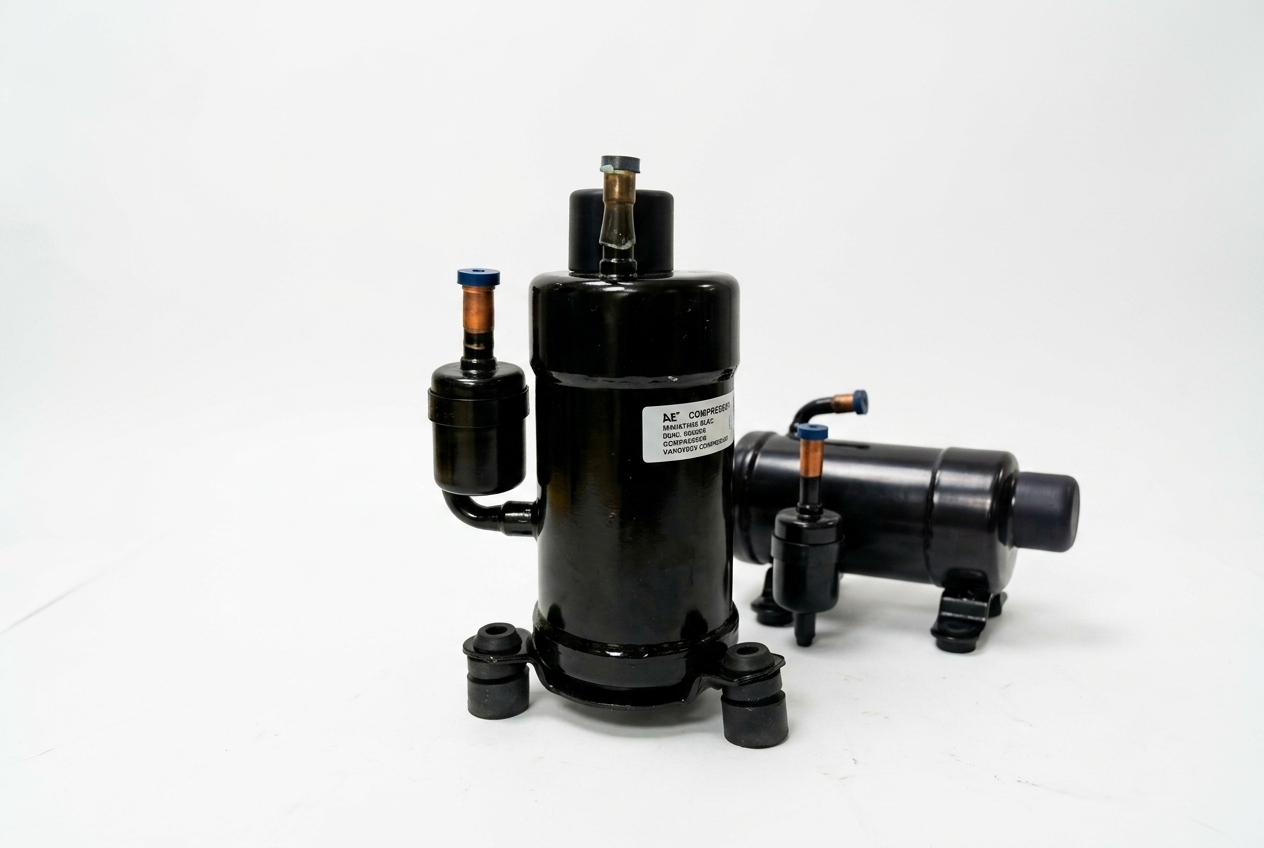
Why 12V DC BLDC Compressors Are the Modern Standard
Traditional compressors run on AC mains power — 110V or 220V depending on your region. That works fine for stationary appliances, but it becomes a major limitation when you need portable, mobile, or off-grid cooling. This is where 12V DC BLDC compressors change the equation entirely.
BLDC stands for Brushless Direct Current. Unlike conventional AC induction motors, a BLDC motor uses permanent magnets and electronic commutation to achieve rotation. This architecture delivers several advantages that are especially relevant for small cooling systems:
Variable speed operation. A BLDC compressor can adjust its speed from approximately 2,000 to 6,500 RPM based on cooling demand. When the thermal load is light, the compressor slows down and consumes less power. When demand spikes, it ramps up. This results in better energy efficiency compared to fixed-speed compressors that cycle on and off.
Direct DC power compatibility. A 12V BLDC compressor runs directly from automotive batteries, solar panels, lithium battery packs, or any 12V DC source. There is no need for an inverter to convert DC to AC, which eliminates conversion losses and reduces system complexity.
Compact size and low weight. Modern 12V BLDC mini compressors can be astonishingly small. For example, RIGID’s miniature models measure just 56.5 × 78 mm and weigh only 720 grams. That is roughly the size of a soda can and lighter than most smartphones with a case. This tiny footprint opens up design possibilities that were simply not feasible with larger AC compressors.
Low vibration and quiet operation. The brushless motor design inherently produces less mechanical vibration than brushed or reciprocating alternatives. Combined with anti-vibration cushions, these compressors operate quietly enough for use in bedside medical devices, passenger vehicle cabins, and enclosed workspaces.
Long service life. Without brushes to wear out, a BLDC motor lasts significantly longer than its brushed counterparts. This translates to lower maintenance costs and higher reliability over the lifetime of your product or project.
Cooling Capacity Tiers: Matching Watts to Your Application
Choosing the right cooling capacity is arguably the most important decision in your compressor selection process. Too little capacity and your system cannot reach or maintain the target temperature. Too much capacity and you waste money, space, and energy on a compressor that is oversized for your needs.
Small DC compressors typically range from about 50 watts to over 500 watts of cooling capacity. Here is how different capacity tiers map to common applications:
50W to 100W — Personal and Micro Cooling
This tier is ideal for very small enclosures and low-heat-load applications. Think personal beverage coolers that hold a few cans, small skincare refrigerators, compact sample storage units for laboratories, or electronics cooling systems where a CPU or laser module needs to stay below a specific temperature threshold. At this capacity, power consumption is minimal, often just a few amps at 12V, making solar-powered and battery-operated designs highly practical.
100W to 250W — Portable Refrigeration and Spot Cooling
The mid-range tier covers the largest number of use cases. Portable refrigerators and freezers for camping, overlanding, and marine use typically require 100W to 200W of cooling capacity. Small water dispensers with chilled water output, compact liquid chillers for medical-aesthetic devices, and telecom equipment cooling enclosures also fall into this range. A 12V compressor in this tier draws roughly 8 to 16 amps, which is manageable for most vehicle electrical systems and medium-sized battery banks.
250W to 500W+ — Compact Air Conditioning and High-Demand Systems
When you need to cool an actual living or working space — such as a small vehicle cabin, a compact server closet, or a thermally-controlled shipping container — you enter the higher capacity range. Portable DC air conditioners, rooftop units for trucks and RVs, and multi-zone cooling systems for specialized vehicles require this level of output. RIGID offers models in this range that still maintain a relatively compact form factor compared to traditional AC compressors, though they are naturally larger and heavier than the micro models.
Key Specifications to Evaluate Before Buying
Beyond cooling capacity, several other specifications deserve careful attention when selecting a small compressor for your project.
Refrigerant type matters for both performance and regulatory compliance. R134a is the most widely used refrigerant in small DC compressors and offers a good balance of efficiency, safety, and availability. R290 (propane) is gaining popularity due to its lower global warming potential and excellent thermodynamic properties, though it is flammable and subject to stricter safety regulations in some regions. R600a (isobutane) is common in household refrigeration and offers quiet, efficient operation at lower capacities.
Operating voltage determines compatibility with your power source. While 12V is the most common choice for automotive and portable applications, 24V models are available for commercial vehicles and industrial equipment, and 48V options exist for higher-power systems where lower current draw is preferred.
Ambient temperature rating is often overlooked but critically important. If your compressor will operate in hot environments — inside an engine compartment, in direct sunlight, or in tropical climates — verify that it is rated for high ambient temperatures. RIGID compressors, for instance, are rated to operate in ambient temperatures up to 52°C, which covers virtually all real-world scenarios.
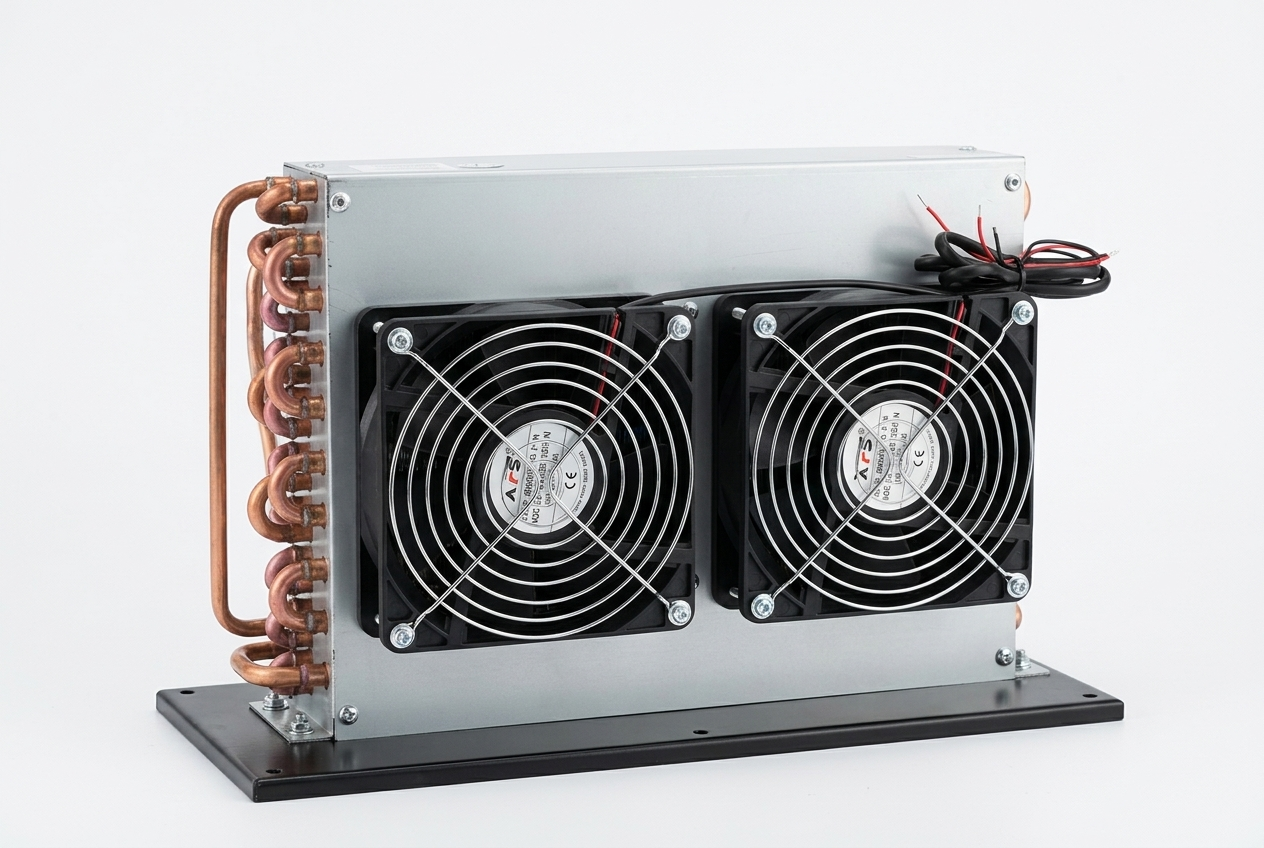 Working current at full load tells you how much your power source needs to deliver. A typical 12V compressor may draw around 16 amps at peak load, which is important for sizing your wiring, fuse, and battery capacity. Variable speed operation helps here, since the compressor draws less current when running at lower speeds.
Physical dimensions and weight directly impact your design. Measure your available installation space carefully and compare it against the compressor’s published dimensions. Remember to account for the driver board, wiring connections, and adequate ventilation around the compressor.
The Role of the Driver Board in System Performance
A BLDC compressor does not run on raw DC power alone. It requires an electronic driver board — sometimes called an inverter board or controller — that converts the DC input into the precisely timed three-phase signals needed to spin the brushless motor.
The quality of the driver board directly affects compressor performance. A well-designed driver board provides smooth speed ramping, soft start capability to reduce inrush current, and automatic protection features such as over-current shutdown, over-temperature shutdown, and low-voltage cutoff. These protections not only safeguard the compressor but also protect your battery or power supply from damage.
RIGID supplies its compressors with matched sine wave variable speed driver boards, ensuring that the motor runs smoothly and efficiently across its entire speed range. When evaluating compressors from any supplier, always confirm that the driver board is included, compatible, and equipped with adequate protection circuits.
Common Applications for Small DC Compressors
The versatility of modern small DC compressors has opened up applications that would have been impractical just a decade ago. Here are some of the most common use cases:
Portable refrigerators and freezers for outdoor recreation, emergency services, and pharmaceutical transport. These units need to maintain precise temperatures while running on vehicle batteries or portable power stations.
Compact liquid chillers for medical and aesthetic devices. Laser equipment, cryotherapy units, and certain diagnostic instruments require chilled water or coolant circulated at a controlled temperature. A small DC compressor paired with a compact heat exchanger provides an elegant solution.
Telecommunications equipment cooling. Remote cell towers and network cabinets in hot climates need active cooling to prevent equipment failure. DC compressors powered by solar panels and batteries can provide this cooling without access to grid power.
Vehicle cabin cooling. Truck drivers, van lifers, and boat operators benefit from compact DC air conditioning systems that run directly from the vehicle battery without needing the engine to idle.
Beverage and food service. Small vending machines, countertop coolers, and mobile food service carts use mini compressors to keep products at serving temperature.
Installation Tips for Best Results
Even the best compressor will underperform if installed incorrectly. Follow these guidelines to get the most from your small DC compressor:
Mount the compressor on a stable, vibration-dampened surface. While BLDC compressors produce less vibration than reciprocating types, proper mounting with anti-vibration cushions will further reduce noise and extend component life.
Ensure adequate airflow around the condenser. The condenser rejects heat from the refrigerant to the surrounding air. If airflow is restricted, the system’s efficiency drops and the compressor has to work harder, drawing more current and generating more heat.
Use appropriately sized wiring for the expected current draw. Undersized wires cause voltage drop, which reduces compressor performance and can trigger the driver board’s low-voltage protection. For a compressor drawing 16 amps at 12V, use wiring rated for at least 20 amps with minimal run length.
Keep refrigerant lines as short as possible. Longer lines increase refrigerant charge requirements and introduce additional pressure drop, both of which reduce system efficiency. Plan your layout to minimize the distance between the compressor, condenser, and evaporator.
Protect the driver board from moisture and dust. While the compressor itself is a sealed unit, the electronic driver board is sensitive to environmental contamination. Use a sealed enclosure or conformal coating if the system will be exposed to harsh conditions.
Why OEMs and Designers Choose RIGID
For original equipment manufacturers and product designers who need to integrate a small compressor into a custom cooling system, choosing the right supplier is as important as choosing the right specifications. RIGID has built a reputation as a premier supplier of miniature BLDC compressors for several reasons.
The product range covers cooling capacities from 50W to over 850W across 12V, 24V, and 48V platforms, with multiple refrigerant options. This breadth means that designers can find a suitable compressor for virtually any small-scale cooling application without needing to source from multiple vendors.
Each compressor ships with a matched variable speed driver board, eliminating the compatibility guesswork that plagues designers who buy components separately. The integrated protection features — over-current, over-temperature, and low-voltage — provide system-level safety without additional engineering effort.
RIGID’s compressors are engineered for extreme conditions, with ambient temperature ratings up to 52°C and robust anti-vibration mounting. This makes them suitable for demanding environments including vehicles, outdoor enclosures, and industrial equipment.
Sample units are available through an online store with 24-hour order processing and international express shipping, so designers can quickly prototype and validate their concepts before committing to production volumes.
Making Your Final Decision
Choosing the right small compressor comes down to a structured evaluation process. Start by clearly defining your cooling requirement in watts or BTU. Consider the environment where the compressor will operate — temperature, vibration, humidity, and available space. Identify your power source and confirm voltage and current compatibility. Verify that the refrigerant type meets your regional regulatory requirements and performance goals.
With these parameters in hand, you can confidently compare specifications and select a compressor that matches your project. Whether you are designing a portable medical cooler, a solar-powered refrigerator, a compact vehicle air conditioner, or any other small-scale cooling system, the right compressor makes all the difference between a product that merely works and one that excels.