
Small Air Conditioner Problems Start with the Space, Not the Unit
Most people searching for a small air conditioner are not looking for a small product. They are looking for a solution to a small space — a vehicle cab, a boat cabin, a server closet, a converted shed, a camper van, or an equipment enclosure that gets too hot. The space is the primary constraint, and the air conditioner needs to fit within that constraint while still delivering real, measurable cooling.
This distinction matters because the conventional air conditioning industry defines “small” relative to buildings. A 5,000 BTU window unit is considered small in the HVAC world, but it weighs 18 kg, requires a window opening, needs 120V AC power, and draws 500W. For many of the spaces where people actually need a small air conditioner, a window unit is physically impossible to install, electrically impossible to power, or both.
The question is not “what is the smallest window unit available?” The question is “what cooling technology actually works in spaces where window units cannot physically fit or electrically operate?”
Why Conventional Small AC Units Fail in Truly Tight Spaces
Window units, portable AC units, and mini-split systems all share the same fundamental design assumption: the space has a wall or window that separates inside from outside, AC power is available, and there is room for the indoor unit plus clearance for airflow. Remove any of these assumptions and the system cannot be installed.
No window or exterior wall access. Interior closets, enclosed vehicle cabs, sealed equipment rooms, and below-deck boat compartments often have no direct path to the outside. Window units and portable AC units with exhaust hoses cannot function without this path.
No AC power. Vehicles, boats, off-grid structures, and remote equipment enclosures often have only DC power from batteries or solar panels. Running a conventional AC unit requires an inverter, which adds cost, weight, complexity, and a 10–15% energy conversion loss.
No space for the unit itself. A portable AC unit occupies roughly 0.1 cubic meters of floor space. In a vehicle cab, a small boat cabin, or an equipment enclosure, that volume may not exist. The cooling system needs to be measured in liters, not cubic feet.
Vibration and orientation. Conventional AC units are designed for stationary, level installation. Vehicles, boats, and mobile equipment subject the unit to vibration, tilting, and shock loads that conventional compressors and mounting systems are not designed to handle.
DC Micro Air Conditioners: Built for the Spaces Others Cannot Reach
DC micro air conditioners exist specifically for the spaces described above. They use the same vapor compression refrigeration cycle as conventional AC — compressor, condenser, evaporator, refrigerant — but engineered from the ground up for constraints that conventional systems cannot meet.
Size. A complete DC micro air conditioner system weighs approximately 5 kg (11 lbs) and occupies a fraction of the volume of even the smallest portable AC unit. The compressor itself is smaller than a standard soda can. This is not a scaled-down window unit — it is a fundamentally different form factor designed for integration into tight spaces.
Power. Direct DC operation at 12V, 24V, or 48V eliminates the need for an inverter. The system connects directly to vehicle batteries, marine batteries, solar charge controllers, or any DC power source. Every watt goes to cooling instead of being lost in DC-to-AC conversion.
Mounting flexibility. Without the constraints of a window frame or floor-standing design, DC micro air conditioners can be mounted in any orientation — horizontal, vertical, inverted, or at an angle. The evaporator and condenser can be separated and placed where space allows, not where a one-piece design dictates.
Vibration tolerance. BLDC (brushless direct current) compressors used in micro air conditioners are inherently more vibration-resistant than conventional AC compressors. They are designed specifically for mobile applications where vibration is constant and unavoidable, not occasional.
Maintenance in Hard-to-Reach Installations
Small air conditioners installed in tight spaces create a maintenance paradox — the space is hard to access, but the unit still needs periodic attention. DC micro air conditioners minimize this with sealed refrigerant circuits that require no field charging, but two maintenance items remain relevant:
Air filter cleaning. The evaporator filter collects dust, pet hair, and debris from the cooled space. In dusty environments (construction vehicles, agricultural equipment, desert installations), filter cleaning may be needed monthly. In clean environments, quarterly is typical. Accessible filter placement during installation saves significant time over the unit’s service life.
Condenser cleaning. The external condenser collects ambient dust and debris. Reduced airflow through a dirty condenser raises condensing pressure, reduces capacity, and increases power consumption. Annual cleaning with compressed air is standard practice. For installations in particularly dusty or debris-heavy environments, more frequent cleaning or protective screens may be warranted.
Planning for maintenance access during the initial installation — even if it means a slightly less optimal mounting position — prevents the situation where a 15-minute filter cleaning becomes a 2-hour disassembly project.
Cooling Capacity: What 450–650W Actually Means
DC micro air conditioners deliver 450–650W of cooling capacity, which translates to approximately 1,535–2,217 BTU. In conventional HVAC terms, this sounds small. But cooling capacity requirements scale with the volume being cooled and the heat load inside it — not with the expectations set by residential AC sizing.
A vehicle sleeping area of 2–3 cubic meters with moderate insulation and one or two occupants generates a heat load of roughly 200–400W (body heat plus solar gain through windows). A 450W micro air conditioner handles this load with margin to spare, maintaining interior temperatures 8–12°C below ambient.
An equipment enclosure with 300W of internal heat generation (power electronics, batteries, computing hardware) needs exactly that — 300W of cooling capacity plus margin for ambient heat gain through the enclosure walls. A 450–650W micro air conditioner is correctly sized, not undersized.
The mistake is comparing micro air conditioner capacity to room-sized cooling needs. A 450W unit will not cool a bedroom. It was never designed to. It cools the spaces that bedrooms do not have — vehicle cabs, equipment boxes, boat cabins, and sealed compartments where the volume is small and the heat load is defined.
Power Consumption and Battery Runtime
For battery-powered applications, the relationship between cooling capacity and power draw determines how long the system can run. DC micro air conditioners achieve a Coefficient of Performance (COP) of 1.5–2.5, meaning each watt of electrical input produces 1.5–2.5 watts of cooling.
At COP 2.0, a 450W cooling output requires 225W of electrical input. From a 100Ah 12V lithium battery (approximately 960Wh usable), that provides roughly 4 hours of continuous full-load operation. With variable-speed compressor control that reduces output when the target temperature is reached, real-world runtime extends to 6–8 hours in moderate conditions.
Compare this to running a conventional 5,000 BTU portable AC through an inverter: 500W AC draw plus 50–75W inverter losses equals 550–575W from the battery. The same 100Ah battery lasts less than 2 hours, delivers cooling to a space that may not need 5,000 BTU, and the inverter adds weight and heat.
The efficiency advantage of direct DC operation is not theoretical — it is the difference between a system that runs through the night and one that dies at 2 AM.
Installation Patterns for Common Applications
The flexibility of DC micro air conditioners enables installation patterns that are impossible with conventional small AC units:
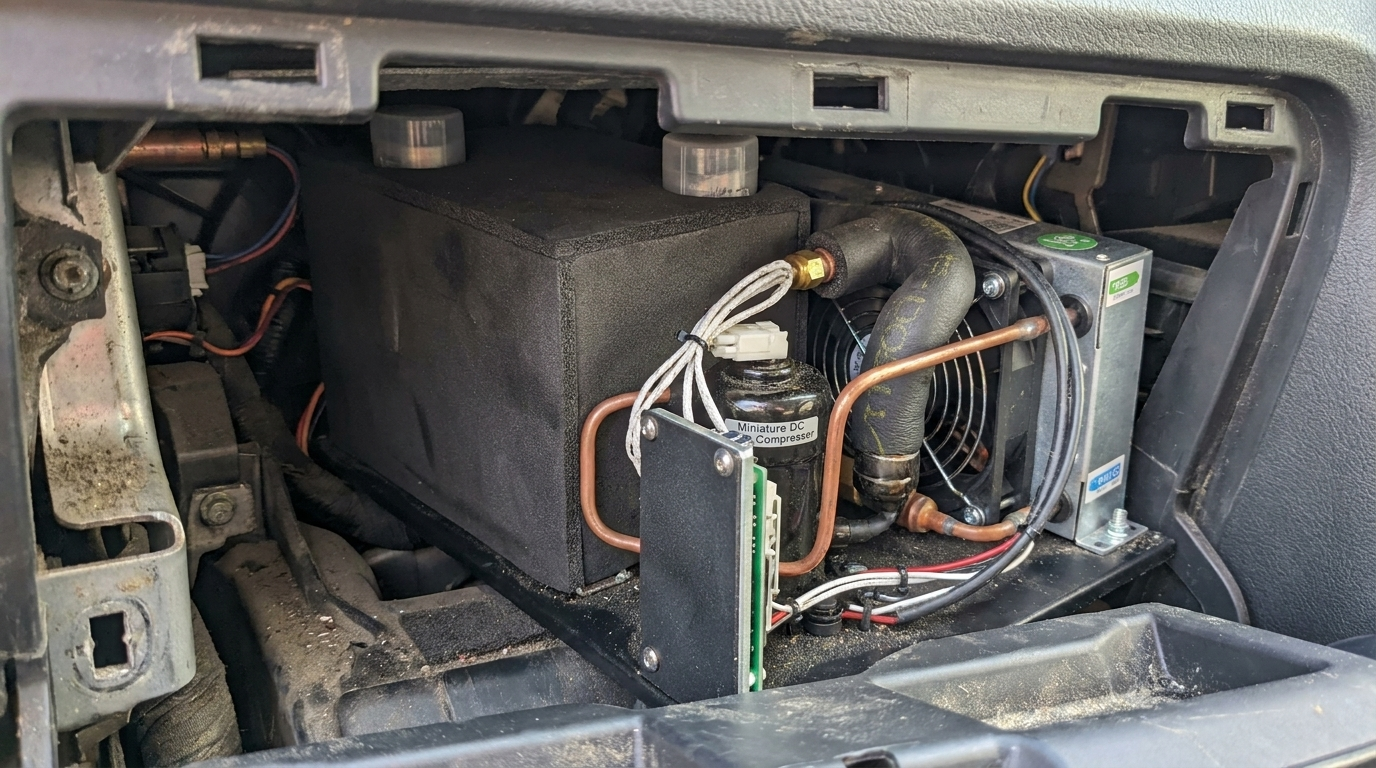
Vehicle cab cooling. Evaporator mounted behind or beneath the dashboard, condenser mounted in the engine bay or on the roof. Refrigerant lines connect the two through existing cable routing paths. The system adds no visible bulk to the cab interior.
Camper van or RV sleeping area. Evaporator mounted in a ceiling cavity or wall panel. Condenser mounted externally or in a ventilated compartment. The system runs from the house battery bank without starting the engine or running a generator.
Equipment enclosure. Through-wall mounting with the evaporator inside the enclosure and the condenser outside. A single panel cutout is the only modification needed. The sealed refrigerant circuit requires no field charging.
Boat cabin. Evaporator in the cabin headliner, condenser in the engine compartment or a deck-level ventilated space. DC power from the house battery bank. No shore power required.
Pet transport. Evaporator in the pet compartment, condenser in a ventilated area of the vehicle. Temperature-controlled environment for animal safety during transport, independent of the vehicle’s main AC system.
Refrigerant Considerations for Small Spaces
In tight spaces, refrigerant choice has safety implications beyond environmental regulations. R134a and R290 are the two most common refrigerants in DC micro air conditioners, and each has characteristics that matter for small-space installations.
R134a is a non-flammable HFC refrigerant with a long track record in automotive and portable cooling. In a sealed system with a small charge (typically under 150g in micro units), the safety profile is straightforward — even a complete leak in a small enclosed space does not create a flammable or toxic atmosphere. R134a has a higher Global Warming Potential (GWP of 1,430), which is driving regulatory pressure toward alternatives in some markets.
R290 (propane) is a natural refrigerant with a GWP of 3 — essentially zero climate impact. It is mildly flammable (A3 classification), which requires attention to charge limits and ventilation in the installation space. At the small charge quantities used in micro air conditioners (under 150g), the flammable volume in a worst-case leak is minimal, but installation standards (IEC 60335-2-40) set maximum charge limits based on room volume.
For vehicle and outdoor applications, either refrigerant works well. For sealed indoor enclosures with limited ventilation, R134a eliminates the flammability consideration entirely. The choice is application-specific, not universally better or worse.
Noise in Small Spaces
Sound behaves differently in small spaces than in rooms. A 45 dB noise source in a bedroom is barely noticeable. The same 45 dB source in a 2-cubic-meter vehicle cab is noticeably louder because the sound has less space to dissipate and more reflective surfaces to bounce off.
DC micro air conditioners with BLDC compressors typically produce 35–50 dB at one meter, depending on compressor speed. Variable-speed operation is the key advantage here — once the space reaches target temperature, the compressor slows to maintenance speed, dropping noise levels to the lower end of the range. This is fundamentally different from conventional AC units that cycle between full-speed operation and off, creating alternating loud and silent periods that are more disruptive to sleep than a steady low hum.
For sleeping applications (vehicle cabs, camper vans, boat cabins), the steady-state noise at partial load — typically 35–40 dB — is comparable to a quiet room fan and well below the threshold that disrupts sleep for most people.
What a Small Air Conditioner Cannot Do
Honesty about limitations builds more trust than overclaiming capabilities:
A DC micro air conditioner with 450–650W capacity will not cool a standard bedroom, a large RV living area, or any space larger than approximately 3–4 cubic meters with significant heat loads. For those applications, you need a larger system — a mini-split, a rooftop RV unit, or a conventional portable AC with adequate power supply.
It will not replace a vehicle’s main AC system for cooling the entire cabin while driving with windows up in 45°C desert heat. The heat load from solar gain through automotive glass at highway speeds exceeds what a micro system can handle.
It will not cool an uninsulated metal shed in direct sunlight. The heat gain through uninsulated walls and roof overwhelms the cooling capacity. Insulation is a prerequisite, not an optional upgrade.
Knowing what a small air conditioner cannot do is as important as knowing what it can do. The right tool for the right job means matching the cooling capacity to the actual heat load in the actual space — not hoping a small unit will somehow cool a large problem. See the Micro DC Aircon specifications to match cooling capacity to your space requirements.