
What “Small Chiller” Means Depends Entirely on Who Is Asking
Search for a small chiller and the results span three orders of magnitude. One vendor’s compact unit removes 450 watts and sits on a bench. Another’s starts at two tons — roughly 7,000 watts — and arrives on casters. A third quotes forty tons and needs a plant room.
All three are described as small, and all three are describing something real. The word is relative to the industry the seller works in, not to any absolute capacity.
That makes the first question in any small chiller selection not “which model” but “which class of machine am I actually shopping for”. Get that wrong and everything downstream — the quotes, the footprint, the installation, the price — is wrong by a factor of ten. This guide sorts the classes by load, so you can find yours before you start comparing products.
Three Classes, Sorted by What They Cool
| Equipment-level | Portable process | Packaged process | |
|---|---|---|---|
| Typical capacity | 100 W – 1 kW | 3.5 – 35 kW (1–10 ton) | 35 – 140 kW (10–40 ton) |
| What it cools | One instrument | One machine or a small cell | Several machines, or a line |
| Where it sits | On or under the bench | Beside the machine, on casters | Plant room or outdoors |
| Who installs it | The user, in an afternoon | Facilities, with plumbing | Contractor, with a design |
| Fluid volume | A few liters | Tens of liters | Hundreds of liters |
| Supply | Single phase, or DC | Single or three phase | Three phase |
The boundaries are soft, but the gaps between the classes are not. Between the bench class and portable process machines, coverage is thinner but not empty: for sub-zero duties the MidiCool™ series runs 1.3–4.6 kW over the same 0 to −40 °C span, bridging most of that band before plant-scale equipment becomes unavoidable.
Step One: Find Your Load in Watts
Every small chiller decision follows from this number, and most people never calculate it.
Three ways to get it, in descending order of reliability:
- The instrument’s documentation. Lasers, rotary evaporators, and analytical instruments frequently state a required cooling capacity, often with a temperature. If it exists, use it.
- Electrical input. Anything that turns electricity into heat inside a closed box cannot produce more heat than it consumes. A 600 W power supply is an upper bound.
- Measurement. If a loop already exists, measure the temperature rise across the load at a known flow. This is the only method that captures the real system.
The one-line calculation, when you need it: Q = flow (L/min) × 69.7 × ΔT (°C) for water. Two liters per minute rising 4 °C carries about 560 W.
Then add 20–30% margin — not double. The reason is in the next section.
Step Two: Read Capacity at Your Setpoint, Not at 20 °C
This is the single most common error in small chiller selection, and it is the reason machines get returned.
A vapor-compression cycle moves less heat as the fluid it is cooling gets colder, because the refrigerant has to run colder still to absorb heat from it. The same machine can deliver 1,000 W at 20 °C and 300 W at −20 °C. Nothing has failed; that is the shape of the curve.
So a capacity figure quoted without a temperature tells you almost nothing, and a vendor who publishes a curve is giving you more information than one quoting a larger single number.
The practical consequence: decide your setpoint before you compare capacities, and compare every candidate at that setpoint. A machine that looks 30% larger on the headline figure can be smaller than its rival at −10 °C.
Step Three: Check the Flow, Because Capacity Alone Will Not Reach Your Load
Capacity determines how much heat the chiller can remove. Flow determines whether that capability reaches the equipment.
The flow you need for a target temperature rise across the load is the same equation rearranged: Flow (L/min) = Q (W) ÷ (69.7 × ΔT). A 500 W load with a 3 °C allowable rise needs about 2.4 L/min. Tighten the allowable rise to 1 °C and it triples.
The trap is that a quoted flow figure is measured into an open pipe. Your circuit is tubing, bends, fittings, and — usually dominant — the narrow passages inside the instrument. All of that is pressure drop, and a pump delivers less as pressure drop rises. What you want is the pump curve: flow against pressure. If a vendor cannot produce one, that is itself information.
The Equipment-Level Class in Detail
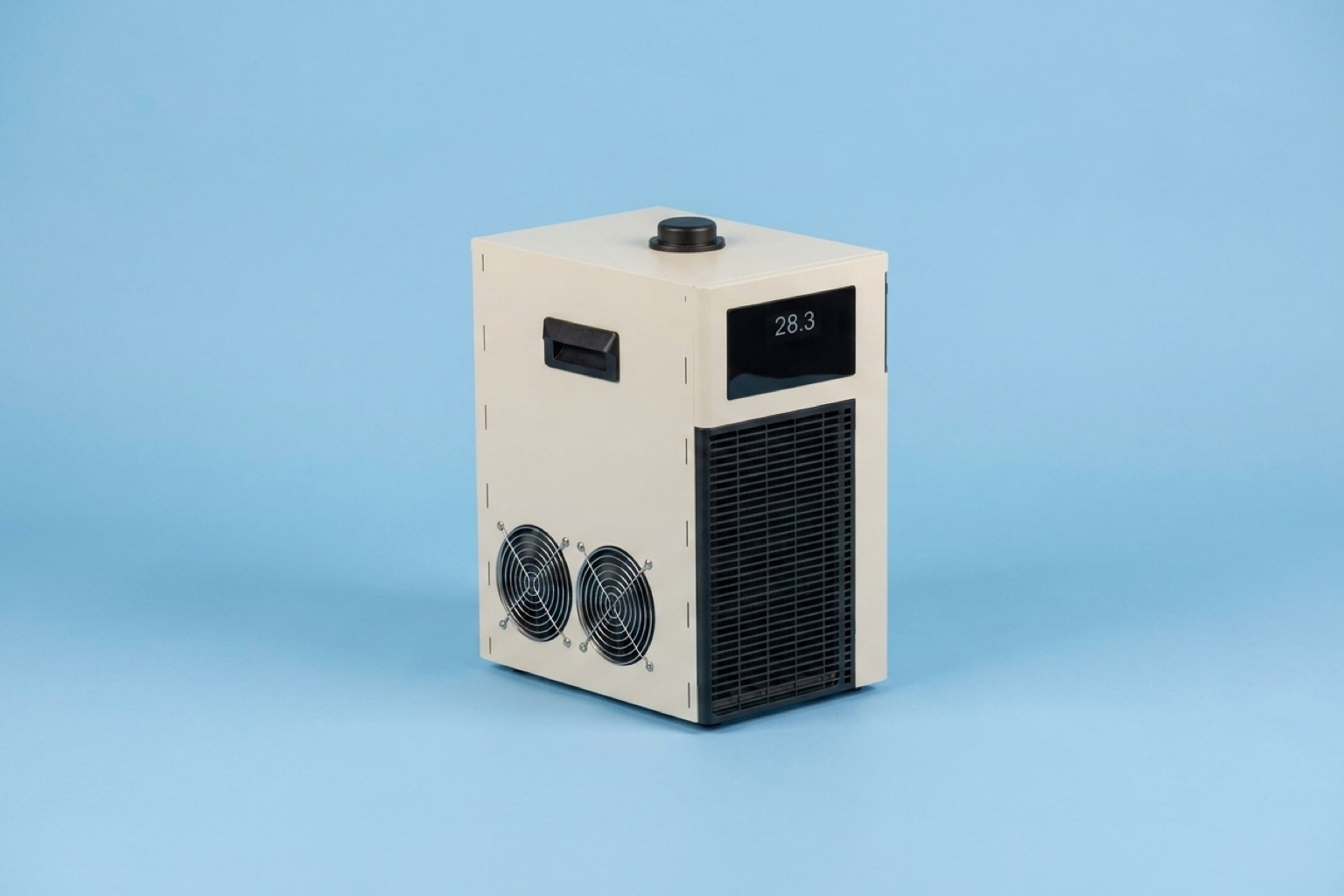
This is the small chiller class most laboratory buyers actually need. If your load is a single instrument producing a few hundred watts, this is your class, and it behaves differently from the two above it.
Stability is the specification, not capacity. Analytical instruments, calorimeters, and interferometers care about the temperature holding still far more than about raw watts. A machine that modulates its compressor to match the load holds a line; one that cycles on and off produces a sawtooth several degrees wide. If a stability figure with a decimal point appears in your requirement, that decides the machine.
The room is part of the system. An air-cooled bench unit rejects its heat into the laboratory — the extracted watts plus its own electrical input. In a small room this is noticeable, and it feeds back: a warmer room means a warmer condenser and less capacity.
Noise matters because people sit next to it. This is a genuine differentiator at bench scale and irrelevant at plant scale — a countertop unit published at under 45 dB is making a claim about the room it lives in, not just about the machine.
Below 0 °C changes the fluid. Water becomes a water/glycol mixture, which carries less heat per degree and pumps harder. Both the capacity and the flow calculation change at the same time.
Air-Cooled or Water-Cooled Condenser
Almost every small chiller at equipment level is air-cooled, and the consequence deserves stating plainly: the heat does not disappear, it goes into the room you are standing in.
A unit removing 500 W from your instrument also consumes a few hundred watts of its own, and all of it — extracted heat plus electrical input — leaves through the condenser into the laboratory air. In a small or already-warm room this is a real load, and it feeds back on itself. A warmer room raises the condensing temperature, which lowers capacity, which makes the machine run longer, which warms the room further.
Two practical responses. Give the condenser genuine clearance and make sure its discharge cannot be drawn straight back into its own intake — recirculation in a crowded bench cupboard is easy to create by accident and quietly removes capacity with no obvious symptom. And check the ambient temperature the capacity figure was measured at, because a rating taken at 20 °C means less in a room that reaches 30 °C in summer.
Water-cooled condensing solves both problems and introduces others: a water supply, water quality management, scale, and a circuit that can freeze. At equipment scale it is rarely worth it. It starts making sense higher up the range, or in rooms where the added heat genuinely cannot be tolerated.
The rotary evaporator case is worked through in more detail, by flask size, in the rotary evaporator chiller sizing guide.
A Worked Example
A rotary evaporator condenser distilling ethanol, to be held at −5 °C. Evaporation runs about 1 L/hour.
Load: ethanol’s latent heat is roughly 846 kJ/kg at 0.789 kg/L, so 0.789 × 846,000 ÷ 3,600 ≈ 185 W. Add the heating bath’s radiant contribution and ambient pickup through the lines: call it 250 W.
Setpoint: −5 °C. Below freezing, so a glycol mixture, and the capacity figure that matters is the one at −5 °C.
Flow: a condenser is fairly restrictive. At 250 W with a 3 °C rise, water would need 1.2 L/min; with glycol, somewhat more.
Class: equipment-level, comfortably. A unit rated 250 W at 20 °C would be badly undersized here, because at −5 °C it delivers perhaps half that. Something rated in the 450 W region at 20 °C is the honest answer — and that is a bench machine, not a portable process chiller.
Which fluid, and at what concentration, is a decision in its own right — see the lab chiller coolant selection guide.
Where the Classes Actually Break
Two signals tell you the small chiller you are being quoted belongs to the wrong class.
You are being quoted in tons for a benchtop instrument. One ton is 3.5 kW. If your load is 400 W and the quotation is in tons, the vendor is selling from a catalog that does not contain your machine. The result will be a unit that short-cycles, controls temperature poorly, and occupies floor space you do not have.
You are trying to cool a production cell with a bench unit. Equipment-level machines top out around 1 kW. Asking one to handle 4 kW produces a compressor that never stops and a temperature that never arrives.
The band between roughly 1 kW and 3.5 kW deserves care. For sub-zero duties the MidiCool series covers 1.3–4.6 kW directly (eight models, MidiCool 2013 through 4046). For above-zero loads in that band, the options remain a pair of smaller units in parallel or the smallest portable process chiller and its footprint.
For jacketed vessels, where the reactor’s own thermal mass changes the pull-down calculation, see chiller sizing for lab reactors.
What to Ask Before You Buy
Six questions separate a small chiller that will hold your setpoint from one that merely looks adequate on paper.
- Capacity at my setpoint — not the headline figure, and stated with the ambient it was measured at.
- Pump curve — flow against pressure, so I can check it against my circuit’s restriction.
- Control type — on/off or modulating. This decides whether a stability figure is achievable at all.
- Fluid compatibility — what the wetted materials tolerate, and what happens below freezing.
- Ambient rating — the room temperature the capacity figure assumes, and how much is lost above it.
- Clearance — how much space the condenser needs to avoid drawing in its own discharge.
Where a Countertop Unit Fits
The equipment-level class — a few hundred watts to about a kilowatt, one instrument, on or beside the bench, with stability mattering more than raw capacity — is what countertop recirculating chillers are built for.
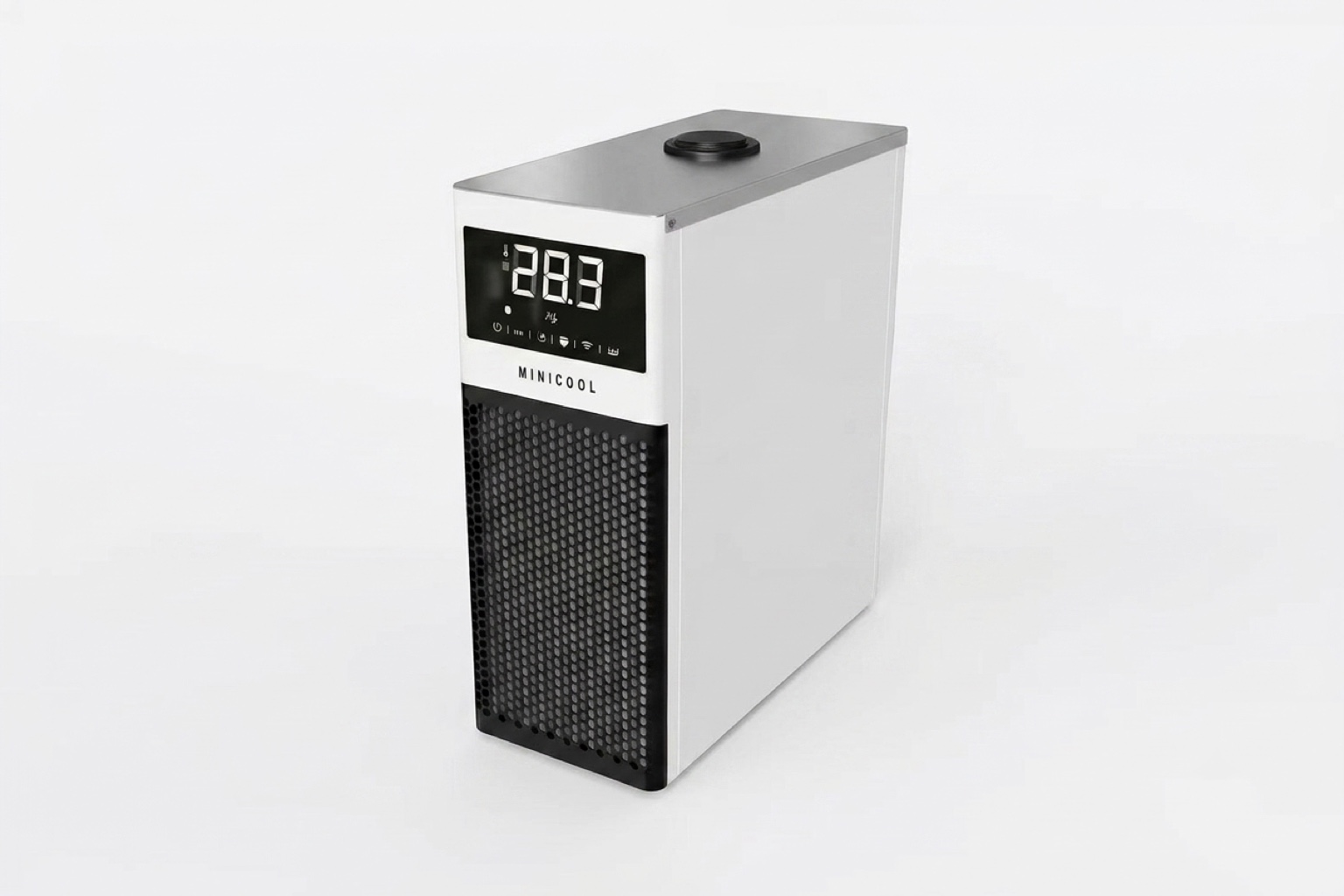
The MiniCool™ countertop recirculating lab chiller sits in this band, in three sizes (MiniCool 450, 800, and 850), with stated capacities of 450 W, 800 W and 850 W respectively, a 0 °C to −40 °C range, ±0.1 °C stability, a choice of R134a, R290 or R1234yf refrigerant, and AC (120–240 V) or DC supply. All three share a 200 × 430 × 450 mm envelope at 18–25 kg — which is the figure that decides whether it goes on the bench or under it. Whether that class is yours comes back to the load calculation above. Note the span: MiniCool runs 0 °C to −40 °C only. For setpoints above 0 °C at up to 550 W, the DV-series compact liquid chiller (−20 to +20 °C) is the line whose range covers it, and for sub-zero loads of 1.3–4.6 kW the MidiCool™ series is the step up.
If you are unsure which class your load falls into, the fastest route is to send the numbers — heat load in watts, target setpoint, and the flow your instrument requires — and have them checked against a capacity curve rather than a headline figure. Contact the RIGID engineering team with those three figures and you will get a straight answer about whether an equipment-level machine covers it.
Frequently Asked Questions
How many watts is a “small” chiller?
There is no standard. Equipment-level units run 100 W to about 1 kW; portable process chillers start around 3.5 kW; packaged units go to 140 kW and beyond. Calculate your load first, then look in the matching class.
Why is the quoted capacity higher than what I get?
Almost always because the quotation is at a warmer setpoint than you run, or a cooler ambient than your room. Ask for capacity at your two temperatures.
Can I use a bigger chiller to be safe?
Not usefully. An oversized unit cycles rather than modulating, which controls temperature more coarsely, and it puts more heat into the room. Twenty to thirty percent margin at your working setpoint is the useful range.
My chiller reaches setpoint but my instrument is still warm.
That is a flow problem, not a capacity one. Check the filter, purge trapped air, and compare the pump curve against your circuit’s pressure drop before considering a larger machine.
Do I need glycol?
Only below about 5 °C. Use the minimum concentration the setpoint requires, because glycol reduces heat capacity and increases the pumping effort.
Summary
Sound small chiller selection starts by identifying which of three classes you are shopping in, because “small” spans from 100 W to 140 kW depending on the seller. Calculate your load in watts, fix your setpoint, then read every candidate’s capacity at that setpoint rather than at the headline condition. Check that the pump can deliver the required flow against your circuit’s real pressure drop, not into an open pipe. And if the load is a single instrument producing a few hundred watts, stop looking at anything quoted in tons — that is a different class of machine, and buying it will cost you floor space, control quality, and money without buying you cooling you can use.