
What Is a Small Chiller Unit and Who Needs One?
A small chiller unit is a compact, self-contained cooling system designed to remove heat from a process or piece of equipment by circulating chilled liquid through a closed loop. Unlike large industrial chillers that occupy entire mechanical rooms, these units sit on a countertop or bench, making them practical for laboratories, medical facilities, small production cells, and research environments where space is limited and precision matters.
If you work with equipment that generates concentrated heat — a fiber laser head, a semiconductor test fixture, an analytical instrument, or a medical diagnostic device — you have likely encountered the question of how to keep that equipment within its rated temperature window. Passive cooling (heat sinks and fans) works up to a point, but once your heat load exceeds a few hundred watts or your process demands temperature stability tighter than a couple of degrees, a recirculating chiller becomes the practical answer.
The market for small chiller units has expanded significantly over the past decade. Advances in miniature compressor technology, environmentally friendly refrigerants, and digital control systems have made it possible to pack serious cooling performance into a box that fits beside your equipment rather than in a separate utility area. That expansion, however, means more choices — and more potential for selecting a unit that does not match your actual needs.
This guide walks you through the key selection criteria, explains where small chillers excel (and where they do not), and introduces one option worth evaluating: the RIGID MiniCool series.
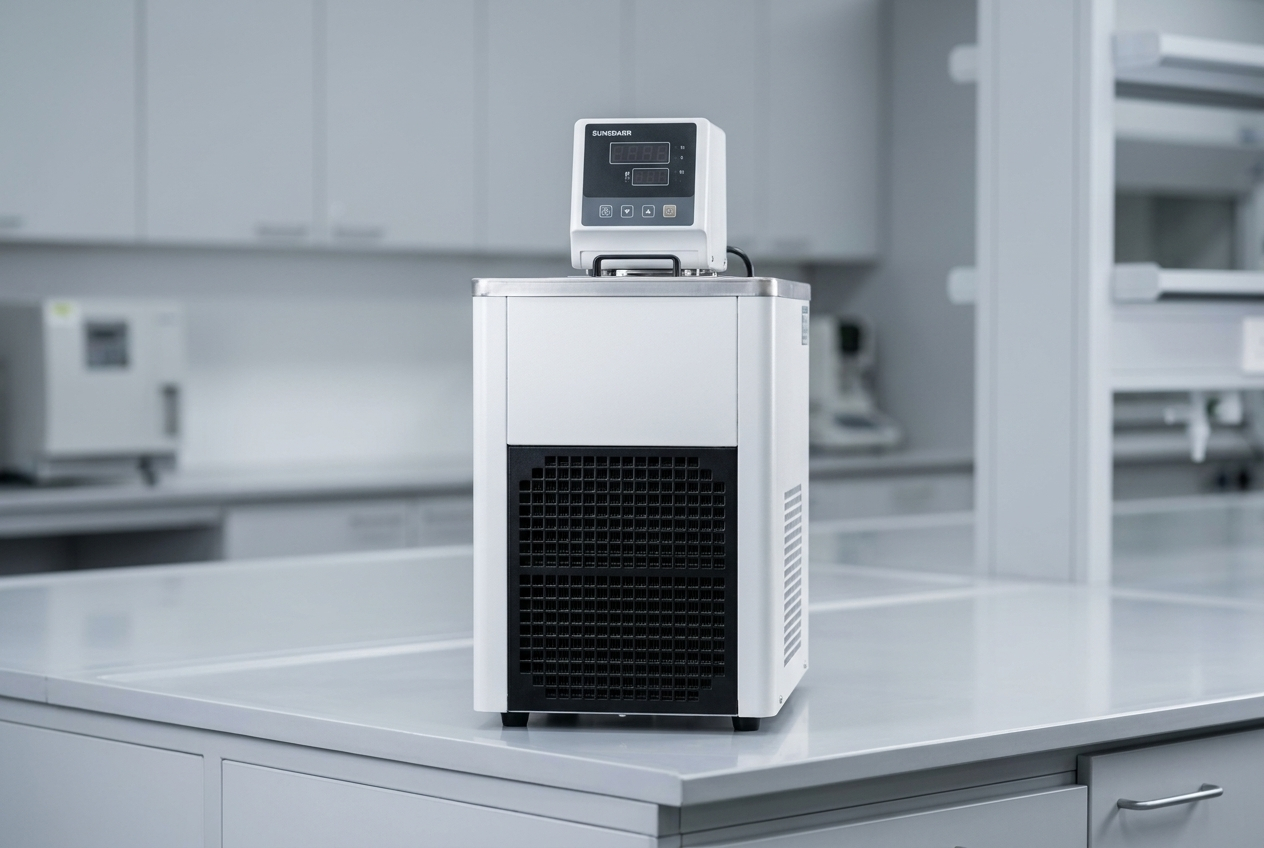
Common Applications for Small Chiller Units
Small recirculating chillers serve a surprisingly wide range of applications. Understanding where they fit — and where they do not — helps you avoid over-specifying or under-specifying your cooling system.
Laser Systems
Diode lasers, fiber lasers, and CO2 laser tubes all generate waste heat that must be removed to maintain beam quality and extend component life. A small chiller unit circulating coolant through the laser head or resonator keeps temperatures stable during extended operation. For low- to mid-power laser setups, a compact chiller with a few hundred watts of cooling capacity is often sufficient.
Electronics and Semiconductor Testing
Burn-in ovens, thermal chambers, and component test stations require precise temperature control to validate device performance across rated operating ranges. A small chiller unit can supply coolant at a set temperature to a test fixture, allowing repeatable thermal cycling without relying on building-level chilled water infrastructure.
Medical and Diagnostic Equipment
Imaging systems, blood analyzers, and other clinical instruments often include internal heat-generating components that need active cooling. Space inside and around these devices is usually tight, so a compact chiller that can be mounted nearby — or even integrated into the equipment enclosure — is a practical choice.
Laboratory and Analytical Instruments
Rotary evaporators, spectrophotometers, reaction vessels, and chromatography systems all benefit from temperature-controlled coolant. Laboratories frequently lack the floor space for large chillers, making a countertop recirculating unit the default solution. Some units also function as cooling baths for direct sample immersion when paired with open-bath circulators.
Where Small Chillers Are Not the Right Fit
Small chiller units are designed for heat loads roughly in the range of a few hundred watts to around one kilowatt. If your process generates multiple kilowatts of waste heat — for example, a high-power industrial laser or a large-scale reactor — you will need a larger chiller system. Similarly, if your application requires coolant temperatures below approximately -40°C, you are moving into ultra-low-temperature territory that typically calls for cascade refrigeration or specialized cryogenic equipment. Knowing these boundaries early saves time and budget.
Key Selection Criteria: What to Evaluate Before You Buy
Choosing the right small chiller unit comes down to matching the chiller’s capabilities to your process requirements. Here are the factors that matter most.
Cooling Capacity
Cooling capacity — measured in watts (W) or BTU/h — tells you how much heat the chiller can remove from your process at a given operating temperature. This is the single most important specification. Undersizing means the chiller runs continuously without reaching your target temperature; oversizing wastes money and bench space.
As a rule of thumb, start by estimating your actual heat load: the electrical power consumed by your equipment that converts to heat, plus any heat absorbed from the environment. Add a safety margin of roughly 20% to account for ambient temperature variations and system aging. This gives you a starting estimate for the minimum cooling capacity you need.
Be careful not to confuse a chiller’s electrical input power with its cooling capacity — they are different numbers. A chiller might draw 300W from the wall while delivering 450W or more of cooling, thanks to the thermodynamic efficiency of the refrigeration cycle.
Temperature Range
Different applications require different coolant temperatures. A laser cooling loop might need coolant at 20°C, while a laboratory cold trap could demand -30°C or lower. Check that the chiller’s rated temperature range covers your process setpoint with some margin on both ends. A unit rated from 0°C to -40°C gives you flexibility for current and future applications.
Temperature Stability and Precision
For many laboratory and medical applications, it is not enough to simply reach the target temperature — you need to hold it there. Temperature stability is typically expressed as a ±value, such as ±0.1°C. The tighter this specification, the more consistent your process results will be. If your application involves quantitative analysis, cell culture work, or precision optics, prioritize chillers with documented stability specifications rather than vague claims of “precise control.”
Physical Size and Footprint
A small chiller unit should actually be small. Measure the space you have available — on the bench, under the fume hood, or inside an equipment enclosure — and compare it to the chiller’s dimensions. Vertical (tower) designs often use floor space more efficiently than wide, flat units. Also consider weight: a chiller you need to move between stations should be light enough for one person to handle safely.
Noise Level
Laboratories, clinics, and office-adjacent workspaces all have practical limits on acceptable noise. Compressor-based chillers inherently produce some sound, but the range across products is wide. Look for units described as “ultra-quiet” and, if possible, ask for measured sound levels in decibels at a defined distance. If the chiller will sit within arm’s reach of people working, noise becomes a decision factor rather than a nice-to-have.
Power Supply Compatibility
Most small chillers run on standard AC mains power. However, some applications — mobile labs, field-deployed instruments, or battery-backed systems — require DC operation. A chiller that supports both AC (120V–240V) and DC inputs gives you deployment flexibility that a purely AC-powered unit cannot match.
Refrigerant Choice
Refrigerant regulations are tightening worldwide, with high-GWP (global warming potential) refrigerants being phased down under the Kigali Amendment and regional regulations. Chillers using R134a, R290 (propane), or R1234yf are positioned well for current and upcoming compliance requirements. When evaluating a chiller, check which refrigerant it uses and whether that refrigerant faces near-term restrictions in your region.
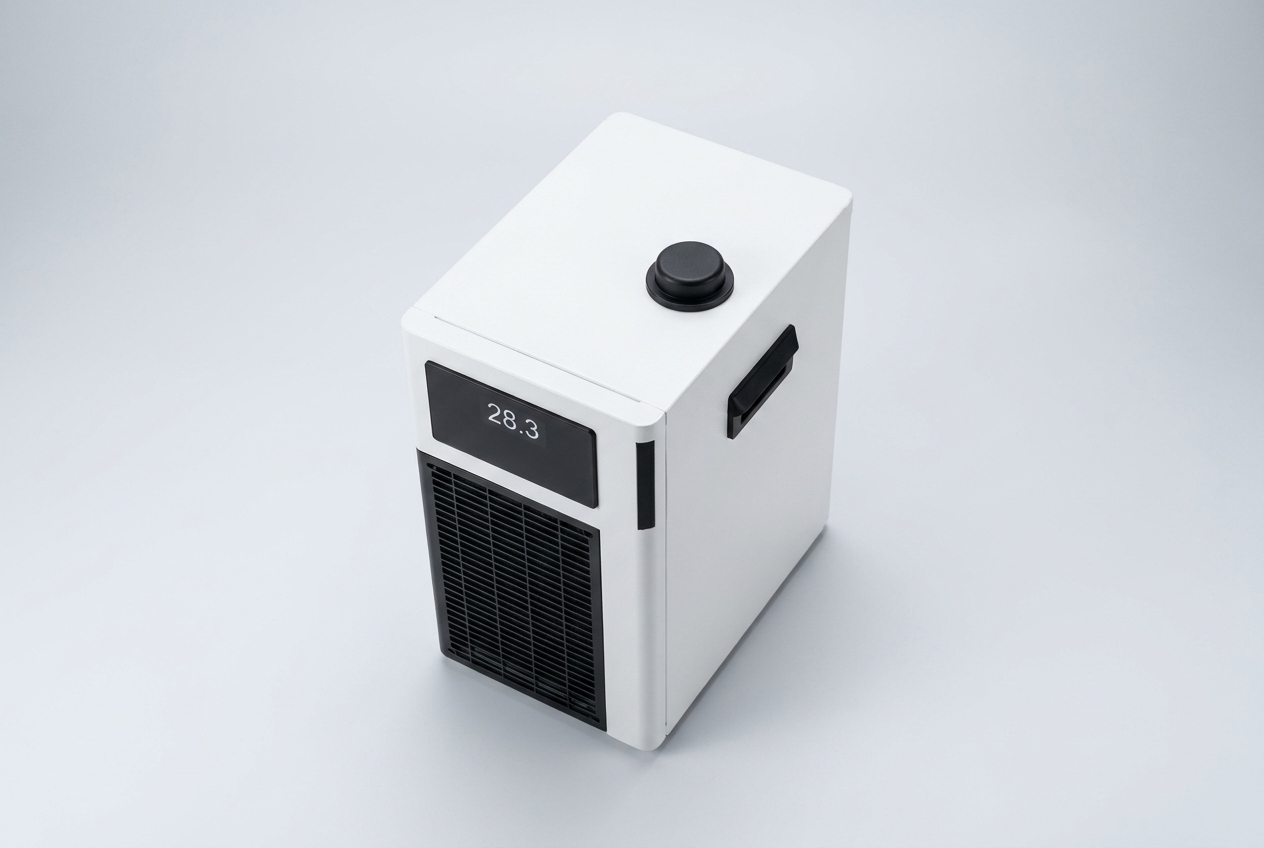
Sizing Your Small Chiller Unit: A Practical Approach
Sizing a chiller does not require complex engineering calculations for most laboratory and light-industrial applications. Here is a practical approach:
- Identify your heat load. Check your equipment’s datasheet for rated power consumption. For devices that convert most of their input power to heat (resistive heaters, thermoelectric devices), the heat load roughly equals the input power. For devices with significant mechanical or optical output (lasers, motors), the heat load is the input power minus the useful output.
- Factor in ambient conditions. If your lab runs warm (above 25°C) or the chiller will sit near other heat-generating equipment, your effective heat load increases. A starting estimate is to add 10–20% to your calculated heat load for ambient gain.
- Check capacity at your operating temperature. Chiller cooling capacity decreases as the setpoint temperature drops further below ambient. A chiller rated at 1kW at 20°C might deliver significantly less at -20°C. Always check the capacity specification at or near your intended operating temperature, not just the headline number.
- Consider future needs. If you anticipate adding equipment or increasing process throughput, sizing slightly above your current need avoids replacing the chiller in a year.
This approach gives you a reliable starting estimate. For critical applications or unusual operating conditions, consulting with the chiller manufacturer’s engineering team is always worthwhile.
The RIGID MiniCool: A Small Chiller Unit Worth Evaluating
Among the compact recirculating chillers available today, the RIGID MiniCool series checks many of the boxes outlined above. Here is what it offers:
- Cooling Capacity: 450W to 1kW+, covering the range needed for most laboratory instruments, small laser systems, and medical device cooling.
- Temperature Range: 0°C to -40°C, providing flexibility for applications from standard process cooling down to cold-trap and cryogenic-adjacent work.
- Precision: ±0.1°C temperature stability, suitable for quantitative analytical work and sensitive biological applications.
- Refrigerant Options: Available with R134a, R290, or R1234yf, giving you choices that align with current and upcoming environmental regulations.
- Power Flexibility: Supports both AC (120V–240V) and DC power inputs, making it viable for bench-mounted lab use, mobile platforms, and off-grid deployments.
- Compact Footprint: Designed as a countertop unit with a vertical form factor that fits on, under, or inside a fume hood.
- Quiet Operation: Engineered for noise-sensitive environments including laboratories and clinical settings.
- Immersion Cooling Capable: Can function as an immersion cooling solution for direct sample cooling when paired with open-bath circulators, eliminating the need for dry ice or liquid nitrogen in some workflows.
Priced between $1,500 and $1,700, the MiniCool sits in a competitive range for laboratory-grade recirculating chillers. RIGID Technology, the manufacturer, brings nearly a decade of experience in miniature refrigeration systems and works directly with OEM customers on custom integration projects.
Integration and System Compatibility
A chiller that performs well on the bench but cannot integrate with your existing equipment creates more problems than it solves. When evaluating any small chiller unit, consider these integration factors:
- Fluid connections: Check fitting sizes and types (barb, compression, quick-disconnect) to ensure compatibility with your existing tubing and manifolds.
- Coolant compatibility: Verify that the chiller supports your preferred coolant — distilled water, water-glycol mixtures, or specialized dielectric fluids — and note any restrictions.
- Control interfaces: For automated systems, look for chillers with RS-232, RS-485, or other communication interfaces that allow your control software to set temperature, monitor status, and log data.
- Drainage and maintenance access: A chiller you cannot easily drain, refill, or clean will become a maintenance headache. Check whether the unit design allows practical service access in your intended installation location.
The RIGID MiniCool series is designed with OEM integration in mind. RIGID’s engineering team supports custom configurations and can work with you on adapting the unit to your specific system requirements, including modified enclosures, custom control interfaces, and application-specific tuning.
Maintenance and Long-Term Ownership
A small chiller unit is a long-term investment. Keeping it running efficiently requires basic but consistent maintenance:
- Coolant management: Check coolant levels regularly. Replace coolant according to the manufacturer’s schedule or when you notice discoloration, particulate matter, or algae growth. Using the recommended coolant type and concentration prevents corrosion and biological fouling.
- Condenser cleaning: Air-cooled condensers collect dust over time, reducing heat rejection efficiency. Clean condenser fins or surfaces periodically — monthly in dusty environments, quarterly in clean labs.
- Filter inspection: If your chiller includes an inline coolant filter, inspect and replace it on schedule to prevent flow restriction and pump strain.
- Ambient environment: Ensure adequate ventilation around the chiller. Placing a chiller in an enclosed cabinet without airflow forces the compressor to work harder and shortens component life.
- Record keeping: Log temperature setpoints, actual temperatures, and any error codes. Trend data helps you spot gradual performance degradation before it becomes a failure.
Making Your Decision
Selecting a small chiller unit comes down to honest assessment of your requirements matched against verified specifications. Resist the temptation to buy the cheapest option without checking cooling capacity at your actual operating temperature, or to over-specify and pay for capability you will never use.
Start with your heat load. Confirm the temperature range and stability you need. Measure your available space. Consider noise, power supply, and refrigerant compliance. Then compare products on these criteria — not on marketing language.
For laboratories, medical device cooling, small laser systems, electronics thermal management, and semiconductor test applications in the 450W to 1kW+ cooling range, the RIGID MiniCool series represents a well-rounded option that balances performance, size, precision, and cost. Its AC/DC compatibility, sub-zero temperature capability, and quiet operation address the most common pain points in compact cooling applications.
Whatever unit you choose, investing time in proper sizing and integration planning up front pays dividends in reliable, low-maintenance operation for years to come.