
A Small Fluid Chiller Loses Capacity in the Loop, Not in the Compressor
Two machines with the same nameplate can deliver very different results at −30 °C, and the difference usually has nothing to do with the refrigeration circuit. It is in the fluid.
Everything that makes a coolant work — flow rate, turbulence at the wall, the temperature difference it can sustain — degrades as it gets colder, because the mixture keeping it liquid also makes it thick. A small fluid chiller rated at 800 W can be delivering considerably less than that to your process at the cold end of its range, while the compressor runs exactly as designed.
This article is about that gap: where it comes from, how to size around it, and what to check at commissioning. It is deliberately not about which coolant to choose — our coolant selection guide covers that decision. This one starts after the fluid is in the loop.
The Number on the Nameplate and the Number at the Wall
A chiller’s capacity rating describes what the refrigeration circuit can remove from the fluid inside the machine. What your process experiences is something else: how much heat crosses from your equipment into that fluid, which is governed by the exchanger surface, the temperature difference across it, and the film coefficient at the wall.
That last term is the one nobody checks, and it is strongly dependent on flow conditions. Get the flow wrong and a perfectly healthy machine will sit there holding a beautiful setpoint in its own reservoir while your process stays warm.
The symptom is distinctive and often misdiagnosed: the chiller display reads the setpoint, the process does not reach temperature, and everybody starts suspecting the refrigeration system. The fault is almost always on the hydraulic side.
What Cold Does to a Glycol Mixture
Water is thin and stays thin. Water with glycol in it, at the concentrations needed for sub-zero work, is a different fluid at −40 °C than it is on the bench at room temperature.
The practical magnitude is worth internalizing: between room temperature and the bottom of a −40 °C range, a typical glycol and water mixture thickens by roughly an order of magnitude. The exact curve depends on the glycol type, the concentration and the supplier’s formulation, and it is on the fluid data sheet — which is the document to consult rather than any general figure, including this one.
Three consequences follow, and they compound.
Flow falls. A pump working against a thicker fluid and a higher circuit pressure drop moves less volume. The pump has not failed; it has simply moved to a different point on its curve.
Pressure drop rises. The same tubing, fittings and jacket passages that were comfortable at room temperature now consume a much larger share of the available head.
Heat transfer at the wall degrades. This is the largest effect and the least visible one, and it deserves its own section.
Laminar Flow Is Where the Capacity Goes
Inside a small fluid chiller loop, heat transfer between a flowing liquid and a wall depends heavily on whether the flow is turbulent or laminar. Turbulent flow constantly brings fresh fluid to the wall; laminar flow does not, and instead builds a stagnant boundary layer that behaves like insulation.
Which regime you are in is set by the Reynolds number, which falls as viscosity rises. A loop comfortably turbulent with water at 20 °C can slip into laminar flow with cold glycol, and when it does, the film coefficient drops sharply.
This is the mechanism behind the most common complaint about sub-zero cooling: “it worked fine when we tested it warm.” It did. The test was in a different flow regime.
| Condition | What changes | Effect on the process |
|---|---|---|
| Room-temperature water in the loop | Low viscosity, turbulent flow, low pressure drop | Bench test looks excellent |
| Glycol mixture near 0 °C | Moderately thicker, flow slightly reduced | Usually still acceptable |
| Glycol mixture at −20 °C | Noticeably thicker, pressure drop up, flow down | Approach temperature widens |
| Glycol mixture at −40 °C | Substantially thicker, possible laminar transition | Process temperature stalls above setpoint |
Sizing the Loop at the Cold End, Not the Warm One
The correction is straightforward once the mechanism is clear: design the hydraulics for the coldest condition the process will use, not for the convenient condition you can test on a bench.
Use the largest bore you can accommodate. Pressure drop is extremely sensitive to internal diameter. Going one size up on tubing is the cheapest capacity you will ever buy on a sub-zero loop.
Keep the run short and the fittings few. Every elbow, quick-connect and reducer costs head, and those costs scale with viscosity too.
Do not over-concentrate the glycol. Protect to the lowest temperature you actually need plus a margin, and no further. Extra glycol beyond the requirement buys nothing and costs viscosity at every operating point.
Insulate everything cold. On a sub-zero loop, uninsulated lines are both a parasitic heat load and a condensation and frost problem in the room. Insulation is capacity you keep.
Check the exchanger passages. Narrow plate channels and small jacket annuli are exactly where cold thick fluid struggles most. If a process component has fine passages, that is where the loop will bottleneck.
Our glycol ratio guide covers how to pick the concentration; the point here is simply that the number you pick has a hydraulic price that shows up only when the loop is cold.
One more consequence is worth naming because it is often blamed on the machine. As flow falls, the temperature rise across the process grows for the same heat load, which means the return fluid arrives warmer and the average loop temperature climbs above the setpoint the display is reporting. Two identical machines, one with adequate flow and one without, will therefore show the same reading and produce different process temperatures.
The corollary is useful diagnostically. If the difference between supply and return temperature is much larger than the design intent, the loop is under-flowing, and no amount of lowering the setpoint will fix the underlying transport problem — it will only push the machine toward its limit while the approach stays wide.
Questions to Ask About the Pump
Pump specifications matter more on a sub-zero loop than on a room-temperature one, and they are frequently the least documented part of a small fluid chiller.
Ask for the pump curve, not a single flow figure. A single number is quoted at open discharge, which is the one condition your circuit will never operate at.
Ask what fluid the curve was measured with. A curve produced with water tells you comparatively little about behavior with cold glycol.
Ask about maximum viscosity or minimum temperature for the pump itself. Some pump types tolerate thick fluid far better than others.
On the RIGID MiniCool range, pump flow, head and reservoir volume are not published on the product page, so these are questions to put to us directly rather than assumptions to make from the datasheet. That is worth doing before purchase whenever the circuit has narrow passages or a long run.
Two Failure Modes That Look Identical
Under-flow and under-capacity produce the same complaint — the process will not reach temperature — and they call for opposite responses, so it is worth being able to tell them apart before ordering anything.
Under-capacity shows up as a machine that runs continuously without holding its own setpoint. The display drifts above the target and stays there, and the compressor never gets a rest. That is a machine too small for the heat load, and the fix is a larger machine.
Under-flow shows up as a machine that holds its setpoint comfortably, cycles normally, and is attached to a process that remains warm. The gap between the display and the process is the tell. That is a hydraulic problem, and a larger machine will not fix it — it will hold the same setpoint just as easily while the process stays exactly where it was.
The distinguishing measurement is the approach: the difference between chiller setpoint and process temperature at steady state. A wide approach with a machine that is not working hard means the loop, not the compressor, is the constraint. This is the single most useful number to record at commissioning, and almost nobody does.
The Machine Behind a Sub-Zero Loop
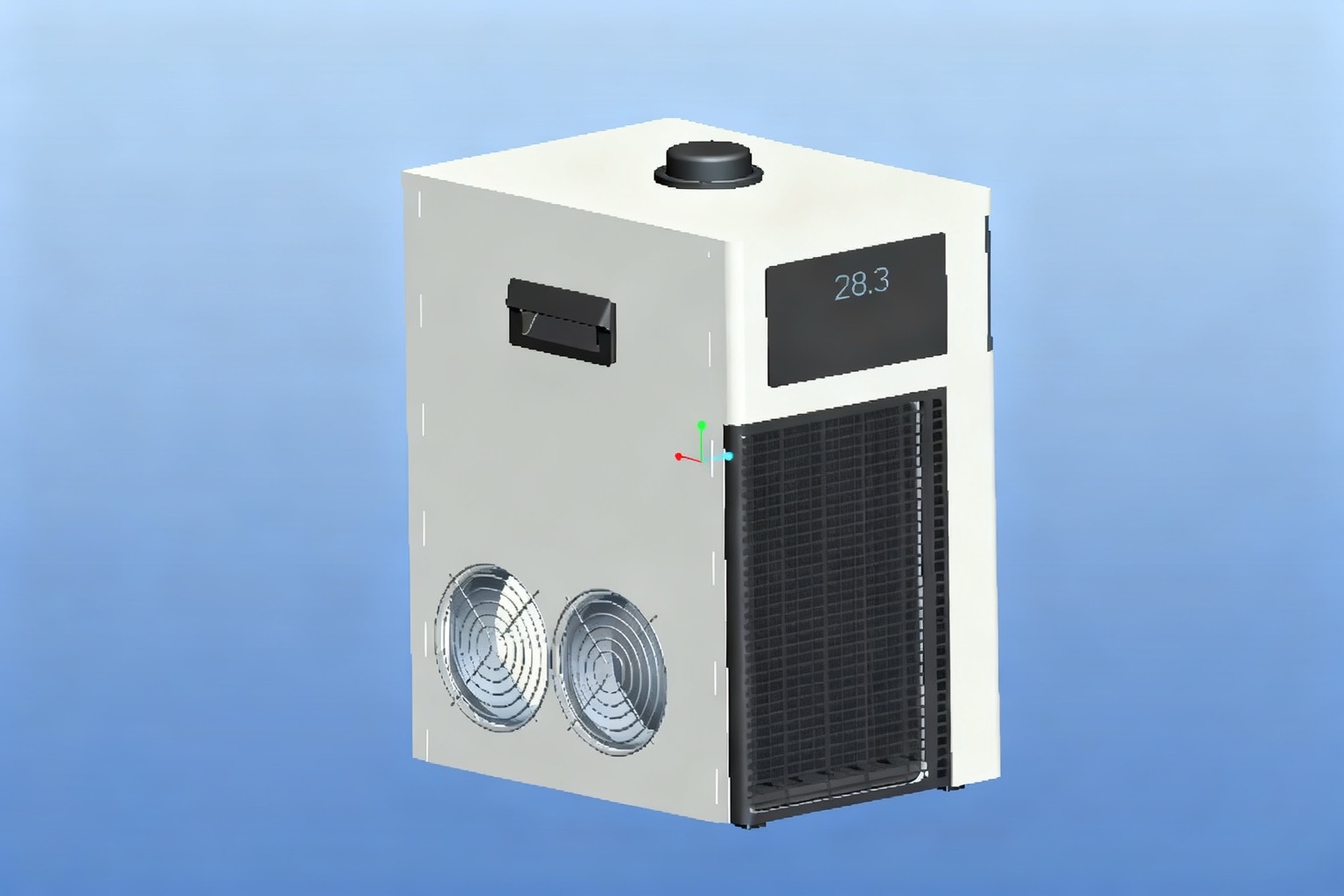
The MiniCool range is the small fluid chiller family built for exactly the band this article concerns: 450 W, 800 W and 850 W models operating from 0 °C down to −40 °C, at published prices of $1,500, $1,600 and $1,700 respectively.
Two specification points deserve reading carefully in this context.
The range does not extend above 0 °C. This is a sub-zero machine. If your process needs a coolant setpoint above freezing, the compact liquid chiller line covering −20 °C to +20 °C is the correct product instead.
Stability is quoted as ±0.1 °C. The product page does not state the test conditions or sensor location behind that figure, and in any case loop-side stability and process-side stability are not the same number — the hydraulic effects described above sit between them. If your application depends on tight control at the process, it is worth confirming what the specification refers to.
Physical specifications are 200 × 430 × 450 mm, 18 to 25 kg, and noise below 45 dB, with quick-connect or threaded port options. The footprint is small enough for a bench, which is the point, but it still needs condenser clearance.
Commissioning Checks That Have to Happen Cold
A small fluid chiller loop verified at room temperature has not been verified. Five checks to run at the working setpoint.
Measure flow at temperature. Not at startup, not warm — at the setpoint you will use, after the loop has stabilized.
Record supply and return temperatures. The difference across your process, combined with flow, tells you the actual heat being moved. This is the only direct measurement of delivered capacity you can make.
Record the approach. The gap between chiller setpoint and process temperature is your baseline. Any future degradation is measured against it.
Watch for a stalled pull-down. A loop that descends smoothly and then stops several degrees short is showing the laminar transition, not a refrigeration fault.
Check for frost and condensation on lines. Both indicate missing insulation, which is parasitic load you are paying for continuously.
For the full range of low-temperature applications this class of machine supports, our −40 °C circulator applications guide covers what tends to run at each part of the range.
Frequently Asked Questions
Why does my small fluid chiller reach setpoint but my process does not?
Almost always a hydraulic problem rather than a refrigeration one. The machine is controlling its own fluid successfully; the heat is not crossing into it fast enough. Cold thick coolant, reduced flow and a possible laminar transition at the exchanger wall are the usual causes. Measure flow at the working temperature before suspecting the compressor.
How much does glycol reduce cooling performance?
Enough to matter, and the effect grows as temperature falls. A glycol mixture carries less heat per unit volume than water and becomes markedly more viscous when cold, which reduces both flow and heat transfer at the wall. This is a reason to use the lowest concentration that protects your minimum temperature, rather than adding margin for comfort.
Can I test a sub-zero loop with water first?
You can test for leaks and confirm the circuit is assembled correctly, which is worthwhile. You cannot conclude anything about thermal performance, because water at room temperature is a different fluid in a different flow regime. Any performance verification has to happen with the real coolant at the real setpoint.
What tubing size should a sub-zero loop use?
The largest the process components and available space allow. Pressure drop is highly sensitive to internal diameter, and that sensitivity increases as the fluid thickens. Going one size up is usually the least expensive way to protect delivered capacity at the cold end.
Does the pump need to be specified differently for cold operation?
Yes. Ask for a pump curve rather than a single flow figure, ask what fluid the curve was measured with, and confirm the pump’s own limits for viscosity or minimum temperature. A pump comfortable with water at 20 °C is not automatically comfortable with glycol at −40 °C.
Where to Take This Next
The summary is short: capacity is delivered through the fluid, and the fluid is at its worst exactly where you need it most. Size the hydraulics for the cold end, keep glycol concentration to what the application requires, insulate, and verify at temperature.
If you want a specific loop reviewed — setpoint, fluid, tubing run, exchanger passages and expected load — send us the circuit details and we will look at whether the flow you need is achievable at the temperature you need it.