
TL;DR: A small water chiller keeps your 3D printer hotend or CNC spindle at a stable temperature, preventing thermal drift and extending tool life. Use distilled water for short-term setups, water-glycol mix (20–30%) for year-round protection, and flush the system every 3–6 months. If your heat load stays under 500W, a compact plate chiller like the DV1910E-P or DV2820E-P handles the job without taking over your bench.
Who This Guide Is For
This guide is written for makers, hobbyists, and small workshop owners who run single-hotend 3D printers, small CNC routers with spindles under 500W, laser diode setups, or LED UV curing systems. If you’ve noticed inconsistent print quality, spindle overheating during long jobs, or you’re tired of swapping buckets of warm water, this is your next step.
Why a Small Water Chiller Matters for Desktop Fabrication
Thermal stability directly affects output quality. A 3D printer hotend that drifts even 3–5°C produces inconsistent layer adhesion. A CNC spindle running hot wears bearings faster and introduces dimensional errors. Air cooling works for light duty, but once you’re running multi-hour jobs or working with heat-sensitive materials, active liquid cooling becomes necessary.
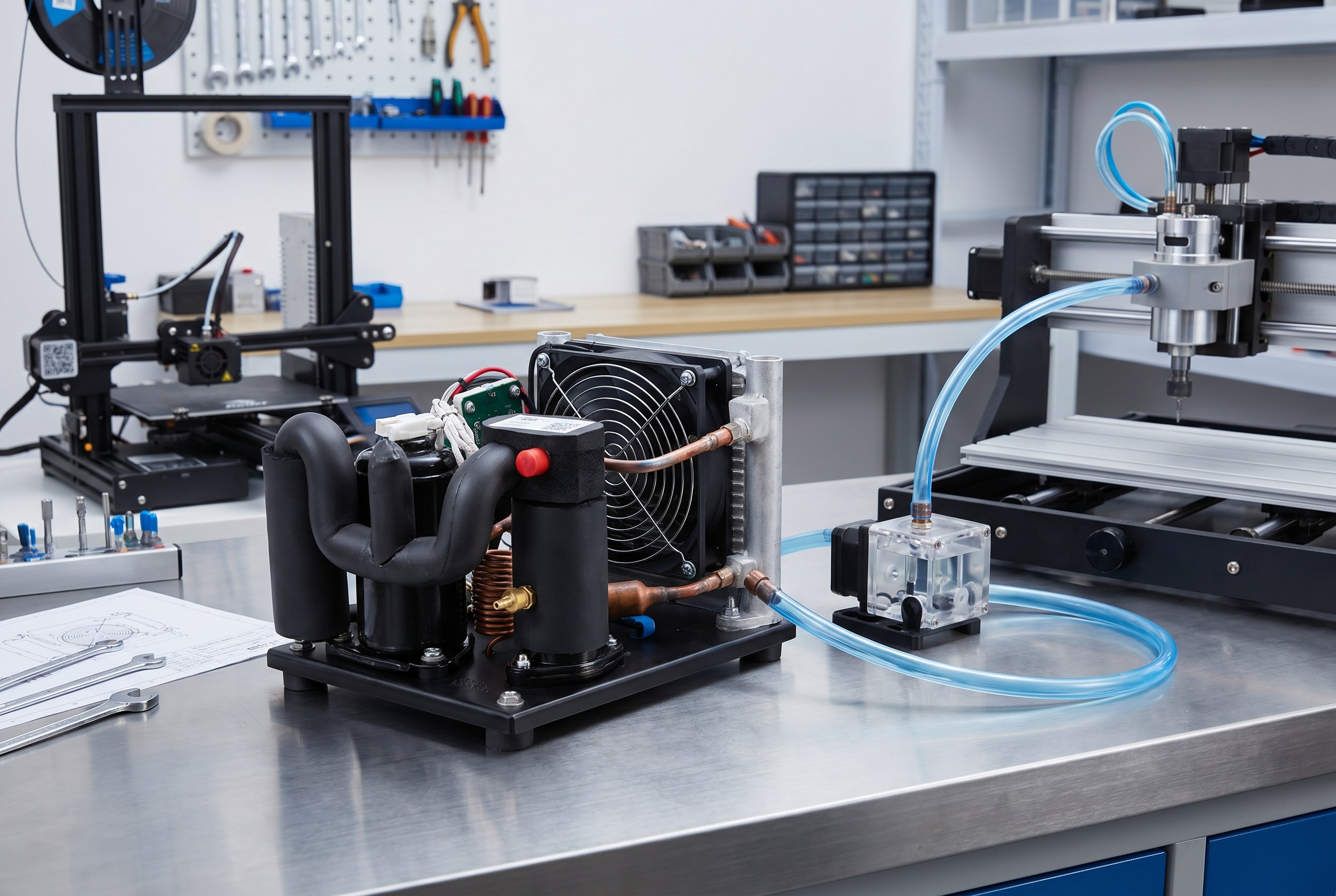
A small water chiller circulates coolant through a closed loop, pulling heat away from the source and rejecting it through a compact condenser. Unlike open-bucket systems, a proper chiller maintains temperature within ±1–2°C regardless of ambient conditions.
Coolant Selection: What to Run in Your Chiller
Choosing the right coolant affects thermal performance, corrosion protection, and maintenance intervals. Here are your three main options:
Distilled Water
The simplest choice. Distilled water offers the best heat transfer coefficient of any common coolant. It’s cheap, readily available, and non-toxic. The downside: zero corrosion protection and biological growth within weeks if untreated. Best for short-term use or systems you flush frequently.
Water-Glycol Mix (20–30%)
Adding propylene glycol or ethylene glycol to distilled water provides freeze protection, raises the boiling point, and inhibits biological growth. A 20–30% concentration balances thermal performance with protection. You lose roughly 5–10% heat transfer efficiency compared to pure water, but gain year-round reliability. This is the recommended choice for most small workshop chillers.
Proprietary Coolant
Some manufacturers offer pre-mixed coolants with corrosion inhibitors, biocides, and surfactants already balanced. These cost more per liter but eliminate guesswork. If you don’t want to mix or test concentrations, proprietary coolant is the low-effort option.
Decision Framework: Matching Coolant to Your Application
Consider these factors when choosing:
- Run time per session: Under 2 hours? Distilled water works. Over 4 hours daily? Use glycol mix.
- Ambient temperature range: If your shop drops below 5°C in winter, glycol prevents freeze damage.
- Material contact: Aluminum fittings and copper tubing need corrosion inhibitors. Stainless and PTFE lines are more forgiving.
- Maintenance tolerance: If you want to set and forget for 6 months, use proprietary coolant or glycol mix with inhibitors.
Selection Matrix: Coolant Comparison
| Coolant Type | Heat Transfer | Corrosion Protection | Bio Resistance | Cost | Maintenance Interval |
|---|---|---|---|---|---|
| Distilled Water | Excellent | None | None | Low | 2–4 weeks |
| Water-Glycol 20–30% | Good | Moderate | Good | Low–Medium | 3–6 months |
| Proprietary Coolant | Good | High | High | Medium–High | 6–12 months |
Maintenance Schedule for Small Water Chillers
Regular maintenance prevents the two most common failure modes: flow restriction from biological growth and pump wear from particulate contamination.
Weekly Checks
- Inspect coolant level — top off if below minimum line
- Check for discoloration or cloudiness (signs of contamination)
- Verify flow rate reads within 2–5 L/min on your gauge
Monthly Tasks
- Clean or replace inline filter if equipped
- Check hose connections for weeping or mineral deposits
- Verify temperature differential between inlet and outlet stays consistent
Quarterly Service
- Full coolant drain and flush with distilled water
- Inspect pump impeller for wear
- Clean condenser fins (compressed air or soft brush)
- Replace coolant with fresh mix
For systems running daily, tighten these intervals. A chiller that runs 8 hours a day needs monthly flushes rather than quarterly.
Looking for compact cooling solutions beyond liquid chillers? Check out RIGID’s micro DC air conditioning systems for enclosure cooling in tight spaces.
Common Problems and Troubleshooting
Reduced Flow Rate
Usually caused by algae buildup, kinked tubing, or a failing pump. Flush the system, inspect lines, and check pump voltage. The DV1910E-P runs on 12V — verify your supply isn’t sagging under load.
Temperature Instability
If your chiller can’t hold ±2°C, check ambient temperature (high shop temps reduce capacity), condenser airflow (blocked fins), and coolant level. An undersized chiller fighting a heat load near its maximum will cycle erratically.
Coolant Discoloration
Green or brown coolant indicates biological growth or corrosion. Drain immediately, flush with a mild citric acid solution, rinse with distilled water, and refill with fresh glycol mix.
Noise Increase
Pump cavitation from low coolant level or air bubbles in the loop. Top off coolant and bleed air from the highest point in your tubing run.
When to Upgrade Your Chiller
Your current setup has limits. Consider upgrading when:
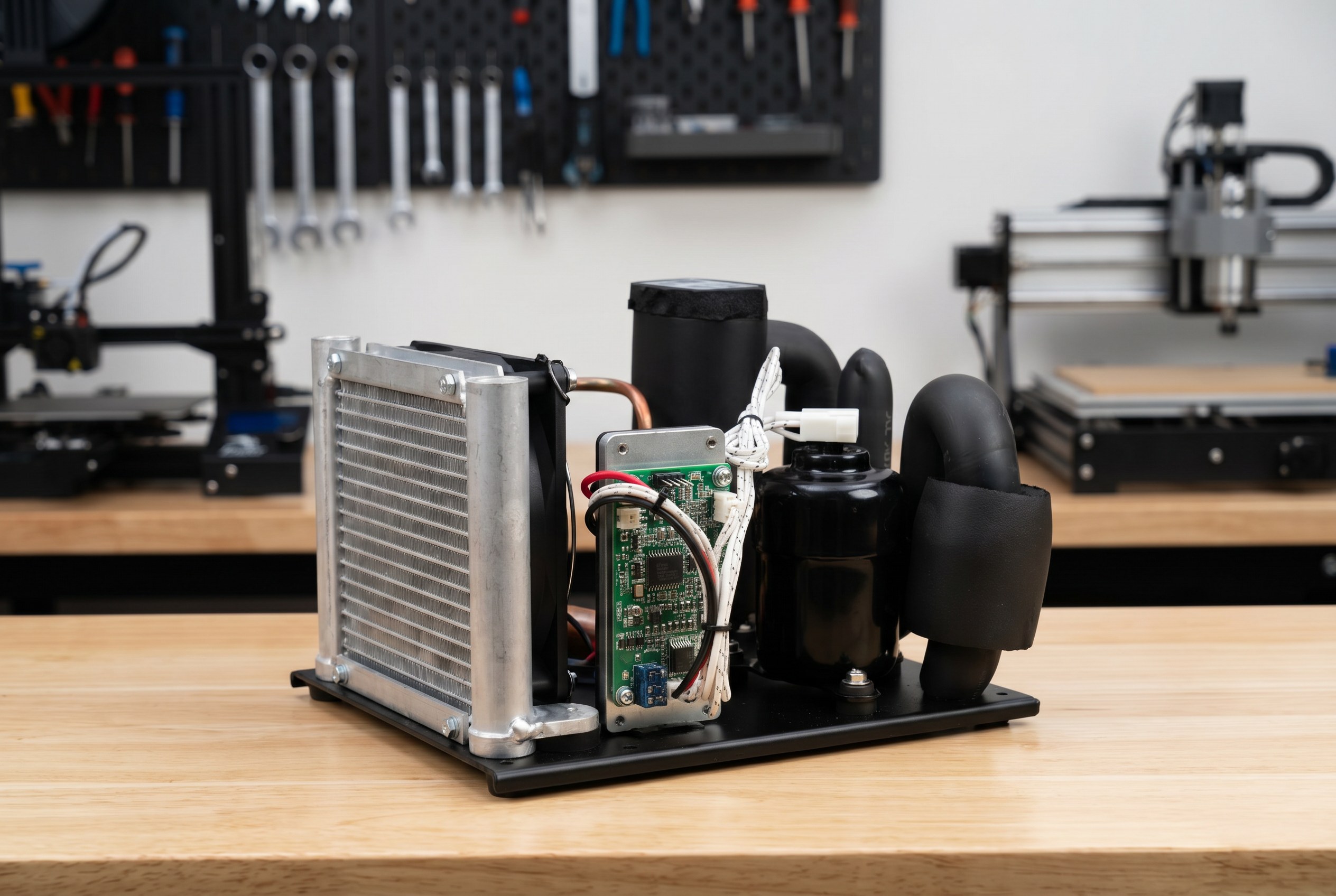
- Heat load exceeds capacity: If you’ve added a second spindle, upgraded to a higher-wattage hotend, or your jobs run longer, you may need to step from the DV1910E-P (450W) to the DV2820E-P (700W).
- Temperature swings exceed ±3°C: Persistent instability despite maintenance means the chiller is undersized for your actual thermal load.
- You’re running 24V equipment: The DV2820E-P and DV3220E-P operate on 24V, matching common CNC and printer power supplies directly.
- Coolant changes are too frequent: If you’re flushing weekly to keep things clean, a higher-capacity system with better filtration reduces maintenance burden.
Important: These compact plate chillers handle heat loads up to about 700W. If your CNC spindle exceeds 1kW or you’re running a large-format printer with multiple hotends, you need an industrial-class system — not a desktop chiller.
Frequently Asked Questions
Can I use tap water in my small water chiller?
Avoid it. Tap water contains minerals that deposit on heat exchange surfaces and promote corrosion. Always use distilled or deionized water as your base.
How often should I change the coolant?
With water-glycol mix: every 3–6 months for daily-use systems. With proprietary coolant: follow manufacturer recommendations, typically 6–12 months. Pure distilled water: every 2–4 weeks maximum.
What glycol concentration should I use?
20–30% propylene glycol by volume. Higher concentrations reduce heat transfer without meaningful benefit for workshop environments. Use propylene glycol (less toxic) over ethylene glycol unless freeze protection below -15°C is required.
Will a small water chiller work for my laser cutter?
Yes, for laser diodes and small CO2 tubes under 500W thermal load. The DV1910E-P at 450W capacity handles most hobby laser setups. Verify your actual heat rejection requirement before sizing.
How do I prevent algae growth?
Use glycol mix (inherently inhibits growth), add a silver coil to the reservoir, or use coolant with biocide additives. Keep the system sealed — light exposure accelerates algae growth.
Can I run the chiller in a cold garage during winter?
With 20–30% glycol mix, yes — it protects against freezing down to approximately -10°C to -15°C depending on concentration. Pure water will freeze and crack components.
What flow rate do I need for a 3D printer hotend?
2–3 L/min is sufficient for single-hotend cooling. Higher flow rates (4–5 L/min) benefit CNC spindles where heat generation is more concentrated.
How loud are these compact chillers?
RIGID plate chillers using BLDC compressors typically run at 35–45 dB depending on load. Quieter than most shop air compressors and comparable to a desktop PC under load.
Do I need a separate reservoir?
A small external reservoir (0.5–1L) helps with air bleeding and provides thermal mass to smooth temperature fluctuations. It’s not strictly required but recommended for CNC applications with intermittent high loads.
What’s the difference between the DV1910E-P and DV2820E-P?
The DV1910E-P is a 450W, 12V unit suited for lighter loads like 3D printer hotends and small laser diodes. The DV2820E-P is a 700W, 24V unit designed for higher thermal loads like CNC spindles. Choose based on your heat rejection requirement and available power supply voltage.
Ready to Keep Your Workshop Running Cool?
Thermal management shouldn’t be an afterthought in your fabrication workflow. Whether you’re printing overnight or cutting aluminum on a weekend, a properly maintained small water chiller protects your equipment and improves output quality. Explore RIGID’s compact plate chiller lineup to find the right capacity for your bench — from 450W single-hotend cooling to 700W spindle-ready systems.