
Small Water Chiller 3D Printer Cooling: Why Active Liquid Cooling Changes Everything
If you run a 3D printer in an enclosure or operate a desktop CNC router, you already know the enemy: heat. It warps prints, shortens spindle bearings, and turns a reliable workflow into a guessing game. Passive cooling — fans, heatsinks, open-loop water reservoirs — works until it doesn’t. The moment ambient temperature climbs or your job runs long, thermal drift creeps in.
A small water chiller solves this by actively refrigerating the coolant loop. Instead of hoping your water reservoir stays cool enough, you set a target temperature and the chiller holds it there — regardless of room conditions or duty cycle. For makers and small workshop owners running desktop-scale equipment, this is the difference between “good enough” and genuinely repeatable results.
This guide covers where heat comes from in 3D printers and CNC machines, why active liquid cooling outperforms passive methods, and how to size a compact chiller for your specific setup.
Heat Sources in 3D Printers
A modern FDM printer generates heat from multiple subsystems, and the total thermal load increases substantially when the printer is enclosed.
The Hotend
The hotend is the most obvious heat source. Printing standard PLA requires temperatures around 200°C, while high-performance materials like PEEK, Ultem, and polycarbonate push hotend temperatures to 300°C or beyond. The heater cartridge typically draws 40-60W, and while most of that energy goes into melting filament, a significant portion radiates into the surrounding structure.
Heated Bed
Heated beds operate between 60°C for PLA and 110°C for ABS and nylon. Bed heaters commonly draw 200-750W depending on size. In an enclosed printer, this heat has nowhere to go — it accumulates inside the chamber, raising ambient temperature steadily over multi-hour prints.
Stepper Motors and Electronics
Each stepper motor dissipates 2-10W as heat during operation. A typical printer has 5-6 steppers, plus the mainboard, stepper drivers, and power supply all contributing thermal energy. In an open-frame printer this is negligible. In an enclosure, it adds up.
The Enclosure Problem
Enclosures are essential for printing ABS, ASA, nylon, and other warp-prone materials — they maintain a stable chamber temperature that prevents layer delamination. But they also trap all internally generated heat. Chamber temperatures of 50-70°C are common, and this elevated ambient affects every component inside: stepper motor life decreases, electronics run hotter, and the cold end of the hotend struggles to maintain a proper thermal break.
This is precisely where liquid cooling enters the picture. A water-cooled hotend with an external chiller keeps the cold end at a controlled temperature regardless of chamber conditions. The coolant absorbs heat from the hotend’s cold zone, carries it outside the enclosure, and the chiller rejects it to the room. The total heat load from a 3D printer hotend and enclosed chamber typically falls in the 50-150W range — well within the capacity of even the smallest compact chillers.
Heat Sources in CNC Machines and Laser Systems
Desktop and benchtop CNC routers face a different but equally challenging thermal environment.
Spindle Motors
CNC spindles range from 200W on small engraving machines to 1-2kW on serious benchtop routers. Electric motors are typically 60-70% efficient, meaning 30-40% of input power becomes heat. A 500W spindle generates roughly 150-200W of waste heat concentrated in the motor windings and bearings. A 1.5kW spindle can produce 450-600W of heat that needs to go somewhere.
Bearing temperature directly determines spindle life. Every 10°C reduction in bearing operating temperature roughly doubles bearing service life. For hobbyists running expensive ER11 or ER20 spindles, keeping bearings cool is the single most cost-effective maintenance strategy.
VFDs and Servo Drives
Variable frequency drives and servo controllers generate their own heat — typically 3-5% of the power they handle. In an enclosed electronics cabinet, this compounds with spindle heat conducted through the machine frame.
Laser Tubes and Diode Modules
CO2 laser tubes are notoriously temperature-sensitive. A 40-60W CO2 tube converts only 15-25% of input electrical power into laser light. The remaining 60-70% becomes heat that must be removed through the water jacket. If coolant temperature rises above the tube’s rated maximum (typically 25-28°C), beam quality degrades and tube life shortens dramatically.
Even solid-state laser diode modules benefit from active cooling. Higher-power diodes (10W+) produce enough waste heat that thermal throttling occurs without adequate cooling, reducing effective cutting power during long jobs.
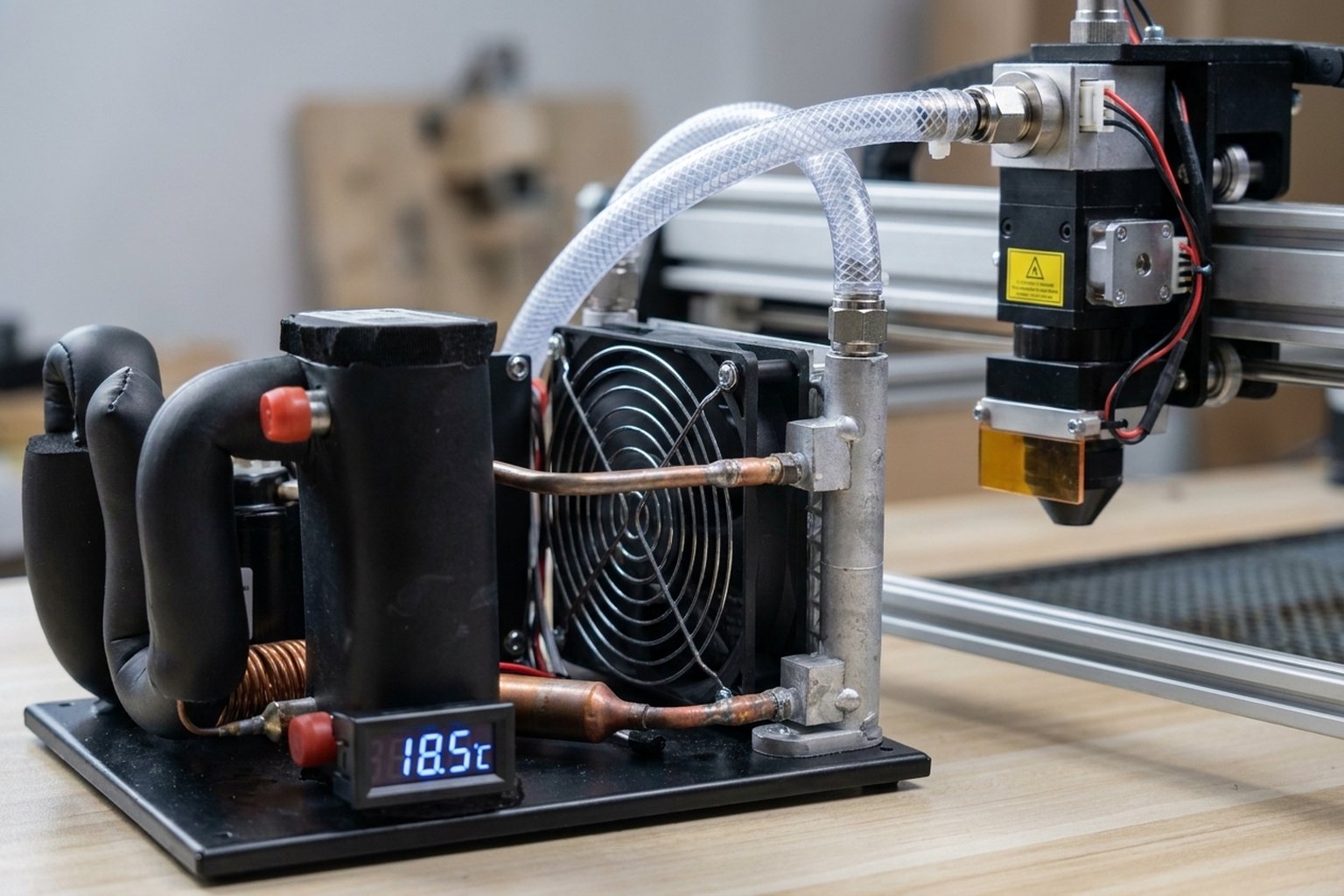
Why Active Liquid Cooling Outperforms Passive Methods
Before investing in a chiller, most makers try passive approaches first. Understanding why they eventually fall short helps clarify when active cooling becomes necessary.
Fans and Heatsinks
Air cooling works when the temperature differential between the component and ambient air is large. As ambient temperature rises — whether from summer weather, an enclosed printer chamber, or a warm workshop — the cooling capacity of fans and heatsinks drops proportionally. You cannot cool a component below ambient temperature with passive methods.
Open-Loop Water Cooling
A bucket of water with a pump is the classic DIY approach. Water has excellent thermal mass, so it absorbs heat effectively — for a while. On a short job, the water temperature might rise only a few degrees. But on a 4-hour print or a full-day CNC session, that reservoir temperature climbs steadily. By hour three, your “cooling” water might be 35-40°C, providing minimal actual cooling.
Some makers add ice or frozen water bottles. This works but introduces temperature swings — the coolant starts too cold, warms through the ideal range, then overshoots. Inconsistent coolant temperature means inconsistent results.
Thermoelectric (Peltier) Coolers
TEC-based coolers can actively cool below ambient, but they are inherently inefficient. A typical Peltier module has a coefficient of performance (COP) around 0.5-1.0, meaning it consumes as much or more electrical power than the heat it removes. They also struggle with higher heat loads and have limited temperature differential capability.
Vapor-Compression Chillers: The Right Tool
A proper vapor-compression chiller — the same fundamental technology in your refrigerator — achieves COP values of 2-4. For every watt of electrical input, it moves 2-4 watts of heat. This means a compact chiller consuming 150W of electricity can remove 450W+ of heat from your coolant loop. The coolant temperature is actively controlled by a thermostat and variable-speed compressor, maintaining your setpoint regardless of ambient conditions or heat load variations.
Sizing a Small Water Chiller for Your Application
Choosing the right chiller capacity requires understanding your actual heat load. Oversizing wastes money and space; undersizing means the chiller runs at 100% continuously and still cannot maintain temperature on hot days.
3D Printer Applications
For a water-cooled hotend in an enclosed printer, the heat load entering the coolant loop is typically 50-150W. This accounts for heat conducted from the heater block through the thermal break, plus any radiant heat absorbed by the cooling block. A chiller rated at 450W cooling capacity provides 3-9x headroom — more than adequate for any single-hotend printer, and sufficient for most dual-extrusion setups as well.
Desktop CNC Spindles (200-500W)
A 500W water-cooled spindle generates approximately 150-200W of waste heat at full load. A 450W-rated chiller handles this comfortably, with enough reserve capacity for sustained operation in warm environments. For spindles in the 200-300W range, the heat load drops to 60-120W — easily managed by the smallest compact chillers.
Larger CNC Spindles (1-2kW)
Moving up to 1-2kW spindles, heat loads reach 300-600W. This is where you need a chiller in the 700-900W capacity range. Running a 450W chiller on a 1.5kW spindle at full load will result in gradually rising coolant temperatures — the chiller simply cannot reject heat as fast as the spindle produces it.
CO2 Laser Tubes (40-60W)
A 40W CO2 laser tube with 20% efficiency produces roughly 160W of input power, of which about 100-130W becomes heat in the water jacket. A 60W tube might produce 180-250W of heat load. A 450W chiller handles either scenario with significant headroom, and the precise temperature control is exactly what laser tubes need for consistent beam quality and long service life.
The Headroom Principle
Always select a chiller with at least 50% more capacity than your calculated heat load. This ensures the compressor runs at partial speed most of the time, which reduces noise, extends compressor life, and provides reserve capacity for hot days or unexpectedly demanding jobs. A chiller running at 60-70% capacity is quieter, more efficient, and longer-lived than one running at 95%.
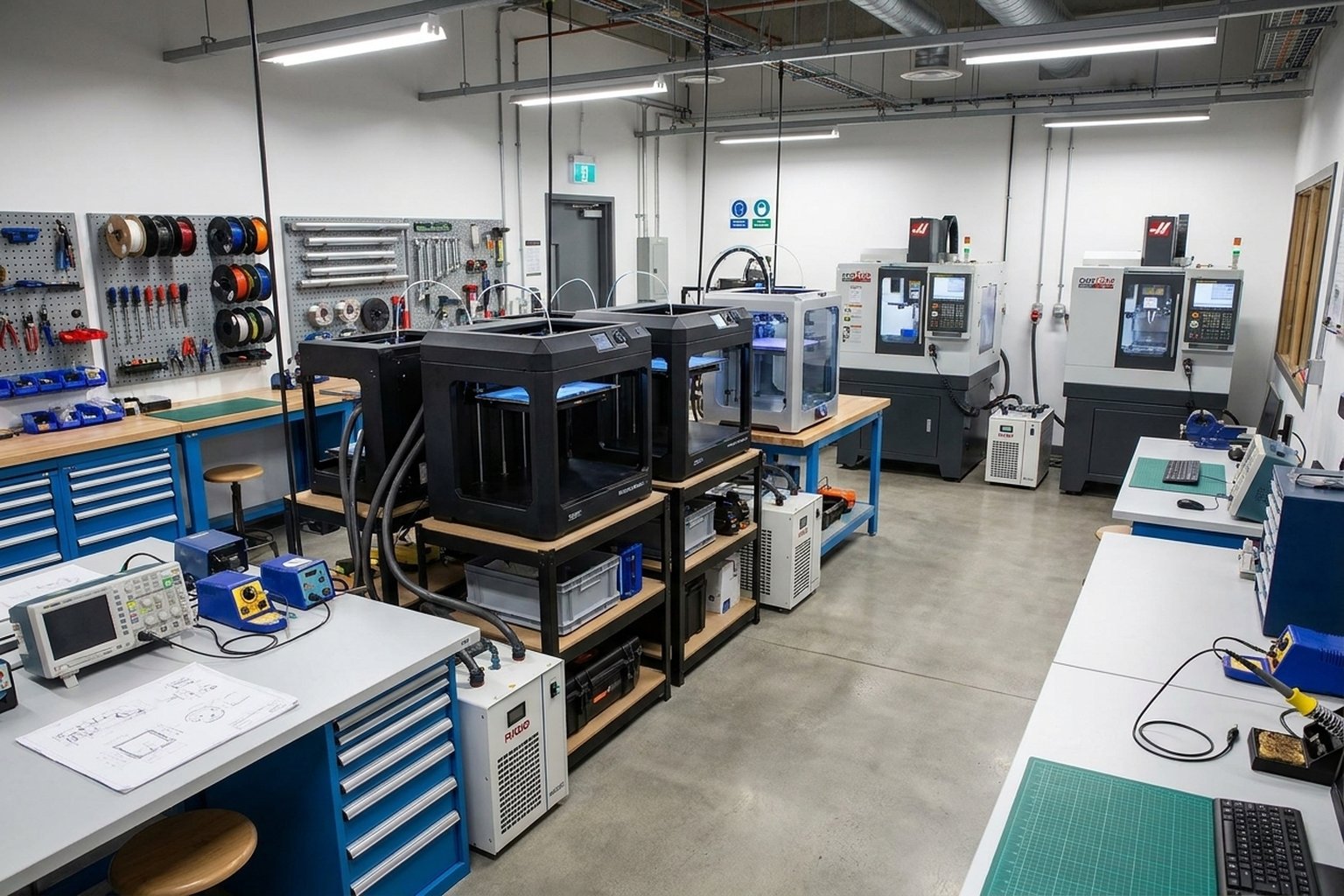
RIGID Compact Liquid Chillers: Purpose-Built for Desktop Equipment
RIGID’s compact liquid chiller series (DV1920E-P and DV3220E-P) was designed specifically for the applications described above. These are not repurposed aquarium chillers or oversized industrial units — they are engineered for the 450-900W cooling capacity range that desktop and benchtop equipment demands.
24V DC Operation
Unlike most chillers that require AC mains power, RIGID compact chillers operate on 24V DC. This opens up integration possibilities that AC-powered units cannot match. You can power the chiller from the same bench power supply running your CNC controller, integrate it into a battery-powered mobile setup, or run it from a solar installation in an off-grid workshop. The 24V input also means no inverter losses in DC-powered environments.
Variable-Speed Compressor
The heart of these chillers is a miniature variable-speed rotary compressor. Unlike fixed-speed compressors that cycle on and off (creating temperature oscillations), a variable-speed unit modulates its capacity to match the current heat load. When your printer is idling between prints, the compressor slows down. When you start a demanding job, it ramps up. The result is tighter temperature control with less energy consumption and lower noise.
Heat Exchanger Options
RIGID offers both plate heat exchanger and coaxial heat exchanger configurations. Plate exchangers provide high efficiency in a compact footprint — ideal when space is at a premium. Coaxial exchangers offer a simpler flow path with lower pressure drop, which can be advantageous in systems with longer tubing runs or lower-pressure pumps.
Compact Form Factor
These units are designed to sit on or under a workbench alongside your equipment. They are not the size of a mini-fridge — they are closer to the size of a large power supply. This matters in workshops where every square inch of bench space is valuable.
Installation Considerations
Setting up a chiller-based cooling loop is straightforward, but a few details make the difference between a reliable system and one that causes problems.
Coolant Selection
Use distilled water with a corrosion inhibitor, or a premixed coolant designed for closed-loop cooling systems. Avoid tap water — mineral content causes scale buildup in heat exchangers over time. For systems that might experience freezing temperatures (unheated garages, shipping), add propylene glycol antifreeze to the appropriate concentration.
Tubing and Fittings
Silicone tubing is the standard choice for desktop cooling loops — it is flexible, temperature-resistant, and does not leach plasticizers into the coolant. Use proper barb fittings with hose clamps rather than push-fit connections that can work loose over vibrating CNC machines. Route tubing away from hot surfaces and moving parts.
Reservoir and Air Removal
Include a small reservoir in the loop to accommodate thermal expansion and make air removal easier. Air bubbles in the cooling loop reduce heat transfer efficiency and can cause pump cavitation. After initial fill, run the system for several minutes and top off as air bleeds out.
Temperature Setpoint
For most applications, a coolant setpoint of 20-22°C works well. This is below typical room temperature, ensuring the coolant always provides active cooling. For CO2 laser tubes, consult the tube manufacturer’s specifications — most recommend coolant temperatures between 18-25°C. Setting the temperature too low causes condensation on cold surfaces, which can damage electronics. A setpoint 2-3°C below ambient is usually the practical minimum without condensation management.
Comparing Cooling Approaches: A Decision Framework
Not every setup needs a chiller. Here is a practical framework for deciding when to upgrade from passive to active cooling.
You Probably Do Not Need a Chiller If:
- Your printer is open-frame and you only print PLA/PETG
- Your CNC spindle is air-cooled and rated for continuous duty
- Your jobs are short (under 1 hour) with long cool-down periods between them
- Your workshop stays below 25°C year-round
You Should Seriously Consider a Chiller If:
- You run an enclosed printer with high-temperature materials
- Your CNC spindle is water-cooled (it needs proper cooling by design)
- You operate a CO2 laser (tube life depends directly on coolant temperature)
- You run long jobs (4+ hours) where thermal drift accumulates
- Your workshop gets warm in summer (above 28-30°C)
- You need repeatable results across seasons and conditions
- Spindle bearing replacement costs more than a chiller
Cost-Benefit Reality
A compact liquid chiller is an investment, but consider what it protects. A quality water-cooled CNC spindle costs several hundred dollars. A CO2 laser tube costs $200-800 depending on power and quality. Failed prints waste material and time. In most cases, the chiller pays for itself by extending the life of the components it cools and reducing waste from thermal-related failures.
Common Questions
Can I use a chiller for multiple machines?
Yes, if the combined heat load stays within the chiller’s capacity. You can plumb multiple cooling loops in parallel from a single chiller, or use a manifold to distribute coolant. Just ensure total heat load does not exceed about 70% of chiller rated capacity for reliable operation.
How loud are these chillers?
Variable-speed compressor chillers are significantly quieter than fixed-speed units because they run at reduced speed most of the time. At partial load, expect noise levels comparable to a quiet desktop computer. At full capacity, they are similar to a small refrigerator compressor — present but not disruptive in a workshop environment.
What maintenance do they require?
Minimal. Check coolant level monthly, replace coolant annually (or when it becomes discolored), and keep the condenser fins free of dust. The sealed refrigeration circuit requires no user maintenance. These are set-and-forget appliances for the most part.
Can I use the chiller outdoors or in an unheated space?
The chiller itself should be protected from rain and extreme temperatures. Operating in cold environments (below 5°C) requires antifreeze in the coolant loop. The chiller’s compressor may not start reliably below 0°C ambient — consult specifications for your specific model’s operating range.
Getting Started
Selecting the right chiller for your specific application depends on your heat load, available space, power supply, and integration requirements. If you are unsure about sizing or have a unique application — perhaps a custom-built printer with multiple hotends, or a CNC with both spindle and VFD cooling needs — an engineering assessment can help you specify the right unit.
RIGID’s engineering team works with makers and OEMs to match chiller specifications to application requirements. Whether you need a single unit for your workshop or are designing cooling into a product, the compact liquid chiller series offers the capacity range and form factor that desktop and benchtop equipment demands.
Ready to eliminate thermal drift from your workflow? Request a free engineering assessment to determine the optimal chiller configuration for your setup.