
The Smallest AC Units That Actually Use a Compressor — What Works and What Doesn’t
Search for “smallest AC” and you will find hundreds of products claiming to cool rooms, tents, and vehicles for under $50. Most of them are not air conditioners. They are evaporative coolers, USB desk fans, or Peltier-based gadgets that move air without actually removing heat from a space. The difference matters — especially when you need real cooling in a confined area where temperatures climb past comfort or safety thresholds.
This guide focuses exclusively on the smallest air conditioning units that use a vapor compression compressor — the same fundamental technology found in your home HVAC system, scaled down to fit spaces measured in square feet rather than square meters. If it does not have a compressor and a refrigeration cycle, it is not covered here.
Why the Compressor Matters: Real Cooling vs Air Movement
A vapor compression air conditioner works by cycling refrigerant through four stages: compression, condensation, expansion, and evaporation. During evaporation, the refrigerant absorbs heat from indoor air and carries it outside. This is the only portable technology that can lower the actual temperature inside an enclosed space below the ambient outdoor temperature.
Alternatives that lack compressors cannot do this:
- Evaporative coolers (swamp coolers) blow air across a wet pad. They can reduce perceived temperature by 5–10°C in dry climates, but they add humidity. In humid conditions — above roughly 50% relative humidity — they become nearly useless and can actually make a space feel worse.
- Peltier (thermoelectric) coolers use semiconductor junctions to create a temperature differential. They move a small amount of heat from one side to the other, but their efficiency (COP) is typically 0.3–0.5 — meaning they generate 2–3 watts of waste heat for every watt of cooling delivered. In an enclosed space, the net effect is often warming, not cooling. Their maximum practical temperature drop is about 5–8°C below ambient.
- USB fans and “personal coolers” circulate air. Air movement increases evaporative cooling from skin, which feels cooler — but the air temperature remains unchanged. In a sealed enclosure like a vehicle cabin or equipment housing, fans provide zero net cooling.
A compressor-based unit, by contrast, can maintain 15–25°C temperature differentials below ambient, works regardless of humidity, and actually removes heat from the space rather than redistributing it.
How Small Can a Real Air Conditioner Get?
The size floor for a compressor-based AC unit is determined by the physical dimensions of the compressor, the heat exchangers (evaporator and condenser), and the fan or blower required for air circulation. Traditional home window units start at roughly 5,000 BTU (1,465W) and weigh 15–25 kg — far too large for a van, tent, or equipment enclosure.
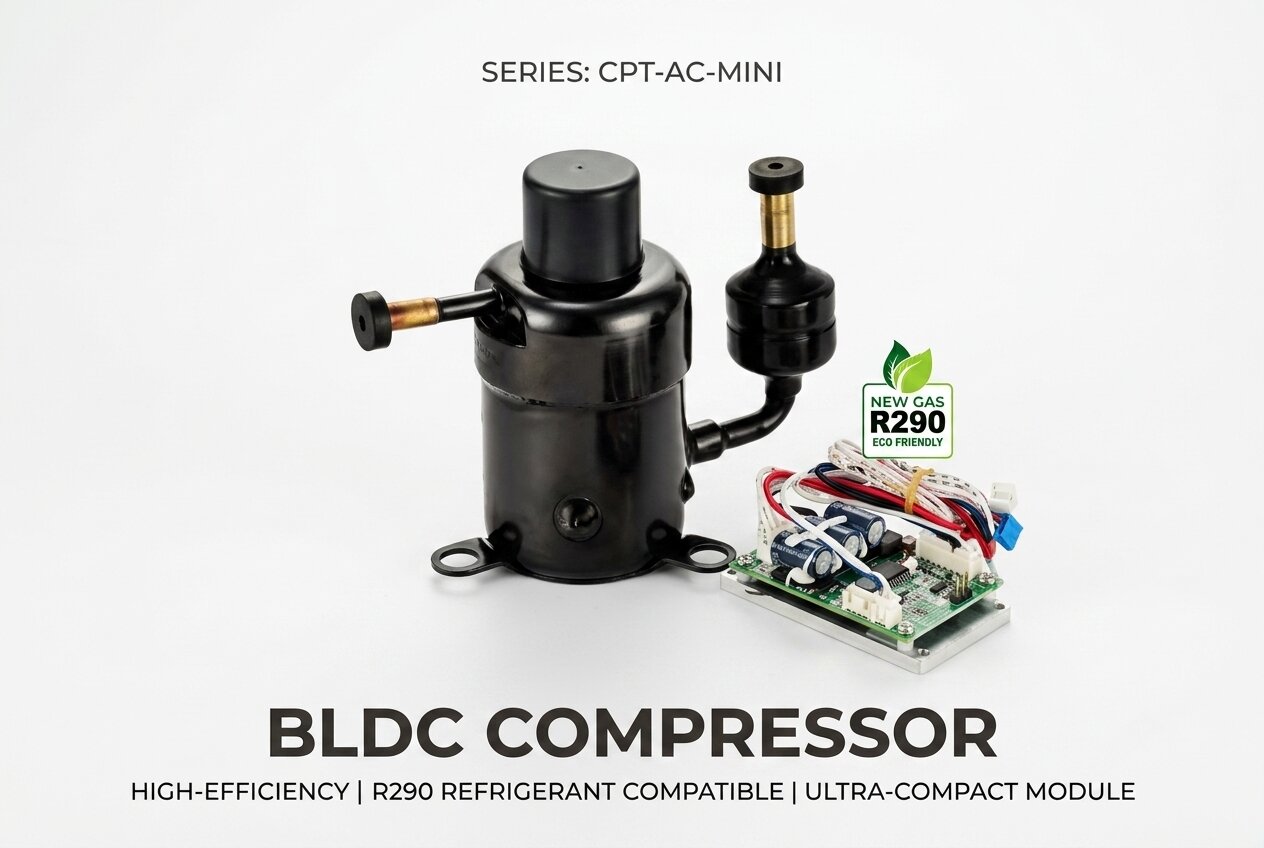
However, advances in miniature BLDC (brushless direct current) compressor technology have pushed the lower limit dramatically. Modern micro DC compressors weigh under 2 kg and deliver 450–900W (1,535–3,069 BTU) of real cooling capacity. When packaged into complete AC units with evaporators, condensers, and controls, the total system weight can be as low as 5 kg (11 lbs) — small enough to mount inside a vehicle dashboard, hang inside a tent, or install in an electronic equipment cabinet.
These are not theoretical products. They are shipping, field-proven units used by campers, van lifers, fleet operators, and equipment engineers who need genuine cooling in spaces where traditional AC cannot fit.

Smallest Compressor AC Units by Cooling Capacity
The following breakdown covers the practical range of miniature compressor-based AC units, from ultra-compact modules to portable units suitable for small rooms:
450W (1,535 BTU) — Ultra-Compact Class
At the entry level of true vapor compression cooling, 450W units are the smallest self-contained AC systems available. They are designed for spaces under 2 cubic meters — think equipment enclosures, pet crates, motorcycle top boxes, or single-person sleeping pods.
- Typical dimensions: roughly 300×200×150mm for the indoor unit
- Weight: approximately 5 kg (11 lbs) complete
- Power draw: 12V or 24V DC, 4–16A depending on voltage
- Best for: small sealed enclosures, battery-powered applications, camping setups where space and weight are critical constraints
At 450W, do not expect to cool a full-size room. These units maintain comfortable conditions in spaces roughly the size of a large closet or a two-person tent. Their strength is efficiency in confined volumes where even small amounts of cooling make a significant difference.
550–700W (1,876–2,387 BTU) — Mid-Range Compact
The mid-range covers the sweet spot for most personal and small-vehicle applications. A 700W unit can maintain comfortable temperatures in a van, small RV sleeping area, or a room-sized tent in moderately hot conditions (outdoor temperatures up to 35°C).
- Typical dimensions: 350×250×180mm for the indoor unit
- Weight: 5–7 kg complete
- Power draw: 24V DC, approximately 8A
- Best for: camper vans, RV sleeping zones, large tents, small server closets, vehicle cabins during engine-off periods
At this capacity level, battery runtime becomes a practical consideration. A 100Ah 24V lithium battery provides roughly 12–15 hours of runtime at typical cycling rates — enough for overnight cooling in most camping scenarios.
900W (3,069 BTU) — Performance Compact
The largest units in the micro-compressor category deliver cooling comparable to the smallest traditional window AC units, but in a fraction of the size and weight. A 900W unit handles spaces up to 8–10 square meters in moderate climates — covering small rooms, large RV cabins, or commercial vehicle operator stations.
- Typical dimensions: 400×280×200mm for the indoor unit
- Weight: 7–9 kg complete
- Power draw: 24V or 48V DC, 8–20A depending on voltage
- Best for: RV main cabins, small bedrooms, commercial vehicle cabs (forklifts, golf carts, sweepers), outdoor vendor booths
DC Power: The Hidden Advantage of Micro Compressor AC
One of the most significant advantages of micro compressor AC units is their native DC power operation. Traditional AC units require 110V or 220V AC power, meaning they need either a building electrical connection or a heavy, inefficient inverter to run from batteries.
Micro DC air conditioners run directly from 12V, 24V, or 48V battery banks with no inverter needed. This eliminates the 10–15% energy loss inherent in DC-to-AC conversion and makes battery-powered operation practical for the first time. Applications that benefit most include:
- Camping and overlanding without generator noise
- Van life and RV setups running from house batteries
- Anti-idling cooling for fleet vehicles (trucks, service vans, emergency vehicles)
- Solar-powered remote installations (weather stations, telecom cabinets, monitoring equipment)
- Electric vehicle battery thermal management
The BLDC compressor technology that enables these small form factors also provides variable-speed operation. Instead of cycling on and off at full power (like a traditional compressor), BLDC compressors adjust their speed continuously to match the actual cooling demand. This reduces peak current draw, extends battery runtime, and eliminates the temperature oscillations associated with fixed-speed compressors.
What to Check Before Buying a “Small AC”
The market is full of misleading product listings. Before purchasing any unit marketed as a small or portable air conditioner, verify these five things:
- Does it have a compressor? Check the product specifications for “compressor type” or “refrigerant.” If there is no compressor listed and no refrigerant specified (R134a, R290, R32, or similar), it is not an air conditioner — regardless of what the marketing says.
- What is the actual cooling capacity in watts or BTU? Legitimate AC units specify cooling output in watts (W) or BTU/hr. If the listing only mentions “power consumption” or “wattage” without distinguishing it from cooling capacity, the number you see is likely the electrical input, not the cooling output.
- Is there a separate condenser (outdoor) unit or exhaust? A real air conditioner must reject heat somewhere outside the cooled space. If the product is a single box with no exhaust hose, no outdoor unit, and no condenser, it cannot cool a room — it is physically impossible for it to reduce the total heat energy in an enclosed space.
- What is the operating temperature range? A real compressor AC unit specifies its rated performance at specific ambient temperatures (typically 35°C or 43°C outdoor). Evaporative coolers and Peltier devices rarely provide this specification because their performance degrades unpredictably with conditions.
- What is the weight? A genuine compressor-based AC unit with adequate cooling capacity weighs at least 3–5 kg due to the compressor, heat exchangers, and refrigerant charge. Any “air conditioner” weighing under 2 kg almost certainly lacks a real compressor.
Real-World Cooling Performance: What to Expect
Managing expectations is important. A 450–900W micro AC unit is not going to replace a 3,500W window unit for cooling a living room. Here is what realistic performance looks like in common scenarios:
| Scenario | Space Volume | Ambient Temp | Unit Size | Expected Interior Temp |
|---|---|---|---|---|
| Two-person tent | ~3 m³ | 35°C | 450W | 22–26°C |
| Camper van sleeping area | ~5 m³ | 35°C | 700W | 24–28°C |
| RV main cabin | ~12 m³ | 35°C | 900W | 27–30°C |
| Equipment enclosure | ~0.5 m³ | 40°C | 450W | 25–30°C (controlled) |
| Vehicle cab (engine off) | ~3 m³ | 38°C | 700W | 25–28°C |
Insulation quality is the biggest variable. A well-insulated van with reflective window covers will stay 5–8°C cooler than one with single-pane windows and no shade. Spending $50 on insulation improvements often does more for comfort than spending $500 on a bigger AC unit.
Where to Find Genuine Micro Compressor AC
The RIGID Micro DC Aircon series covers the full 450W–900W range with models available in 12V, 24V, and 48V DC configurations. All units use BLDC compressor technology with R134a or R290 refrigerant, and they are designed specifically for the mobile, off-grid, and embedded applications discussed above. The complete system — compressor, evaporator, condenser, and controller — weighs approximately 5 kg (11 lbs) and fits in spaces where no traditional air conditioner could be installed.
Unlike consumer “portable AC” products that often disappoint with misleading specifications, these are engineering-grade cooling modules with documented performance curves at rated ambient temperatures. They ship to OEM integrators, fleet operators, and end users who need verified cooling performance in demanding environments.
Maintenance and Longevity: What Small Compressor AC Units Need
Micro compressor AC units require minimal maintenance compared to traditional systems, but they are not maintenance-free. To keep a small DC air conditioner running efficiently over its expected 30,000–50,000 hour lifespan:
- Clean or replace the air filter every 2–4 weeks during active use. Dust buildup on the evaporator filter reduces airflow, forces the compressor to work harder, and can eventually cause the unit to freeze up. Most micro AC units use washable mesh filters that take 30 seconds to rinse.
- Keep the condenser clear. The outdoor side of the unit rejects heat through a small condenser coil and fan. If the condenser is blocked by debris, pressed against a wall, or mounted in a location with no airflow, cooling capacity drops dramatically and the compressor may overheat and shut down.
- Check condensate drainage. Even small AC units produce condensation as they dehumidify the air. Ensure the drain line or collection tray is clear. In humid environments, a 700W unit can produce 0.5–1.5 liters of condensate per hour.
- Inspect electrical connections annually. Vibration from vehicle mounting or portable use can loosen terminal connections over time. Check all DC power connections for corrosion, especially in marine or high-humidity environments.
Unlike traditional AC systems that require periodic refrigerant recharging, sealed micro compressor units are factory-charged and should not need refrigerant service during their normal lifespan. If cooling performance degrades after years of use, the most likely cause is a dirty condenser or evaporator, not a refrigerant leak.
Frequently Asked Questions
Can a 450W micro AC cool a full-size room?
No. A 450W (1,535 BTU) unit is designed for enclosed spaces under 3 cubic meters — small tents, equipment cabinets, pet enclosures, or sleeping pods. For a standard 10 m² room, you need at least 2,500–3,500W (8,500–12,000 BTU). Micro compressor AC targets specific small-space applications, not whole-room cooling.
How long will a micro DC AC run on batteries?
Runtime depends on battery capacity, voltage, and the AC unit’s cycling rate. As a general reference: a 700W/24V unit drawing an average of 6A (accounting for compressor cycling) on a 100Ah 24V lithium battery will run approximately 16 hours. Actual runtime varies with ambient temperature, insulation quality, and thermostat setpoint. Higher ambient temperatures cause longer compressor run times and shorter battery life.
What is the difference between “smallest ac” and “portable air conditioner”?
Portable air conditioners are typically 2,000–4,000W (7,000–14,000 BTU) units on wheels designed for room cooling with an exhaust hose through a window. They weigh 20–35 kg and run on 110/220V AC power. “Smallest AC” in the micro compressor category refers to units under 900W that weigh 5–9 kg and run on DC power for mobile and embedded applications. They serve fundamentally different use cases.