
Smallest AC Unit for Equipment Cooling: Why the Search Has Changed
When most people search for the smallest AC unit, they picture a tiny box cooling a bedroom or a dorm room. But a growing number of those searches come from engineers and system designers who need something very different: a compact, self-contained cooling module that fits inside or alongside equipment enclosures, battery compartments, and instrument housings.
The distinction matters. A consumer mini AC trades cooling performance for portability. An equipment-grade micro AC unit trades nothing — it delivers real vapor compression cooling in a package small enough to bolt onto a control panel or slide into a telecom cabinet. The engineering challenge is fundamentally different, and so is the solution.
This article is for the second group. If you need the smallest AC unit that actually maintains stable temperatures inside sealed enclosures, protects sensitive electronics from thermal shutdown, or keeps battery systems within safe operating windows, here is what the technology looks like in practice.
What Makes an AC Unit Genuinely Small
Size claims are easy to make and hard to verify. A unit marketed as “small” might still weigh 15 kg and require a 120V AC outlet. For equipment cooling, the meaningful metrics are different:
- Weight under 5 kg (11 lbs) — light enough for mobile platforms, drone docking stations, and vehicle-mounted enclosures
- Voltage compatibility with DC power — 12V, 24V, or 48V direct current, no inverter required
- Cooling capacity per unit volume — how many watts of heat can it remove relative to its physical footprint
- Self-contained refrigeration loop — compressor, condenser, evaporator, and expansion device in one module
By these criteria, the smallest AC units available today are micro DC aircon modules built around brushless direct current (BLDC) compressors. These are not scaled-down versions of household air conditioners. They are purpose-built for confined-space cooling, designed from the compressor outward to minimize size while maintaining real vapor compression performance.
The Technology Behind Sub-5kg Cooling
Vapor compression is the same thermodynamic cycle used in every refrigerator and air conditioner on the planet. The difference in a micro AC unit is how the components are engineered to shrink the package without losing efficiency.
BLDC compressors are the enabling technology. Unlike conventional AC compressors that run at fixed speed on alternating current, BLDC compressors operate on direct current with variable speed control. This eliminates the need for an inverter — a component that adds weight, generates heat, and introduces conversion losses. Running directly from a 12V, 24V, or 48V battery or power supply means the entire system stays compact and efficient.
Variable speed also means the compressor adjusts its output to match the actual cooling load. In a sealed enclosure that generates 200W of heat, the compressor runs at low speed and low power draw. When ambient temperature spikes or the heat load increases, it ramps up. This is not just an efficiency feature — it extends compressor life and reduces acoustic noise during normal operation.
The refrigerant circuit uses either R134a or R290 (propane), both well-established in compact refrigeration. R134a is the standard choice for most industrial applications. R290 offers higher thermodynamic efficiency and lower global warming potential, making it relevant for applications where environmental regulations are tightening.
Cooling Capacity: What the Numbers Mean for Equipment
The smallest AC units in the micro DC aircon category range from 450W to 900W of cooling capacity. In BTU terms, that is 1,535 to 3,069 BTU/h. These numbers deserve context, because equipment cooling math works differently from room cooling math.
In a sealed electronics enclosure, the heat load comes from the components inside: power supplies, processors, motor drives, communication modules. A typical telecom outdoor cabinet might generate 150–400W of internal heat. A battery management system in an EV charging station might produce 200–600W during peak charging cycles.
Matching the AC unit to the heat load is straightforward in principle: the cooling capacity must exceed the internal heat generation plus any solar or ambient heat gain through the enclosure walls. In practice, engineers typically add a 20–30% safety margin to account for peak loads and degraded performance at high ambient temperatures.
Here is how the current product range maps to common applications:
- 450W (1,535 BTU) — telecom cabinets, small PLC enclosures, edge computing nodes, sensor housings in outdoor installations
- 550W (1,876 BTU) — mid-size control panels, medical device enclosures, laser cooling systems with moderate heat loads
- 700W (2,387 BTU) — EV charger cabinets, larger battery compartments, industrial automation enclosures with multiple heat-generating components
- 900W (3,069 BTU) — high-density electronics racks, multi-module battery systems, equipment trailers with significant thermal loads
Temperature Stability vs Raw Cooling Power
In human comfort cooling, the goal is simple: make the room feel cooler. A few degrees of temperature swing is perfectly acceptable. Equipment cooling operates under tighter constraints.
Semiconductor components have maximum junction temperatures. Exceed them, and the device throttles performance or shuts down entirely. Battery cells have optimal charging and discharging temperature windows — typically 15°C to 35°C for lithium-ion chemistry. Optical instruments drift out of calibration when ambient temperature fluctuates more than a few degrees.
The smallest AC unit for equipment cooling needs to maintain temperature within a defined band, not just push air around. This is where variable-speed BLDC compressors provide a measurable advantage over fixed-speed alternatives. A fixed-speed compressor cycles on and off, creating temperature swings with each cycle. A variable-speed compressor modulates continuously, holding the enclosure temperature within a tighter range.
For applications like laser diode cooling, analytical instrument enclosures, or precision measurement equipment, this stability is not optional — it is the primary reason for choosing vapor compression over simpler alternatives like thermoelectric (Peltier) coolers. Peltier devices can cool small heat loads, but their efficiency drops sharply as the temperature differential increases, and they lack the capacity to handle heat loads above approximately 50–80W in practical configurations.
DC Power: Why It Changes the Design Equation
Most equipment that needs compact cooling already runs on DC power. Telecom systems use 48V. Electric vehicles and charging infrastructure use 24V or 48V bus voltages. Solar installations have 12V or 24V battery banks. Mobile platforms — from drones to autonomous ground vehicles — are entirely DC.
An AC-powered cooling unit in these environments requires an inverter to convert DC to AC, then the unit’s own power supply converts it back to DC for the electronics. Each conversion step loses 5–15% of the energy as heat — heat that the cooling system then has to remove. It is a compounding inefficiency problem.
A DC-native micro AC unit eliminates both conversion steps. The BLDC compressor runs directly from the DC bus. The control electronics operate on the same voltage. The result is a measurably shorter thermal path from power source to cooling output, with less waste heat generated by the cooling system itself.
Available voltage options — 12V, 24V, and 48V — cover the vast majority of DC power architectures in industrial and mobile applications. No inverter means no inverter failure mode, no inverter weight, and no inverter cost.
Installation in Sealed Enclosures
The defining challenge of equipment cooling is that many enclosures are sealed. They have to be. Dust, moisture, corrosive gases, and insects will destroy electronics faster than heat will. Opening the enclosure to ambient air for ventilation is not an option in most industrial environments.
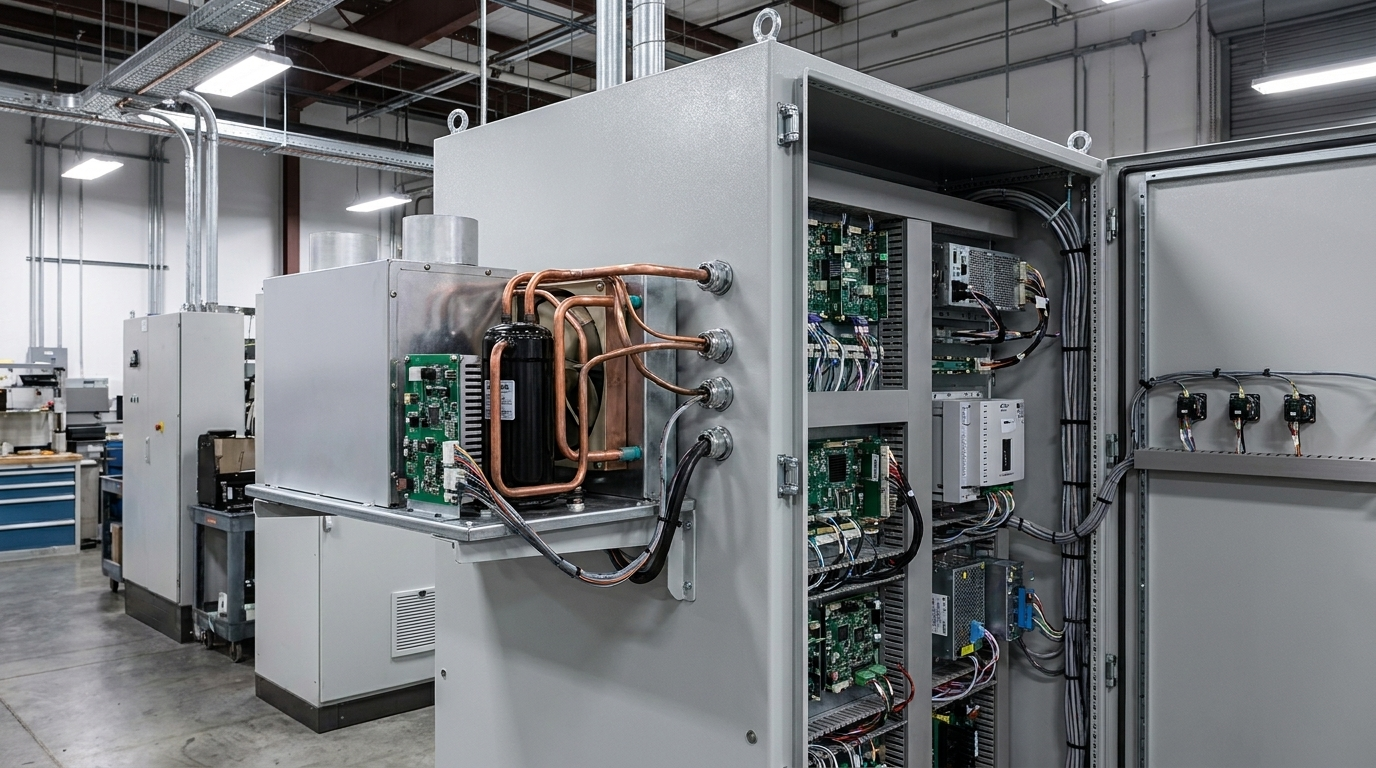
A micro AC unit solves this by operating as a split system within the enclosure boundary. The evaporator side circulates air inside the sealed space, absorbing heat. The condenser side rejects that heat to the outside ambient air. The enclosure seal is maintained — the only penetrations are the refrigerant lines and power cable, both of which can be sealed with standard grommets.
This is the same principle as a through-wall air conditioner, but at a fraction of the size. The smallest units require a mounting cutout smaller than a standard electrical panel knockout. For enclosures that cannot accept any wall penetration, top-mount configurations place the entire unit on the enclosure roof with internal ducting.
Real Applications Where Size Is the Constraint
The reason engineers search for the smallest AC unit is rarely about preference — it is about physical constraints that eliminate larger alternatives.
Telecom base stations deploy outdoor cabinets on rooftops, poles, and roadside locations. Space is limited by zoning regulations and structural load limits. A 5 kg cooling module that maintains cabinet temperature below 40°C on a 50°C day keeps the radios running without requiring a larger, heavier enclosure.
EV charging stations pack power electronics into weather-sealed cabinets. During fast charging, internal temperatures can spike rapidly. A 700W micro AC unit mounted on the cabinet wall prevents thermal throttling of the charging electronics — maintaining full charging speed even in summer heat.
Autonomous vehicle sensor pods house LiDAR, cameras, and processing units in compact, sealed housings. These pods are mounted on vehicle roofs where space and weight directly affect vehicle dynamics. A sub-5 kg cooling module is often the only option that fits the weight budget.
Medical diagnostic equipment in field settings — mobile labs, disaster response units, remote clinics — needs temperature-controlled environments for reagents and instruments. Battery-powered micro AC units provide that control without requiring grid power or a generator.
Vibration, Humidity, and Harsh Environments
Equipment cooling often happens in environments that would destroy a consumer air conditioner within weeks. Construction sites, marine vessels, mining operations, and roadside telecom installations expose cooling equipment to vibration, dust, salt spray, and temperature extremes.
Micro DC aircon modules designed for industrial use address these conditions at the component level. Brazed heat exchangers resist vibration-induced leaks better than mechanical fittings. Conformal-coated control boards tolerate humidity and condensation. Compressor mounting systems absorb shock loads from vehicle movement or equipment vibration.
This durability is not visible in a spec sheet comparison, but it determines whether the smallest AC unit still works after six months in a real installation. For engineers specifying cooling for harsh environments, requesting vibration and environmental test data from the manufacturer is a standard part of the evaluation process.
What the Smallest AC Unit Cannot Do
Honest engineering means stating boundaries. Micro DC aircon modules in the 450–900W range are not replacements for every cooling need:
- They are not designed for human comfort cooling in large spaces. A 900W unit can maintain temperature in a sealed enclosure or a very small cabin, but it will not cool a standard room.
- They do not replace industrial chillers for process cooling that requires liquid circulation at precise temperatures.
- Deep-freeze applications below -10°C are outside the operating envelope. These units maintain enclosure temperatures in the 5°C to 30°C range.
Knowing what a product does well and where it stops is how engineers avoid costly misapplications. These modules excel in confined-space, DC-powered, weight-sensitive cooling. Outside that envelope, other solutions are more appropriate.
Choosing the Right Unit for Your Application
The selection process for equipment cooling follows a clear sequence:
- Calculate heat load — sum all internal heat sources plus ambient heat gain through enclosure walls
- Match voltage — confirm the available DC bus voltage (12V, 24V, or 48V) and select the corresponding unit
- Verify physical fit — check unit dimensions against available mounting space and enclosure cutout requirements
- Confirm ambient range — ensure the unit’s rated performance covers your worst-case ambient temperature
- Select refrigerant — R134a for standard applications, R290 where lower GWP is required or preferred
For applications where the heat load falls between standard unit capacities, sizing up is the safer choice. Running a larger unit at partial load is more efficient and quieter than running a smaller unit at maximum capacity continuously.
If your application involves a sealed enclosure, a DC power source, and a heat load under 900W, the smallest AC unit built for equipment cooling is likely the right starting point. Custom configurations — including modified refrigerant circuits, specialized mounting brackets, and application-specific control logic — are available for projects that fall outside standard product parameters. Explore the full Micro DC Aircon product line to match specifications to your specific thermal challenge.