
The Smallest AC Unit That Actually Cools — What to Look for in 2026
When you search for the smallest AC unit, most results show you portable air conditioners that weigh 25 kg and stand knee-high. Those are not small. They are just smaller than window units. If you need to cool a genuinely small space — a boat cabin, a camper sleeping area, a shed, a server closet, an off-grid cabin, or any enclosed space under 150 square feet — you need something fundamentally different from a scaled-down room air conditioner.
This guide covers the truly smallest AC units available in 2026: micro DC air conditioners that weigh under 5 kg, run on 12V or 24V battery power, and deliver real vapor-compression cooling. Not fans. Not evaporative coolers. Not Peltier devices that move 50 watts and call it air conditioning. Actual compressor-based cooling systems small enough to hold in one hand.
Why Most “Small” Air Conditioners Are Not Small Enough
The air conditioning industry defines “small” relative to commercial HVAC. A 5,000 BTU window unit is considered small. It weighs 15-20 kg, requires a 120V outlet, and needs a window or wall opening for exhaust. A portable AC unit rated at 8,000 BTU weighs 25-30 kg and takes up a square foot of floor space, plus an exhaust hose that must vent outside.
For many real-world applications, these are not viable options:
- Boats and marine cabins: No window installation possible. Weight matters. Must run on 12V/24V battery power.
- Truck cabs and vehicle sleeping areas: Cannot idle the engine all night. Need DC power operation.
- Off-grid cabins: No grid power. Must run from solar panels and batteries.
- Equipment enclosures: Need cooling inside a sealed box, not a room.
- Camping tents and popup shelters: Temporary setup, no infrastructure.
- Pet enclosures: Safe cooling for kennels and crates during transport or hot weather.
These applications need the actual smallest AC unit — something that delivers real cooling in a package measured in pounds, not tens of kilograms.
Micro DC Air Conditioners: The Real Smallest AC Units
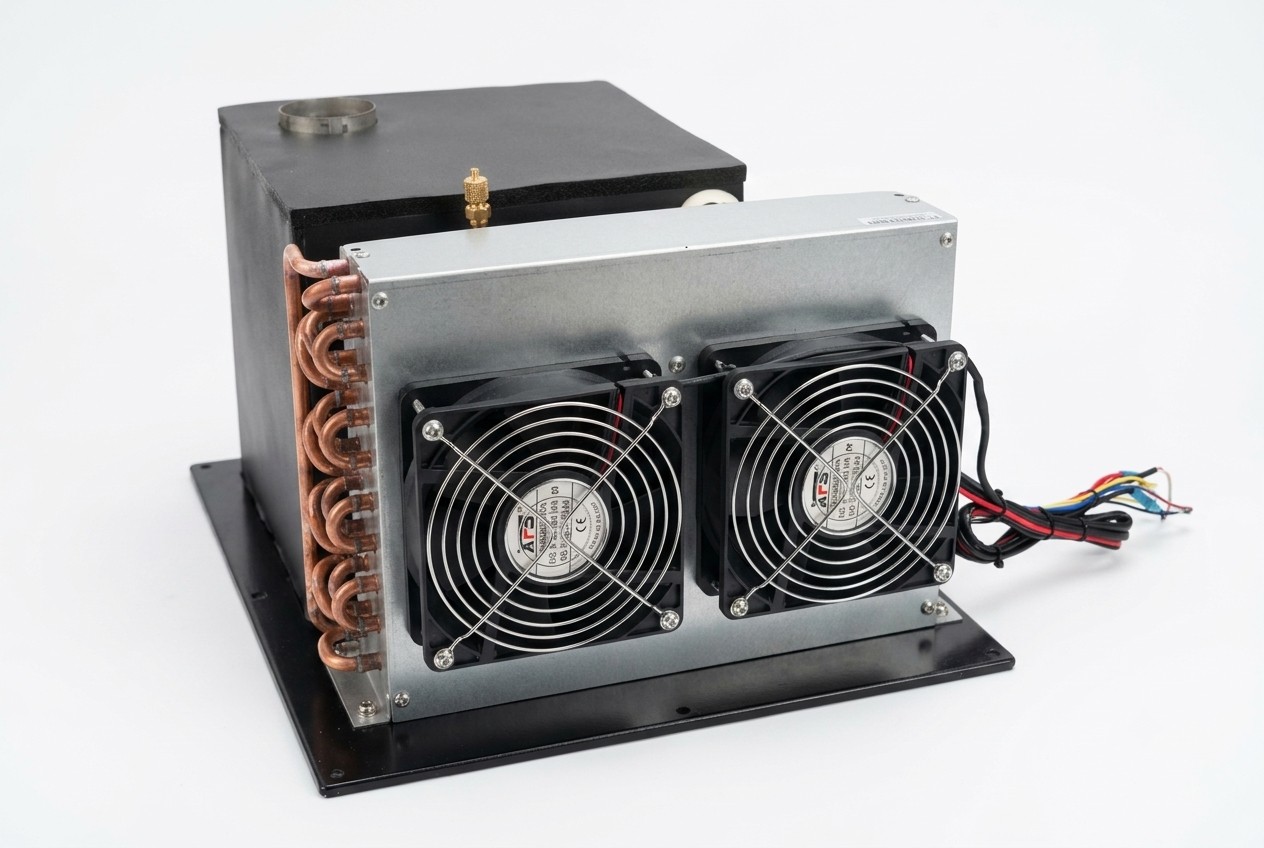
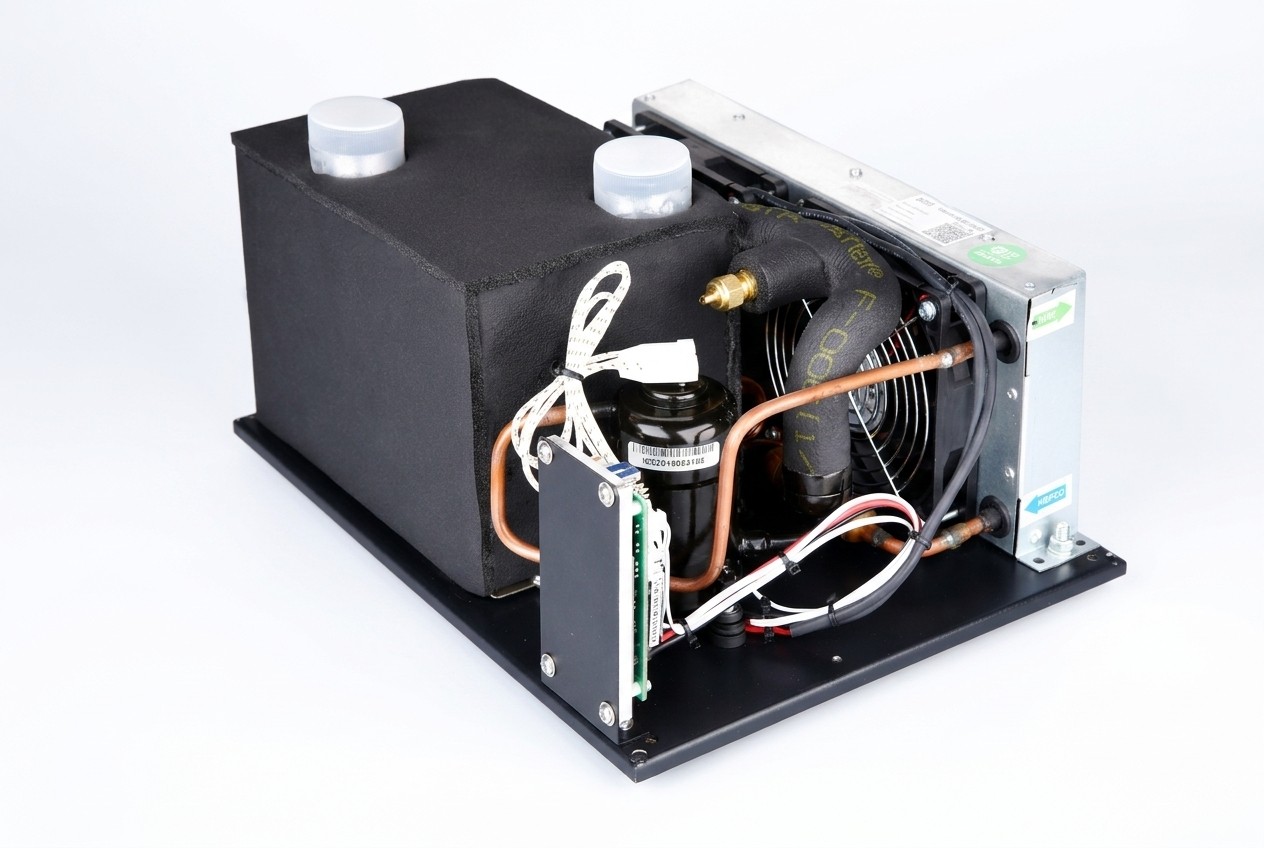
Micro DC air conditioners use the same vapor-compression refrigeration technology as your home AC, but miniaturized using BLDC (brushless DC) compressors. They circulate refrigerant through a compressor, condenser, expansion device, and evaporator — the same thermodynamic cycle that has cooled buildings for a century — but in a package that weighs 5 kg (about 11 pounds) and runs on DC battery power.
The RIGID Micro DC Aircon line represents the current state of the art in this category, with models ranging from 450W to 900W of cooling capacity:
Entry Level: DV1910E-AC / DV1920E-AC / DV1930E-AC — 450W (1,535 BTU)
The absolute smallest. Runs on 12V, 24V, or 48V DC. Delivers 450 watts of genuine cooling — enough to maintain a comfortable temperature in spaces up to approximately 60-80 square feet with moderate insulation. Ideal for individual sleeping areas, small equipment enclosures, pet crates, and single-person cooling applications.
Mid-Range: DV3220E-AC — 550W (1,876 BTU)
A step up in cooling capacity for spaces that need a bit more. Runs on 24V DC. Suitable for slightly larger cabins, better-insulated boat compartments, and applications where 450W is not quite enough but 700W is overkill.
High Performance: DV2820E-AC — 700W (2,387 BTU)
The sweet spot for most users. 700 watts of cooling capacity handles spaces up to 100-120 square feet with moderate insulation. Runs on 24V DC. Also available as the DV2820E-AC-T with R290 (propane) refrigerant for applications requiring lower global warming potential.
Maximum Capacity: DV3820E-AC / DV3830E-AC — 900W (3,069 BTU)
The most powerful micro DC air conditioner available. 900 watts handles spaces up to 150 square feet. Available in 24V and 48V configurations. When you need the most cooling a micro unit can deliver, this is the top of the range.
How to Size the Smallest AC Unit for Your Space
Cooling capacity needed depends on several factors beyond just room size:
Space Volume and Insulation
A well-insulated 100 sq ft cabin might need only 500W of cooling. The same space with thin walls and a metal roof in direct sun might need 900W+. Insulation quality is the single biggest variable in cooling load. If your space has poor insulation — thin walls, single-pane windows, metal construction — size up significantly.
Heat Sources Inside the Space
People generate 75-100W of heat each. Electronics add their power consumption as heat. Cooking generates substantial heat. A space with two people and a laptop has 250-350W of internal heat generation that the AC must overcome in addition to heat gain through the walls.
Climate and Sun Exposure
Direct sun on a metal roof can add 200-500W of heat gain to a small space. Ambient temperature matters — cooling from 35°C down to 25°C is harder than cooling from 30°C to 25°C. In hot climates (regular 35°C+), size up by 30-50% over what you would need in moderate climates.
Practical Sizing Guide
| Space Type | Size | Recommended Capacity |
|---|---|---|
| Single sleeping area (well insulated) | 30-50 sq ft | 450W (DV1910E) |
| Boat cabin / van sleeping area | 50-80 sq ft | 550-700W (DV3220E / DV2820E) |
| Small office / shed (insulated) | 80-120 sq ft | 700W (DV2820E) |
| Larger cabin / RV living area | 100-150 sq ft | 900W (DV3820E) |
| Pet transport crate | Under 20 sq ft | 450W (DV1910E) |
| Equipment enclosure | Varies | Match to heat load |
Battery Runtime: How Long Will It Run?
The most common question about battery-powered AC: how long does the battery last? The answer depends on the battery size, the AC model, and how hard the unit is working.
Micro DC air conditioners with variable-speed BLDC compressors adjust their power consumption based on cooling demand. During initial cooldown, power draw is at maximum. Once the space reaches the target temperature, the compressor slows down and power consumption drops significantly — often to 30-50% of maximum.
Runtime Estimates (24V System)
| Battery | DV1910E (450W) | DV2820E (700W) | DV3820E (900W) |
|---|---|---|---|
| 50Ah LiFePO4 | 5-8 hours | 3-5 hours | 2-4 hours |
| 100Ah LiFePO4 | 10-16 hours | 6-10 hours | 5-8 hours |
| 200Ah LiFePO4 | 20+ hours | 12-20 hours | 10-16 hours |
These ranges reflect real-world variation. The lower number is continuous high-demand operation (hot day, poor insulation, initial cooldown). The higher number is overnight maintenance mode (cool evening, well-insulated space, temperature already at setpoint). Most users experience runtime closer to the higher end once the space is initially cooled down.
Installation Options
Split Configuration
The Micro DC Aircon ships as a split system — an indoor evaporator unit and an outdoor condenser unit connected by refrigerant lines. This is the most efficient and quietest configuration because the noisy condenser (with its fan) stays outside the living space. The indoor unit delivers cool air quietly. Pre-charged refrigerant lines make installation straightforward without specialized tools.
Self-Contained Configuration
For applications where split installation is not practical — equipment enclosures, portable deployments, temporary setups — the entire system can be configured as a self-contained unit. All components fit in a compact assembly. The tradeoff is that condenser noise is inside the space, and the condenser needs fresh air for heat rejection.
Micro DC Aircon vs Other “Small” Cooling Options
vs Portable Evaporative Coolers (Swamp Coolers)
Evaporative coolers blow air over a wet surface. They work in dry climates (below 40% humidity) and add moisture to the air. In humid climates, they are nearly useless. They cannot cool below the wet-bulb temperature. They do not dehumidify. For sealed spaces like boats, vehicles, and enclosures, they are not effective because they need dry incoming air and an exhaust for humid outgoing air. A micro DC air conditioner works in any humidity and any sealed space.
vs Thermoelectric (Peltier) Coolers
Peltier coolers use semiconductor junctions to move heat. They are silent and have no moving parts, but their cooling capacity is severely limited — typically 20-80W for a unit the size of a small appliance. COP is 0.3-0.7, meaning they use 1.5-3x more electricity than a compressor for the same cooling. For any space larger than a cup holder, Peltier cooling is inadequate. A 450W micro DC air conditioner delivers 6-20x more cooling than a comparable-sized Peltier device.
vs Mini Split Air Conditioners
The smallest conventional mini splits are rated at 5,000-6,000 BTU (1,500-1,800W cooling). They are far more powerful than micro DC units, but they require 120/220V AC power, professional installation, wall penetration for line sets, and weigh 15-25 kg per unit. If you have grid power and permanent installation, a mini split may be the better choice. If you need DC power, portability, or a truly compact system, the micro DC aircon wins.
Power System Setup
Running a micro DC air conditioner requires a DC power source. The most common setups:
Battery Bank
LiFePO4 (lithium iron phosphate) batteries are the preferred choice: light weight, deep discharge capability, long cycle life, and stable voltage output. A 24V 100Ah LiFePO4 bank provides 2.4 kWh of usable energy — enough for 6-16 hours of micro AC operation depending on the model and conditions.
Solar + Battery
For extended off-grid use, solar panels recharge the battery during the day while the AC runs. A 200-400W solar array paired with a 100Ah LiFePO4 battery provides indefinite cooling in most climates — the solar input roughly matches the AC’s average consumption, with the battery bridging cloudy periods and nighttime.
Vehicle Electrical System
Direct connection to a vehicle’s 12V or 24V system works when the engine is running (alternator provides power). For overnight use without engine, an auxiliary battery with a battery isolator prevents draining the starting battery. Many van lifers and boat owners use this configuration with a dedicated house battery bank.
Real User Applications
Sailboat Cabin Cooling
A 32-foot sailboat with a sleeping cabin of roughly 70 square feet. Traditional marine AC requires shore power or a generator. A DV2820E-AC on a 24V 200Ah LiFePO4 bank provides all-night cooling at anchor with solar recharging during the day. Total system weight: under 30 kg including batteries. Quiet enough to sleep through.
Off-Grid Hunting Cabin
A 10×12-foot insulated cabin with 400W of solar panels and a 24V 100Ah battery. A DV3820E-AC provides comfortable cooling during summer afternoons and evenings. The solar panels fully recharge the battery each day, making the system self-sustaining without grid power or generator.
Pet Transport Safety
A large dog crate in a vehicle during summer. Interior temperatures in parked vehicles can exceed 60°C. A DV1910E-AC powered by the vehicle’s 12V system maintains safe temperatures inside the crate indefinitely while the vehicle is running, and for several hours on an auxiliary battery when parked. This is a genuine safety application — not comfort, but survival.
What to Check Before You Buy
- Verify cooling capacity in watts or BTU. Ignore marketing terms like “personal cooling zone” or “chill factor.” Only vapor-compression BTU/watt ratings represent actual cooling capacity. If the listing does not specify watts or BTU, it probably is not a real air conditioner.
- Check the power source requirement. 12V, 24V, or 48V? Match to your available battery system. 24V is the most common for the Micro DC Aircon line and provides the best balance of current draw and component availability.
- Understand the refrigerant. R134a is standard and widely available for servicing. R290 (propane) is more environmentally friendly but has specific safety requirements for indoor use. Both work well; choose based on your application’s regulatory and safety context.
- Measure your space and estimate insulation quality. A 450W unit in a poorly insulated metal shed will struggle. The same unit in a well-insulated van sleeping area will keep you comfortable all night. Honest assessment of your space prevents disappointment.
- Plan your power system. The AC unit is only as good as the battery powering it. Budget for adequate battery capacity — at minimum, enough for your longest expected runtime between charges.
Bottom Line
The smallest AC units that actually cool are micro DC air conditioners — compressor-based systems weighing around 5 kg, running on 12V/24V/48V battery power, and delivering 450-900W of genuine cooling capacity. They are not toys, fans, or marketing gimmicks. They use the same refrigeration technology as your home AC, miniaturized for spaces and power systems where conventional air conditioners cannot go. Size yours based on your space, insulation, and climate conditions. Pair it with an adequately sized LiFePO4 battery, and you have real air conditioning anywhere — no grid power, no window, no generator required.