
What Qualifies as the Smallest Air Conditioner — and What Doesn’t
Search for the “smallest air conditioner” and you’ll find three very different categories of products lumped together: vapor-compression units with real compressors, Peltier (thermoelectric) devices, and evaporative coolers. They all claim to cool. They all come in small packages. But they work on fundamentally different principles, and the differences matter enormously when you need actual temperature reduction in an enclosed space.
This article breaks down all three technologies — how they work, what they can realistically deliver, and where each one falls short. If you’re trying to cool a vehicle cab, a small enclosure, a boat cabin, or any tight space where heat is a real problem, understanding these differences will save you money and frustration.
Let’s be clear about terminology first. A true air conditioner uses a refrigeration cycle to move heat from inside a space to outside it. The air inside gets cooler; the heat goes somewhere else. Evaporative coolers and Peltier devices do something different, and calling them “air conditioners” is, at best, generous marketing.
How Vapor Compression Works — The Real Refrigeration Cycle
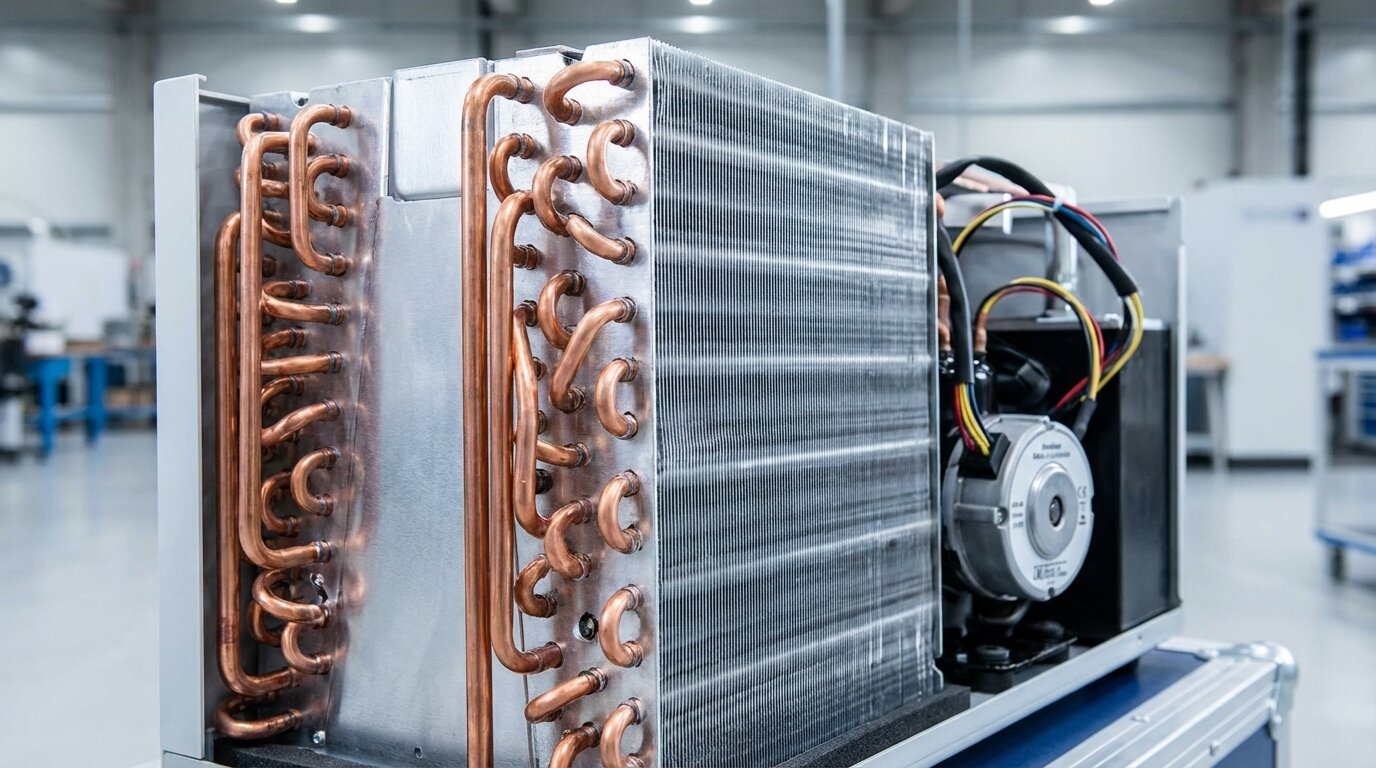
Every full-size air conditioner you’ve ever used — window units, split systems, car AC — runs on vapor compression. A compressor pressurizes refrigerant gas, which then flows through a condenser where it releases heat and becomes liquid. That liquid passes through an expansion valve, drops in pressure, and evaporates in the evaporator coil, absorbing heat from the surrounding air. The now-cool air is blown into your space. The cycle repeats.
This is thermodynamically efficient because the phase change (liquid to gas) absorbs a large amount of energy. The coefficient of performance (COP) of a well-designed vapor compression system typically ranges from 2.0 to 4.0 or higher — meaning for every watt of electrical energy input, you get 2 to 4 watts of cooling output.
The challenge has always been size. Traditional compressors are heavy, require AC power, and need substantial condenser and evaporator assemblies. That’s why, until recently, the smallest true air conditioners were still bulky window or portable units weighing 15–30 kg or more.
But miniaturization has changed the equation. BLDC (brushless DC) compressor technology has made it possible to build complete vapor compression systems that weigh approximately 5 kg (11 lbs) and run directly on 12V or 24V DC power — no inverter required. These aren’t toy coolers. They deliver real cooling capacities ranging from 450W (1,535 BTU) up to 760W (2,592 BTU), depending on the model.
How Peltier (Thermoelectric) Coolers Work
Peltier coolers use the thermoelectric effect: when electric current flows through a junction of two different semiconductor materials, one side gets cold and the other gets hot. Stack enough of these junctions together and you get a solid-state “heat pump” with no moving parts except fans.
On paper, this sounds ideal for small cooling applications. No compressor, no refrigerant, no mechanical complexity. Peltier modules are thin, light, and silent. They’re widely used in small consumer products marketed as “personal air conditioners” or “desktop coolers.”
The problem is efficiency. Peltier devices have a COP well below 1.0 in most real-world applications — often around 0.3 to 0.5. That means for every watt of electricity consumed, you get less than half a watt of cooling. Worse, the hot side of the Peltier module generates substantial waste heat that must be dissipated. In an enclosed space, this waste heat can actually raise the ambient temperature, making the net cooling effect negligible or even negative.
Peltier coolers also struggle with temperature differential. Their cooling capacity drops sharply as the difference between the hot and cold sides increases. In a hot environment — exactly when you need cooling most — a Peltier device delivers the least.
For context, a vapor-compression micro DC aircon is approximately 3–5 times more efficient than a Peltier device of comparable size. That efficiency gap translates directly into battery life, solar panel requirements, and actual cooling performance.
How Evaporative Coolers Work — and Why They’re Not Air Conditioners
Evaporative coolers (sometimes called “swamp coolers”) blow air across a wet pad or wick. As water evaporates, it absorbs heat from the air, lowering the air temperature. Simple, cheap, and energy-efficient in the right conditions.
The critical limitation: evaporative cooling only works well in dry climates. The process adds moisture to the air. In humid environments (above approximately 50–60% relative humidity, as a starting estimate), the air is already saturated and can’t absorb much more water. The cooling effect drops to nearly zero, and you’re left with a fan blowing damp air.
Evaporative coolers also cannot cool below the wet-bulb temperature of the ambient air. In a desert at 40°C and 15% humidity, an evaporative cooler might bring air down to 24–26°C — genuinely useful. In a coastal city at 32°C and 75% humidity, the same cooler might drop the temperature by 1–2°C at best, while making the space feel muggier.
Crucially, evaporative coolers don’t remove heat from a space. They convert sensible heat (temperature) into latent heat (humidity). In an enclosed space, humidity builds up rapidly, and the cooling effect diminishes over time. They work best with open windows or ventilation — the opposite of how an air conditioner operates.
Many products sold as the “smallest air conditioner” are actually evaporative coolers with misleading marketing. If it has a water tank and no compressor, it’s not an air conditioner.
Side-by-Side: Three Technologies Compared
Here’s how the three technologies stack up across the metrics that matter most for small-space cooling:
Cooling Capacity
Vapor compression: 450W to 760W (1,535–2,592 BTU) in units weighing approximately 5 kg. Real, measurable cooling that can maintain a set temperature in an enclosed space.
Peltier: Typically 20–100W of actual cooling in consumer-grade devices. Enough to cool a beverage or a very small sealed chamber, but not a vehicle cab or enclosure.
Evaporative: Variable and climate-dependent. Can feel effective in dry heat with good airflow, but provides zero net cooling in enclosed or humid spaces.
Efficiency (COP)
Vapor compression: COP of approximately 2.0–4.0 (varies with conditions and design).
Peltier: COP of approximately 0.3–0.5 in typical applications.
Evaporative: High fan efficiency, but “cooling” efficiency depends entirely on ambient humidity. Not directly comparable.
Works in Enclosed Spaces?
Vapor compression: Yes — designed for it. Removes heat from the space and rejects it outside.
Peltier: Partially. The hot side must be outside the cooled space, or net cooling is zero. Most consumer Peltier “ACs” don’t separate hot and cold sides properly.
Evaporative: No. Requires ventilation. In a sealed space, humidity rises and cooling stops.
Works in Humid Climates?
Vapor compression: Yes. Also dehumidifies the air as a byproduct of the cooling process.
Peltier: Poorly. Performance degrades in heat, and no dehumidification.
Evaporative: No. Effectiveness drops sharply above approximately 50–60% relative humidity (starting estimate).
Power Source Compatibility
Vapor compression (DC micro aircon): Runs on 12V, 24V, or 48V DC. Compatible with batteries, solar panels, and vehicle electrical systems. No inverter needed with BLDC compressor designs.
Peltier: Runs on DC, low voltage. But high power draw relative to cooling output means batteries drain fast.
Evaporative: Low power (just a fan and pump). But limited usefulness offsets the power advantage.
When Each Technology Makes Sense
Vapor Compression Micro DC Aircon Is Right When:
- You need to cool an enclosed space (vehicle cab, equipment enclosure, small cabin, medical pod)
- The environment is humid, hot, or both
- You need a specific temperature maintained (the 5°C–30°C range is achievable with micro DC units)
- You’re running on DC power — batteries, solar, or vehicle electrical
- Weight and size are constrained but you still need real cooling
- You need dehumidification along with cooling
Peltier Might Work When:
- You’re cooling a very small, well-insulated chamber (like a beverage cooler or a laser housing)
- The required temperature differential is small (less than 10–15°C below ambient)
- Silence and zero vibration are more important than efficiency
- The application is intermittent, not continuous
Evaporative Cooling Works When:
- You’re in a dry climate (below approximately 40% relative humidity, as a starting estimate)
- The space is open or well-ventilated
- You need to cool people (personal comfort), not a space
- Water supply is available and manageable
What Micro DC Aircon Is NOT Suitable For
Honesty matters more than a sale. Vapor compression micro DC aircon units in the 450W–760W range are not a replacement for full-size HVAC systems. Here’s where they don’t fit:
- Large rooms or buildings: A 760W (2,592 BTU) unit is designed for small enclosed spaces — think vehicle cabs, small server closets, medical equipment enclosures, or boat cabins. It won’t meaningfully cool a 30 m² living room.
- Spaces with massive heat loads: If your enclosure has kilowatts of heat-generating equipment, a micro unit can’t keep up. Size the cooling to the heat load.
- Extreme cold environments: These units cool. They don’t heat. The operating range is 5°C–30°C for cooling output.
- Applications requiring redundancy or precise control: For mission-critical cooling (medical devices, certain industrial processes), you may need redundant systems or units with tighter control loops than a standalone micro aircon provides.
The RIGID Micro DC Aircon Lineup
RIGID’s Micro DC Aircon line spans the range of small-space cooling needs. All models use BLDC brushless DC compressors, run directly on DC power without an inverter, and weigh approximately 5 kg (11 lbs). They come pre-charged with refrigerant.
The lineup is split into two series:
Micro A/C Units (450W–550W):
- DV1910E-AC — 12V DC, 450W (1,535 BTU), R134a
- DV1920E-AC — 24V DC, 450W (1,535 BTU), R134a
- DV1930E-AC — 12V DC, 450W (1,535 BTU), R134a
- DV3220E-AC — 24V DC, 550W (1,876 BTU), R134a
Power A/C Units (650W–760W):
- DV3820E-AC — 24V DC, 650W (2,216 BTU), R134a
- DV3820E-AC-T — 12V~24V DC, 700W (2,387 BTU), R134a
- DV3830E-AC — 48V DC, 650W (2,216 BTU), R134a
- DV3830E-AC-T — 48V DC, 760W (2,592 BTU), R290
The R290 option on the DV3830E-AC-T offers a lower global warming potential refrigerant for applications where that matters. Note that R290 regulations vary by region and application — check local requirements.
All models are compatible with battery and solar power systems, making them practical for off-grid, mobile, and remote applications where AC mains power isn’t available.
You can explore the full Micro DC Aircon product range, including detailed specifications and application guidance, on the RIGID Micro DC Aircon product page.
How to Choose: A Practical Decision Framework
If you’re still deciding which technology fits your application, work through these questions:
- Is the space enclosed? If yes, evaporative cooling is out. You need vapor compression or (for very small chambers) Peltier.
- Is the environment humid? If yes, or if humidity varies seasonally, evaporative cooling is unreliable. Vapor compression handles humidity well and dehumidifies as a bonus.
- How much cooling do you actually need? Estimate the heat load. As a rough starting estimate, a well-insulated vehicle cab in direct sun might need 300–700W of cooling, depending on size, insulation, and ambient temperature. Equipment enclosures depend on the heat output of the electronics inside.
- What’s your power source? If you’re on DC power (batteries, solar, vehicle alternator), a DC-native compressor system avoids the losses and complexity of an inverter. If you have unlimited AC mains power, a conventional mini-split might be more appropriate.
- What’s your weight and size budget? At approximately 5 kg for a complete vapor compression system delivering up to 760W of cooling, micro DC aircon units are in a class that Peltier can’t match on a cooling-per-kilogram basis, and evaporative coolers can’t match on enclosed-space performance.
The Bottom Line: Real Cooling Requires Real Thermodynamics
The smallest air conditioner that actually works as an air conditioner uses vapor compression. That’s not marketing — it’s physics. The refrigeration cycle is the only proven method for removing heat from an enclosed space efficiently and reliably across all climate conditions.
Peltier devices have their niche in very small, low-differential applications. Evaporative coolers work in dry, ventilated environments. But neither one is an air conditioner in any meaningful sense, and neither can deliver the sustained, controllable cooling that a compressor-based system provides.
The engineering achievement of the past decade has been shrinking vapor compression down to the 5 kg range while maintaining real cooling capacity. That’s what makes micro DC aircon units genuinely new — not a repackaged fan or a Peltier chip with a marketing budget, but a complete refrigeration system small enough and efficient enough to run on a battery.
If you need the smallest air conditioner that actually cools, start with the physics. The rest follows.