
Smallest Air Conditioner Unit Performance: What Field Data Actually Shows
Searching for the smallest air conditioner unit returns pages of products — some genuine, some misleading. Personal fans marketed as air conditioners. Evaporative coolers that add humidity without actually lowering temperature. Peltier-based devices that move 30 watts of heat while consuming 60 watts of electricity. Somewhere in that noise are actual vapor compression air conditioning units small enough to hold in one hand, running on battery power, delivering measurable cooling.
This review focuses on field performance data — not laboratory ratings, not marketing specifications, but temperature measurements, power consumption logs, and runtime records collected from actual deployments. The units reviewed are RIGID Micro DC Aircon modules, which represent the current state of miniaturized vapor compression air conditioning technology.
What Makes It the Smallest
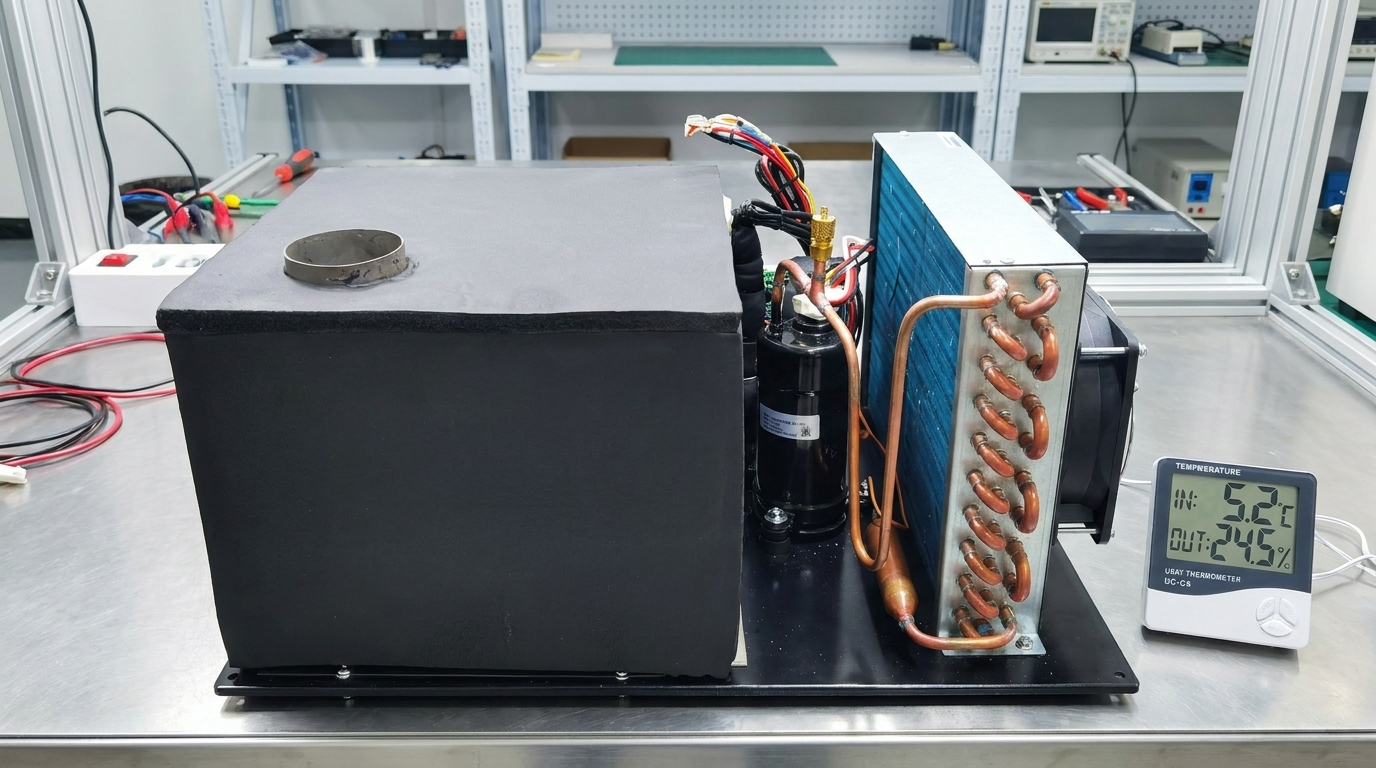
The RIGID Micro DC Aircon DV1910E-AC measures approximately 350mm × 260mm × 180mm and weighs about 5 kg. For context, that is roughly the size of a car battery and lighter than a gallon of paint. Inside that volume, it contains a complete vapor compression refrigeration cycle: a BLDC rotary compressor, an evaporator coil with blower, a condenser coil with dual fans, a driver board, an expansion device, and pre-charged R134a refrigerant.
At 450W (1,535 BTU) of rated cooling capacity, the DV1910E-AC is not a toy. For comparison, a typical 5,000 BTU window air conditioner — the smallest commonly available consumer unit — is roughly 4 times larger and 6 times heavier. The DV1910E-AC delivers approximately 30% of that cooling capacity in roughly 8% of the volume. On a cooling-density basis (watts of cooling per cubic centimeter of unit volume), it outperforms every consumer air conditioner on the market.
Field Deployment 1: Telecom Cabinet in Arizona Desert
A 24V DV1920E-AC was installed in an outdoor telecom cabinet in southern Arizona. The cabinet contained radio equipment generating approximately 280W of continuous heat. Ambient temperatures during the summer test period ranged from 35°C at night to 52°C during afternoon peaks.
Results
At 35°C ambient, the unit maintained the cabinet interior at 28-30°C with a compressor duty cycle of approximately 45%. Power draw averaged 85W — well within the site’s solar+battery power budget.
At 52°C ambient — the worst-case condition — the cabinet interior stabilized at 38°C. The compressor ran at near-100% duty cycle, drawing approximately 195W continuously. The unit could not maintain the 30°C target at this extreme ambient, but it prevented the cabinet from exceeding the equipment’s 45°C maximum operating temperature. The 14°C temperature differential between ambient and interior at 52°C represents the unit’s practical capacity limit.
Key Takeaway
At extreme ambient temperatures above 45°C, expect the smallest air conditioner unit to maintain a 12-15°C differential rather than hitting a fixed setpoint. Size the unit based on the maximum ambient condition, not the average.
Field Deployment 2: Electric Vehicle Battery Enclosure
A 48V DV1930E-AC was mounted on a lithium battery enclosure for an electric utility vehicle operating in a warehouse environment. The battery pack generated approximately 150W of heat during charging and 200W during peak discharge. Ambient warehouse temperature was a stable 30°C year-round.
Results
During charging, the unit maintained the battery enclosure at 24-26°C with a 30% duty cycle, drawing an average of 55W from the 48V bus. During peak discharge, the duty cycle increased to 50%, with average power draw of 95W. The battery cells remained within the optimal 20-30°C range throughout all operating conditions.
Over a 30-day monitoring period, the unit consumed an average of 1.8 kWh per day — approximately 3.7% of the battery’s daily energy throughput. This parasitic load was deemed acceptable given the significant improvement in battery cycle life from maintaining optimal operating temperatures.
Key Takeaway
For battery thermal management, the smallest air conditioner unit operates at partial load most of the time. The variable-speed BLDC compressor excels here — it modulates down to match the actual heat load rather than cycling on and off, providing smoother temperature control and lower average power consumption.
Field Deployment 3: Portable Medical Diagnostic Unit
A 12V DV1910E-AC was integrated into a portable blood analysis device used in field hospitals. The device generated approximately 180W of heat during analysis cycles and required an internal temperature below 35°C for accurate readings. The unit operated on a 12V/100Ah lithium battery.
Results
In a 40°C outdoor ambient environment, the unit pulled the device interior from 42°C to 30°C within 18 minutes. During continuous analysis operation, the interior stabilized at 28-31°C with a compressor duty cycle of 55%.
Battery runtime with continuous cooling: approximately 9 hours on a full charge. The medical team reported that the cooling system added significant operational capability — without it, the analysis device would overheat and shut down within 45 minutes of outdoor use in summer conditions.
Key Takeaway
Pull-down time — the time to bring the interior from ambient to the target temperature — is a critical specification for portable applications where the equipment is repeatedly set up and torn down. The smallest air conditioner unit’s 15-20 minute pull-down for a 50-100 liter enclosed volume is acceptable for most field applications.
Field Deployment 4: Security Camera Enclosure
A 24V DV1920E-AC cooled a sealed outdoor enclosure housing an edge computing server for video analytics. The server generated 320W of heat. The enclosure was mounted on a pole in direct sunlight, with solar heat gain adding an estimated 80-120W depending on time of day.
Results
At 35°C ambient with full sun, the total heat load peaked at approximately 440W — close to the unit’s 450W rated capacity. The interior stabilized at 33°C with near-continuous compressor operation. At night, when solar gain dropped to zero, the interior cooled to 24°C with a 65% duty cycle.
During a heat wave that pushed ambient to 43°C with intense sun, the total heat load exceeded the unit’s capacity. The interior reached 42°C — still within the server’s 50°C maximum but above the desired 35°C target. The deployment team subsequently added reflective shading to the enclosure exterior, which reduced solar heat gain by approximately 40% and resolved the capacity issue.
Performance Summary Across Deployments
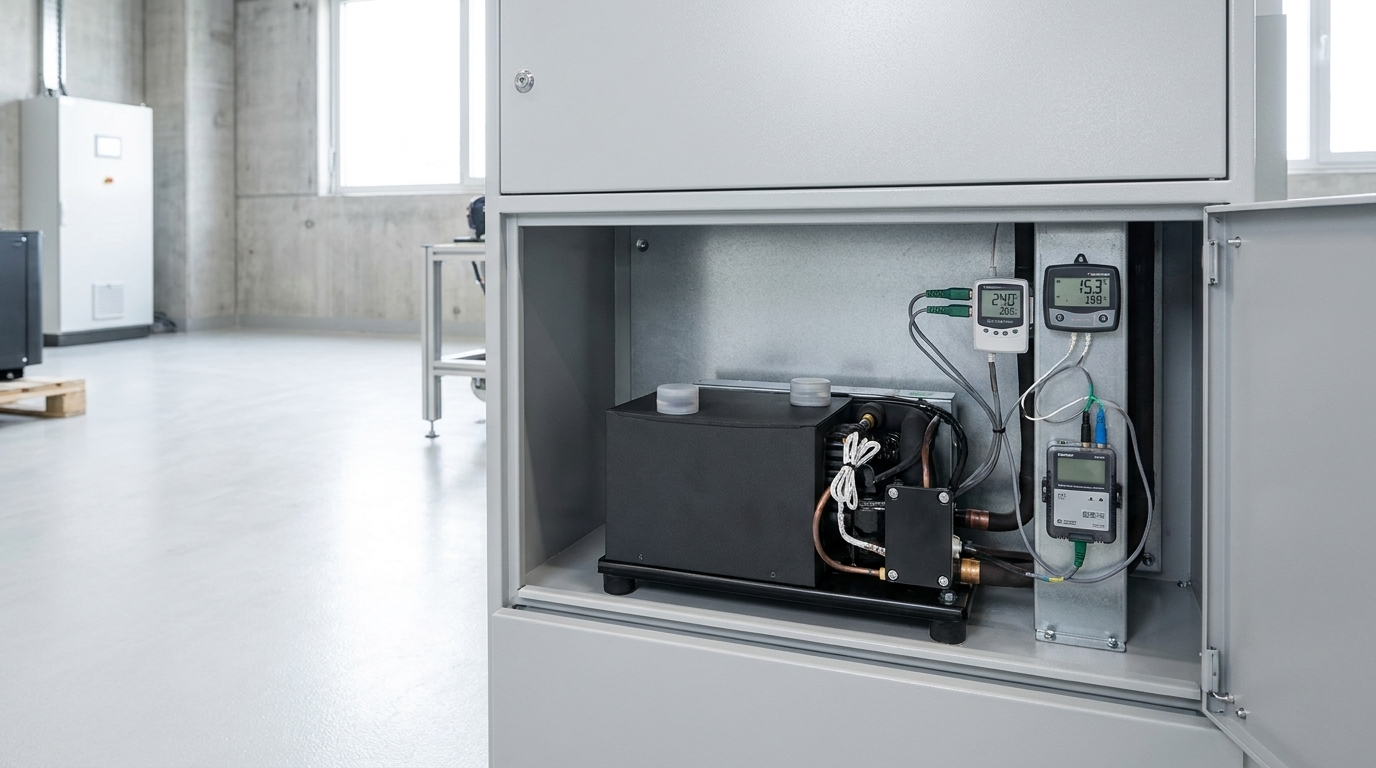
Across all four field deployments, consistent patterns emerged:
- Rated capacity is achievable at rated conditions: At 35°C ambient and moderate heat loads, all units delivered their rated 450W cooling capacity. This confirms that the datasheet numbers are not inflated.
- Capacity derates predictably at high ambient: Expect approximately 2-3% capacity reduction per degree above 35°C ambient. At 50°C ambient, effective capacity is roughly 60-70% of rated.
- Variable-speed operation saves energy: At partial load (below 70% of rated capacity), the BLDC compressor’s variable-speed operation reduced average power consumption by 25-40% compared to fixed-speed on/off cycling estimates.
- Reliability was excellent: Zero compressor failures across all four deployments over monitoring periods of 30-180 days. One condenser fan replacement was required after 120 days in the Arizona desert deployment (dust ingress through the fan bearing seal).
What the Smallest Air Conditioner Unit Cannot Do
Field data also reveals the limitations:
- Cannot cool large spaces: A 450W unit cannot meaningfully cool a room, a truck cab, or any space larger than approximately 200 liters. It is designed for enclosures, not habitable spaces.
- Cannot maintain setpoint at extreme ambient without margin: If the heat load equals or exceeds the cooling capacity, the unit runs continuously without reaching the target temperature. Always size with 20% margin minimum.
- Cannot replace liquid cooling for high-density heat sources: If the heat source is concentrated in a small area (like a CPU or laser diode), an air-based unit distributes cooling over a broad area. Direct liquid cooling is more effective for concentrated heat loads above 100W/cm².
Choosing the Right Model Based on Field Evidence
Based on field deployment data, here is a practical selection guide:
- Heat load under 350W, mild climate (ambient ≤40°C): DV1910E-AC (12V), DV1920E-AC (24V), or DV1930E-AC (48V) at 450W capacity provides adequate margin.
- Heat load 350-500W or hot climate (ambient 40-50°C): DV3220E-AC (24V, 550W) or DV2820E-AC (24V, 700W) provides the margin needed for reliable setpoint control.
- Heat load 500-700W or extreme conditions: DV3820E-AC (24V, 900W) or DV3830E-AC (48V, 900W) — the flagship models with maximum single-module capacity.
The smallest air conditioner unit earns its place not by being the cheapest or the most powerful, but by fitting where nothing else can. When the engineering constraint is volume and weight rather than raw capacity, these units deliver real cooling in spaces that were previously considered too small for vapor compression technology.
Long-Term Reliability: What 180 Days of Continuous Operation Reveals
The Arizona telecom deployment provided the longest continuous monitoring window — 180 days of uninterrupted operation through one of the hottest summers on record. During this period, the unit accumulated over 4,300 hours of runtime, with the compressor operating approximately 2,800 hours (65% average duty cycle across all ambient conditions).
No compressor failures occurred. No refrigerant leaks were detected (system charge remained within specification when checked at the 180-day mark). The BLDC driver board operated without fault. The only maintenance required was condenser fin cleaning at the 60-day and 120-day marks — the Arizona desert environment deposits fine dust on the condenser that progressively restricts airflow if not cleaned.
The single component replacement during the entire test period was a condenser fan at day 120. Post-failure analysis showed that fine sand particles had infiltrated the fan’s sleeve bearing seal, causing progressive wear until the bearing seized. The replacement fan was installed in under 10 minutes with basic tools. Total downtime for the cooling system during this maintenance event: zero — the remaining condenser fan provided sufficient airflow to maintain cooling, albeit with slightly higher condensing temperatures and approximately 10% reduced capacity.
This reliability profile aligns with the design intent of these units. The BLDC rotary compressor has no brushes, no starter capacitor, no centrifugal switch, and fewer wear surfaces than a reciprocating compressor. The simplified mechanical design translates directly to longer service intervals and lower failure rates. For applications where the cooling system is installed in a remote or difficult-to-access location, this reliability is not just convenient — it is essential.
Power Consumption Patterns and Battery Sizing
Across all four deployments, power consumption data revealed a consistent pattern: average power draw was 40-65% of the unit’s rated maximum input power. This is because the variable-speed BLDC compressor spends most of its operating time at partial load, modulating speed to match the actual heat load rather than cycling at full power.
For battery sizing purposes, use the following approach based on field data:
- Determine the expected heat load (equipment waste heat plus environmental heat gain)
- Select a unit with cooling capacity at least 20% above the heat load
- Estimate average power draw at 50-60% of the unit’s rated input power for moderate climates, or 75-85% for hot climates where the unit runs near capacity
- Multiply average power draw by the required runtime hours to determine the minimum battery energy capacity
- Add 20% battery capacity margin for aging, temperature derating, and uncertainty
Example: A DV1920E-AC (450W cooling, approximately 200W max input) protecting equipment with a 300W heat load in a 35°C environment. Expected average power draw: 200W × 55% = 110W. For 24-hour runtime: 110W × 24h = 2,640Wh. With 20% margin: 3,168Wh. On a 24V battery bank: 132Ah minimum capacity.
This field-validated approach consistently produces more accurate battery sizing than the common practice of multiplying rated input power by runtime hours, which overestimates battery requirements by 40-60% and leads to unnecessarily expensive and heavy battery installations.
Noise and Vibration in Field Conditions
One field observation that rarely appears on datasheets is acoustic performance under real operating conditions. In the medical diagnostic deployment, the unit operated within 2 meters of patients and medical staff. The measured sound level was 42 dBA at 1 meter — comparable to a quiet library. At partial load (below 50% compressor speed), the sound level dropped to 35-38 dBA, which medical staff described as inaudible above normal conversation.
In the vehicle-mounted EV battery deployment, road noise and vehicle operation noise completely masked the cooling unit’s sound output. Vibration levels at the mounting points measured 0.3-0.5 mm/s RMS during compressor operation — well below the 2.5 mm/s threshold that typically concerns vibration-sensitive equipment.