
The Smallest Air Conditioner: What Does “Smallest” Really Mean?
When people search for the smallest air conditioner, they usually picture a compact window unit or a slim portable tower. But the word “smallest” means something radically different depending on the problem you are trying to solve. A studio apartment owner wants a unit that fits a tight window frame. A van-lifer wants something that runs on a 12V battery and fits behind the driver seat. An engineer designing a drone ground station or a sealed electronics enclosure needs a cooling module no bigger than a shoebox — and it still has to deliver genuine refrigeration, not just blow warm air around.
Size matters in air conditioning because every cubic centimeter of space consumed by the cooling system is space that cannot be used for payload, cargo, living area, or equipment. In a full-size building, that trade-off is invisible. In a camper van, a camping tent, a pet transport crate, or an outdoor telecom cabinet, it becomes the deciding factor. If the cooling system is too large, the project simply does not work.
This article explores the engineering behind truly compact air conditioning — the physics that limit how small a conventional AC can get, the micro compressor technology that shatters those limits, and the real-world applications where ultra-small size is not a luxury but a requirement.
Why Traditional Air Conditioners Cannot Shrink Below a Certain Size
A conventional air conditioner, whether a window unit, a split system, or a portable floor model, relies on a vapor compression refrigeration cycle. Liquid refrigerant absorbs heat as it evaporates inside an evaporator coil, a compressor raises the pressure and temperature of the resulting gas, and a condenser rejects that heat to the outside. A metering device — usually a capillary tube or expansion valve — drops the pressure, and the cycle repeats.
Every component in that cycle imposes a minimum size. The compressor, by far the largest single part, uses a piston or scroll mechanism driven by an AC induction motor. These motors need iron stator cores, copper windings, and a crankshaft assembly that cannot physically be miniaturized below a certain volume while still producing enough torque to compress refrigerant. A typical residential reciprocating compressor weighs 9 to 12 pounds and occupies roughly 400 to 600 cubic inches.
The heat exchangers — condenser and evaporator — are the second constraint. To transfer enough thermal energy, they need surface area. Fins, tubes, and the fans that push air across them all add volume. A conventional portable AC unit ends up measuring 28 to 34 inches tall, 14 to 18 inches wide, and weighing 50 to 70 pounds. Even so-called “mini” portable ACs on the consumer market still weigh 30 pounds and stand over two feet tall.
There is a physics floor here. Below a certain compressor displacement, a reciprocating piston simply cannot move enough refrigerant mass per cycle to produce meaningful cooling. Below a certain heat exchanger area, the temperature differential between the refrigerant and the air becomes too small, and the system’s coefficient of performance (COP) drops to the point where it wastes more energy as heat than it removes from the space.
For decades, this floor sat at roughly 5,000 BTU — the smallest rating you would find in any consumer AC. That meant approximately 1,500 watts of cooling capacity, a 40-pound package, and a mandatory 120V AC outlet. For anyone who needed cooling in a truly small or off-grid scenario, this was simply too large, too heavy, and too power-hungry.
Micro Compressor Technology: Breaking the Size Barrier
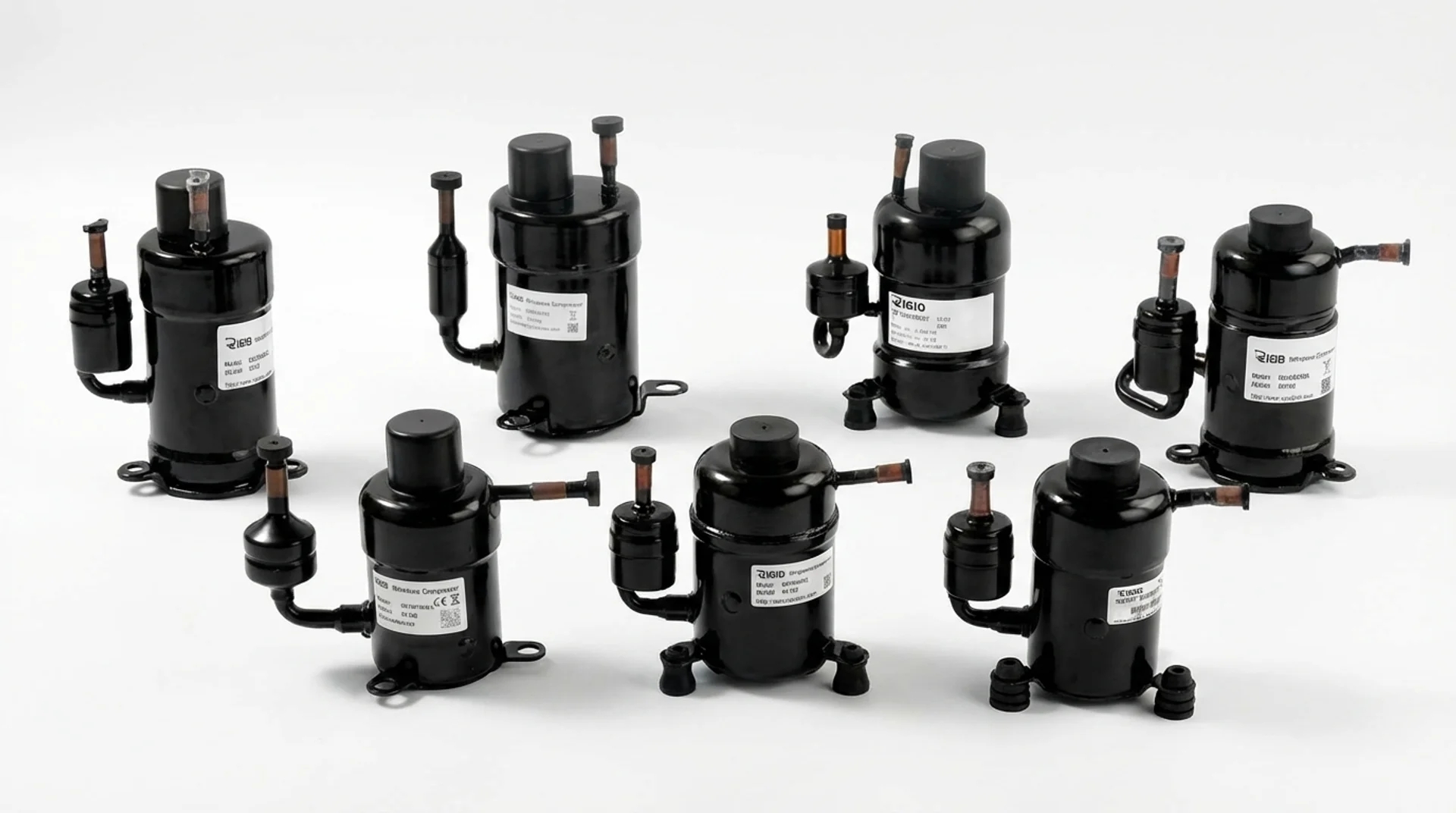
The breakthrough that made a genuinely tiny air conditioner possible was the miniature brushless DC (BLDC) rotary compressor. Unlike a reciprocating piston compressor, a rotary compressor uses a rolling piston inside a cylindrical chamber. This design eliminates the crankshaft, connecting rod, and multiple valves that make reciprocating compressors bulky. A BLDC motor replaces the heavy AC induction motor, cutting weight further and enabling direct DC power input.
The result is dramatic. A modern micro DC compressor measures just 56.5 × 78 mm — roughly the size of an adult’s closed fist — and weighs only 720 grams (1.6 pounds). Compare that to a conventional reciprocating DC compressor of equivalent cooling capacity, which typically weighs 9.5 pounds and occupies several times the volume. The miniature compressor delivers approximately 30 percent higher cooling capacity at roughly one-sixth the weight.
When engineers measure cooling power density — how much cooling you get per unit of volume or weight — the numbers are striking. The micro rotary compressor produces 17 times the cooling power per unit volume and 10.5 times the cooling power per unit weight compared to a traditional reciprocating compressor. These are not incremental improvements. They represent a fundamental shift in what is physically possible.
The variable-speed drive board is equally important. It controls the compressor’s rotational speed between 1,800 and 6,500 RPM, allowing the system to modulate cooling output precisely. At low speed, the compressor sips power and runs near-silently. At full speed, it delivers maximum capacity. This inverter-driven approach achieves a coefficient of performance (COP) greater than 3.5 W/W, meaning the system removes more than 3.5 watts of heat for every watt of electrical power it consumes.
Noise is another area where micro compressors excel. Operating below 40 dB — quieter than a library — they are suitable for noise-sensitive environments like medical devices, laboratory instruments, and sleeping quarters in camper vans.
What a Complete Micro Air Conditioner System Looks Like
A miniature compressor alone is not an air conditioner. It is the heart of a vapor compression system that also needs a condenser, an evaporator, a blower, fans, a filter drier, and pre-charged refrigerant (typically R134a). The engineering challenge is to make all of these components proportionally small while maintaining sufficient heat exchange surface area.
 A fully assembled portable DC air conditioning unit built around a micro compressor can measure as small as 350 × 260 × 180 mm (13.8 × 10.2 × 7.1 inches) and weigh just 5 kilograms (11 pounds). That is roughly the size of a large lunchbox. For applications that need more capacity, a larger portable configuration at 565 × 255 × 245 mm (22.2 × 10.0 × 9.6 inches) and 11 kilograms (24 pounds) delivers up to 700 watts (2,387 BTU) of cooling — enough to meaningfully cool a small enclosed space like a camper van cabin, a pet transport kennel, or a sealed equipment enclosure.
These systems run on 12V, 24V, or 48V DC power, which means they connect directly to batteries, solar panels, vehicle alternators, or fuel cells without an inverter. Working current sits at approximately 16A on a 24V system at full load, making them compatible with standard automotive wiring and fusing. A digital display controller lets the user set target temperatures and monitor system status.
Critically, these units arrive with refrigerant fully charged. There is no need for a licensed HVAC technician to braze lines and evacuate the system. You connect DC power, position the condenser where it can reject heat to the outside, and the unit is operational. This plug-and-play approach makes them accessible to DIY builders, van conversion enthusiasts, and field engineers who need cooling in remote locations.
Applications Where Ultra-Compact Size Is the Deciding Factor
Once an air conditioner shrinks to lunchbox dimensions, it unlocks applications that were previously impossible or required awkward workarounds. Here are some of the most compelling use cases:
Camper vans and overlanding vehicles. A full-size rooftop RV air conditioner weighs 80 to 100 pounds, requires a generator or shore power, and adds aerodynamic drag. A micro DC unit weighing 5 to 11 kilograms mounts inside the vehicle, runs directly from the house battery bank charged by solar panels, and draws a fraction of the power. For stealth campers who cannot have a visible rooftop unit, this is the only viable option.
Camping tents and temporary shelters. No conventional AC can cool a tent without overwhelming it physically and electrically. A micro DC unit running on a portable lithium battery provides genuine refrigeration for hot-weather camping without requiring a generator.
Pet transport and animal enclosures. Transporting pets in hot climates requires temperature-controlled environments. A micro air conditioner can be integrated into a pet transport crate or kennel, keeping the animal safe during transit. The small size ensures the cooling system does not consume valuable cargo space.
Drone ground stations and unmanned systems. Autonomous drone docking stations need to keep electronics cool in desert or tropical environments. These stations are designed to be as compact as possible for field deployment. A micro AC unit provides the thermal management that passive cooling cannot achieve when ambient temperatures exceed 40°C (104°F).
Sealed electronics and telecom cabinets. Outdoor telecom equipment, edge computing nodes, and industrial controllers generate heat inside sealed enclosures that cannot be opened for ventilation (to keep out dust, moisture, and insects). A micro DC air conditioner fits inside or mounts on the side of these cabinets, maintaining the internal temperature within the equipment’s operating range.
Laser systems and precision instruments. Laser diodes and optical systems require stable temperatures for beam quality and longevity. A compact cooling module can be integrated directly into the laser enclosure, dissipating heat without the bulk of a traditional chiller.
EV battery thermal management. Electric vehicle battery packs need active cooling to maintain optimal operating temperatures and prevent thermal runaway. Micro DC compressor systems can be embedded within battery enclosures where space is measured in millimeters.
True Compressor Cooling vs. Evaporative Coolers and TEC Systems
The market is flooded with products labeled “mini air conditioner” or “portable air conditioner” that are not air conditioners at all. Understanding the distinction is critical before making a purchasing or engineering decision.
Evaporative coolers (swamp coolers) blow air across a wet pad or wick. As water evaporates, it absorbs heat from the air, lowering the dry-bulb temperature. This works reasonably well in hot, dry climates with relative humidity below 30 percent. But evaporative coolers add moisture to the air — they raise humidity. In humid climates (which describes most of the world during summer), they provide almost no perceptible cooling and can make conditions worse. They cannot cool below the wet-bulb temperature of the ambient air. They cannot dehumidify. They are fans with water, not air conditioners.
An evaporative cooler cannot maintain a specific target temperature. It cannot cool a sealed enclosure. It cannot protect electronics or batteries from overheating. It is physically incapable of removing heat from a closed system because it requires a constant supply of outside air and water.
Thermoelectric coolers (TEC / Peltier devices) use the Peltier effect to pump heat from one side of a semiconductor junction to the other when direct current flows through it. They have no moving parts, no refrigerant, and can be made very thin. This makes them appealing for certain niche applications like cooling small electronics enclosures or beverage coolers.
However, TEC systems have a fundamental efficiency problem. Their COP (coefficient of performance) is typically 0.3 to 0.6 at common temperature differentials — meaning they consume 2 to 3 watts of electrical power for every watt of heat they move. Compare that to a micro compressor system with a COP above 3.5, which moves 3.5 watts of heat for every watt consumed. The compressor-based system is roughly 6 to 12 times more energy-efficient than a TEC.
At cooling loads above 100 watts, TEC systems become impractical. They generate so much waste heat on the hot side that they need large heat sinks and fans, negating their size advantage. Their maximum practical cooling capacity tops out around 50 to 80 watts for a reasonably sized module, and even at that level, they draw significant power.
Compressor-based vapor compression is the only technology that can deliver true air conditioning at meaningful capacities in a compact package. It actively removes heat from the cooled space and rejects it elsewhere. It can dehumidify air as a natural byproduct of the evaporator coil dropping below the dew point. It can maintain precise temperature setpoints. And with micro compressor technology, it can do all of this in a package weighing 5 kilograms.
How to Choose the Right Micro Air Conditioner for Your Application
Selecting the right system depends on several key factors. Getting these right ensures your cooling solution performs as expected without over-drawing power or under-cooling the space.
Cooling capacity (watts or BTU). Calculate the heat load of your space or enclosure. For occupied spaces like van cabins, consider body heat (roughly 100W per person), solar heat gain through walls and windows, and ambient temperature differential. For equipment enclosures, sum the wattage of all electronics inside plus solar gain if the enclosure is outdoors. Micro DC systems range from 100W to 700W (up to 2,387 BTU), with twin-cylinder models reaching 900W for higher-demand applications.
Voltage and power source. Micro DC air conditioners are available in 12V, 24V, and 48V configurations. Match the voltage to your existing battery bank or vehicle electrical system. A 24V system offers a good balance — lower current draw than 12V (for the same wattage) and more commonly available batteries than 48V. Dual-voltage options (12V and 24V) provide flexibility for systems that may be used in different vehicles.
Physical dimensions and mounting. Measure your available space precisely. The smallest micro DC units at 350 × 260 × 180 mm can fit in spaces that would be impossible for any conventional AC. Remember that the condenser needs access to outside air — it rejects heat, and that heat must go somewhere. Plan for condenser placement where airflow is adequate and where the rejected heat will not recirculate back into the cooled space.
Ambient temperature range. Standard micro compressors operate reliably up to 52°C (126°F) ambient temperature, thanks to tropical-rated designs. If your application involves desert environments, engine compartments, or other extreme heat conditions, verify that the system is rated for your worst-case ambient temperature.
Noise requirements. At less than 40 dB, micro compressor systems are among the quietest cooling solutions available. But if your application is particularly noise-sensitive — such as a recording studio, a patient care environment, or a sleeping area — consider variable-speed models that can run at lower RPM during periods of reduced cooling demand, further reducing noise.
Cooling vs. heating. Some micro DC units offer both cooling and heating modes. The heating function typically uses a PTC (positive temperature coefficient) heater element integrated into the air handler, providing 300 to 400 watts of heating capacity in addition to the compressor’s cooling function. For applications in climates with both hot summers and cold winters — like camper vans used year-round — a dual-function unit eliminates the need for a separate heater.
Conclusion: When the Smallest Possible Size Is Non-Negotiable
For most people, “small air conditioner” means a compact consumer appliance that fits a studio apartment. But for engineers, DIY builders, and professionals working with constrained spaces, the definition is far more demanding. They need genuine vapor compression refrigeration — not a fan, not an evaporative cooler, not a Peltier device — in a package that fits inside a backpack.
Micro DC compressor technology makes this possible. A compressor the size of a fist, weighing 720 grams, driving a complete air conditioning system that delivers up to 700 watts of cooling capacity at a COP above 3.5 — all running on 12V, 24V, or 48V DC power without an inverter, without an HVAC technician, and without a connection to the power grid.
Whether you are building out a camper van, designing a sealed electronics enclosure, engineering a drone docking station, or simply need cold air in a place where no conventional AC can fit, the RIGID portable DC air conditioner represents the current state of the art in ultra-compact, compressor-based cooling. It is, by any measurable dimension, the smallest true air conditioner available.