
What Counts as the Smallest Air Conditioning Unit?
Search for the smallest air conditioning unit and you will find hundreds of products claiming the title. Desktop fans with ice trays. USB-powered gadgets that blow moist air. Peltier-based boxes that barely drop the temperature by a few degrees. The word “air conditioner” gets attached to almost anything that moves cool air, but real air conditioning has a specific engineering definition — and most of these products do not meet it.
An air conditioner, by definition, removes heat from a space and transfers it elsewhere. This requires a refrigeration cycle: a compressor, a condenser, an evaporator, and a refrigerant. The compressor does work to move heat against the natural gradient — from a cooler space to a warmer environment. Without this cycle, you are not conditioning air. You are circulating it, evaporating water into it, or at best moving a tiny amount of heat through a thermoelectric junction.
Understanding this distinction matters because it directly affects what you can expect from the device. An evaporative cooler adds humidity and only works in dry climates. A Peltier cooler moves perhaps 20–40W of heat — enough to cool a cup of coffee, not a tent. A true vapor-compression air conditioner with a BLDC compressor moves 450W or more of heat and can drop the temperature in a sealed space by 5–8°C or more below ambient.
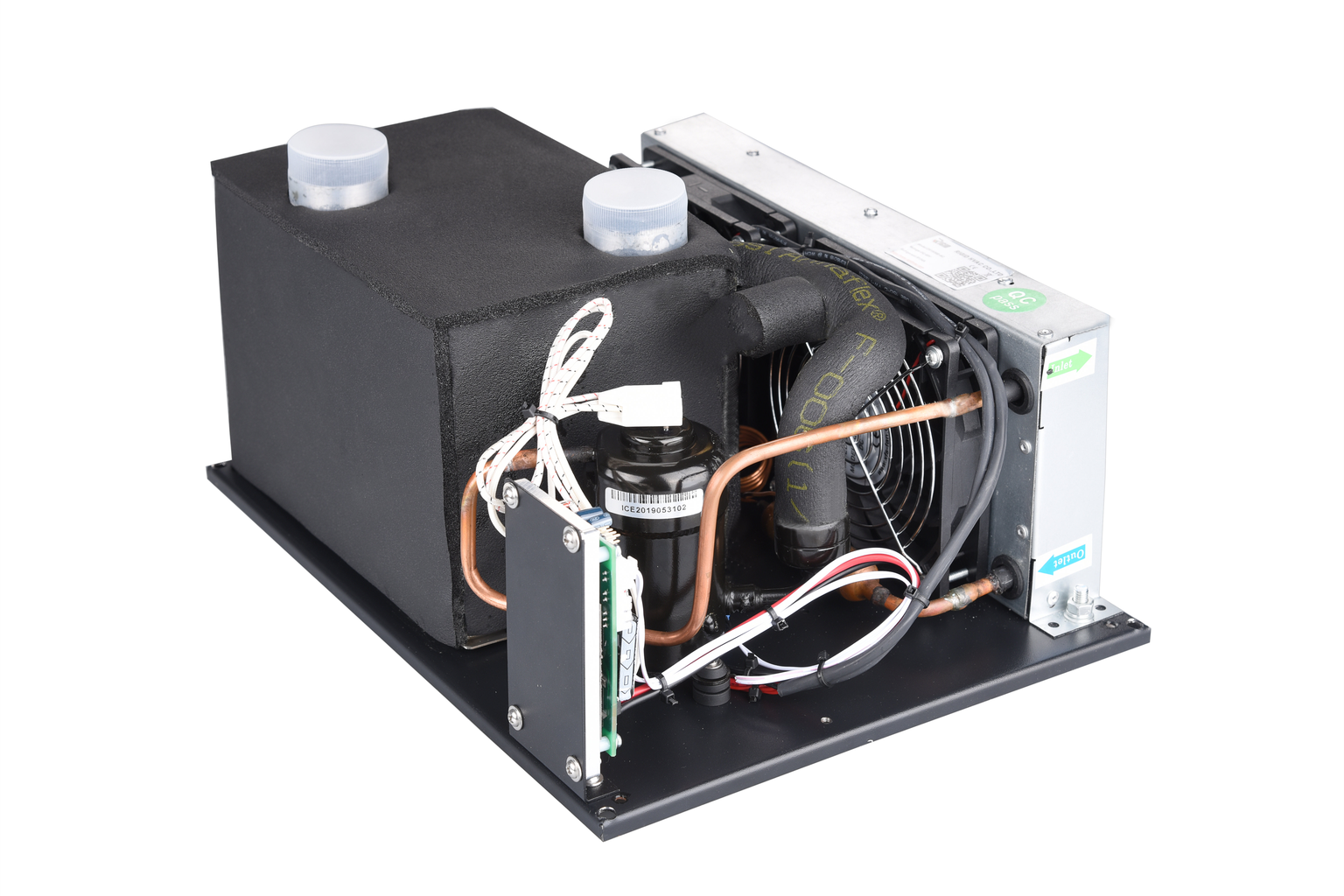
Three Technologies Compared: Vapor Compression, Peltier, and Evaporative
Vapor compression is the technology inside every household air conditioner, refrigerator, and vehicle AC system. A compressor pressurizes refrigerant gas, the condenser releases heat outside, and the evaporator absorbs heat inside. The efficiency advantage is enormous: a well-designed vapor-compression system delivers 2–4 watts of cooling for every watt of electrical input. This is expressed as the coefficient of performance (COP).
Peltier (thermoelectric) cooling uses the Peltier effect — passing current through a junction of two different semiconductors to create a temperature difference. The advantages are zero moving parts and tiny form factor. The disadvantages are severe: COP typically falls between 0.3 and 0.7, meaning the device consumes more electricity than the heat it moves. At higher temperature differences, efficiency drops further. A Peltier module rated at 60W of electrical input might deliver only 20–30W of actual cooling. For personal comfort in any real-world space, this is inadequate.
Evaporative cooling blows air across a wet surface. As water evaporates, it absorbs heat from the air, lowering the air temperature. This works well in arid environments (below 30% relative humidity) but fails completely in humid conditions — the air cannot absorb more moisture, so no evaporation occurs and no cooling happens. Evaporative coolers also add moisture to the space, which is problematic in enclosed environments like tents, vehicles, or equipment enclosures.
How Small Can a Real Air Conditioner Get?
The limiting factor for air conditioner size is the compressor. Traditional AC compressors are large, heavy, and designed for AC mains power. But advances in BLDC (brushless DC) compressor technology have dramatically reduced the minimum viable size of a true vapor-compression system.
Modern miniature BLDC compressors weigh under 2 kg and can be packaged into complete air conditioning units weighing around 5 kg (11 pounds). That is small enough to carry by hand, mount inside a vehicle, or integrate into portable equipment. The key innovation is the BLDC motor itself — it runs directly on DC power without needing an inverter, which eliminates a bulky and inefficient conversion stage.
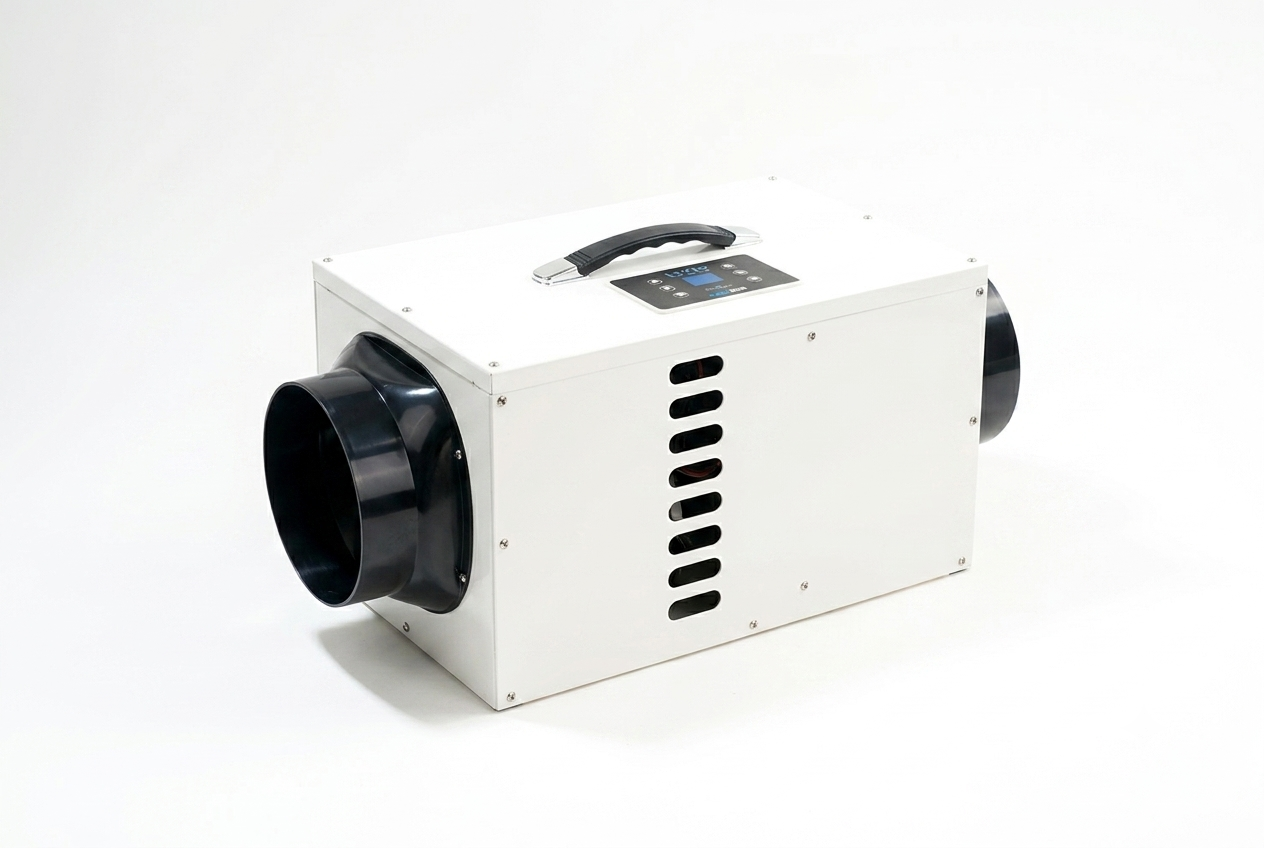
The RIGID Micro DC Aircon line represents the current state of the art in miniature air conditioning. The DV1910E-AC runs on 12V DC, delivers 450W (1,535 BTU/h) of cooling capacity, and weighs approximately 5 kg. For context, 450W of cooling capacity can lower the temperature inside a well-insulated 2-person tent by 5–8°C below ambient — a meaningful difference between uncomfortable and comfortable on a hot night.
The product line scales up from there. The DV3220E-AC delivers 550W (1,876 BTU/h) on 24V, and the DV2820E-AC reaches 700W (2,387 BTU/h) on 24V for larger spaces or higher thermal loads. Even the most powerful units in the range — the DV3820E-AC at 650W (2,216 BTU/h) — maintain the compact, battery-friendly form factor.
Real-World Performance: What to Expect
Marketing claims are easy. Field performance is what matters.
A 450W (1,535 BTU/h) unit like the DV1910E-AC is designed for small, enclosed spaces. Think: a camping tent, a pet transport crate, a small equipment enclosure, or a vehicle cabin during rest stops. It will not cool a large room or replace a window AC unit — and it is not designed to. Knowing the boundaries of what these units can do is just as important as knowing what they excel at.
Battery runtime depends on your power source. On a 12V, 100Ah lithium iron phosphate (LiFePO4) battery, a 450W-class unit drawing approximately 16A at full load would run for roughly 5–6 hours. At partial load — which is where BLDC variable-speed compressors spend most of their time once the space reaches target temperature — runtime extends significantly, potentially reaching 8–10 hours. A 200Ah battery roughly doubles these figures.
Variable speed is the key advantage. Unlike fixed-speed compressors that cycle on and off (consuming high startup current each time), a BLDC compressor ramps down to the minimum speed needed to maintain temperature. This means lower average power consumption, quieter operation, and less stress on the battery.
Who Actually Needs the Smallest Air Conditioning Unit?
The smallest true AC units serve specific use cases where conventional air conditioning is impossible or impractical.
Camping and overlanding. A rooftop or portable AC that runs on the vehicle battery or a portable power station, providing real cooling inside a tent or vehicle without needing shore power.
Pet safety during transport. Keeping an animal crate at safe temperatures during travel, especially in regions where vehicle interiors can reach dangerous temperatures within minutes of parking.
Emergency and disaster preparedness. A battery-powered AC provides cooling during power outages, which can be critical for vulnerable populations during heat waves.
Enclosed equipment cooling. Protecting sensitive electronics, batteries, or instruments inside sealed enclosures where passive cooling is insufficient and conventional AC units are too large.
For industrial and OEM applications — telecom cabinets, drone docking stations, EV battery cooling — the same Micro DC Aircon platform can be integrated as a component rather than used as a standalone product.
What the Smallest AC Unit Cannot Do
Honesty builds trust. Here is what a 450W miniature air conditioner is not designed for.
It will not cool a full-sized room. A standard bedroom requires 1,500–2,500W (5,000–8,500 BTU/h) of cooling capacity, depending on insulation, sun exposure, and climate. A 450W unit delivers roughly one-fifth to one-third of that.
It will not replace a vehicle’s engine-driven AC system for continuous driving. It is designed for rest stops, sleeping, and parked operation — not highway driving with full cabin cooling.
It will not work without a power source. Unlike evaporative coolers that only need water, a compressor-based AC requires electrical power. Budget for a battery or power station if you are going off-grid.
Setting realistic expectations means you will be satisfied with the product rather than disappointed by unrealistic assumptions.
How to Choose: A Practical Framework
When evaluating the smallest air conditioning units, ask these questions.
Does it use a compressor? If not, it is not an air conditioner regardless of what the marketing says. Peltier and evaporative devices have their uses, but cooling capacity is fundamentally limited.
What is the stated cooling capacity in watts or BTU/h? Anything below 200W (680 BTU/h) will struggle to cool any space larger than a small enclosure. For personal comfort applications (tents, vehicle cabins), look for at least 400W (1,365 BTU/h).
What voltage and power source does it require? A 12V unit works directly with most vehicle batteries and portable power stations. Higher-voltage units (24V, 48V) may need specific battery configurations.
How much does it weigh? True portability means you can carry it. Under 6 kg is genuinely portable. Over 10 kg starts to require dedicated mounting.
What is the COP? Higher COP means more cooling per watt of electricity, which translates directly to longer battery runtime. Vapor-compression systems with BLDC compressors typically achieve COP values of 2.0–3.0 — meaning 2–3 watts of cooling for every watt of electrical input.
Installation Considerations for Small Spaces
The smallest air conditioning units are designed for spaces where installation options are limited. Understanding the practical requirements helps you plan a successful setup.
Airflow matters more than raw capacity. A 450W unit needs to exhaust warm air somewhere — the condenser rejects heat to the outside. In a tent, this means positioning the condenser section outside the tent wall or using a duct to direct warm exhaust air away from the cooled space. In a vehicle, the condenser typically faces the exterior through a vent or window gap. Blocking the condenser airflow reduces cooling capacity dramatically, sometimes by 50% or more.
Condensate management is another practical consideration. When an air conditioner cools air, it also removes moisture — this is the condensation that drips from any AC unit. Small units produce less condensate than full-sized systems, but in humid environments, you still need a plan for the water. Some units include a drain port for a hose. Others use a condensate tray that requires periodic emptying. In dry climates, the small amount of condensate may evaporate on the condenser before it even drips.
Noise levels deserve attention for sleeping applications. BLDC compressors are inherently quieter than conventional AC compressors because they avoid the hard start-stop cycling that produces noise spikes. Variable speed operation means the compressor runs at the lowest speed needed to maintain temperature — which is the quietest operating point. For camping use, this difference between a BLDC unit and a cycling fixed-speed unit can mean the difference between sleeping comfortably and being woken by compressor startups every 15 minutes.
Mounting orientation is flexible with modern miniature compressors. Most rotary-type BLDC compressors can operate in any orientation — horizontal, vertical, or even inverted. This gives you freedom to mount the unit where it fits best in your specific application, whether that is on a shelf in a van, hanging from a roof bracket in an equipment enclosure, or sitting on the floor of a tent.
Battery Sizing: Matching Power Supply to Runtime
For off-grid applications, the battery is just as important as the AC unit itself.
A rule of thumb starting estimate: divide your desired runtime in hours by the battery’s usable capacity to determine if the battery can support the load. For a 12V unit drawing 16A at full load, each hour requires 16Ah of battery capacity. A 100Ah LiFePO4 battery provides roughly 80Ah of usable capacity (assuming 80% depth of discharge), which gives approximately 5 hours of full-load operation.
In practice, runtime is usually longer than this calculation suggests. Once the space reaches target temperature, the variable-speed compressor reduces speed — often to 40–60% of maximum. This cuts current draw proportionally, extending battery life. Real-world users frequently report 7–10 hours of cooling from a 100Ah battery in moderate conditions.
For longer runtime, consider a 200Ah or larger battery, or supplement with solar panels. A 200W solar panel in good sun conditions can offset roughly half the power consumption of a 450W-class AC unit, effectively doubling your battery runtime during daylight hours.
RIGID Micro DC Aircon: The Smallest Real AC Units Available
The RIGID Micro DC Aircon line starts at 450W (1,535 BTU/h) with the DV1910E-AC on 12V DC, scaling up to 700W (2,387 BTU/h) with the DV2820E-AC on 24V. Every unit in the range uses a BLDC compressor with variable speed control, R134a refrigerant, and runs directly on DC power without an inverter.
At approximately 5 kg and under $600 for the entry-level model, these represent what is technically achievable when you combine miniature BLDC compressor technology with thoughtful engineering. No ice, no water, no humidity problems — just genuine vapor-compression cooling from a unit small enough to fit in a backpack.
The smallest air conditioning unit is not the one with the most creative marketing. It is the smallest device that actually moves heat using the refrigeration cycle. By that definition, miniature BLDC compressor-based AC units are the real answer — and they are smaller, lighter, and more efficient than most people expect.