
Smallest Aircon Unit Comparison: Real Refrigerant Compressor vs Everything Else
Search for the smallest aircon unit and you will find four fundamentally different technologies competing for your attention — and your money. Only one of them actually air conditions. The other three cool you in limited ways that work in some conditions and fail completely in others. Understanding which is which prevents a purchasing mistake that no amount of returns processing can undo: wasted time in a hot environment with a device that cannot deliver.
This comparison pits the RIGID Micro DC Aircon — a true vapor compression air conditioner weighing approximately 5 kg — against Peltier coolers, evaporative coolers, and personal fans that claim the same “smallest aircon unit” territory in search results and product listings.
Technology 1: Vapor Compression (Real Air Conditioning)
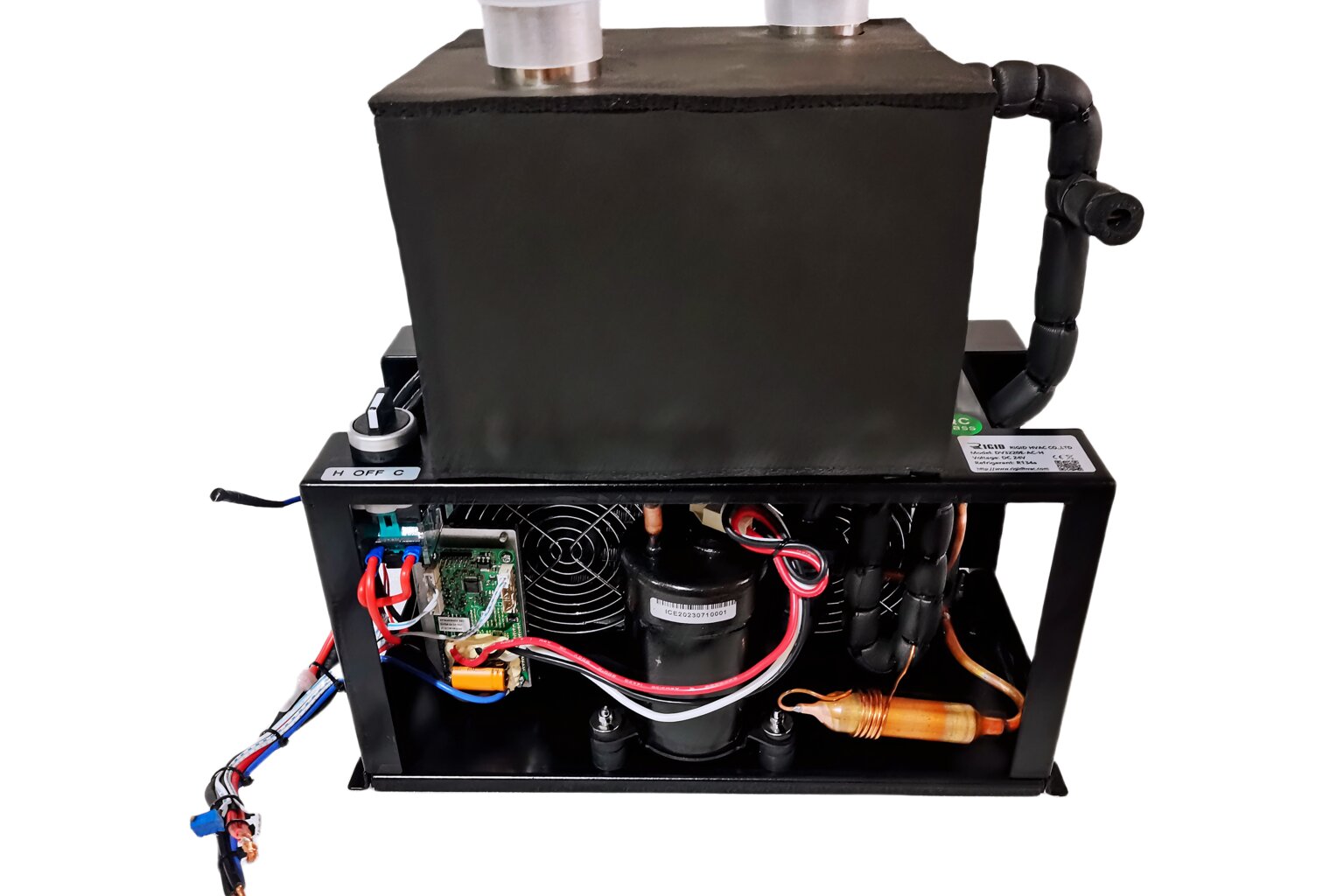
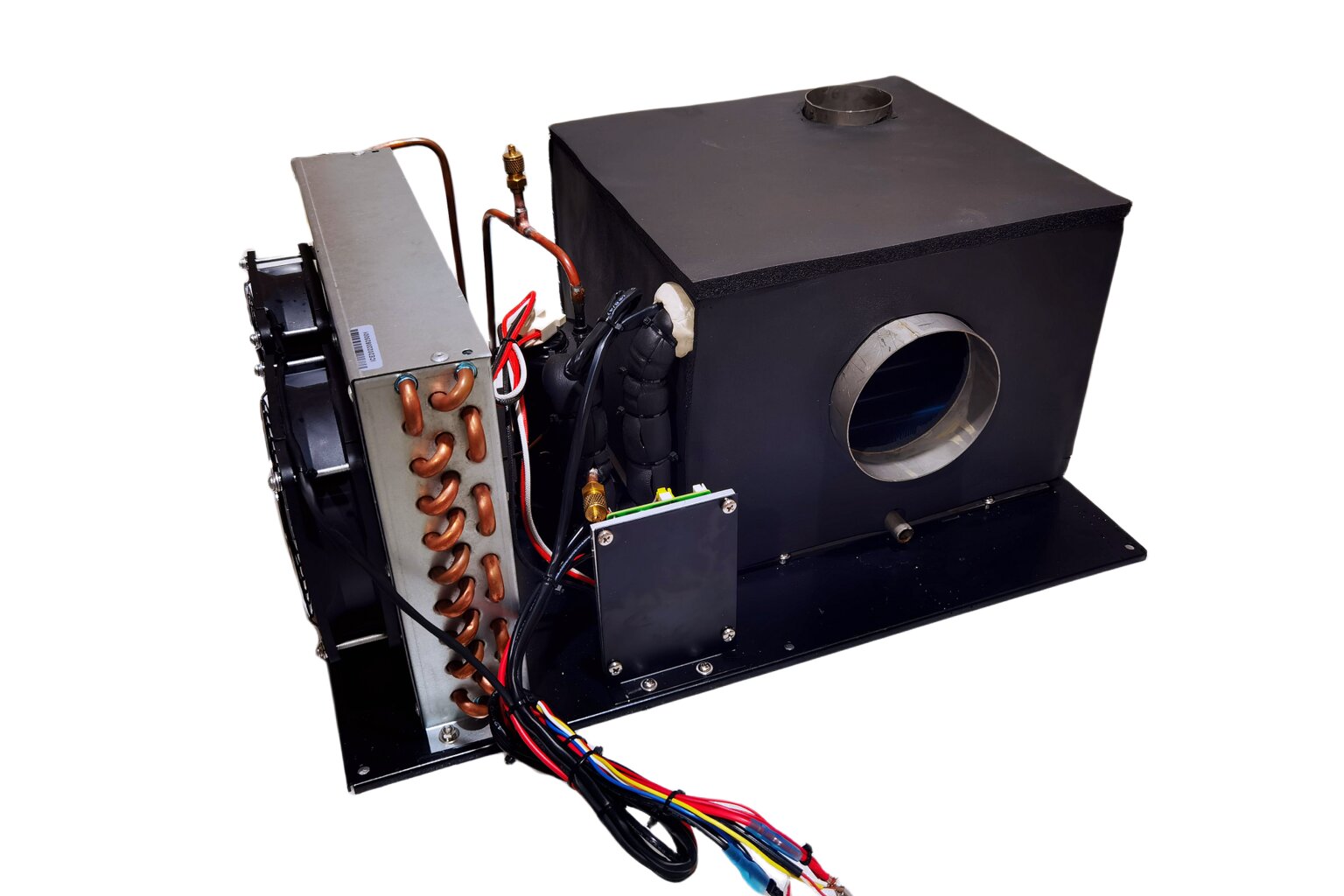
A vapor compression system uses a compressor to circulate refrigerant through an evaporator (which absorbs heat from the air) and a condenser (which rejects that heat to the outside). This is the same thermodynamic cycle used in every residential air conditioner, every car air conditioner, and every refrigerator. It works in any humidity, at any altitude, and at ambient temperatures up to 55°C.
The smallest aircon unit using vapor compression — the RIGID DV1910E-AC — delivers 450W (1,535 BTU) of cooling capacity. It measures roughly 350mm × 260mm × 180mm and weighs about 5 kg. It runs on 12V, 24V, or 48V DC power depending on the model variant, drawing approximately 16A on 12V at full load.
What It Actually Does
It removes heat from an enclosed space and pumps it to the outside. The air inside gets cooler and drier. The temperature drops measurably — 10-15°C below ambient in a properly sized enclosure. This is actual air conditioning: temperature reduction, humidity control, and heat removal.
COP (Coefficient of Performance)
The COP of a small vapor compression system typically ranges from 2.0 to 3.5, meaning for every watt of electrical input, the system moves 2.0 to 3.5 watts of heat. The DV1910E-AC achieves a COP of approximately 2.3-2.8 depending on operating conditions. This means 192W of electrical input moves 450W of heat — a 2.3:1 energy multiplication that no competing technology can match at this scale.
Technology 2: Peltier (Thermoelectric) Coolers
Peltier coolers use the thermoelectric effect — passing electric current through a junction of two different semiconductors creates a temperature differential. One side gets cold, the other gets hot. No moving parts except a fan, no refrigerant, no compressor.
The Attraction
Peltier coolers are small, silent, have no moving parts (except fans), require no refrigerant, and cost $30-$100 for a complete unit. They appear in countless “portable air conditioner” listings on Amazon and AliExpress.
The Reality
A typical Peltier module (TEC1-12706) moves approximately 30-50W of heat while consuming 60-70W of electricity. The COP is 0.4-0.7 — meaning the device generates more waste heat than it removes from the target space. For every watt of cooling it provides, it adds 1.5-2.5 watts of heat to the room via its hot side.
In an enclosed space, a Peltier cooler makes things worse, not better. The hot side rejects the absorbed heat plus the electrical input heat into the same environment. Unless the hot side exhaust is ducted completely outside the space, the net effect is heating, not cooling.
At 50W of cooling capacity versus the vapor compression unit’s 450W, the Peltier delivers approximately 11% of the cooling at roughly 35% of the electrical input — dramatically worse efficiency and dramatically less absolute cooling.
Technology 3: Evaporative Coolers
Evaporative coolers blow air across a wet surface. The water absorbs heat as it evaporates, cooling the air. This is the same principle as sweating — it works, but only under specific conditions.
The Attraction
Evaporative coolers are cheap ($20-$80), use very little electricity (5-20W for the fan and pump), require no refrigerant, and can be very compact. Some models fit in a cup holder.
The Reality
Evaporative cooling effectiveness depends entirely on humidity. In dry air (below 30% relative humidity), evaporative coolers can reduce air temperature by 10-15°C. In humid air (above 60% RH), the temperature reduction drops to 2-4°C — barely perceptible. Above 80% RH, evaporative cooling is essentially zero.
Worse, evaporative coolers add moisture to the air. In an enclosed space, humidity rises rapidly, making the occupants feel hotter even if the air temperature drops slightly. In electronics enclosures, the added humidity can cause condensation on circuit boards, corrosion on contacts, and short circuits — exactly the outcomes a cooling system is supposed to prevent.
Evaporative coolers also require a continuous water supply. A small portable unit evaporates approximately 0.5-1.0 liters per hour, requiring frequent refilling. In remote or mobile applications, this water consumption is a logistics burden that battery-powered vapor compression avoids entirely.
Technology 4: Personal Fans
Some products marketed as “smallest aircon units” are simply small fans — sometimes with a misting function, sometimes with an ice compartment, but fundamentally just fans.
The Physics
Fans do not cool air. They move air across skin, accelerating evaporative heat loss from the body. A fan pointed at a thermometer does not change the reading. In an enclosed equipment space with no human skin to cool, a fan provides zero temperature reduction. The fan motor actually adds heat to the space — typically 5-15W depending on fan size.
Fans with ice compartments provide temporary cooling until the ice melts (typically 30-60 minutes for a portable unit), after which they become pure fans. The total cooling energy provided by the ice is determined by the ice mass and the heat of fusion (334 kJ/kg) — a 500g ice pack provides approximately 46 Wh of cooling, compared to the vapor compression unit’s continuous 450W output.
Head-to-Head Comparison
For a concrete comparison, consider cooling a 100-liter sealed equipment enclosure from 45°C ambient to below 35°C — a common requirement for telecom, industrial, and vehicle applications:
- Vapor compression (DV1910E-AC): Achieves target in 8-12 minutes. Maintains temperature indefinitely. Works at any humidity. Power: 192W continuous. Effective: Yes.
- Peltier cooler (50W cooling): Cannot achieve target — net heat addition to enclosure exceeds heat removal. Even with hot side fully ducted outside, would require 2+ hours to cool the same volume. Power: 70W for 50W of cooling. Effective: Marginally, if hot side is perfectly ducted.
- Evaporative cooler: Cannot cool a sealed enclosure — evaporative cooling requires airflow exchange with a drier environment. In a sealed space, humidity saturates and cooling stops. Effective: No.
- Fan: Cannot reduce air temperature in an enclosed space. Adds heat from motor. Effective: No.
When Alternatives Make Sense
This comparison is not intended to dismiss all non-compressor cooling. Each technology has legitimate applications:
- Peltier coolers excel at precise temperature control of very small volumes (laser diodes, CCD sensors, small sample chambers) where the cooling load is under 20W and the temperature differential is under 20°C. They are also preferred in vibration-sensitive applications where a compressor’s mechanical vibration is unacceptable.
- Evaporative coolers work well in dry climates (desert Southwest US, Middle East, Central Asia) for open-air or well-ventilated spaces where humidity addition is acceptable. They are the most energy-efficient cooling method when conditions permit.
- Fans are appropriate for human comfort in open spaces where actual temperature reduction is not required — the wind chill effect on skin provides a 3-5°C perceived temperature reduction at typical fan speeds.
The Cost of Choosing Wrong
The vapor compression unit costs more upfront — approximately $580-$790 depending on the model, versus $30-$100 for a Peltier cooler or $20-$80 for an evaporative cooler. The temptation to save money by choosing the cheaper option is understandable. But the true cost includes the consequences of inadequate cooling.
If a $50 Peltier cooler fails to prevent a $5,000 telecom radio from overheating, the savings are negative. If an evaporative cooler adds humidity to an electronics enclosure and causes corrosion damage, the “cooling” system caused the very failure it was supposed to prevent. If a fan provides psychological comfort while equipment temperatures continue to rise, the eventual thermal shutdown will be more disruptive for having been unexpected.
The smallest aircon unit that uses real refrigerant costs more because it does more. It is the only option in this size class that actually air conditions — removing heat, controlling humidity, and maintaining a target temperature regardless of ambient conditions. For applications where cooling is a requirement rather than a preference, it is the only option that works.
Efficiency at Scale: Why COP Matters More Than Price
The COP difference between vapor compression and Peltier cooling compounds dramatically over operating hours. Consider a year of operation at 8 hours per day, 250 days per year (2,000 hours total), maintaining a 200W heat load:
Vapor compression (COP 2.5): Electrical input = 200W / 2.5 = 80W average. Annual energy consumption: 80W × 2,000 hours = 160 kWh. At $0.12/kWh: $19.20/year in electricity.
Peltier (COP 0.5): Electrical input = 200W / 0.5 = 400W. But this assumes perfect hot-side ducting. In practice, the Peltier needs multiple stages or modules to handle 200W, consuming 500-600W. Annual energy consumption: 500W × 2,000 hours = 1,000 kWh. At $0.12/kWh: $120/year in electricity.
The vapor compression unit costs $580-$790 upfront versus $100-$200 for a Peltier array capable of 200W cooling. The electricity cost difference of approximately $100/year means the vapor compression unit reaches cost parity in 4-7 years — and saves money every year after that. For a 10-year equipment lifecycle, the vapor compression unit saves $400-$600 in electricity compared to Peltier, more than offsetting its higher purchase price.
For battery-powered applications, the efficiency difference is even more consequential. The same 200W cooling load depletes a 24V/100Ah battery in approximately 30 hours with vapor compression versus approximately 5 hours with Peltier. The battery cost to achieve equivalent runtime with Peltier cooling is 6 times higher — a difference that far exceeds the cost difference between the cooling technologies themselves.
Humidity Control: The Overlooked Advantage
Vapor compression systems inherently dehumidify the air as a byproduct of cooling. When warm, humid air passes over the evaporator coil (which operates below the dew point), moisture condenses on the coil surface and drains away as condensate. The air leaving the evaporator is both cooler and drier.
This dehumidification is not optional — it happens automatically whenever the evaporator surface temperature is below the dew point of the incoming air, which is nearly always during cooling operation. For electronics enclosures, this is a critical benefit: lower humidity means lower corrosion rates, fewer condensation events on cold surfaces (such as heat sinks and circuit boards), and longer component life.
Peltier coolers provide some dehumidification on their cold side, but the condensate management is problematic. The cold side of a Peltier module is a flat semiconductor surface — condensate pools on it, potentially dripping onto whatever is being cooled. There is no drain pan, no drain fitting, and no engineered condensate path. In practice, Peltier installations in humid environments frequently cause more moisture damage than they prevent.
Evaporative coolers, as discussed, add humidity — the opposite of dehumidification. In any application where humidity control matters (electronics, pharmaceuticals, food storage, archives), evaporative cooling is actively harmful.
Noise Comparison
Sound levels matter in occupied spaces, medical environments, and residential applications:
- Vapor compression (DV1910E-AC): 42-48 dBA at 1 meter. At partial load with variable-speed compressor: 35-40 dBA. Comparable to a quiet conversation.
- Peltier cooler: Fan noise only, typically 30-40 dBA depending on fan size and speed. Quieter than vapor compression at full load, comparable at partial load.
- Evaporative cooler: Fan plus water pump, typically 35-50 dBA depending on size. The water splashing adds a characteristic sound that some users find pleasant and others find irritating.
- Fan only: 25-45 dBA depending on size and speed.
The vapor compression unit is the loudest option at full load, but the difference narrows at partial load where the variable-speed compressor operates at reduced speed. In applications where noise is the primary constraint and cooling requirements are minimal (under 30W), a Peltier cooler’s lower noise profile may justify its efficiency penalty. For any application requiring more than 50W of cooling, the noise difference is insufficient to overcome the vapor compression unit’s overwhelming advantages in capacity and efficiency.