
Soxhlet Condenser Cooling Requires a Complete Circulating Loop
Soxhlet condenser cooling needs a stable coolant supply that removes the returning vapor load throughout extraction. Begin with the condenser manufacturer’s water requirements and the intended number of operating positions. Then select the refrigeration capacity, circulation arrangement and fluid conditions together. Replacing an open water supply with a cooling module also requires a pump, a reservoir and a defined return path.
A RIGID stainless steel coil liquid-cooling module can serve as the cold source in a user-designed tank. The coil is immersed in the tank liquid; a separate circulation arrangement supplies the condenser. This is a modular option for equipment builders and laboratories with an engineered loop, not a claim that a bare coil module is a complete laboratory recirculator.
Define What the Condenser Must Return to the Extraction Process
In a conventional Soxhlet arrangement, vapor reaches the condenser and returns as liquid to the extraction apparatus. The cooling duty therefore follows the vapor arriving at that condenser. The extraction flask volume alone does not establish that duty. Heating conditions, solvent and the permitted operating method all affect the load.
Keep the cooling water and extraction solvent as separate circuits. The condenser wall transfers heat between them. Nothing in a chiller selection establishes that the refrigeration module may contact the solvent directly. Record the condenser’s approved coolant and connection arrangement rather than treating every liquid in the apparatus as the same fluid.
Size the cold source from the actual condenser duty. The heater’s electrical rating describes its available input, not a measured rate of heat entering the coolant. Obtain a supported duty estimate or an approved way to measure it. Avoid copying a rotary evaporator sizing rule onto an extraction method with different operating conditions.
Check Whether One Position or Several Positions Govern the Load
A single extraction position and a shared manifold require different inquiries. List the maximum number of condensers that may operate simultaneously, their expected duty and their required flow. If procedures allow only certain combinations, include that limitation in the equipment specification rather than relying on an operator to remember it later.
Intermittent behavior at one position does not guarantee that the combined system has a low average load. Several positions can overlap. An initial test with only one active condenser may leave the shared cold source and pump untested at their intended duty. Review the repeated operating sequence as well as the first warm startup.
| Selection item | Single position | Shared extraction station |
|---|---|---|
| Thermal load | One approved condenser duty and its operating sequence. | Permitted simultaneous duties and recovery between runs. |
| Circulation | Flow through the installed condenser branch. | Branch distribution as well as common-line flow. |
| Reservoir behavior | Starting condition and repeat-run recovery. | Combined transient load, return routing and usable fluid level. |
| Supply scope | Cold source, tank, pump and connections. | The same items plus manifold, branch monitoring and operating limits. |
Keep the Coolant Temperature Requirement Specific to the Apparatus
For Soxhlet condenser cooling, request the allowed inlet temperature and any return-temperature restriction from the condenser or extraction-system supplier. Choose the coolant condition needed for adequate condensation under the actual method. A colder supply is not automatically a better selection if it creates condensation on exposed hoses or conflicts with the intended solvent recovery arrangement.
Measure at the relevant location when verifying the setup. Tank temperature, condenser inlet temperature and the instrument’s process temperature are different quantities. Tubing heat gain and the operating load can create differences between them. Label those points clearly on any commissioning record.
Confirm the positive-temperature duty with the right product line. RIGID’s DV liquid-cooling family publishes a −20°C to +20°C range. MiniCool’s published upper limit is 0°C, so it should not be substituted for a required positive-temperature condenser loop. A required condition outside the DV range needs a separately confirmed solution.
Understand How the Stainless Steel Coil Transfers Heat
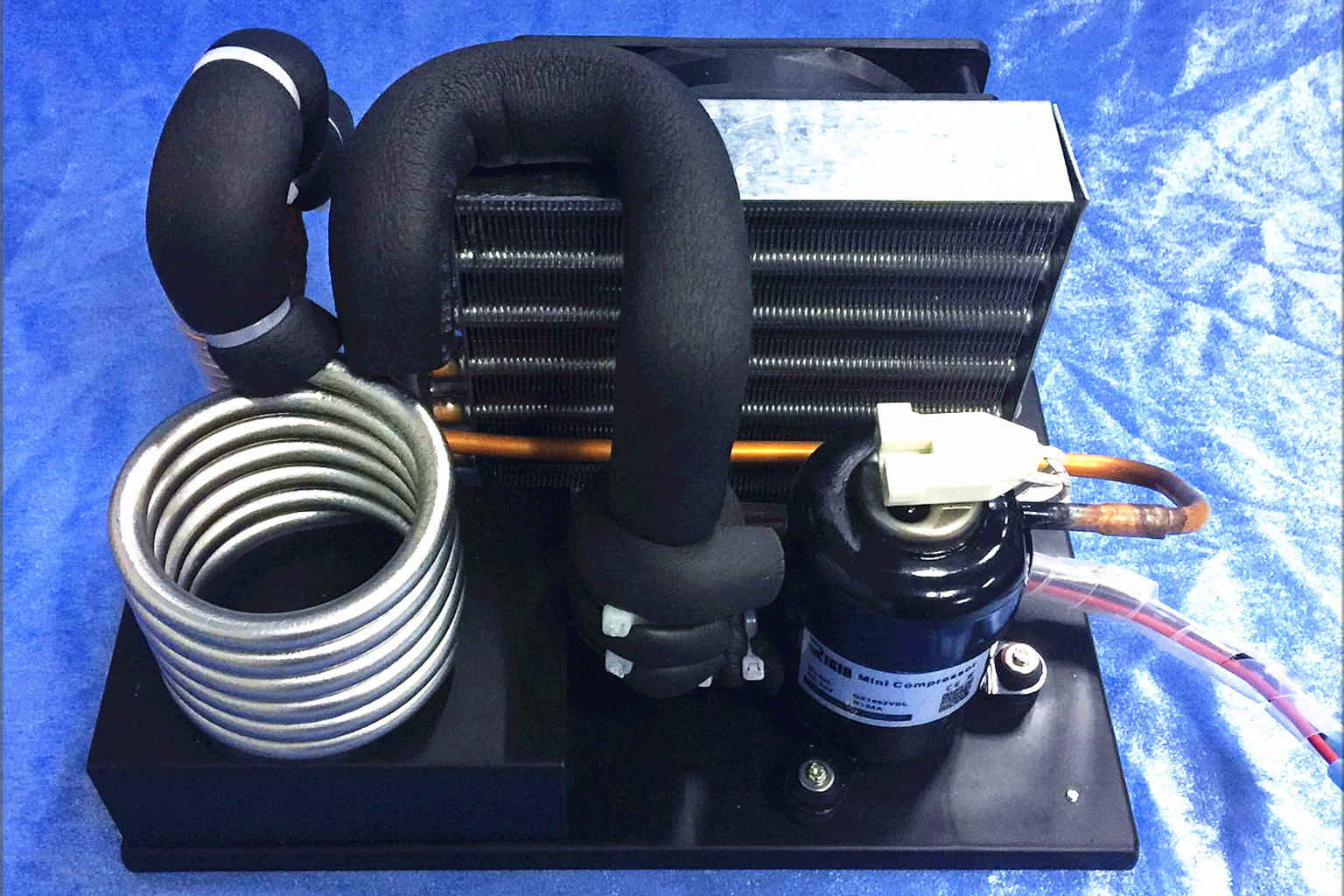
The RIGID stainless steel coil is the cold heat exchanger in a refrigeration module. It is intended to remove heat from surrounding liquid when installed in an appropriate tank arrangement. The visible coil is not a water passage to cut open and connect to the condenser. Its refrigeration circuit must retain its specified construction.
The external coolant circuit is assembled around that cold source. A pump draws or circulates tank liquid through the condenser branch, and warmed liquid returns to the tank. The equipment design must establish how that liquid contacts the cold coil and how the supply remains representative of the intended tank condition.
Stainless steel identifies a material category, not universal chemical compatibility. Obtain approval for the complete coolant formulation and every wetted component in the assembled loop. The module’s coil, external pump, seals, tubing and condenser connections may impose different restrictions.
Specify Tank Mixing and Coil Contact Without Assuming Uniformity
A coil partly above the liquid cannot provide the same useful liquid contact as the intended immersed arrangement. Define the acceptable operating level and installation orientation from the supplier’s requirements. Keep enough access to observe or verify that condition without relying on an unreadable fill mark hidden behind the apparatus.
Also review where warmed return liquid enters and where the pump takes supply. A temperature probe close to the cold coil can read differently from the liquid delivered to the condensers. Short circulation paths within the tank can hide warmer regions elsewhere. Tank layout and any separate mixing arrangement belong in the integration design.
Tank volume is not a substitute for heat-transfer design. It can influence the time taken for temperatures to change, but it cannot establish continuous capacity. A larger tank that starts cold may conceal an inadequate steady cold source during a short demonstration, then warm over a longer extraction run.
Budget the Heat That Reaches the Shared Coolant
Add the approved condenser duties that can occur together and any other heat entering the same coolant boundary. This may include pump input dissipated into the fluid and heat gained through exposed surfaces. Use actual equipment information to decide which contributions belong in the budget; do not add every electrical load in the room.
As an explicitly hypothetical example, suppose two operating branches each transfer 100 W to the coolant, while the integration estimate assigns another 30 W to the shared liquid circuit. The resulting requirement is 230 W at that defined condition. The example demonstrates addition, not a measured Soxhlet load or a RIGID capacity guarantee.
The available refrigeration must be checked at the required liquid and ambient conditions. A nominal capacity printed for a product family cannot close that comparison when its rating basis is missing. Preserve the heat estimate, assumptions and operating combination so the supplier can evaluate the same duty you intend to run.
Match Circulation to the Installed Condenser Branches
The pump must deliver the required flow through the actual restrictions. Those include the condenser passages, hoses, connectors and any manifold. Free-flow pump capacity does not establish branch flow after installation. Compare the installed operating point using the intended coolant at its relevant temperature.
Pressure limits matter independently. A pump that can push water through a restrictive branch may also exceed a condenser’s allowed pressure under another condition. Confirm the component limits, return path and permitted branch states with the equipment supplier. Do not add a shutoff or bypass based only on a general diagram from another setup.
Parallel branches should be checked individually. The shortest or least restrictive branch can receive a disproportionate share of circulation. A common supply reading can therefore look adequate while a distant condenser receives too little. Keep branch identification with each accepted measurement and repeat the check after a routing change.
Define the RIGID Module and the Equipment Supplied Around It
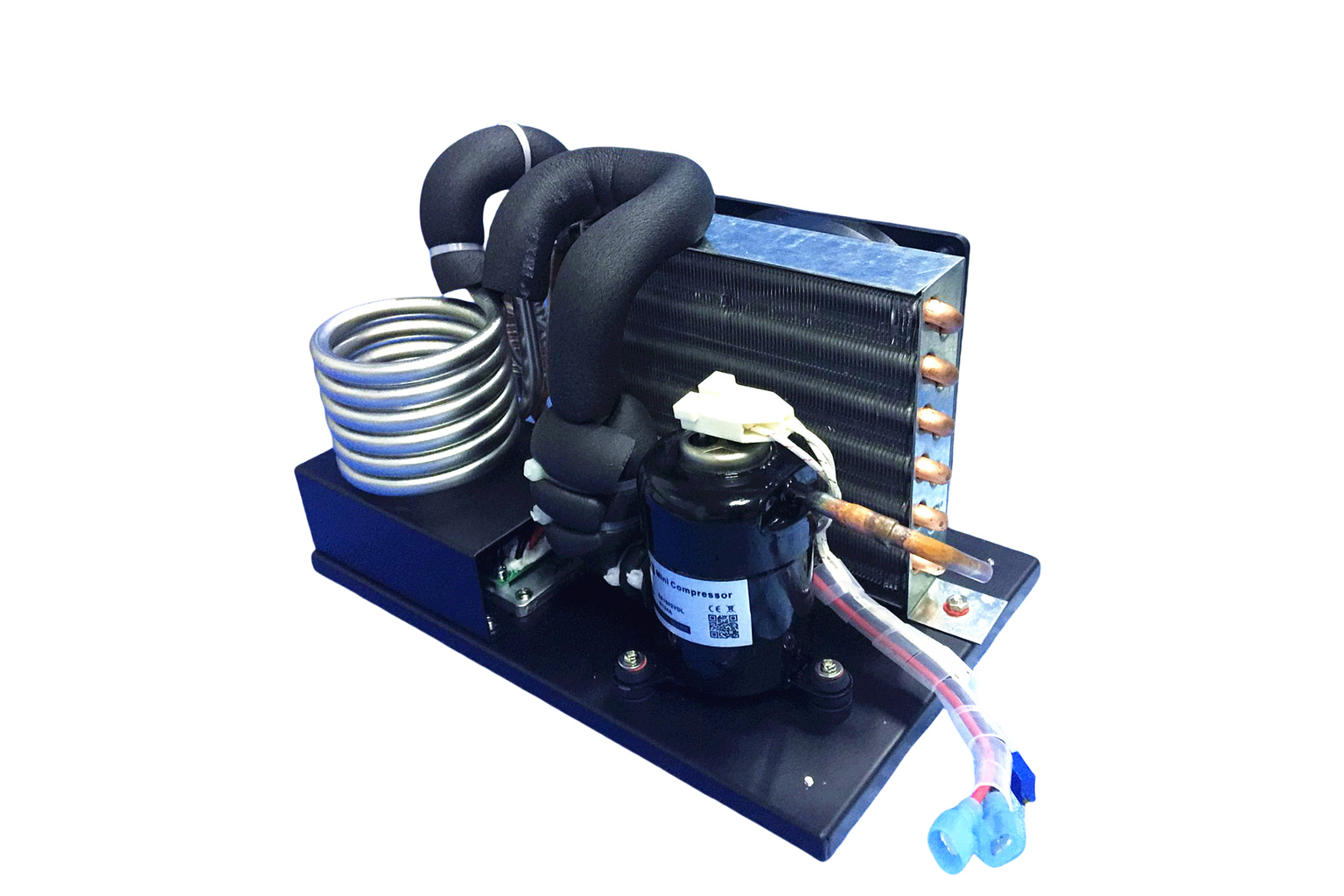
RIGID offers stainless steel coil variants including DV1920E-S in its compact liquid chiller family. The family lists nominal capacities of 100–550 W and a −20°C to +20°C temperature range. Those figures establish a product category for review; the applicable performance curve and operating limits are still required for the selected configuration.
Specify the complete supply scope before ordering. Identify who provides the tank, pump, coolant, fittings, insulation, control arrangement and monitoring. The article’s photographs show the stainless steel coil module family. They do not prove that an external tank, a particular pump or the pictured exact model is included in a quotation.
If the laboratory wants a complete recirculator, state that requirement directly. An OEM refrigeration module may be appropriate where an equipment builder supplies the rest of the loop. Confusing those purchase scopes creates an integration task after delivery even when the refrigeration hardware itself is suitable.
Compare Recirculation With Tap Water on the Actual Workload
Recirculation can reduce reliance on continuously supplied tap water, but it adds responsibility for the tank condition, heat rejection and circulation equipment. Compare the two routes using the actual operating schedule and available utilities. The existing tap water versus recirculating chiller guide addresses the broader utility decision.
For Soxhlet condenser cooling, the deciding question remains whether the chosen route meets the apparatus requirement throughout the run. Record the incoming water condition for the existing arrangement before assuming that a replacement must copy its flow or temperature exactly. The apparatus supplier should identify which limits are essential and which readings simply describe the old installation.
Neither water-saving calculations nor a cold tank establishes solvent containment, ventilation suitability or hazardous-area approval. Those belong to the extraction equipment and laboratory process review. Do not treat a compact cooling module as permission to change the approved extraction method.
Accept Soxhlet Condenser Cooling Under a Representative Run
Verify the complete system with the permitted operating procedure and the intended simultaneous positions. Record coolant temperature at the relevant points, branch circulation, operating conditions and the duration represented. Observe whether the next run begins from an equivalent thermal condition. A single short test after a long precooling period may not represent repeated extraction work.
Define what monitoring and response the laboratory requires if circulation or cooling is lost. Do not assume that a refrigeration controller provides every extraction-system interlock. Keep the cold source, pump command, actual flow and equipment response identifiable as separate functions.
Send RIGID the condenser requirements, operating combination, coolant specification and desired supply scope. Discuss a stainless steel coil cooling configuration for that loop before treating the module as a complete replacement for the existing water supply.
Frequently Asked Questions
Can a stainless steel coil module directly circulate water through a Soxhlet condenser?
Not by itself. The module is a refrigeration cold source. A complete external arrangement needs the appropriate tank, circulation pump, fluid connections and controls, with their supply scope confirmed.
Is Soxhlet condenser cooling sized from the extraction flask volume?
Flask volume alone is insufficient. Use the condenser duty associated with the solvent, operating method and simultaneous positions. Confirm circulation and pressure requirements separately from refrigeration capacity.
Can the extraction solvent flow through the RIGID coil?
No such arrangement is established here. The extraction solvent and external coolant remain separate, and the coil belongs to the module’s sealed refrigeration circuit. Use only an approved tank fluid and system arrangement.
Can MiniCool replace a positive-temperature condenser water supply?
MiniCool’s published range ends at 0°C. Evaluate the DV liquid-cooling line for positive-temperature duty within its published range, with actual performance and interfaces confirmed.
Does a larger tank solve an undersized cold source?
No. Additional thermal mass can delay temperature change, but it does not establish sufficient continuous heat removal. Verify the repeated operating cycle as well as the initial run.