
Stirling Cooler Integration for Portable Gas Analysis Systems
Quick Answer: A free-piston Stirling cooler (FPSC) is the preferred cooling method for portable IR-based gas analyzers operating in field conditions. These coolers reach cold-tip temperatures of -100°C to -196°C within minutes, draw 50–150W of DC input power, and weigh 1–3 kg — making them viable for battery-powered or vehicle-mounted deployments. The key selection factors are cooling capacity at your detector’s operating temperature, vibration tolerance of your optical path, and orientation constraints during transport.
Who This Guide Is For
This guide is written for analytical instrument engineers designing portable gas analyzers, field service technicians responsible for deploying and maintaining these systems, and environmental monitoring professionals who need reliable cryogenic cooling in remote locations. If you are evaluating whether a Stirling cooler fits your next-generation portable FTIR, NDIR, or photoacoustic gas analyzer, this document provides the technical framework for that decision.
Key Decision Framework: Does a Stirling Cooler Fit Your Application?
Before diving into specifications, answer these three questions:
- What cold-tip temperature does your detector require? MCT detectors typically need -196°C (77K). InSb detectors operate at -196°C. PbSe detectors may only need -40°C to -80°C. If your requirement falls between -40°C and -196°C, a Stirling cooler is a strong candidate.
- What is your cooling load at that temperature? Stirling coolers provide 5–15W of cooling at -80°C. If your detector assembly dissipates less than 10W at operating temperature, a single-stage FPSC handles it comfortably. Loads above 20W push beyond practical Stirling cooler capacity.
- Can your optical system tolerate micro-vibration? Free-piston Stirling coolers produce inherent vibration from the oscillating piston and displacer. With counterbalancers, this drops to manageable levels — but if your application demands zero vibration (sub-nanometer optical stability), a Stirling cooler is not the right choice.
If your answers align with Stirling cooler capabilities, continue reading for detailed integration guidance.
Selection Matrix: Stirling Cooler Models for Gas Analysis Applications
| Application | Detector Type | Required Temp | Cooling Load | Recommended Model | Why |
|---|---|---|---|---|---|
| Portable FTIR (field emissions) | MCT | -196°C (77K) | 0.5–1.5W | RS100-L | Lowest vibration profile, compact cold finger interface |
| NDIR multi-gas analyzer | PbSe / InAs | -40°C to -80°C | 2–5W | RS100-S | High COP at moderate temperatures, fast cooldown |
| Photoacoustic gas sensor | Microphone + IR source | -60°C to -100°C | 3–8W | RS100-M | Balanced capacity and weight for vehicle-mounted systems |
| Stack gas CEMS (portable) | MCT / DTGS cooled | -196°C | 1–2W | RS100-L | Proven reliability in industrial environments, IP-rated options |
| Ambient air quality monitor | InSb | -196°C | 0.3–1W | RS100-S | Lowest power draw for solar/battery operation |
Why Stirling Coolers Dominate Portable Gas Analysis
Portable gas analyzers face a fundamental engineering tension: infrared detectors perform dramatically better at cryogenic temperatures, but traditional cooling methods — liquid nitrogen dewars or thermoelectric coolers — impose severe constraints on portability.
Liquid nitrogen requires regular refilling, adds significant weight, and creates logistical challenges in remote deployments. Thermoelectric (Peltier) coolers cannot reach temperatures below approximately -40°C in a single stage, and multi-stage TECs draw excessive power while still falling short of -100°C.
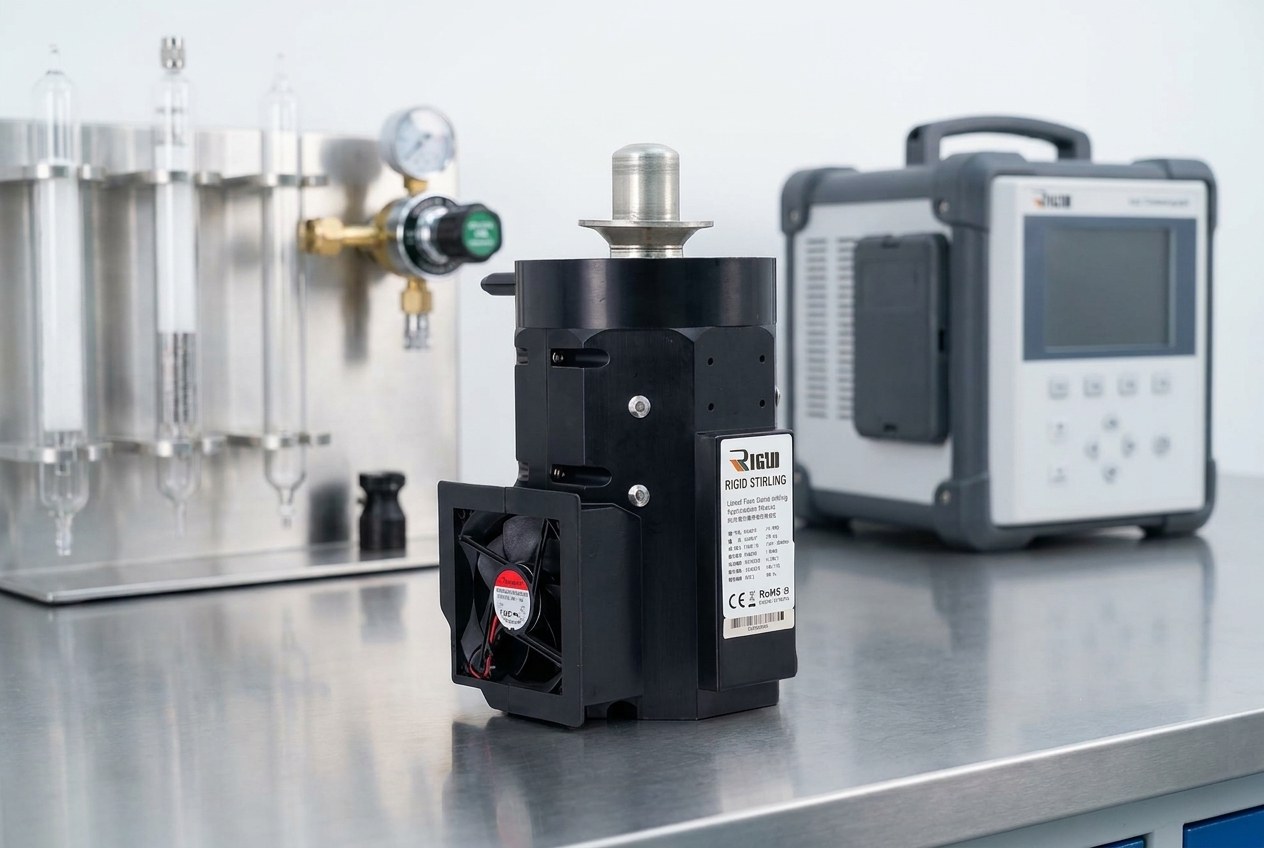
A Stirling cooler resolves this tension. The free-piston design converts electrical input directly into cryogenic cooling without consumable cryogens, mechanical wear surfaces, or excessive power draw. For field-deployed gas analyzers, this translates to:
- Unlimited runtime without cryogen resupply
- DC power compatibility (12V, 24V, or 48V input)
- Cooldown from ambient to -196°C in 5–12 minutes
- Continuous operation in ambient temperatures from -20°C to +50°C
- No scheduled maintenance intervals (MTBF exceeds 50,000 hours)
Field Deployment Considerations
Power Budget Planning
In field conditions, power is often the limiting resource. A Stirling cooler draws 50–150W depending on the model, ambient temperature, and cold-tip setpoint. Plan your power budget with these factors:
- Startup surge: Initial cooldown draws peak power for 5–12 minutes. Budget 120–150% of steady-state draw during this phase.
- Steady-state draw: Once at temperature, power consumption drops 30–50% as the controller reduces piston stroke.
- Ambient temperature effect: Every 10°C increase in ambient adds approximately 8–12% to power consumption. A cooler rated at 80W in a 25°C lab may draw 95–100W at 40°C field conditions.
- Battery sizing: For a typical 80W steady-state draw over an 8-hour field day, budget minimum 640Wh plus 20% margin = 770Wh of battery capacity.
For vehicle-mounted systems, the 12V or 24V DC input of RIGID Stirling coolers connects directly to vehicle electrical systems without inverters, eliminating conversion losses.
Vibration Management in Optical Systems
The free-piston mechanism produces vibration at the drive frequency (typically 50–60 Hz) and its harmonics. For gas analysis instruments, this matters in two ways:
- Detector microphonics: Mechanical vibration at the cold tip can induce noise in the detector signal. MCT detectors are particularly sensitive. Mitigation: use a flexible cold link between the cooler cold finger and the detector dewar, adding 10–20mm of thermal isolation while decoupling mechanical vibration.
- Optical alignment: In FTIR systems, interferometer mirror alignment is sensitive to vibration. Mitigation: mount the Stirling cooler on vibration-isolating mounts (elastomeric or wire-rope isolators) and orient the piston axis perpendicular to the optical axis.
With proper counterbalancers and mounting, residual vibration drops below 10 mN force amplitude — acceptable for most portable gas analysis configurations.
Orientation and Transport
Some Stirling cooler models use gas bearings that are orientation-sensitive. During operation, these units must remain within ±30° of their designed orientation (typically vertical, cold end down). Other models with flexure bearings operate in any orientation.
For portable gas analyzers that may be carried by hand, mounted on tripods, or installed in vehicles at various angles, select a flexure-bearing model or design your instrument housing to maintain the cooler in its required orientation regardless of how the overall system is positioned.
During transport, Stirling coolers are robust — no fragile components or liquid reservoirs. However, protect the cold finger from mechanical shock, as this thin-walled component is the most vulnerable element.
Ready to discuss cooling requirements for your portable gas analyzer? Send us your detector specifications, target temperature, and cooling load, and our engineering team can recommend the optimal Stirling cooler configuration for your field deployment.
IR Detector Cooling Requirements by Type
Different infrared detector technologies demand different cooling levels. Here is how common gas-analysis detectors map to Stirling cooler capabilities:
| Detector Type | Operating Temp | Typical Heat Load | Cooldown Tolerance | Stirling Cooler Fit |
|---|---|---|---|---|
| MCT (HgCdTe) | 77K (-196°C) | 0.2–1.5W | 5–10 min acceptable | Excellent — primary use case |
| InSb | 77K (-196°C) | 0.1–0.5W | 5–10 min acceptable | Excellent — low load, fast cooldown |
| InAs | 77K–200K | 0.3–1W | 3–8 min acceptable | Excellent |
| PbSe | 200K–250K (-73°C to -23°C) | 1–5W | 2–5 min acceptable | Good — consider TEC alternative at -23°C |
| DTGS (cooled) | 250K–270K | 0.5–2W | 1–3 min acceptable | Marginal — TEC often sufficient |
| Quantum cascade laser (QCL) | 250K–300K | 5–15W | Continuous | Good for sub-ambient, TEC for near-ambient |
The decision boundary is clear: if your detector needs temperatures below -40°C and you cannot use liquid nitrogen, a Stirling cooler is the practical choice. Above -40°C, multi-stage thermoelectric coolers may suffice at lower cost and complexity.
Integration Engineering: Mechanical and Thermal Interface
Cold Finger Interface Design
The cold finger is the thermal bridge between the Stirling cooler and your detector. Design considerations:
- Material: Oxygen-free copper (OFHC) for temperatures above 77K. For lower temperatures, use copper with indium foil at joints to minimize thermal resistance.
- Cross-section: Size the cold finger to conduct your heat load with less than 5K temperature drop. For a 1W load over 50mm length, minimum 6mm diameter OFHC copper.
- Vacuum dewar: The cold finger must operate inside a vacuum enclosure (10⁻⁴ mbar or better) to prevent condensation and convective heat leakage. Use multi-layer insulation (MLI) for radiation shielding.
- Flexible thermal link: If vibration isolation is critical, use a copper braid or flexible copper strap between the cooler cold tip and the detector mount. This adds 2–5K thermal penalty but dramatically reduces transmitted vibration.
Electronics Integration
RIGID Stirling coolers include integrated drive electronics that accept DC input and provide temperature control. Key integration points:
- Temperature feedback: A silicon diode or platinum RTD at the cold tip provides closed-loop temperature control to ±0.1K stability.
- Communication interface: RS-232 or RS-485 serial interface for setpoint adjustment, status monitoring, and fault reporting.
- Sync signal: A TTL sync output at the drive frequency allows your data acquisition system to gate measurements between piston strokes, reducing vibration-correlated noise.
Environmental Qualification for Field Use
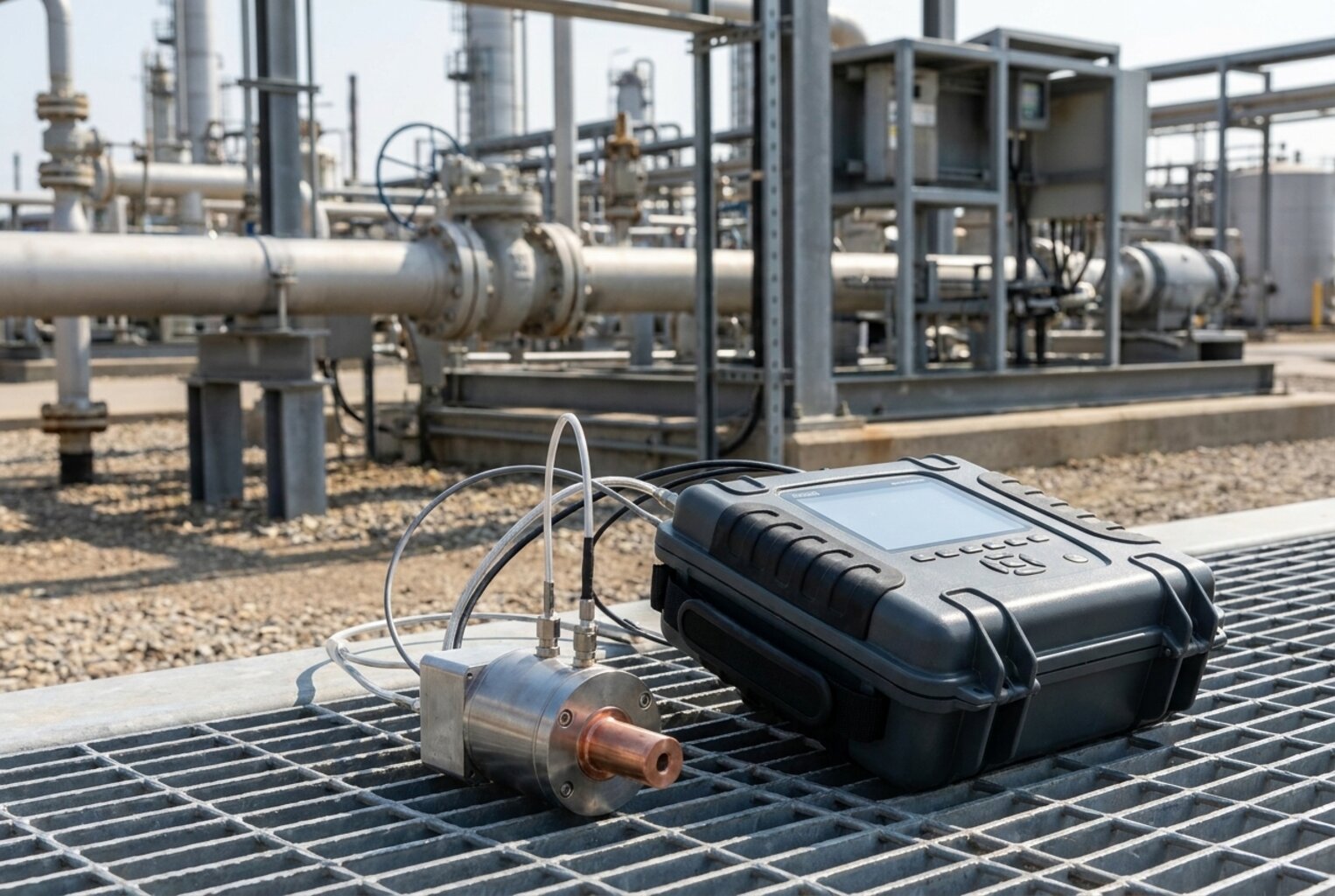
Portable gas analyzers encounter conditions far harsher than laboratory environments. RIGID Stirling coolers are qualified for:
- Operating temperature: -20°C to +50°C ambient (extended range to +60°C with derating)
- Storage temperature: -40°C to +70°C
- Humidity: Up to 95% RH non-condensing (electronics enclosure sealed)
- Shock: 15g, 11ms half-sine (non-operating)
- Vibration (external): 2g RMS, 10–500 Hz random (operating)
- Altitude: Up to 4,500m (reduced heat rejection efficiency above 3,000m — budget additional power margin)
- EMC: EN 61326-1 compliant — critical for instruments with sensitive analog front-ends
For hazardous area deployments (oil and gas, chemical plants), the Stirling cooler itself does not require ATEX certification as it operates within a sealed instrument enclosure. However, verify that your overall instrument design meets the required protection level.
Lifetime and Maintenance in Field Operations
One of the strongest arguments for Stirling coolers in portable gas analysis is the maintenance profile:
- MTBF: Greater than 50,000 hours (5.7 years continuous operation)
- Wear mechanism: None — free-piston design has no mechanical contact between moving parts
- Consumables: None — no cryogen, no oil, no filters
- Scheduled maintenance: None required. Periodic inspection of electrical connections and thermal interface recommended at instrument service intervals.
- End-of-life indicator: Gradual increase in cooldown time or inability to reach setpoint temperature indicates helium charge loss (the primary failure mode)
For field service organizations, this means the Stirling cooler is effectively a fit-and-forget component. The instrument’s optical alignment, detector calibration, and sample handling system will require attention long before the cooler needs replacement.
Cost Considerations: Stirling Cooler vs. Alternatives
When evaluating total cost of ownership for a portable gas analyzer cooling system:
| Factor | Stirling Cooler | Liquid Nitrogen | Multi-stage TEC |
|---|---|---|---|
| Initial hardware cost | Medium-High | Low (dewar only) | Low |
| Operating cost (per year) | Electricity only (~$50) | LN2 supply ($500–2000) | Electricity (~$30) |
| Maintenance cost | Near zero | Dewar service, safety training | Near zero |
| Logistics cost | None | High (supply chain, transport) | None |
| Achievable temperature | -196°C | -196°C | -40°C (practical limit) |
| Field autonomy | Unlimited (with power) | 4–12 hours per fill | Unlimited (with power) |
| Weight penalty | 1–3 kg | 3–8 kg (dewar + LN2) | 0.1–0.5 kg |
The Stirling cooler wins on total cost of ownership for any deployment exceeding 6–12 months, and wins immediately on logistics simplicity for remote or international field work where liquid nitrogen supply is unreliable.
Need a cost estimate for your specific gas analysis application? Send us your detector type, target temperature, and expected duty cycle, and our team can provide a detailed quotation including integration support.
Frequently Asked Questions
How long does a Stirling cooler take to reach -196°C from ambient temperature?
Typical cooldown time is 5–12 minutes depending on the thermal mass of the cold finger assembly and detector. Lighter assemblies (under 50g at the cold tip) reach temperature in under 7 minutes. Heavier assemblies with larger dewars may take up to 12 minutes.
Can a Stirling cooler operate continuously in a portable gas analyzer?
Yes. RIGID Stirling coolers are designed for continuous operation with MTBF exceeding 50,000 hours. Many field-deployed gas analyzers run their coolers 24/7 for years without intervention. The free-piston design has no wear surfaces that degrade with runtime.
What happens if the Stirling cooler loses power during field operation?
The detector warms toward ambient temperature at a rate determined by the dewar’s thermal isolation. Well-designed dewars maintain cryogenic temperature for 2–5 minutes after power loss, providing time for graceful shutdown. No damage occurs to the cooler — it simply restarts when power returns.
How much vibration does a Stirling cooler transmit to the IR detector?
With integrated counterbalancers, residual force at the mounting interface is typically below 10 mN amplitude at the fundamental frequency (50–60 Hz). Using a flexible thermal link between the cold tip and detector reduces transmitted displacement to sub-micron levels, acceptable for most gas analysis optical configurations.
Can I mount the Stirling cooler in any orientation inside my portable instrument?
This depends on the bearing type. Flexure-bearing models operate in any orientation. Gas-bearing models must remain within ±30° of their designed axis. For portable instruments that may be tilted or carried at various angles, specify a flexure-bearing model during selection.
What is the minimum cooling capacity needed for a typical MCT detector?
Most MCT detectors used in gas analysis have heat loads of 0.2–1.5W at 77K. A Stirling cooler providing 5W at -80°C has substantial margin for these applications. The excess capacity allows faster cooldown and accommodates parasitic heat loads from the dewar, wiring, and radiation.
How does altitude affect Stirling cooler performance in field deployments?
Stirling coolers reject heat through a heat exchanger that relies on ambient air. At altitudes above 3,000m, reduced air density decreases heat rejection efficiency by approximately 5–10% per 1,000m. Budget additional input power or specify a larger heat rejection fan for high-altitude deployments.
What is the expected lifetime before a Stirling cooler needs replacement?
With MTBF exceeding 50,000 hours, a cooler operating 8 hours per day in field use lasts over 17 years statistically. The primary end-of-life mechanism is gradual helium charge loss through seals, which manifests as slowly increasing cooldown time over years of operation.
Can I use a Stirling cooler with a quantum cascade laser (QCL) gas analyzer?
Yes, though QCLs typically operate at higher temperatures (250K–300K) where thermoelectric coolers may suffice. A Stirling cooler becomes advantageous for QCL systems requiring temperatures below -40°C or where the QCL heat load (5–15W) exceeds TEC capacity at the required temperature differential.
How do I specify a Stirling cooler for my gas analyzer project?
Provide these parameters: detector type, required cold-tip temperature, estimated heat load at that temperature, available input power (voltage and wattage), orientation constraints, vibration sensitivity of your optical system, and ambient temperature range. Our engineering team will recommend the optimal model and interface configuration.
Next Steps: Get a Cooling Solution Matched to Your Gas Analyzer
Selecting the right Stirling cooler for a portable gas analysis instrument requires balancing thermal performance, power budget, vibration tolerance, and mechanical integration. The decision matrix above narrows the field, but every instrument has unique constraints.
Send us your detector specifications, operating temperature requirement, and deployment environment details. Our applications engineering team has integrated Stirling coolers into gas analyzers across environmental monitoring, industrial emissions, and defense applications. We can recommend the right model, provide thermal interface design guidance, and support your integration from prototype through production.