
What Is a Stirling Cooler and Why Does It Matter?
A stirling cooler is a cryogenic refrigeration device that operates on the Stirling thermodynamic cycle — the controlled compression and expansion of a working gas (typically helium) to move heat from a cold region to a warm region. Unlike vapor-compression refrigerators that rely on phase-change refrigerants, a stirling cooler uses a sealed charge of inert gas and mechanical work to reach temperatures far below what conventional systems can achieve.
This distinction matters because many scientific, industrial, and defense applications demand stable cooling at temperatures ranging from -40 °C down to -160 °C or even colder. Standard compressor-based systems struggle below -40 °C, and cascade systems that reach -86 °C are bulky, power-hungry, and maintenance-intensive. Stirling-cycle coolers fill this gap with a compact, efficient, and environmentally friendly alternative.
Over the past two decades, stirling cooler technology has evolved from large laboratory instruments into compact, commercially accessible modules. Today, engineers and researchers can integrate a small stirling cryocooler directly into portable analyzers, satellite payloads, and medical devices — something that was impractical with older cryogenic approaches. The growing demand for ultra-low temperature cooling in compact form factors has made stirling coolers one of the most actively adopted cryogenic technologies across multiple industries.
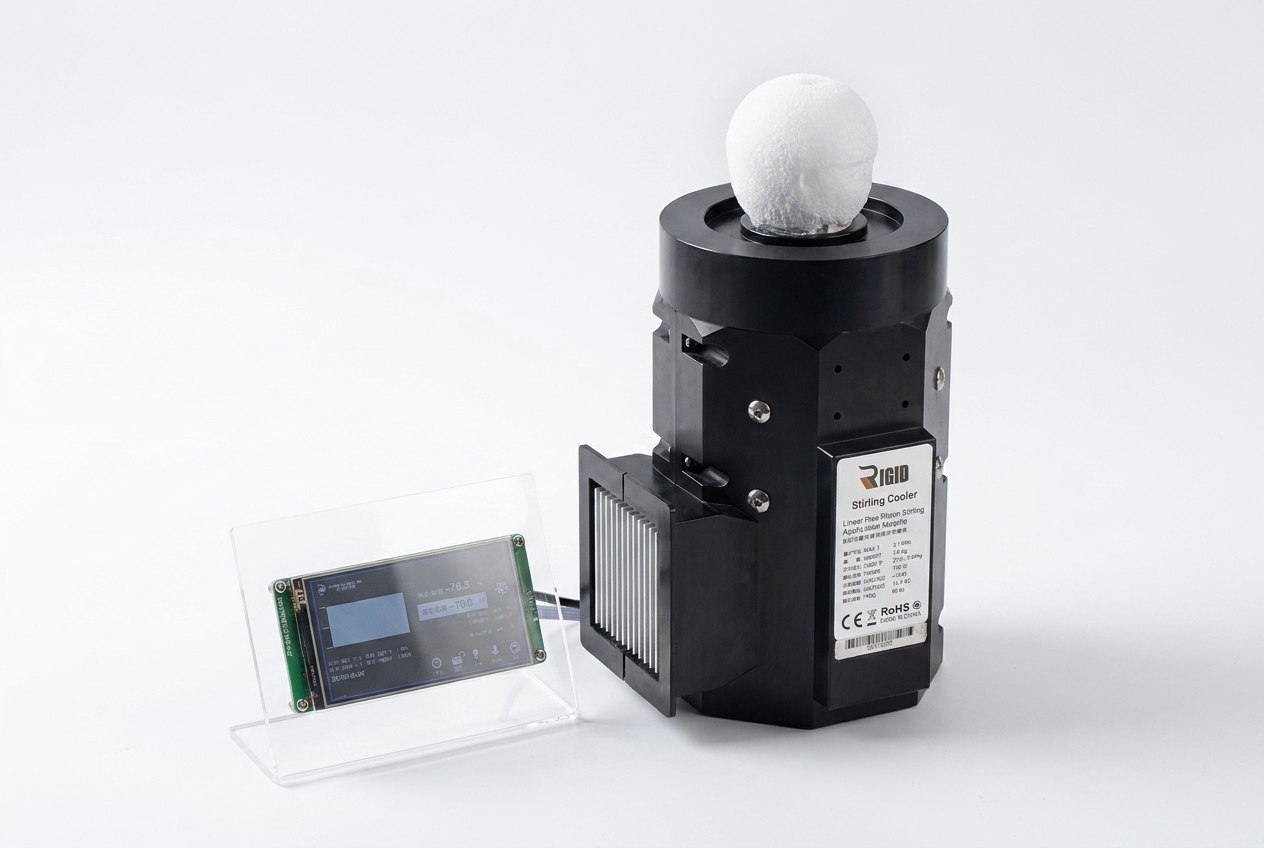
Three Main Types of Stirling Cooler Technology
When engineers evaluate cryogenic cooling options, they typically encounter three major categories of stirling-based and regenerative cryocoolers. Each type has distinct mechanical architectures, temperature capabilities, and operational trade-offs. Understanding these differences is essential for selecting the right cooler for a given application.
Free Piston Stirling Cooler (FPSC)
A Free Piston Stirling Cooler, or FPSC, uses a linear motor to drive a piston and a displacer that float freely inside a sealed cylinder — there are no mechanical linkages, crankshafts, or bearings connecting them. The piston and displacer oscillate at a resonant frequency (typically around 50–80 Hz), and the gas springs formed by the helium charge itself provide the restoring force.
This design has several practical advantages. With no contact between moving parts and the cylinder wall, there is virtually no mechanical wear. There is no lubricating oil in the system, which eliminates contamination risks and removes the need for oil management. The sealed, hermetic construction means the helium working gas never leaks under normal conditions, giving FPSC units operational lifetimes that can exceed 50,000 hours without maintenance.
FPSCs typically reach cold-tip temperatures between 0 °C and -160 °C, depending on the model and heat rejection conditions. Their input power ranges from about 40 W to 100 W, making them suitable for battery-powered, solar-powered, or DC-powered systems. The compact size — often smaller than a soda can — allows direct integration into handheld instruments, portable freezers, and embedded OEM modules.
Gifford-McMahon (GM) Cryocooler
The Gifford-McMahon cryocooler, commonly called a GM cooler, is a split-cycle system that separates the compressor from the cold head. A remote helium compressor delivers high-pressure gas through flexible lines to a cold head containing a displacer and regenerator. The displacer moves in a timed sequence controlled by rotary valves, cycling the gas through expansion and compression phases.
GM coolers can reach temperatures as low as 4 K (approximately -269 °C) in two-stage configurations, which makes them the workhorse of superconducting magnet cooling, cryopump systems, and laboratory cryostats. Their cooling capacity at very low temperatures (10–80 K) is significantly higher than what FPSC units offer.
However, this capability comes at a cost. GM coolers are large, heavy, and power-hungry — typical compressor units draw 1–7 kW of electrical power and weigh 30–100 kg. The rotary valve mechanism and compressor require periodic maintenance (valve rebuilds, compressor adsorber changes), and the system produces considerable vibration and acoustic noise. GM coolers are not portable and are generally installed in fixed laboratory or industrial settings.
Pulse Tube Cryocooler
A pulse tube cryocooler is similar to a stirling cooler in that it uses oscillating gas pressure to produce cooling, but it replaces the mechanical displacer with an open tube (the pulse tube) and a passive flow network (inertance tube and reservoir). By eliminating the moving displacer, pulse tube coolers reduce vibration at the cold tip to extremely low levels — often below 1 micron of displacement.
This makes pulse tube coolers attractive for applications where vibration is critical, such as space-based infrared sensors, precision optical systems, and certain MRI configurations. Pulse tube coolers can reach temperatures from about 20 K to 80 K in single-stage designs, and below 4 K in multi-stage versions.
The trade-off is efficiency. Pulse tube coolers are generally 10–20% less efficient than equivalent stirling or GM coolers at the same temperature, because the passive gas management introduces thermodynamic losses. They also tend to be more expensive than FPSC units for applications above 100 K, where the FPSC’s simpler design delivers comparable or superior performance at a fraction of the cost.
Temperature Ranges and Cooling Capacity Compared
One of the most practical ways to compare cryocooler types is by their achievable temperature range and the cooling power they deliver at specific temperature points. Here is a functional breakdown:
FPSC (Free Piston Stirling Cooler) — Achievable cold-tip temperature: 0 °C to -160 °C. Cooling capacity: 5–40 W at -80 °C (model dependent). Input power: 40–100 W DC. These units are optimized for the -40 °C to -120 °C range where most analytical, medical, and cold-chain applications operate.
GM Cryocooler — Achievable cold-tip temperature: down to 4 K (-269 °C) in two-stage models. Cooling capacity: 1–10 W at 20 K, 40–100 W at 80 K. Input power: 1,000–7,000 W AC. Best suited for deep cryogenic applications such as superconducting systems, cryopumps, and liquefied gas research.
Pulse Tube Cryocooler — Achievable cold-tip temperature: 20 K to 80 K in single-stage designs, below 4 K in multi-stage. Cooling capacity: similar to GM at equivalent temperatures but with reduced efficiency. Input power: 500–5,000 W. Preferred where ultra-low vibration at cryogenic temperatures is the primary requirement.
For applications that require cooling between -40 °C and -120 °C — which covers the vast majority of gas analysis, infrared detector, and portable medical use cases — the FPSC delivers the most practical combination of temperature capability, low power consumption, compact size, and cost efficiency. GM and pulse tube coolers become necessary only when the target temperature drops below -160 °C or when specific vibration or cooling capacity requirements exceed what an FPSC can provide.
Key Applications for Stirling Coolers Across Industries
Stirling coolers, particularly FPSC models, have found growing adoption in several high-value application areas. The following sections describe the most common use cases and explain why the stirling cooler architecture is well-suited to each.
Gas Analysis and Cold Traps
Gas chromatographs, mass spectrometers, and environmental monitoring instruments often require cold traps to condense and capture volatile organic compounds (VOCs) or moisture before analysis. These cold traps need to reach temperatures between -40 °C and -100 °C, maintain precise temperature stability (within ±1 °C), and cycle quickly between cooling and heating phases.
An FPSC stirling cooler meets all three requirements. Its electronic modulation allows continuous temperature adjustment rather than the on-off cycling of compressor systems, which means the cold trap temperature stays stable even as the thermal load changes during a sampling cycle. The absence of oil in the system eliminates hydrocarbon contamination — a critical concern in trace-level gas analysis where even parts-per-billion of contaminants can skew results.
Several RIGID customers have integrated FPSC modules directly into portable gas analyzers used for environmental monitoring, industrial emission testing, and air quality assessment in confined spaces.
Infrared Detector Cooling
Infrared focal plane arrays (IRFPAs) and single-element IR detectors used in thermal imaging, spectroscopy, and remote sensing require cooling to reduce thermal noise and achieve high sensitivity. Mercury cadmium telluride (MCT) detectors, for example, typically operate between -77 °C and -196 °C (77 K to 200 K).
Stirling coolers have long been the standard cooling method for tactical and commercial IR detectors because they offer a good balance between cooling temperature, size, weight, power consumption, and reliability. An FPSC can cool an MCT detector to its operating temperature within minutes of startup and maintain it there for thousands of hours continuously.
Compared to liquid nitrogen dewars (which require frequent refilling) or thermoelectric coolers (which cannot reach temperatures below about -60 °C efficiently), FPSC stirling coolers provide a self-contained, maintenance-free solution that is suitable for both field-deployed and laboratory-based IR systems.
Mass Spectrometry
Mass spectrometers, particularly those used in leak detection, residual gas analysis, and process monitoring, benefit from cryogenic trapping and pumping stages that remove unwanted gas species before they reach the analyzer. Cryotraps operating at -80 °C to -120 °C can selectively condense water vapor, solvents, and heavy hydrocarbons while allowing lighter analyte gases to pass through.
FPSC stirling coolers are increasingly used in these systems because they can be mounted directly onto the vacuum chamber, reducing the thermal path length and improving cooling efficiency. Their low vibration characteristics — especially compared to GM coolers — minimize mechanical interference with sensitive mass analyzer components.
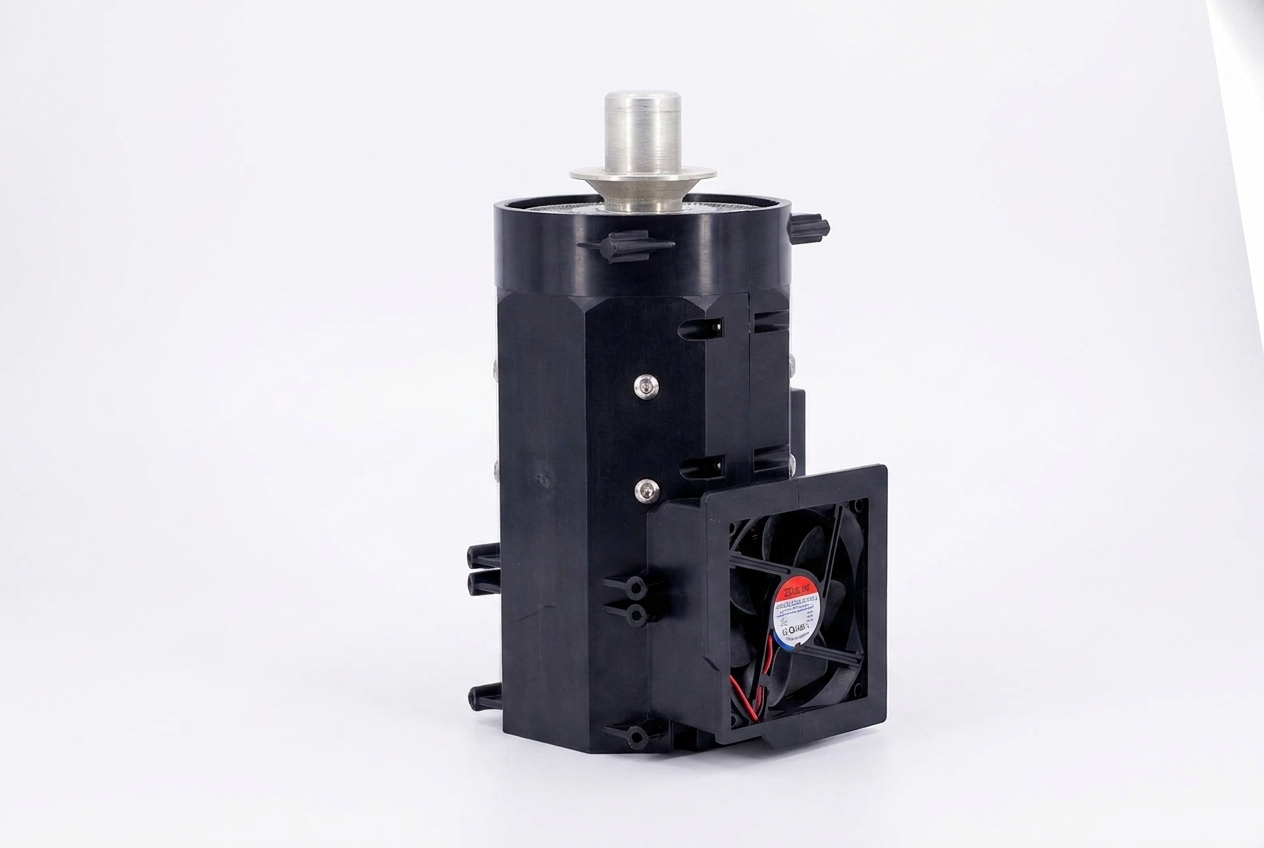
Ultra-Low Temperature Research
University laboratories, national research institutes, and R&D departments in pharmaceutical and biotech companies use stirling coolers for a variety of experimental setups that require sustained low temperatures. These include material characterization at cryogenic temperatures, biological sample preservation, superconductor research at pre-cooling stages, and calibration of temperature sensors.
For experiments that require temperatures between -80 °C and -150 °C, an FPSC offers a practical alternative to liquid nitrogen cooling. LN2 systems require a continuous supply of liquid nitrogen, a storage dewar, safety ventilation (due to oxygen displacement risk), and regular refilling. An FPSC needs only a DC power supply and adequate heat rejection — making it far simpler to deploy in small labs, mobile research stations, or remote field locations.
Medical and Life Science Equipment
Point-of-care diagnostic devices, portable sample storage units, and cryotherapy systems benefit from FPSC stirling coolers because of their small size, low noise, and ability to run on battery or solar power. In resource-limited settings — rural clinics, field hospitals, disaster relief operations — a compact stirling cooler can maintain vaccine or biological sample storage at -70 °C to -80 °C without requiring grid power or refrigerant service infrastructure.
How to Choose the Right Stirling Cooler for Your Project
Selecting a cryocooler involves balancing several technical and practical factors. Here is a structured approach:
Define your target temperature. If you need cooling between 0 °C and -160 °C, an FPSC is likely your most efficient and cost-effective option. If you need to reach below -196 °C (77 K), consider a GM or pulse tube cooler.
Estimate your cooling load. Calculate the heat that needs to be removed at the target temperature, including conductive, radiative, and convective loads, plus any heat generated by the device being cooled. FPSC units typically provide 5–40 W of cooling at -80 °C; if your load exceeds this, you may need a larger GM system or multiple FPSC units.
Consider size and weight constraints. If your system must be portable, handheld, or fit into a compact enclosure, the FPSC’s small size (some models are under 300 mm in length and weigh 6–7 kg) gives it a significant advantage over GM coolers that require a separate compressor unit.
Evaluate power availability. FPSC stirling coolers run on 12 V or 24 V DC power at 40–100 W, compatible with batteries, solar panels, and vehicle electrical systems. GM and pulse tube coolers require AC mains power at 1–7 kW, limiting them to fixed installations.
Assess vibration sensitivity. If your application involves precision optics or sensitive detectors, note that FPSC units produce low vibration (with active balancers available), while pulse tube coolers offer the lowest vibration at cryogenic temperatures. GM coolers produce the most vibration due to their rotary valve mechanism.
Factor in total cost of ownership. FPSC units have the lowest acquisition cost and near-zero maintenance cost over their lifetime. GM coolers have moderate acquisition costs but ongoing maintenance expenses (valve rebuilds, adsorber replacements). Pulse tube coolers typically have the highest acquisition cost but lower maintenance than GM systems.
RIGID FPSC Stirling Cooler Solutions
RIGID has developed a range of Free Piston Stirling Cooler (FPSC) modules designed for OEM integration and direct application use. These units are built around the core FPSC architecture — hermetically sealed, oil-free, CFC-free, with helium as the working gas — and are available in several power and temperature configurations.
The RS40 model is an entry-level FPSC module drawing 40 W at 12 V DC. It reaches cold-tip temperatures as low as -100 °C, measures just 86 mm in diameter by 260 mm in length, and operates at noise levels below 38 dB. At a price point of $780, the RS40 is designed for applications where moderate cooling capacity and compact size are the primary requirements — portable gas analyzers, small cold traps, and educational or research setups.
For applications that demand deeper cooling or higher cooling capacity, the RS100 Plus is RIGID’s high-performance FPSC module. It operates at 100 W on 24 V DC, reaches cold-tip temperatures as low as -160 °C, and includes a KF50 vacuum flange for direct integration into vacuum systems. The RS100 Plus is priced at $1,800 and is suited for mass spectrometer cryotraps, infrared detector cooling, and ultra-low temperature research applications.
Both models share several design characteristics that make RIGID FPSC units practical for real-world deployment:
No mechanical wear — the free-piston design eliminates contact friction, enabling operational lifetimes exceeding 50,000 hours.
No oil, no CFC — the system uses only helium gas, which is environmentally inert and eliminates contamination risks in sensitive analytical equipment.
Precise electronic temperature control — continuous modulation maintains setpoint accuracy within ±1 °C, unlike the temperature swings caused by on-off compressor cycling.
Wide power compatibility — 12 V or 24 V DC input allows operation from batteries, solar panels, vehicle power systems, or AC adapters.
Compact and lightweight — all models weigh between 6 and 7 kg and fit into enclosures smaller than most conventional cryocooler cold heads.
RIGID also offers the RS80 (80 W, 24 V DC, cold-tip to -120 °C) and the RS100 (100 W, 24 V DC, cold-tip to -150 °C without vacuum flange) for applications that fall between the RS40 and RS100 Plus in terms of performance requirements.
To explore the full FPSC product range, technical specifications, and integration support, visit the RIGID Free Piston Stirling Cooler product page.
Frequently Asked Questions About Stirling Coolers
How long does a stirling cooler last?
FPSC stirling coolers are designed for continuous operation lifetimes exceeding 50,000 hours. Because there is no mechanical contact between moving parts, wear is virtually eliminated. Many FPSC units in field service have operated continuously for five or more years without requiring any maintenance or component replacement.
What refrigerant does a stirling cooler use?
Stirling coolers use helium gas as the working fluid. Helium is a noble gas — it is non-toxic, non-flammable, chemically inert, and has zero ozone depletion potential and zero global warming potential. The helium charge is sealed inside the cooler at the factory and does not need to be replaced during normal operation.
Can a stirling cooler run on solar power?
Yes. FPSC stirling coolers operate on 12 V or 24 V DC power and draw between 40 W and 100 W, making them compatible with standard solar panel and battery systems. This makes them particularly useful for off-grid and remote applications such as field-deployed environmental monitors, mobile medical storage, and remote research stations.
How does an FPSC compare to a thermoelectric (Peltier) cooler?
Thermoelectric coolers are solid-state devices with no moving parts, but they become increasingly inefficient as the temperature differential increases. Below about -40 °C, thermoelectric coolers require impractical amounts of power and produce excessive waste heat. FPSC stirling coolers can be up to 6 times more efficient than Peltier coolers at the same temperature point, and they can reach much lower temperatures (-100 °C to -160 °C) that thermoelectric devices simply cannot achieve.
Is vibration a concern with FPSC stirling coolers?
FPSC units use a balanced piston arrangement where the displacer and compression piston move in opposition, largely canceling out vibration forces. RIGID FPSC models produce low vibration suitable for most laboratory and analytical instrument applications. For applications requiring extremely low vibration (sub-micron), pulse tube coolers may be more appropriate, but they come at higher cost and lower efficiency.