
Why a Stirling Cryocooler Portable Solution Changes Field Gas Analysis
Gas analysis has long depended on cryogenically cooled detectors to achieve the sensitivity required for trace-level measurements. Whether identifying volatile organic compounds in ambient air, monitoring stack emissions, or screening for hazardous gases in industrial environments, the detector at the heart of the instrument often needs to operate at temperatures near 77K (approximately -196°C). Historically, this meant relying on liquid nitrogen — a logistics-heavy, time-limited cooling method that confined high-performance gas analysis to laboratory settings.
The emergence of Free Piston Stirling Cooler (FPSC) technology has fundamentally shifted this equation. By providing reliable cryogenic cooling in a compact, electrically powered package, Stirling cryocoolers now enable portable gas analysis instruments to deliver laboratory-grade sensitivity in the field. This article explores why cryogenic cooling matters for gas analysis, the practical problems with liquid nitrogen in portable applications, and how FPSC-based Stirling cryocoolers address these challenges for instrument designers and field technicians.
The Role of Cryogenic Cooling in Gas Detection
Infrared spectroscopy forms the backbone of modern gas analysis. Molecules absorb infrared radiation at characteristic wavelengths, creating spectral fingerprints that allow identification and quantification of gas species. The sensitivity of this measurement depends heavily on the detector’s ability to distinguish faint absorption signals from thermal noise.
At room temperature, thermal noise in infrared detectors can overwhelm the signals from trace gas concentrations. Cooling the detector element to cryogenic temperatures dramatically reduces this thermal noise floor, improving the signal-to-noise ratio by orders of magnitude. This is why the most sensitive infrared detectors — particularly Mercury Cadmium Telluride (MCT or HgCdTe) and Indium Antimonide (InSb) types — require operating temperatures near 77K to achieve their specified detectivity.
General industry knowledge indicates that MCT detectors typically need cooling to approximately 77K to reach their optimal D* (specific detectivity) values. InSb detectors similarly require cryogenic temperatures for peak performance. While uncooled alternatives like DTGS (deuterated triglycine sulfate) pyroelectric detectors operate at room temperature, they offer significantly lower sensitivity and slower response times — often insufficient for trace gas analysis or rapid scanning applications.
For portable gas analyzers targeting parts-per-billion sensitivity, cooled detectors remain essential. The question becomes: how do you deliver cryogenic cooling outside the laboratory?
Liquid Nitrogen in the Field: A Logistical Burden
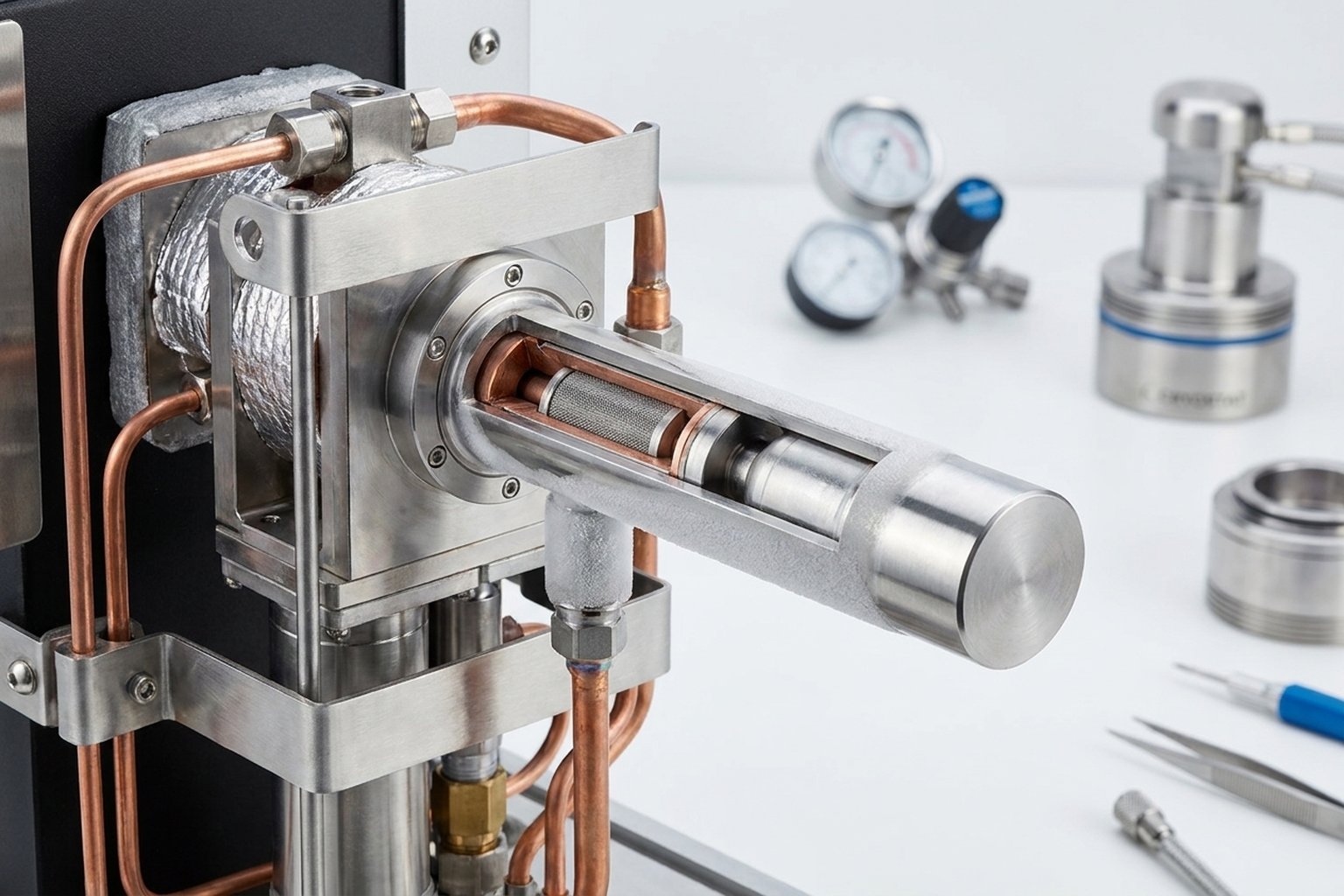
For decades, liquid nitrogen (LN2) served as the default cooling method for infrared detectors. A small dewar flask surrounding the detector element provides the necessary 77K environment through the boiling of liquid nitrogen at atmospheric pressure. In a laboratory, this approach works well — LN2 is readily available, refill schedules are predictable, and the instrument stays stationary.
In field applications, however, liquid nitrogen introduces a cascade of practical problems that limit instrument utility:
Limited Hold Time
Portable detector dewars typically hold enough LN2 for 8 to 24 hours of operation, depending on dewar size and thermal design. This creates hard operational windows. A field technician conducting environmental monitoring at a remote site must plan around LN2 availability, often cutting measurement campaigns short or carrying excess coolant weight.
Supply Chain Dependency
Liquid nitrogen requires a supply infrastructure — gas suppliers, delivery schedules, and storage facilities. In remote locations, developing regions, or emergency response scenarios, this supply chain may not exist. The instrument becomes useless once the dewar runs dry, regardless of battery life or data storage capacity.
Safety and Handling Concerns
Transporting and handling cryogenic liquids in field conditions introduces safety risks. Spill hazards, asphyxiation risk in confined spaces, pressure buildup in sealed containers during transport, and the need for specialized training all add operational complexity. Many field environments — offshore platforms, underground mines, aircraft cabins — impose strict restrictions on cryogenic liquid transport.
Weight and Volume Penalties
The dewar assembly, insulation, and LN2 supply add significant weight and volume to portable instruments. For truly man-portable applications — handheld analyzers, drone-mounted sensors, or backpack-carried monitoring systems — this mass budget is often unacceptable.
Cool-Down Delays
After an LN2 fill, the detector and dewar assembly require time to reach thermal equilibrium. This cool-down period delays the start of measurements and wastes valuable field time, particularly when multiple fill cycles are needed during extended campaigns.
How Stirling Cryocoolers Solve the Portable Cooling Problem
Free Piston Stirling Coolers eliminate the liquid nitrogen dependency entirely. Instead of relying on a consumable cryogen, FPSC technology uses the thermodynamic Stirling cycle to pump heat from a cold tip to a heat rejection surface, achieving cryogenic temperatures through mechanical refrigeration powered by electricity alone.
The RIGID FPSC series — including the RS44, RS100, and RS100-Plus models — exemplifies this approach. These coolers reach temperatures down to -196°C (77K) at the cold tip, matching the operating point required by MCT and InSb detectors. They operate from 12V or 24V DC power, making them compatible with battery packs, vehicle power systems, and solar installations commonly available in field scenarios.
Several design characteristics make FPSC technology particularly suited to portable gas analysis instruments:
Sealed, Maintenance-Free Operation
The free piston design eliminates mechanical contact between moving parts — there are no wearing seals, no lubricants to degrade, and no consumables to replenish. The working gas (helium) is permanently sealed within the cooler. This translates to maintenance-free operation with a mean time between failures (MTBF) exceeding 50,000 hours. For field instruments, this reliability means years of service without scheduled maintenance interventions.
Compact Form Factor
With typical weights in the 1 to 3 kg range (model-dependent), FPSC coolers add far less mass than an LN2 dewar system. Their cylindrical geometry integrates efficiently into instrument housings, and the absence of a liquid reservoir eliminates the need for orientation-specific mounting that dewars require.
DC Power Compatibility
Operating from 12V or 24V DC, these coolers connect directly to the same power systems that run the instrument’s electronics, laser sources, and data acquisition hardware. No AC power infrastructure is needed, enabling truly autonomous field deployment powered by batteries or renewable energy sources.
Unlimited Operational Duration
Unlike LN2 systems with fixed hold times, an electrically powered Stirling cooler operates continuously as long as power is available. Combined with modern lithium battery technology or vehicle power, this enables measurement campaigns lasting days or weeks without cooling interruptions.
Detector Types That Benefit from FPSC Cooling
Different gas analysis techniques employ various detector technologies, each with specific cooling requirements. FPSC Stirling coolers are well-suited to the following detector categories:
Mercury Cadmium Telluride (MCT/HgCdTe) Detectors
MCT detectors are the workhorse of high-sensitivity FTIR spectroscopy. They offer broad spectral response across the mid-infrared region (typically 2-12 μm or wider, depending on composition) with fast response times suitable for rapid-scan interferometry. MCT detectors require cooling to approximately 77K for optimal performance — precisely the temperature range achievable by FPSC coolers. In portable FTIR instruments for gas analysis, replacing the LN2 dewar with a Stirling cooler transforms a laboratory instrument into a field-deployable system.
Indium Antimonide (InSb) Detectors
InSb detectors provide exceptional sensitivity in the 1-5.5 μm spectral range, covering important absorption bands for gases like CO, CO2, N2O, and various hydrocarbons. Like MCT detectors, InSb elements require cryogenic cooling near 77K. Their use in portable gas correlation spectrometers and filter-based analyzers benefits directly from FPSC cooling integration.
Quantum Well Infrared Photodetectors (QWIPs)
While less common in portable instruments, QWIP-based imaging systems used in gas leak visualization (optical gas imaging) also require cryogenic cooling. FPSC coolers enable handheld or drone-mounted gas imaging cameras that would be impractical with LN2 cooling.
Superconducting Sensors
Emerging gas analysis techniques using superconducting transition-edge sensors or kinetic inductance detectors for terahertz spectroscopy require even lower temperatures, but FPSC coolers can serve as the upper-stage cooler in multi-stage cryogenic systems, reducing the heat load on sub-Kelvin stages.
Portable Instrument Design Considerations
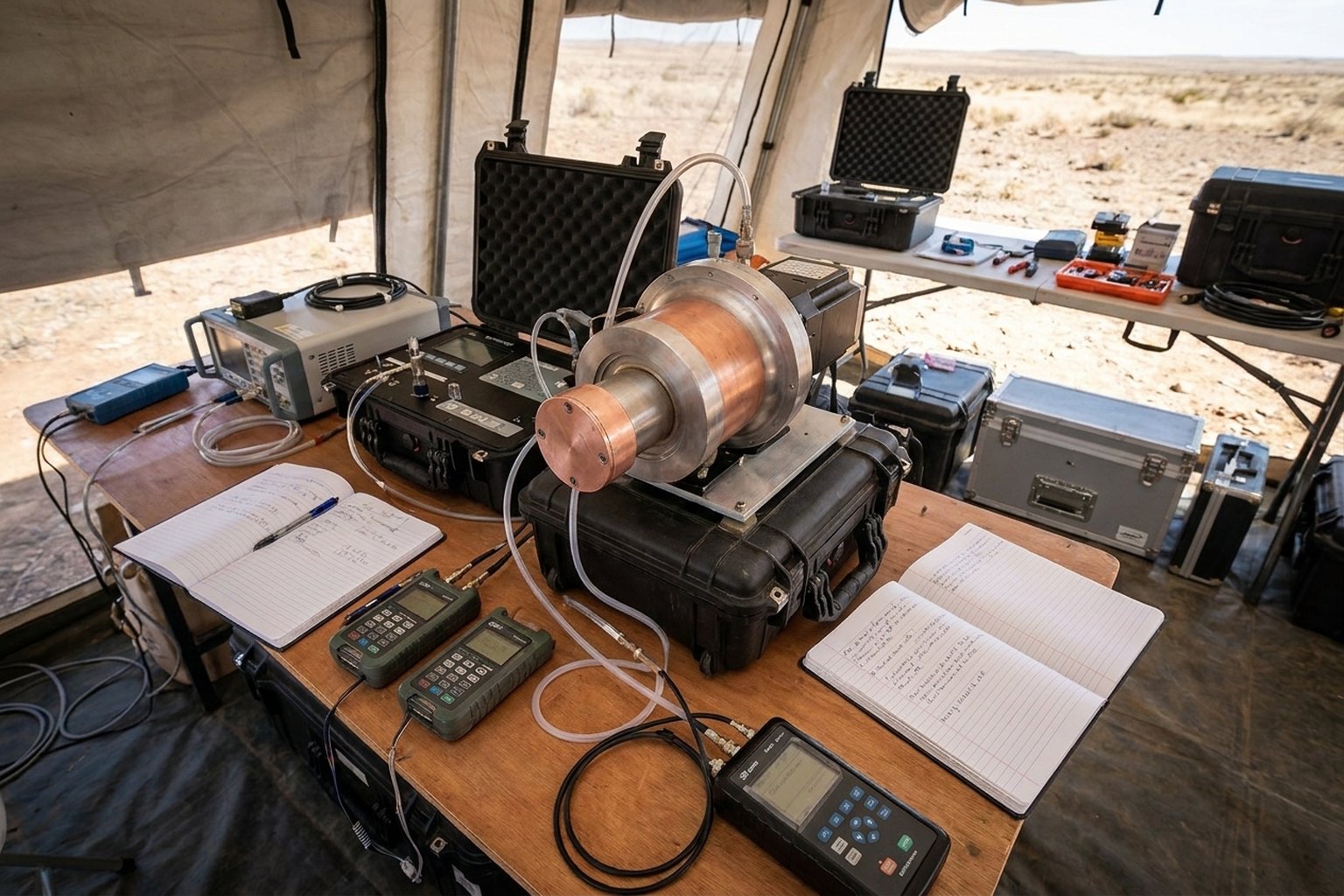
Integrating a Stirling cryocooler into a portable gas analyzer requires attention to several engineering factors that differ from laboratory instrument design:
Vibration Management
While FPSC coolers feature balanced piston designs that minimize vibration, some residual mechanical disturbance exists at the drive frequency and its harmonics. For sensitive optical measurements — particularly interferometric techniques like FTIR — this vibration must be managed. Instrument designers typically employ soft mounting systems, counterbalance mechanisms, or signal processing techniques to mitigate vibration effects on measurement quality. The low vibration signature of modern FPSC designs makes this manageable, but it requires deliberate engineering attention during instrument development.
Heat Rejection
Stirling coolers reject heat at their warm end — the thermal energy pumped from the cold tip plus the electrical input power must be dissipated. In portable instruments, this heat rejection must be managed without excessive fan noise, without raising internal instrument temperatures beyond acceptable limits, and without creating thermal plumes that could interfere with gas sampling. Careful thermal design of the instrument enclosure, including heat sink sizing and airflow management, is essential.
Power Budget
While FPSC coolers are efficient relative to other mechanical cryocoolers, they still represent a significant portion of a portable instrument’s power budget. System designers must balance cooling power against battery capacity, instrument runtime requirements, and the power needs of other subsystems (laser sources, electronics, displays, communications). Power management strategies — including cooler power modulation based on thermal load — can optimize battery life.
Orientation Flexibility
Field instruments may operate in various orientations — handheld at different angles, mounted on vehicles traversing uneven terrain, or installed on aerial platforms. FPSC coolers can operate in multiple orientations (model-dependent), but performance may vary with orientation due to gravity effects on internal gas dynamics. Instrument designers should verify cooler performance across the expected range of operating orientations during the design phase.
Environmental Protection
Field environments expose instruments to dust, moisture, temperature extremes, and mechanical shock. The cooler integration must account for environmental sealing, shock isolation, and thermal management across the specified operating temperature range. The sealed, hermetic construction of FPSC coolers provides inherent protection for the cooler mechanism itself, but the overall instrument design must protect the cooler’s heat rejection surfaces and electrical connections.
Field Deployment Advantages
When a portable gas analyzer incorporates Stirling cryocooler technology instead of liquid nitrogen, the operational profile transforms in several meaningful ways:
Rapid Deployment
FPSC coolers typically reach operating temperature within minutes of power-on, compared to the fill-and-wait cycle of LN2 systems. A field technician can power up the instrument and begin measurements quickly, critical in emergency response scenarios where time-to-data matters.
Autonomous Operation
Without the need for periodic LN2 refills, Stirling-cooled instruments can operate unattended for extended periods. This enables continuous monitoring stations in remote locations, automated sampling systems on mobile platforms, and long-duration survey campaigns without human intervention for cooling maintenance.
Simplified Logistics
Eliminating liquid nitrogen from the field kit removes an entire logistics chain — no cryogen suppliers, no specialized transport containers, no handling training requirements, no disposal considerations. The instrument needs only electrical power, which is universally available through batteries, generators, vehicle systems, or renewable sources.
Regulatory Compliance
Many transport and workplace regulations restrict cryogenic liquid handling. Stirling-cooled instruments avoid these restrictions entirely, enabling deployment in regulated environments (aircraft, submarines, mines, clean rooms) where LN2 may be prohibited or heavily restricted.
Reduced Total Cost of Ownership
While the initial cost of a Stirling cooler may exceed a simple dewar, the elimination of ongoing LN2 procurement, the reduction in maintenance visits, and the extended instrument availability (no downtime waiting for coolant delivery) typically result in lower total cost of ownership over the instrument’s service life. The >50,000 hour MTBF of FPSC coolers means the cooling system may outlast other instrument components.
Limitations and When Liquid Nitrogen Is Still Appropriate
FPSC Stirling coolers are not a universal replacement for all cryogenic cooling needs in gas analysis. Understanding their application boundaries helps instrument designers make appropriate technology selections:
Heat Load Capacity
FPSC coolers are designed for milliwatt-to-few-watt heat loads at cryogenic temperatures. They excel at cooling small detector elements, focal plane arrays, and similar low-thermal-mass components. Applications requiring bulk cooling of large optical assemblies, cooling of high-power laser components, or maintaining large volumes at cryogenic temperatures exceed FPSC capabilities and still require LN2 or larger mechanical coolers.
Temperature Stability
For applications requiring extremely tight temperature stability (sub-millikelvin), the inherent temperature fluctuations from the Stirling cycle may require additional thermal buffering or active temperature control loops. LN2 baths provide inherently stable temperature at the boiling point, which some precision applications may prefer.
Ultra-Low Temperatures
While FPSC coolers reach 77K, applications requiring temperatures below this — such as far-infrared detectors needing 40K or below, or superconducting devices requiring single-digit Kelvin temperatures — need either specialized pulse tube coolers, Gifford-McMahon systems, or multi-stage cooling architectures where the FPSC serves as a pre-cooling stage rather than the primary cooler.
Zero-Vibration Requirements
Some ultra-sensitive measurements — certain interferometric techniques, scanning probe microscopy, or gravitational wave detection — require vibration levels below what any mechanical cooler can achieve. These applications may still require LN2 or superfluid helium cooling with vibration-isolated transfer systems.
The Future of Portable Gas Analysis
The convergence of FPSC Stirling cooler technology with advances in miniaturized optics, MEMS-based spectrometers, and low-power electronics is driving a new generation of portable gas analysis instruments. Systems that once filled laboratory benches now fit in ruggedized cases carried by a single technician. Drone-mounted gas analyzers survey pipeline corridors and industrial facilities autonomously. Networked arrays of cooled-detector instruments provide continuous spatial mapping of atmospheric composition.
This evolution depends on reliable, compact cryogenic cooling that operates without consumables — exactly what FPSC technology delivers. As detector technologies continue to advance and new spectroscopic techniques emerge, the demand for portable cryogenic cooling will only grow.
For instrument designers and system integrators working on portable gas analysis platforms, RIGID offers engineering support for FPSC cooler integration, including thermal interface design guidance, vibration characterization data, and application-specific configuration recommendations. The RS series coolers provide a proven foundation for next-generation portable analytical instruments.
Whether you are developing a handheld FTIR for environmental monitoring, a vehicle-mounted emissions analyzer, or a drone-based gas imaging system, Stirling cryocooler technology provides the path from laboratory sensitivity to field-ready performance — no liquid nitrogen required.