
You need cryogenic cooling for a portable instrument, a gas analyzer, an infrared detector, or a laboratory experiment. The thermal analysis says you need a cold tip at -80°C, -150°C, or even 77K. You have searched “cryocooler price” and found almost nothing — because cryogenic equipment manufacturers rarely publish pricing online.
This guide provides actual pricing for free piston Stirling coolers (FPSC) currently available, what determines the cost, and how to evaluate whether the investment makes sense for your application.
Cryocooler Price Overview: What Current Models Cost
RIGID manufactures free piston Stirling coolers spanning from compact portable units to high-performance cryogenic systems. Here are current list prices:
| Model | Cold Tip Temperature | Cooling Capacity | Price (USD) | Application |
|---|---|---|---|---|
| RS40 | -40°C to -80°C | 15-40W | $780 | Portable cooling, PCR, small storage |
| RS100 | -60°C to -100°C | 10-30W | $1,500 | Cascade pre-cooling, medical, industrial |
| RS100 Plus | -80°C to -120°C | 8-25W | $1,800 | Deep-freeze applications, gas analysis |
| RS100 Plus 77K | 77K (-196°C) | 3-8W at 77K | $22,800 | Infrared detectors, superconductor cooling, research |
The price jump from RS100 Plus ($1,800) to the 77K version ($22,800) reflects the exponential difficulty of reaching cryogenic temperatures. Each additional degree below -120°C requires disproportionately more engineering in seals, regenerator design, gas bearing precision, and heat rejection management.
What Drives Cryocooler Price: The Cost Factors
Stirling cryocooler pricing is not arbitrary. Several engineering and manufacturing factors explain the cost structure:
Cold tip target temperature: This is the primary cost driver. Cooling to -40°C requires a relatively simple thermodynamic cycle. Cooling to 77K (-196°C) requires a precision-engineered regenerator with specific mesh geometry, ultra-tight gas seals that prevent helium leakage over thousands of hours, and higher-grade materials throughout. The manufacturing tolerance at cryogenic performance levels increases cost by 10-15× compared to moderate temperature units.
Cooling capacity at target temperature: Watts of cooling power at the cold tip. A cooler rated for 5W at 77K is significantly more capable than one rated for 1W at the same temperature. Higher capacity means larger displacer, bigger regenerator, and more powerful linear motor — all adding material and precision manufacturing cost.
Lifetime and reliability requirements: Standard industrial FPSC units are designed for 50,000+ hours of operation. Specialty units for defense or space applications may require additional screening, burn-in testing, and documentation that adds to per-unit cost. Standard commercial units do not carry this overhead.
Production volume: Cryocoolers are low-volume precision instruments compared to conventional compressors. Manufacturing runs are measured in hundreds, not millions. This limits economy-of-scale benefits that commodity compressors enjoy. Custom configurations further reduce batch sizes and increase per-unit cost.
Integration completeness: A bare cooler module costs less than a complete system with driver electronics, temperature controller, heat rejection fan assembly, and protective enclosure. Prices listed above are for the cooler module; complete integrated systems typically add 30-50% depending on accessories required.
Comparing Cryocooler Approaches: FPSC vs Alternatives
Free piston Stirling coolers are not the only path to cryogenic temperatures. The alternatives and their cost context:
Gifford-McMahon (GM) coolers: Larger, higher capacity, and very reliable for stationary laboratory use. Price range: $15,000-$60,000+ depending on capacity and temperature. They require a separate helium compressor unit, making them impractical for portable applications. Best for: permanently installed research equipment, MRI cold heads, liquefiers.
Pulse tube coolers: No moving parts at the cold end, extremely reliable. Price: $20,000-$100,000+. Used primarily in space applications and sensitive detector cooling where vibration must be minimized. Best for: satellite instruments, telescope focal planes, vibration-sensitive measurements.
Liquid nitrogen (LN2): Not a cooler but a consumable coolant. Cost: $0.50-2.00 per liter. Provides 77K indefinitely but requires regular refilling, storage dewar maintenance, and logistics. Best for: laboratory use near a supply source, short-duration experiments, applications where periodic manual intervention is acceptable.
Thermoelectric (Peltier) cascades: Inexpensive ($50-500) but limited to approximately -60°C maximum with multiple stages, and very low efficiency below -30°C. COP drops below 0.1 at extreme temperatures. Best for: moderate cooling requirements above -40°C where size and simplicity matter more than efficiency.
The FPSC (free piston Stirling) occupies the unique intersection of: portable/compact form factor + cryogenic temperatures + reasonable lifetime + no consumables. This combination is unavailable from any other single technology at any price.
How to Evaluate If a Stirling Cryocooler Is Worth the Investment
The price of a cryocooler matters in context. Questions to answer before purchase:
What is your alternative cost? If you currently use liquid nitrogen, calculate your annual LN2 consumption cost plus dewar rental, delivery charges, safety equipment, and labor for refilling. A facility consuming 50 liters of LN2 per week at $1.50/liter spends $3,900/year on consumables alone. An RS100 Plus at $1,800 pays for itself in under 6 months if it eliminates LN2 dependency.
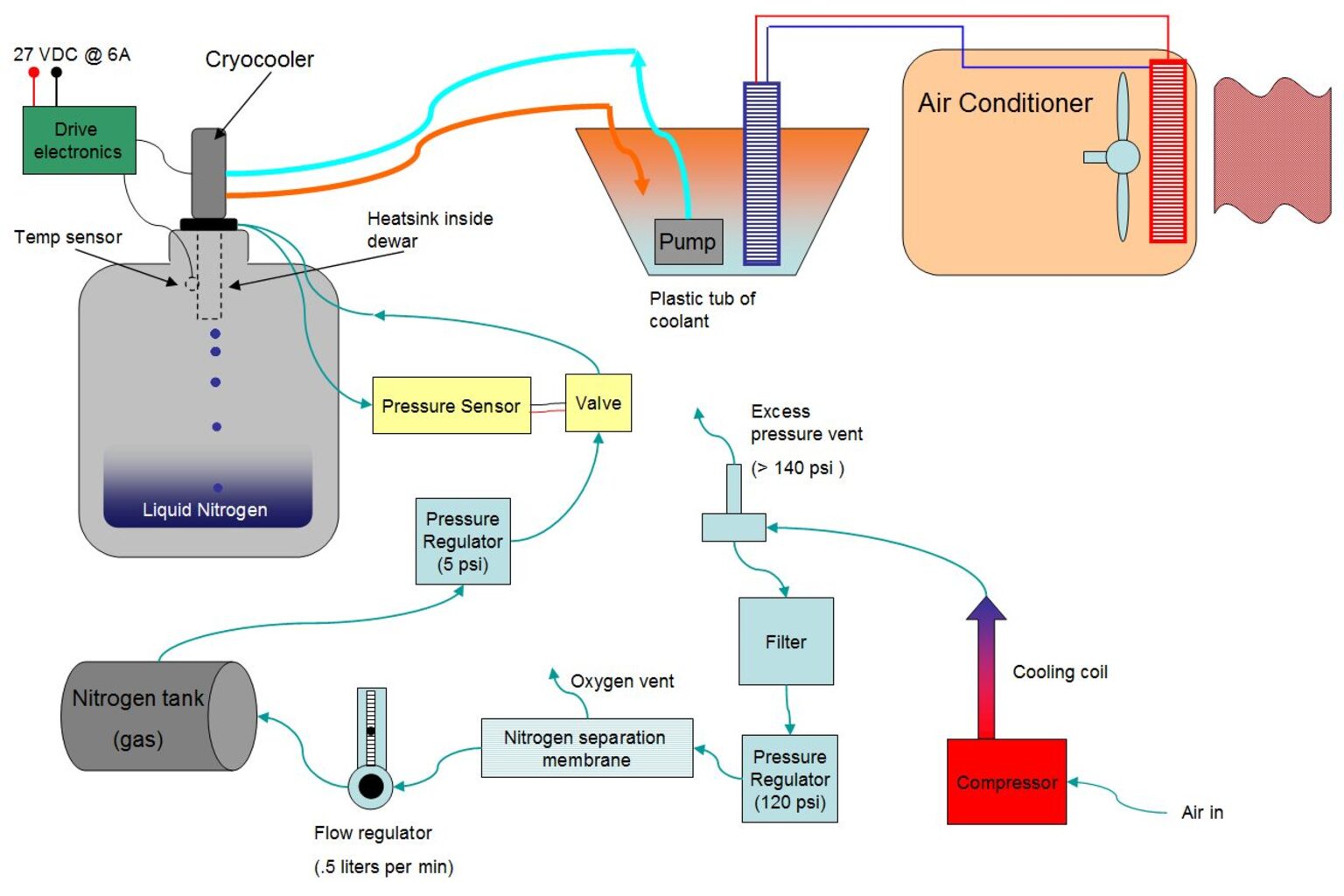 What is the value of portability? If your application requires field deployment (gas analysis at remote sites, portable IR imaging, on-vehicle detection systems), no LN2-based solution works practically. The cryocooler enables capabilities that have no fixed-infrastructure alternative. Price becomes irrelevant when the alternative is “cannot do the job at all.”
What is your duty cycle? For applications requiring continuous 24/7 cooling (detector systems, ongoing experiments), a cryocooler with 50,000+ hour life provides years of uninterrupted operation. For occasional use (a few hours per month), LN2 or rental cooler arrangements may be more economical.
What integration support do you need? If your team has cryogenic engineering experience, a bare cooler module is sufficient. If not, budget for a complete system with controller, heat management, and application engineering support. This affects total acquisition cost significantly.
Volume Pricing and OEM Programs
The list prices above apply to single-unit purchases. For OEM integration programs and volume production:
- 10+ units: Typically 10-15% below list price
- 50+ units: 15-25% below list, with possible custom configuration at no additional NRE
- 100+ units: Significant discount structure, dedicated production allocation, custom specifications included
Government, military, and research institution purchases often qualify for additional pricing programs. Contact directly for quotation on specific quantities and configurations.
Custom cold tip temperatures, non-standard mounting orientations, specialized electrical interfaces, and modified heat rejection configurations are available as engineering options. NRE (non-recurring engineering) charges for custom work range from $0 (for minor modifications at volume) to $5,000-15,000 for significant redesign.
What You Get for the Price: Performance and Specifications
To set expectations, here is what the FPSC technology delivers at each price point:
RS40 ($780): The entry point to Stirling cooling. Reaches -40°C to -80°C cold tip. Approximately 15-40W of cooling capacity depending on rejection temperature and cold tip target. Weight approximately 3-4 kg including driver electronics. Input power 50-80W. Suitable for portable PCR thermocyclers, compact deep-freeze compartments, and cascade pre-stage for reaching lower temperatures.
RS100 ($1,500): Mid-performance with -60°C to -100°C capability. Higher cooling power than RS40 at equivalent temperatures. Weight 4-5 kg. Input power 80-120W. Used in portable gas chromatography cold traps, infrared component cooling, and industrial spot-cooling applications.
RS100 Plus ($1,800): Extended temperature range to -120°C. The performance per dollar sweet spot for most deep-cooling applications. Same form factor as RS100 with enhanced regenerator design. Applications include ultra-low temperature freezers, cold trap systems for vacuum processes, and scientific instrumentation.
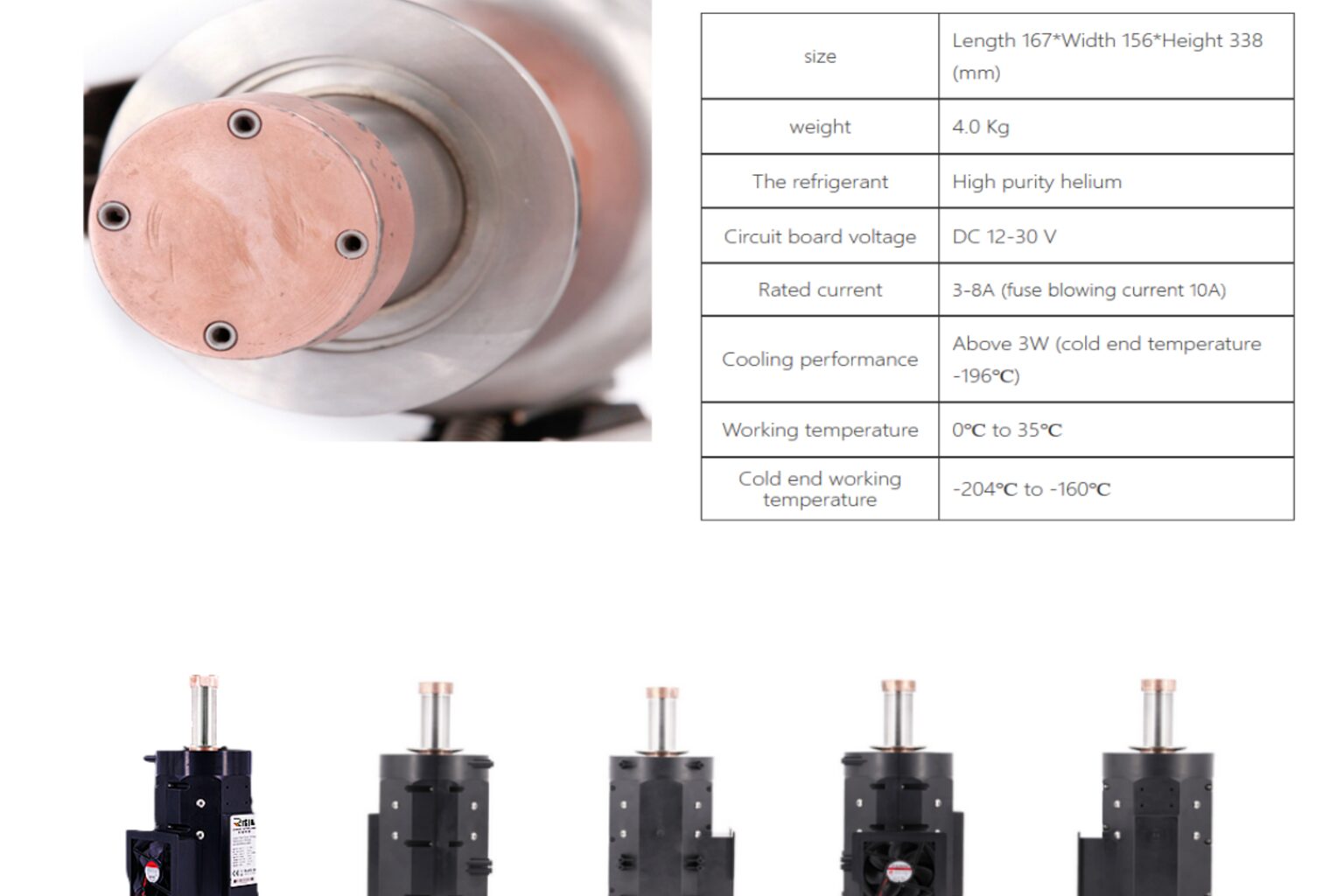
RS100 Plus 77K ($22,800): True cryogenic performance at liquid nitrogen temperatures without liquid nitrogen. 3-8W cooling at 77K sustained indefinitely. This enables portable IR detector cooling, HTS (high-temperature superconductor) experiments, and mobile cryogenic applications that previously required LN2 logistics. The price reflects precision manufacturing of components that must survive millions of cycles at temperature extremes spanning 200+ degrees.
For detailed specifications, cooling curves at various rejection temperatures, and dimensional drawings, visit the RIGID Free Piston Stirling Cooler product page.
Ordering and Lead Time
Standard models (RS40, RS100, RS100 Plus) typically ship within 2-4 weeks for in-stock units or 6-8 weeks for production runs. The RS100 Plus 77K, due to precision manufacturing and testing requirements, has 8-12 week lead time.
Evaluation programs are available for qualifying applications — contact engineering support to discuss your thermal requirements, operating environment, and integration constraints before committing to a purchase. Proper application matching prevents expensive mistakes and ensures the cooler you buy actually solves your thermal problem.
Real Applications and Their Price Context
Understanding what people actually use cryocoolers for helps contextualize the pricing:
Portable gas analyzers ($780-$1,800 cooler): Field-deployable instruments for environmental monitoring, leak detection, or process gas analysis use cold traps to concentrate trace analytes. Previously these instruments required LN2 dewars in the field — heavy, limited-duration, logistically complex. An RS40 or RS100 eliminates the LN2 dependency entirely, enabling continuous unattended operation at remote sites. The cooler cost is 5-15% of the total instrument cost.
Medical ultra-low freezers ($1,500-$1,800 cooler): Point-of-care devices needing -80°C storage for biological samples traditionally required large mechanical cascade refrigeration systems (heavy, power-hungry, expensive). A Stirling cooler provides -80°C in a portable form factor suitable for field clinics, ambulances, and disaster response teams. The cooler enables a device category that simply did not exist previously.
Infrared detector cooling ($22,800 cooler): Military and scientific IR detectors (HgCdTe, InSb) require cooling to 77K for optimal sensitivity. These detectors cost $50,000-$500,000 for the focal plane array alone. A $22,800 cooler is a modest fraction of the detector system cost, and enables portable/vehicle-mounted operation that dewar-cooled alternatives cannot match for extended missions.
 Superconductor experiments ($22,800 cooler): High-temperature superconductors (YBCO, BSCCO) transition below ~90K. Maintaining a small sample at 77K for materials research, magnetic levitation demonstrations, or sensor development previously required continuous LN2 supply. A cryocooler provides indefinite hold time without logistics.
Total Cost of Ownership: Beyond Purchase Price
The sticker price of a cryocooler is not the full picture. Total cost of ownership over a 5-year operating period:
FPSC Stirling Cooler (example: RS100 Plus at $1,800):
- Purchase: $1,800
- Electricity (100W average × 24h × 365d × 5yr × $0.12/kWh): $526
- Maintenance: Minimal — no consumables, no oil changes, no refilling. Possible fan replacement at year 3-4: $20
- Total 5-year cost: ~$2,350
Equivalent LN2 cooling to -100°C:
- LN2 consumption (estimated 5L/day for continuous operation): 5 × 365 × 5 = 9,125 liters
- LN2 cost at $1.50/L: $13,688
- Dewar rental or purchase: $500-2,000
- Delivery charges: $200-500/year × 5 = $1,000-2,500
- Labor for refilling (15 min/day × value): significant
- Total 5-year cost: $15,000-18,000+
The cryocooler pays for itself within the first 3-4 months of continuous operation when replacing LN2 cooling. Even for intermittent use (a few hours per day), payback occurs within the first year in most scenarios.
Buying Process: What to Expect
Purchasing a Stirling cryocooler differs from commodity equipment procurement. Here is the typical process:
- Application consultation: Describe your thermal load, target temperature, duty cycle, environment, and integration constraints. The engineering team confirms whether the cooler can meet your requirements and recommends the appropriate model.
- Quotation: Formal quote including the cooler model, accessories (controller, heat sink, cables), and any custom configuration. Lead times are confirmed at this stage.
- Technical review: For complex integrations, an application note or integration guide may be provided showing mechanical interface, electrical connections, thermal budget, and expected performance at your specific conditions.
- Order and production: Standard models 2-4 weeks. Custom configurations 6-12 weeks depending on modification scope.
- Commissioning support: Remote or on-site support for initial installation and performance verification available upon request.
For current pricing, availability, and application engineering consultation on the complete FPSC range, see the RIGID Free Piston Stirling Cooler page.
Frequently Asked Questions About Cryocooler Pricing
Why is there such a large price gap between the RS100 Plus and the 77K version?
The 77K version requires fundamentally different regenerator technology (rare earth materials for the cold section), tighter manufacturing tolerances (micron-level gas bearing gaps), longer helium paths, and extensive performance testing at cryogenic temperatures. Each unit undergoes multi-day characterization at operating temperature before shipment. The manufacturing process has yield-rate considerations that do not apply to warmer-temperature units.
Can I get a cryocooler for under $500?
Not a Stirling cryocooler. Below $500 you are in Peltier thermoelectric territory, which reaches approximately -40°C maximum with multi-stage modules and has very low efficiency at those temperatures. If your target temperature is above -40°C and efficiency is not critical, Peltier may serve your needs at lower cost. Below -40°C, Stirling is the lowest-cost path to cryogenic temperatures in a portable format.
Are used or refurbished cryocoolers available?
Occasionally. Some integrators sell systems when projects end. However, Stirling coolers have finite life characteristics (gas bearing wear, flex lead fatigue) that are not visible externally. A used unit may have significant life consumed with no external indication. Buying from the manufacturer with full warranty and known operating hours is strongly recommended for critical applications.
What is included in the listed price?
Standard pricing includes the cooler module and basic driver electronics. Heat rejection hardware (heat sink, fan assembly), mounting brackets, temperature controller, and interconnect cables are typically ordered separately based on your specific integration requirements. Ask for a complete system quote if you need everything for a turnkey installation.
Do prices change with quantity?
Yes, significantly. Single-unit pricing represents the worst case. For production programs of 10+ units, pricing improves 10-25% depending on model and quantity. For 100+ units, custom engineering modifications may be included at no additional charge. Government and research institution programs have separate pricing structures.