
Street Sweeper Cooling Is an Energy Budget Problem — Not a Comfort Problem
On a diesel street sweeper, cab air conditioning is an afterthought. The engine has power to spare, the alternator feeds a compressor, and nobody measures the fuel cost of keeping the operator cool because it disappears into the noise of a machine that burns 15–25 liters of diesel per shift regardless.
On a battery-electric street sweeper, everything changes. The entire vehicle — drive motor, sweeping brushes, vacuum fan, water spray system, lights, controls, and operator comfort — runs from a single battery pack with a fixed energy budget for the shift. Every kilowatt-hour consumed by the air conditioning system is a kilowatt-hour not available for sweeping. Cab cooling is no longer a comfort line item — it is a direct competitor for operational runtime.
This is the central engineering tension that fleet managers and municipal procurement teams face when specifying street sweeper cooling for battery-electric platforms. The operator needs a habitable cab to work an 8-hour shift in summer heat. The machine needs enough battery capacity to complete its route without a mid-shift recharge. The AC system sits between these two non-negotiable requirements, and its efficiency determines whether both can be satisfied simultaneously.
The Battery Budget Reality on Electric Sweepers
Understanding why AC efficiency matters on electric sweepers requires looking at the energy math that governs these machines.
A typical mid-size battery-electric street sweeper carries a battery pack in the range of 60–200 kWh, depending on manufacturer and configuration. Of this total capacity, the drive motor consumes 30–40% during a full shift, the sweeping system (brushes, vacuum, water) consumes another 30–40%, and the remaining 20–30% covers auxiliary systems — lights, controls, hydraulics, and cabin comfort.
On a 100 kWh battery, that auxiliary budget is roughly 20–30 kWh for an 8-hour shift. A cab AC system drawing 2,300 W at full load would consume 18.4 kWh over 8 hours of continuous full-load operation — consuming nearly the entire auxiliary budget and leaving almost nothing for lights, controls, and other systems.
In practice, of course, the AC does not run at full load continuously. A variable-speed DC compressor throttles back once the cab reaches setpoint, and the average power draw in moderate conditions is typically 40–60% of rated capacity. That brings the 8-hour consumption down to roughly 7–11 kWh — a significant but manageable fraction of the auxiliary budget.
The difference between a high-efficiency DC system and a low-efficiency generic unit can be 30% or more in energy consumption for the same cooling output. On an electric sweeper, that 30% translates directly to additional sweeping range or the difference between completing the route on one charge versus needing a mid-shift battery swap.
Why Generic Vehicle AC Falls Short on Sweepers
Street sweepers — whether diesel or electric — present a combination of operating conditions that generic vehicle AC systems are not optimized for.
Low Vehicle Speed, High Solar Exposure
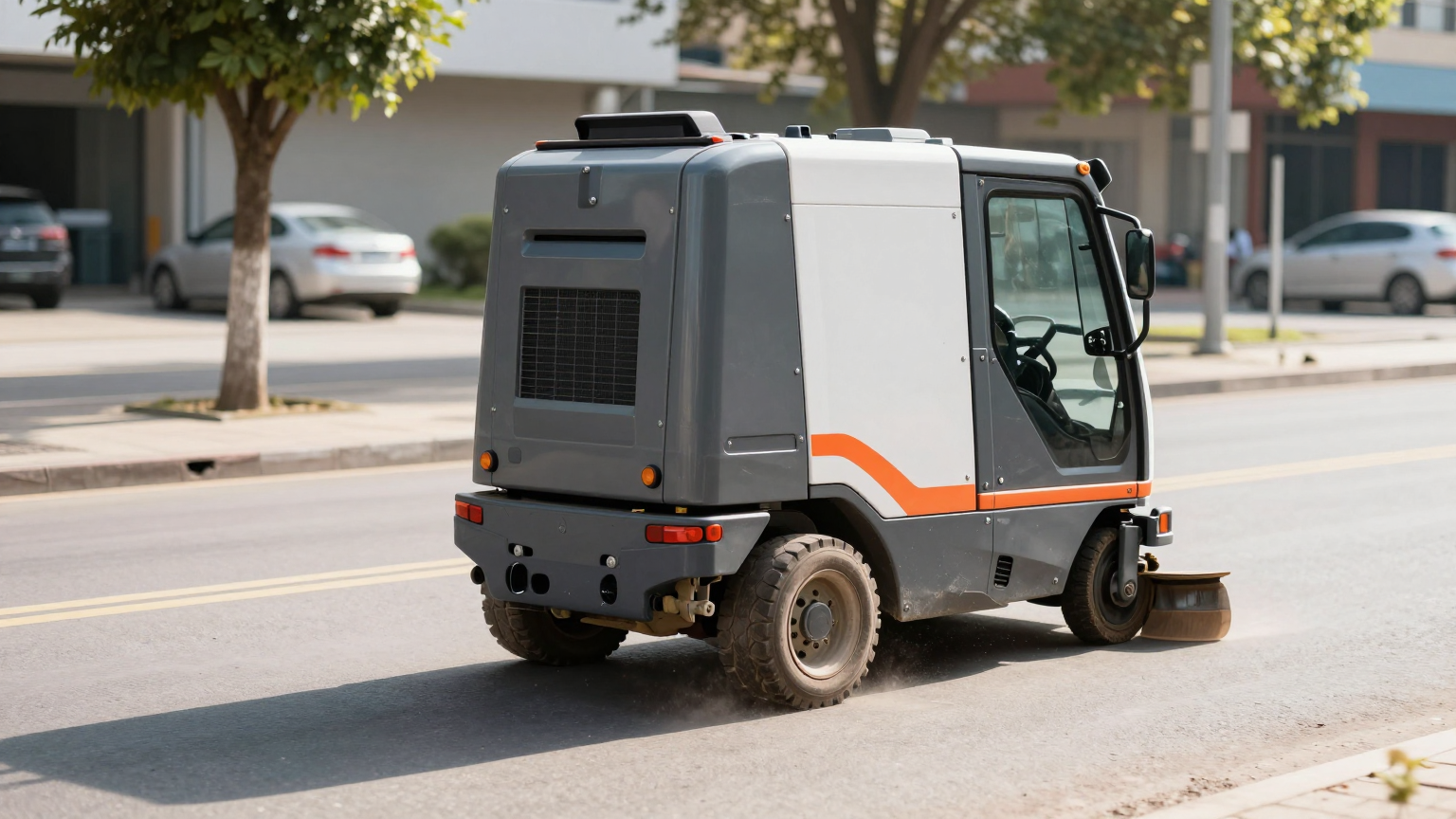
Sweepers operate at 5–15 km/h during active sweeping — too slow to generate meaningful ram air across the condenser. The machine spends hours crawling along sun-exposed roads, parking lots, and open areas with no shade. The condenser must rely entirely on its own fan for heat rejection, and the thermal load on the cab is sustained and maximum for the duration of the sweeping route.
Dust and Debris Environment
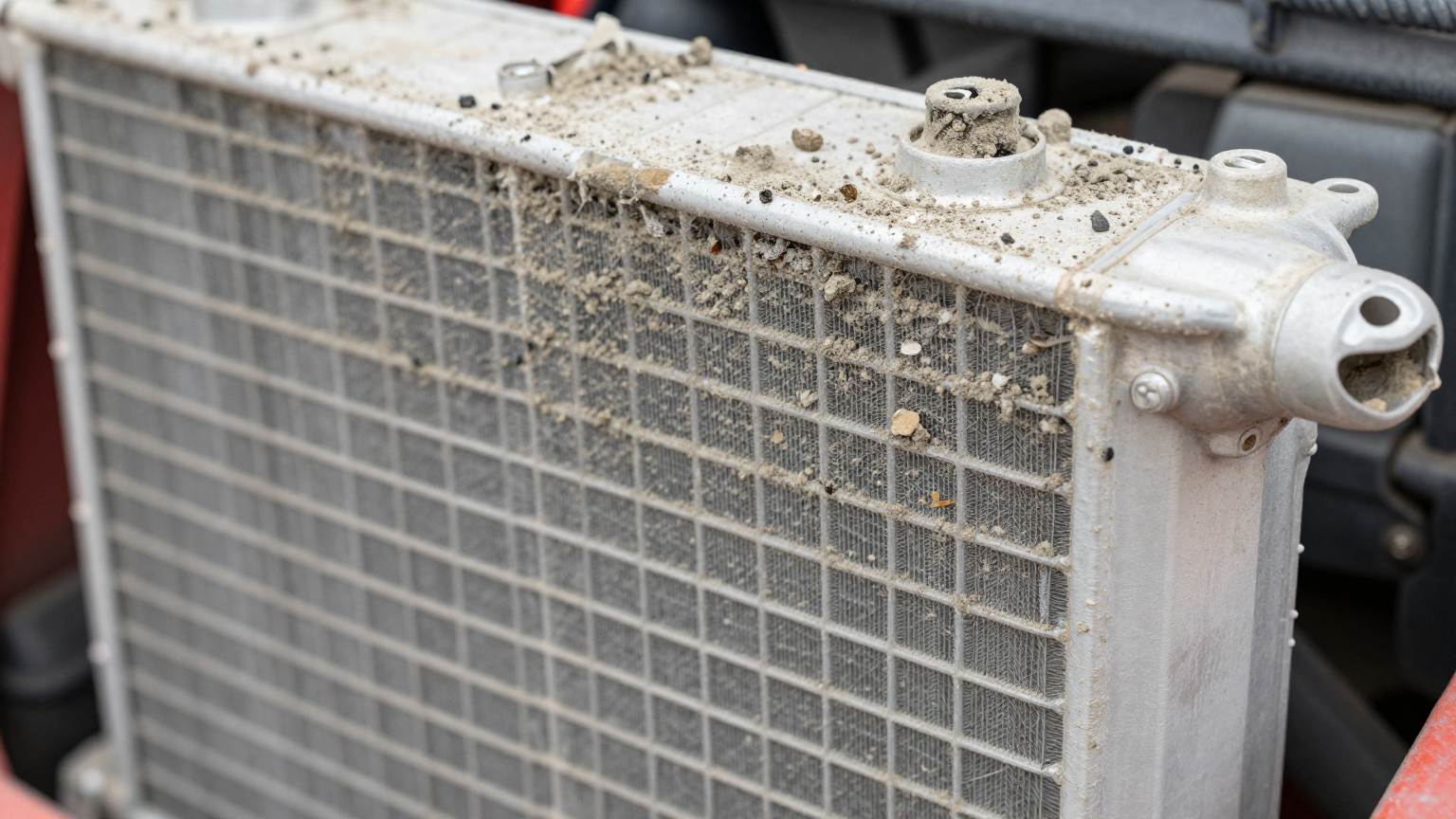
Sweepers operate in their own dust cloud. The machine generates airborne particulates as a core function of its operation — the brushes and vacuum system lift dust, debris, and fine particles from the road surface, and a portion of this material surrounds the vehicle in a persistent haze. The condenser coil, which must draw ambient air across its fins, ingests this dust continuously. Condenser fouling is the single most common cause of AC underperformance on sweeper applications, and it happens faster on sweepers than on virtually any other vehicle type.
Extended Daily Runtime
Municipal sweepers typically operate 6–10 hours per day, often starting in early morning and running through midday heat. The AC system accumulates more daily run hours than most vehicle applications — comparable to over-the-road trucks but with the added stress of continuous dust exposure and low-speed condenser airflow.
Operator Retention in Municipal Fleets
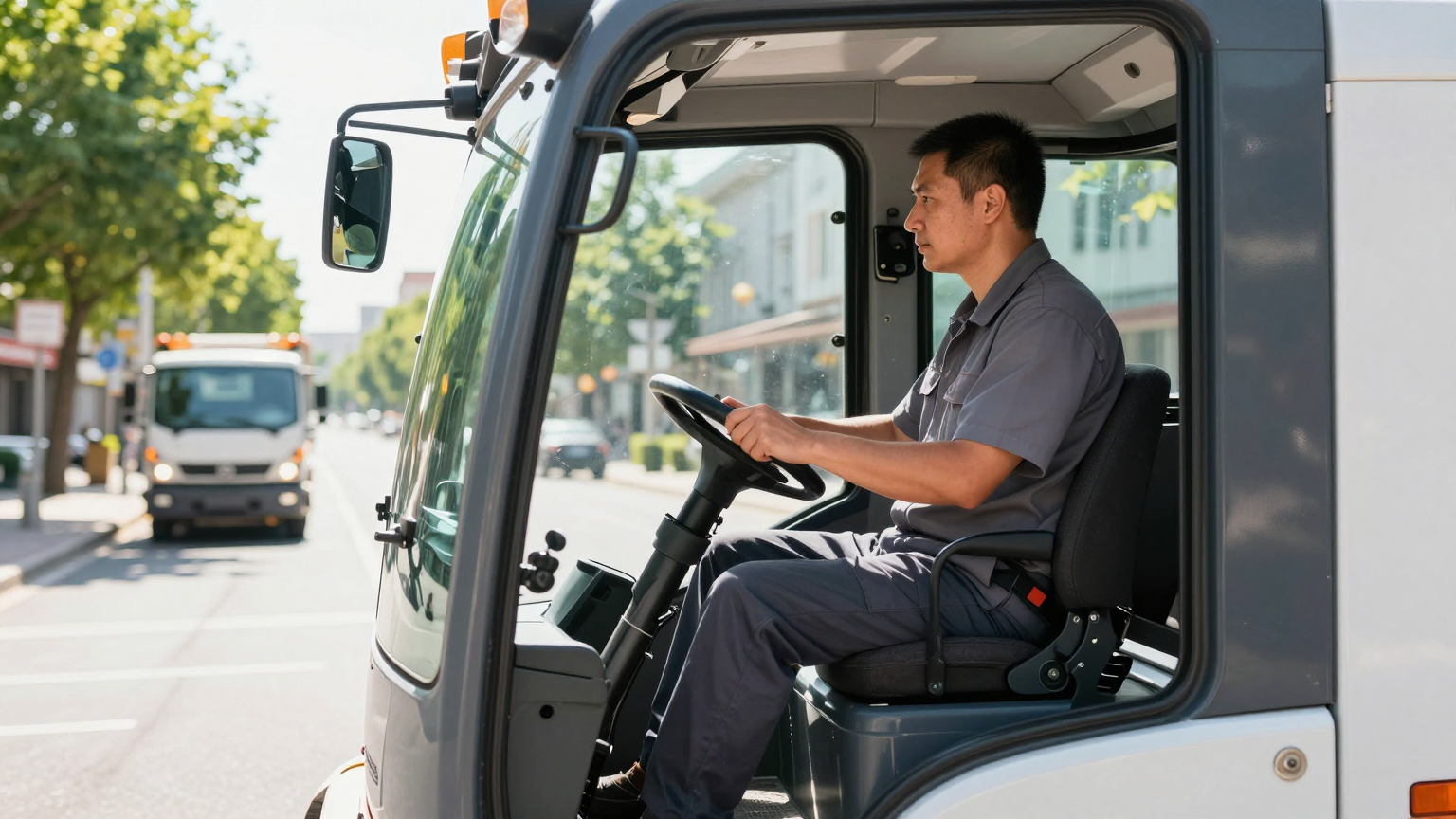
Sweeper operators are among the hardest-to-recruit positions in municipal public works departments. The work is repetitive, the hours are early, and in summer the cab environment without AC makes an already difficult job physically punishing. Fleet managers consistently report that cab comfort — specifically, working air conditioning — is a top factor in operator retention and sick-day reduction during summer months.
Efficiency Levers: Where the Energy Savings Come From
Not all AC systems consume the same energy for the same cooling output. The efficiency gap between a well-designed DC system and a generic aftermarket unit comes from several specific engineering choices.
Variable-Speed Compressor Operation
Variable-speed operation is the single largest efficiency lever. A fixed-speed compressor runs at one speed — full capacity — and cycles on and off to regulate temperature. Each startup draws a surge current that is 3–5 times the running current, stressing the battery and the compressor motor. A variable-speed DC compressor adjusts its speed continuously to match the actual cooling demand. Once the cab reaches setpoint, the compressor slows to the minimum speed needed to maintain temperature, drawing a fraction of its rated power. This modulating behavior produces the 30%+ energy savings that matter on a battery-constrained vehicle.
DC-Native Architecture
Electric sweepers run on DC battery power. An AC system that requires an inverter to convert DC to AC before driving the compressor loses 5–15% of the input energy in the conversion process — energy that produces heat rather than cooling. A DC-native system — where the compressor motor runs directly on DC power from the vehicle battery — eliminates this conversion loss entirely. On a vehicle where every kilowatt-hour is accounted for, this efficiency gain is not theoretical; it shows up in the route completion data.
Intelligent Controls and Setpoint Management
Simple thermostats cycle the system between two temperature thresholds. More sophisticated controllers can manage the compressor speed, fan speed, and fresh-air intake rate as an integrated system, optimizing for energy consumption rather than simply maintaining a fixed setpoint. Some systems allow the operator to select an “eco” mode that relaxes the setpoint by 1–2 °C in exchange for significant energy savings — a trade-off that most operators accept willingly when explained.
System Specification for Sweeper Fleets
| Specification | Sweeper Requirement | Rationale |
|---|---|---|
| Cooling capacity | 2,000–2,500 W (typical cab) | Small cab but sustained full-sun load at low speed |
| Power input | DC direct from vehicle battery | Eliminates inverter conversion losses |
| Voltage range | 24V–72V multi-voltage | Covers diesel (24V) and electric (48V–72V) platforms |
| Compressor type | Variable-speed DC rotary | Energy efficiency, low noise, vibration tolerance |
| Condenser access | Tool-free or quick-release for cleaning | Weekly cleaning required in sweeper dust environment |
| Refrigerant | Pre-charged R134a | No field charging; simplifies fleet maintenance |
| Weight | Under 50 kg total system | Minimize impact on vehicle payload and range |
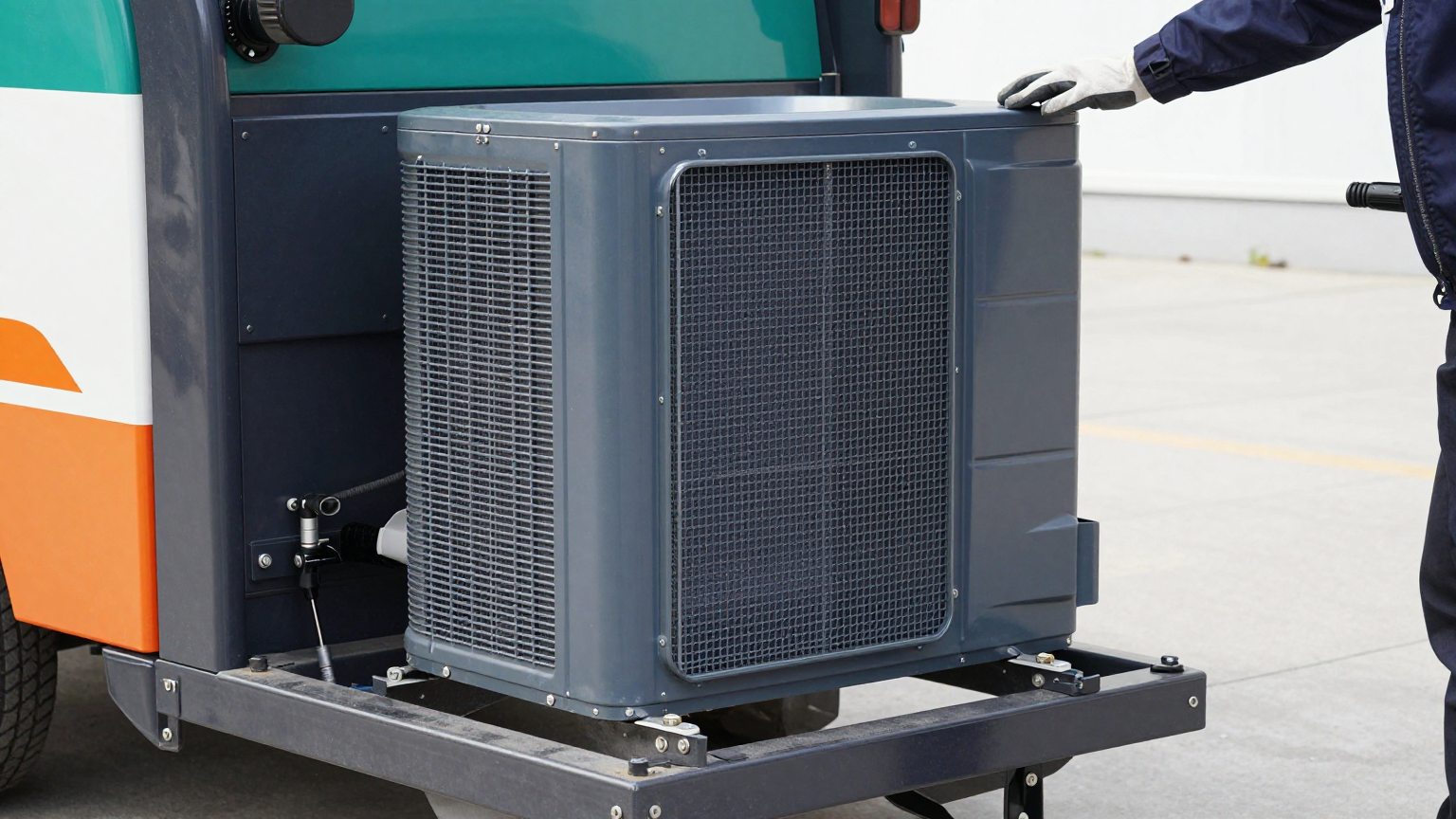
A system rated at 2,300 W (7,843 BTU) with a SANYO DC rotary compressor meets these requirements. The split-type form factor — evaporator inside the cab (440 × 140 × 320 mm), condenser mounted externally (600 × 250 × 430 mm) — allows the condenser to be positioned for maximum airflow access and cleaning convenience, which is critical in the sweeper environment.
Condenser Maintenance: The Make-or-Break Factor
On most vehicle types, condenser maintenance is a quarterly or seasonal task. On street sweepers, it is a weekly requirement — and in heavy-dust operations (construction zone sweeping, leaf season, industrial yards), it may need to be daily.
A condenser that is 30% fouled reduces cooling capacity significantly, forces the compressor to run harder and longer, and increases energy consumption by a corresponding margin — directly cutting into the battery budget. On a diesel sweeper, this shows up as slightly higher fuel consumption. On an electric sweeper, it shows up as a shorter route before the battery is depleted.
The installation should position the condenser where a technician can access it quickly — ideally at ground level, facing outward, with enough clearance to direct compressed air or a low-pressure water rinse through the fins. Mounting the condenser behind body panels that require tools to remove adds 15–20 minutes to each cleaning cycle — time that, multiplied across a fleet of 20 sweepers and weekly cleaning intervals, represents a substantial maintenance labor cost.
Integration with Electric Sweeper Platforms
Battery-electric sweepers from manufacturers like Dulevo, Boschung, Global Environmental, and others are increasingly common in municipal fleets. Integrating an aftermarket DC AC system with these platforms involves several platform-specific considerations.
Battery Management System (BMS) Compatibility
The AC system draws current from the same battery pack that the BMS monitors and protects. The AC’s power draw must be within the BMS’s allowable auxiliary load parameters. Some electric sweeper BMS systems will reduce or cut auxiliary power when the battery state of charge drops below a threshold — the AC system should handle this gracefully (shutting down cleanly rather than stalling the compressor mid-cycle).
CAN Bus Integration (Where Available)
Some advanced electric sweeper platforms offer CAN bus communication for auxiliary systems. An AC system with CAN bus capability can report its operating status, power consumption, and fault codes to the vehicle’s central display, and can receive commands to reduce power draw when the BMS signals low battery state. This level of integration is not universally available but is increasingly valued in fleet procurement specifications.
Weight and Balance
Every kilogram added to an electric sweeper reduces its operational range. A 48 kg AC system is roughly equivalent to 0.5–1.0 kWh of additional energy consumption per shift due to the increased mass the drive motor must move. While this is a small fraction of total consumption, it reinforces the importance of selecting a compact, lightweight system rather than over-specifying a heavier unit with excess capacity.
Common Field Questions
How much range will I lose by running the AC on an electric sweeper?
It depends on the battery capacity and the AC system’s average duty cycle. On a 100 kWh electric sweeper with a 2,300 W DC AC system running at 50% average duty cycle, the AC consumes approximately 9 kWh over an 8-hour shift — about 9% of total battery capacity. With a high-efficiency variable-speed system, this can drop to 7–8%. The actual range impact depends on the proportion of total energy consumed by the drive system versus auxiliary loads.
Can I use the same AC system on both diesel and electric sweepers in my fleet?
A DC AC system with multi-voltage input (24V–72V) can install on diesel sweepers (typically 24V electrical system) and electric sweepers (typically 48V–72V battery) without modification. This simplifies fleet procurement, spare parts inventory, and technician training — one system, one maintenance procedure, across the entire fleet.
How often does the condenser really need cleaning on a sweeper?
Weekly is the baseline for normal municipal sweeping operations. During heavy-dust periods (construction zone cleanup, fall leaf season, industrial yard sweeping), daily blowdown with compressed air may be necessary. Monitor the system’s cooling performance — if the compressor runs continuously without reaching setpoint on a moderately warm day, the condenser is almost certainly fouled.
Is a rooftop monoblock or split-type better for sweepers?
Split-type is generally preferred for sweepers because the condenser can be positioned for easy cleaning access — the most critical maintenance task in this application. A rooftop monoblock places the condenser on top of the cab where it is harder to reach and where airflow may be restricted by the sweeper’s body structure. The split-type also distributes weight better, which matters on battery-electric platforms where every kilogram affects range.
What happens if the BMS cuts auxiliary power mid-shift?
A well-designed DC AC system handles power interruption by shutting down the compressor cleanly and resuming operation automatically when power is restored. The cab temperature will rise during the interruption, but the system will recover setpoint once auxiliary power returns. If BMS-triggered shutdowns are frequent, the fleet should evaluate whether the battery capacity or the AC system’s energy consumption needs adjustment.
Does the AC system affect the sweeper’s noise profile?
Electric sweepers are marketed partly on their low noise output — important for early-morning residential sweeping and urban noise ordinance compliance. A variable-speed DC compressor operating at partial load generates minimal noise (typically 45–55 dB at the indoor unit), well below the sweeper’s own brush and vacuum noise during operation. At idle or during breaks, the AC system becomes the dominant noise source; a quiet system maintains the electric sweeper’s noise advantage over diesel equivalents.
Integration Support
Municipal sweeper fleets vary widely in platform, battery voltage, operational patterns, and route profiles. If your fleet includes electric sweeper models with specific BMS constraints, unusual voltage ranges, or extreme dust environments, the Rigid engineering team can evaluate the application and work toward a cooling configuration that fits within the battery budget. The HS23P split-type DC air conditioner provides the energy-efficient variable-speed compressor, multi-voltage DC input, and serviceable split-type form factor that electric sweeper fleets require.
The electric street sweeper is a battery-budgeted machine. Every system on the vehicle earns its energy allocation by delivering measurable value. The AC system earns its allocation by keeping the operator functional, focused, and willing to show up for tomorrow’s shift. The question is not whether to cool the cab — it is how efficiently the cooling system uses the energy it draws. On an electric sweeper, efficiency is not a marketing claim. It is the difference between finishing the route and calling for a mid-shift battery swap.