
Light Scattering External Circulator: Identify the Circuit
For sub-zero measurements, choose a light scattering external circulator only after identifying the instrument’s temperature-control circuit, approved fluids, allowable supply conditions, and temperature measurement near the sample cell. Keep that circuit separate from any index-matching-liquid filtration circuit. A sub-zero sample target does not establish the required supply temperature or prove that the optics, vat, cell, and fluids can operate at that condition. MiniCool can enter the cooling-source review only when the required supply falls within its documented 0 to −40°C range and the complete instrument interface is approved.
This guide covers externally circulated research light scattering arrangements, including suitable DLS and SLS goniometer configurations. It does not assume that a compact benchtop analyzer with internal temperature control accepts an external bath. Identify the instrument plumbing before selecting the cooling source. The decision is about a particular thermal circuit and measurement workflow, not the broad label optical instrument cooling.
Confirm That the Instrument Supports an External Circulator
Brookhaven’s BI-200SM product literature describes temperature control using an external circulator and separate temperature and filtration plumbing. Its optional temperature accessory measures the index-matching liquid near the sample cell. This provides a real example of an external-circulation architecture. It does not establish the temperature limits, hydraulic requirements, or compatibility of a particular RIGID connection.
Obtain the installed instrument’s instructions and accessory list. Record the specimen-cell assembly, vat, hoses, manifolds, and relevant sensor options. Older and newer instrument configurations may differ, so identify the actual hardware rather than relying on a current family brochure. If the instrument has no specified external-liquid connection, resolve that question with its manufacturer before evaluating an external circulator.
Map Temperature Control and Filtration Separately
The temperature-control circuit carries the fluid that transfers heat to or from the instrument’s thermal arrangement. A separate filtration circuit can circulate the index-matching liquid to maintain its optical condition. In an instrument designed with isolated plumbing, the fluids and their purposes are distinct. Do not combine them because both paths have hoses near the specimen cell.
| Circuit or location | Primary question | Evidence to obtain |
|---|---|---|
| External temperature-control circuit | What liquid and supply conditions does the instrument require? | Thermal connection drawing, fluid approval, flow and pressure limits |
| Index-matching-liquid circuit | How is the optical fluid circulated and filtered? | Vat and filtration-system instructions |
| Sample cell | What sample condition does the method require? | Sample, cell, and method temperature limits |
| Temperature sensor near the cell | What temperature does it measure and how is it used? | Accessory location, measurement specification, software configuration |
Label the circuits by function and fluid. Confirm the port identities with the manufacturer when the physical routing is unclear. The chart is a selection aid, not an instruction to alter the instrument’s plumbing. A mistake at this stage can invalidate later coolant and pump comparisons even if the proposed source reaches the requested display temperature.
Define the Sample Condition Before the Supply Setpoint
Start with the measurement requirement: the sample’s permitted temperature, the condition to be established before acquisition, and the acceptable evidence of stability. Then ask the instrument supplier what external supply conditions support that requirement. The supply liquid may need a different temperature from the sample because heat passes through the instrument’s thermal structure and exchanges with the local environment.
A requested negative sample temperature therefore does not automatically become the chiller setpoint. Conversely, a negative supply range alone does not qualify the sample, vat, or optical fluid for sub-zero use. Review those boundaries together. If the manufacturer has not approved the proposed measurement condition, retain it as an unresolved instrument requirement rather than presenting the source selection as approval.
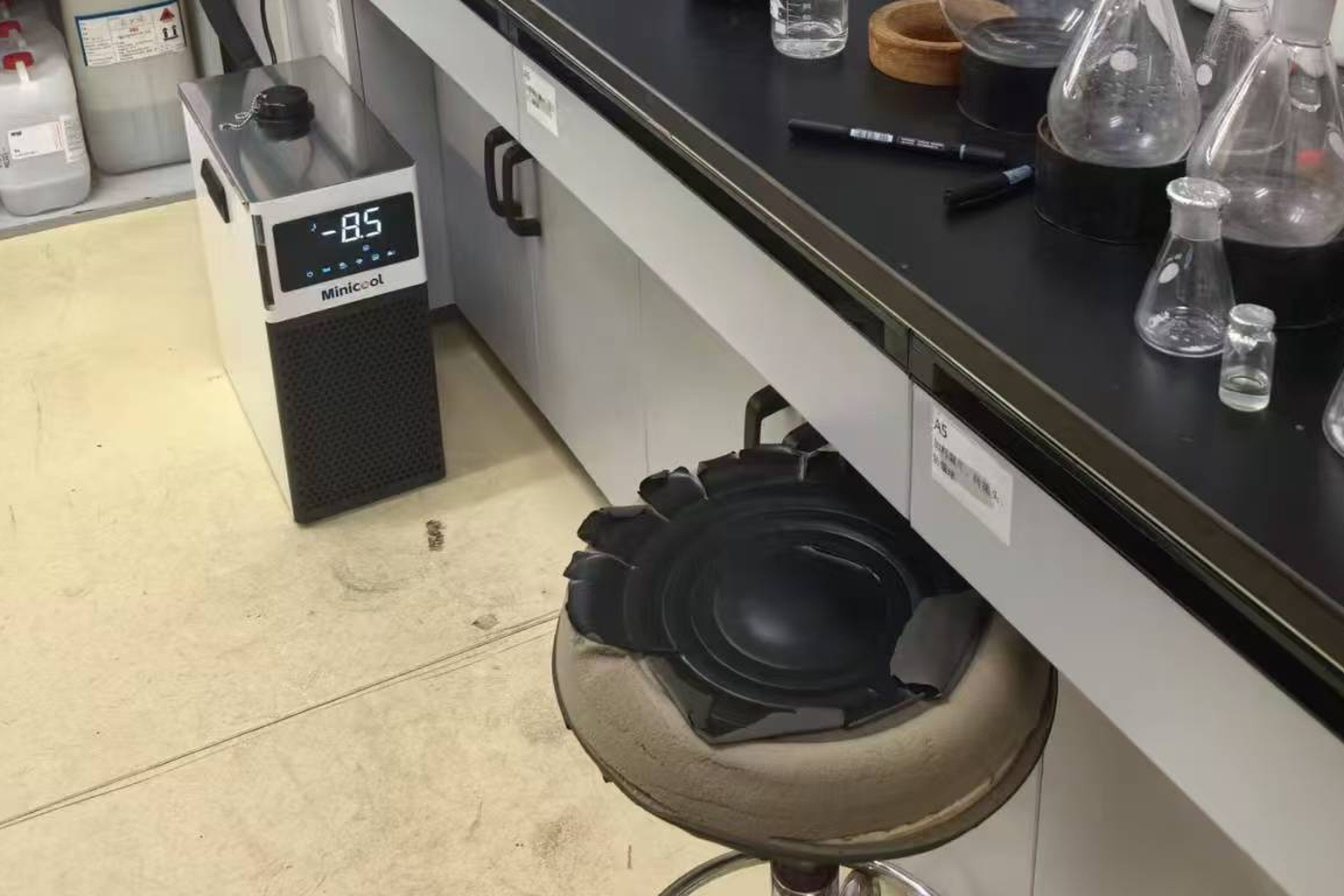
Customer MiniCool laboratory cabinet. Original screen readings are preserved; this is not a light scattering installation or a validated performance test.
Verify Temperature Near the Cell
The external circulator display and the temperature near the cell represent different locations. Brookhaven’s optional near-cell measurement illustrates why that distinction matters. For the installed light scattering system, establish which sensor is present, where it measures, and whether its result enters the analysis software or is simply recorded separately. Follow the instrument’s intended arrangement.
Compare the measurement requirement with the actual near-cell evidence. A stable reservoir reading cannot by itself establish the condition of the index-matching liquid or sample. Nor should a manufacturer accessory’s accuracy be copied to the cooling source. Use the measurement location relevant to the experiment. Document the allowed difference and stability criteria through the instrument and method requirements; do not invent a universal offset correction.
Review Both Liquids at the Proposed Temperature
Evaluate the external coolant and the index-matching liquid separately. For each, obtain the manufacturer’s permitted temperature range, material compatibility, and relevant properties. At sub-zero conditions, freezing or changes in viscosity can affect how a fluid behaves. An optical liquid also has a measurement role that a generic chiller coolant does not share. Approval of one liquid does not establish approval of the other.
The sample itself requires a separate review. A phase change, precipitation, or changed sample condition may be meaningful to the experiment, but it is not a cooling-source acceptance criterion by itself. State which sample changes the method permits and which indicate an invalid measurement condition. RIGID’s coolant selection guide provides cooling-loop context; it does not specify the index-matching liquid for an instrument.
Check Cold-Condition Flow and Pressure
Specify the light scattering external circulator using the approved coolant at the required supply condition. A pump’s water rating at a different temperature may not describe the installed cold-fluid operating point. Include the actual hose lengths and bores, instrument thermal path, fittings, and any external measurement device in the hydraulic evaluation. Obtain the allowable pressure at the instrument connections as well as the required circulation.
If hydraulic information is incomplete, define the missing items and the installed verification needed. Do not compensate by assuming a higher pump head will be acceptable. A source must meet both the circulation requirement and the instrument’s mechanical limits. The existing low-flow protection article explains a protection function, while the light scattering interface still determines the actual branch that must be monitored.
Assess Moisture Around the Optical Assembly
A sub-zero thermal arrangement can expose cold surfaces to laboratory air. Review condensation and frost risks at the hoses, external thermal connections, and instrument locations identified by the manufacturer. Use the proposed surface conditions and local humidity in that review. Optical access and moving parts can constrain the placement of insulation or environmental controls, so a generic hose-insulation plan may not resolve the full instrument condition.
Agree what evidence will show that the environment supports the measurement. Do not claim that a cold source makes the optical path moisture-free. If additional environmental protection is required, identify who supplies and approves it before delivery. This is especially relevant when light scattering acquisition depends on consistent optical conditions over a temperature sequence.
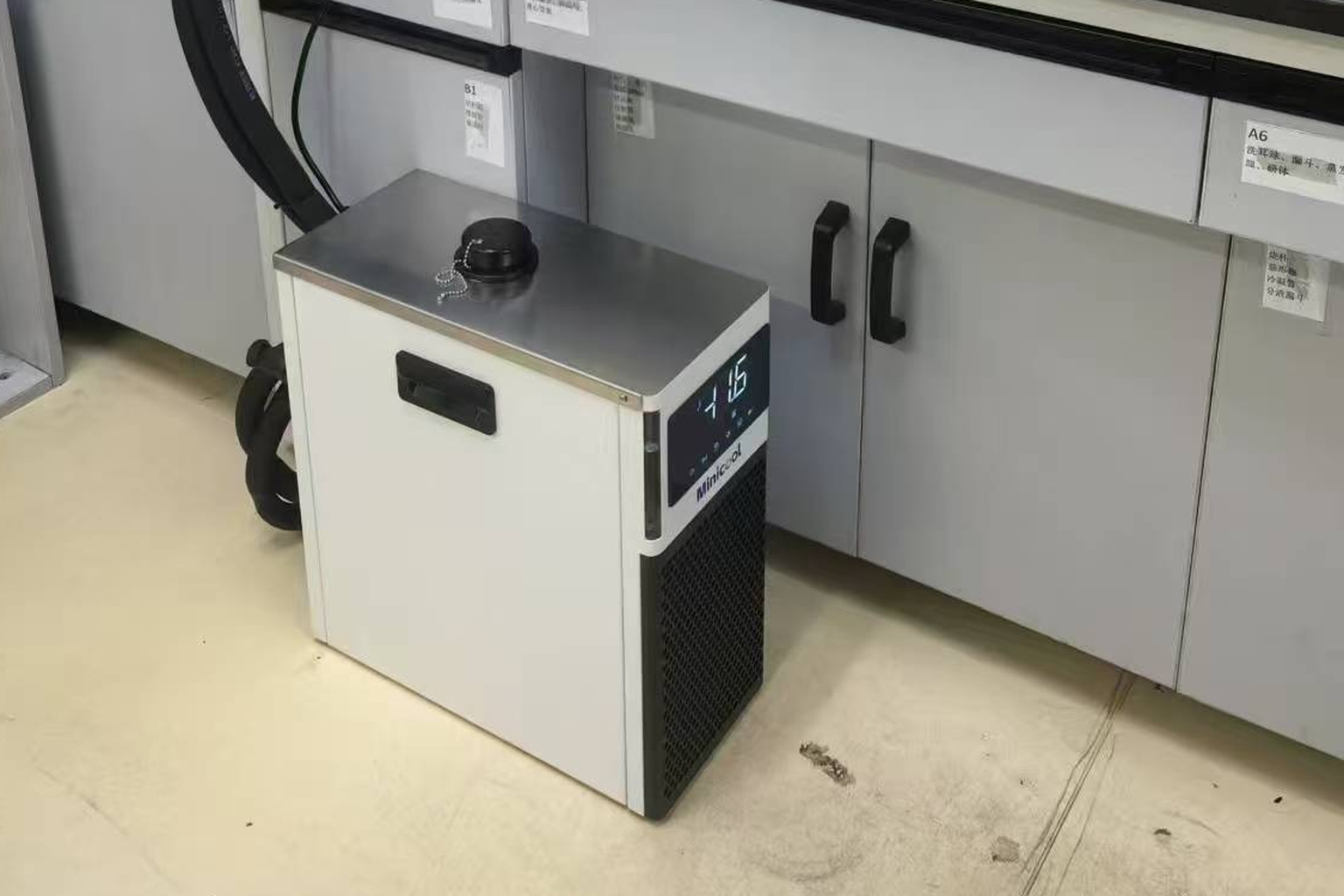
Customer MiniCool laboratory cabinet. Original screen readings are preserved; this is not a light scattering installation or a validated performance test.
Where MiniCool Enters the Sub-Zero Review
The MiniCool laboratory chiller family has a documented 0 to −40°C cooling range. That makes it a light scattering external circulator candidate for an approved negative-temperature supply duty, subject to instrument and configuration confirmation. It is not recommended here for positive-temperature supply operation. If an experiment needs warming or positive-temperature stages, establish the required heating-and-cooling arrangement separately.
MiniCool 450, MiniCool 800, and MiniCool 850 have published nominal cooling capacities, but those labels do not establish available capacity at a selected sub-zero condition. Ask for configuration-specific capacity evidence, pump information, fluid approval, and the delivered connection arrangement. No instrument compatibility is established by a family temperature range. The customer photographs show MiniCool cabinets in laboratory settings; they do not show a connected light scattering goniometer.
Keep Source Stability Separate from Measurement Performance
The MiniCool webpage lists ±0.1°C stability, while the associated test point and sensor-location conditions are not stated. Treat it as a published source specification with those limits. Do not transfer it to the sample, the index-matching liquid, or the accuracy of a light scattering result. Those quantities require the instrument’s own measurement evidence and the agreed installed validation.
Define which variation matters to the experiment and where it will be recorded. The comparison can include source supply temperature, a near-cell reading, and the timing of data acquisition, but the analytical acceptance criteria belong to the method. A clear record is more useful than describing the complete system as precise without specifying the measured quantity.
Plan the Temperature Sequence and Recovery Evidence
Define the light scattering external circulator duty by describing how the instrument is used: the starting condition, requested temperature stages, acquisition periods, and the approved return condition. Confirm whether the external source, instrument, or operator controls each stage. Do not assume that a refrigeration unit includes external-probe control, a particular communications protocol, or synchronization with the instrument software when that capability is not stated.
After a hose or fluid change, use the manufacturer’s approved filling and air-removal process, then confirm circulation and the relevant temperature condition before acquiring results. Define the recovery evidence in advance rather than assigning a universal waiting time. Release the measurement from observed conditions. That ties the external circulator’s operation to the actual light scattering workflow without claiming an unverified control integration.
Assign Control and Measurement Responsibilities Explicitly
Identify who commands the external source, who decides that the near-cell condition is acceptable, and which temperature is entered into the instrument’s analysis. These can be separate responsibilities. A temperature probe near the cell does not establish that the external source can use it as a control input, and software displaying both temperatures does not establish automatic synchronization. Request those functions only when the delivered configuration documents them.
A useful handover distinguishes an approved negative-temperature cooling duty from a sequence that also needs heating, positive-temperature holding, or an unconfirmed instrument interface. The first can proceed to configuration-specific cooling evaluation. The others need their respective gaps resolved before the source is selected. This is a practical purchasing decision for light scattering equipment: keep the supported duty visible, and identify the exact missing function rather than assuming that a laboratory-chiller label includes it. Record the agreed responsibilities with the acceptance criteria so the operator receives the same arrangement that procurement approved.
Frequently Asked Questions
Does every analyzer accept a light scattering external circulator?
No. Confirm the installed instrument’s architecture and specified liquid interface. An internally temperature-controlled benchtop analyzer does not automatically accept the circulation arrangement used by a research goniometer.
Can index-matching liquid be put in the chiller?
Do not assume so. Where the instrument has isolated thermal and filtration plumbing, treat the fluids separately. Obtain approval for the fluid used in each circuit and follow the instrument connection drawing.
Does the circulator display prove the sample temperature?
No. Use the instrument’s approved measurement near the cell and the method’s stability criteria. Record the sensor location and how the temperature is used in the measurement or analysis.
Does MiniCool’s cooling range approve a sub-zero experiment?
No. It screens the source’s possible supply range. The instrument, sample, cell, optical liquid, external coolant, and installed circulation must also be approved for the proposed condition.
Can source stability be quoted as sample stability?
No. The published source figure belongs to its stated specification and has unstated test conditions. Sample or near-cell stability needs measurement at the relevant location in the installed system.
Prepare an External-Circulator Requirement
Send RIGID the light scattering external circulator requirements with the instrument configuration, circuit drawing, approved liquids, supply conditions, hydraulic limits, and temperature evidence near the cell. Include the temperature sequence and the scope of any existing heating, circulation, or filtration equipment so the cooling-source review addresses the correct interface.