
Tensiometer Circulating Bath Selection Starts With the Sample Vessel
A tensiometer circulating bath should be selected for the temperature-control accessory attached to the instrument, not for the word tensiometer alone. Establish that the accessory has a liquid circuit, identify its supply requirements, and separate the required sample temperature from the circulating-liquid temperature. For a sub-zero test, the sample must also remain in the physical state required by the measurement method. A cold supply and a stable chiller display do not demonstrate that the liquid surface being tested has reached an acceptable condition.
This guide concerns surface and interfacial tension measurements using an externally temperature-controlled sample vessel. It does not address soil-water tension instruments. RIGID MiniCool can be considered for a documented negative-temperature cooling duty within its published range, subject to the accessory and coolant requirements. The instrument accessory defines the interface. Confirm that interface before buying a bath, because an instrument with an integrated Peltier accessory may have no external circulation connection at all.
Identify the Measurement Method and Accessory
Start with the instrument model, measurement method, sample vessel, and temperature-control accessory part number. A force tensiometer, bubble-pressure instrument, and other surface-tension system can impose different constraints on the vessel and its surroundings. The cooling source supports that arrangement; it does not choose the measurement method. Retain the instrument provider’s instructions for sample preparation, immersion or capillary position, and the temperature at which the result is to be reported.
An accessory list is useful evidence of available arrangements, but it is not a compatibility approval for another manufacturer’s circulator. DataPhysics, for example, separately lists liquid-controlled sample-vessel accessories and a Peltier-controlled version for its bubble-pressure instrument. That distinction establishes two different temperature-control routes. It does not establish that their sample ranges, controllers, or supply connections can be transferred to a RIGID installation.
Choose Between a Liquid Accessory and an Integrated Route
A jacket or liquid-controlled vessel needs an identified circulating source and a return path. Its supplier should state the allowed liquid, supply temperature, flow, pressure, and connection arrangement. An integrated Peltier accessory instead has its own thermal and electrical design. It may still need heat rejection or other services, but those services must be taken from the actual accessory documentation. Do not add an external cold bath simply because the accessory can reach a negative sample temperature.
| Accessory route | Cooling-selection task | Evidence needed |
|---|---|---|
| Liquid-controlled vessel | Match the external supply to the accessory | Liquid circuit, supply conditions, pressure limits, connections |
| Integrated Peltier control | Use the accessory’s documented services | Controller, heat-rejection requirements, permitted operating conditions |
| Unidentified temperature accessory | Resolve the configuration before choosing a bath | Part number, drawing, measurement method, temperature instructions |
For tensiometer circulating bath selection, this is the first purchasing decision. An external cooling quote is meaningful only after the liquid-controlled route is confirmed. Keep any additional heater or instrument controller in the scope; purchasing a refrigeration source does not supply those functions automatically.
Keep Sample, Jacket, and Supply Temperatures Separate
The sample is the measured liquid. The jacket or surrounding accessory transfers heat to or from it. The circulating supply is a third location. Their temperatures can differ during cooldown and under a sustained environmental load. Write the sample target and measurement location first, then obtain the accessory’s required supply conditions. A manufacturer-listed sample-temperature range does not identify the temperature that an external chiller must deliver.
Sample temperature is the measurement condition. If the instrument uses an accessory-mounted sensor, establish what that sensor represents and how the sample temperature is checked. A jacket reading may be useful for control while leaving a sample gradient unresolved. Likewise, a remote chiller probe measures its own location. Keep the chosen measurement locations in the test method so a reported surface-tension result is attached to a defined thermal condition rather than an assumed setpoint.
Check the Sample’s Physical State Below Zero
A requested negative temperature does not guarantee that the original sample remains a suitable liquid. Freezing, phase separation, precipitation, or a change in formulation can alter what is being measured. The laboratory should establish the acceptable sample state for its method before using the accessory’s lower temperature limit as an experimental target. Do not add an antifreeze agent to the sample merely to make the cooling specification easier to meet.
The circulating liquid belongs to a separate circuit and can have a different formulation. An approved coolant additive must remain isolated from the sample unless the experimental method explicitly specifies it. Check vessel integrity, handling, and contamination controls with the instrument provider. For a surface-active formulation, an unintended addition can change the quantity of interest. The useful temperature range is therefore the overlap of sample suitability, instrument accessory conditions, and cooling-source capability.
Translate the Test Program Into a Cooling Duty
Describe the sample volume, vessel construction, starting temperature, target points, and intended hold sequence. Cooling the vessel and its support takes time and removes stored heat; maintaining a settled sample removes ongoing heat entering through the accessory and surroundings. These are different parts of the duty. Do not size the source from the sample volume alone or treat an accessory’s temperature range as a statement of its cooling load.
A program containing warm and cold points also needs a defined heating route. MiniCool’s published negative-temperature cooling range does not establish a complete heating-and-cooling program for the instrument. Identify which component controls the sample program and whether the proposed source acts as a cold sink or as the directly controlled circulating supply. Cooling capacity must match the actual operating point. A catalog wattage without its temperature and environmental conditions cannot demonstrate the planned cooldown or hold performance.
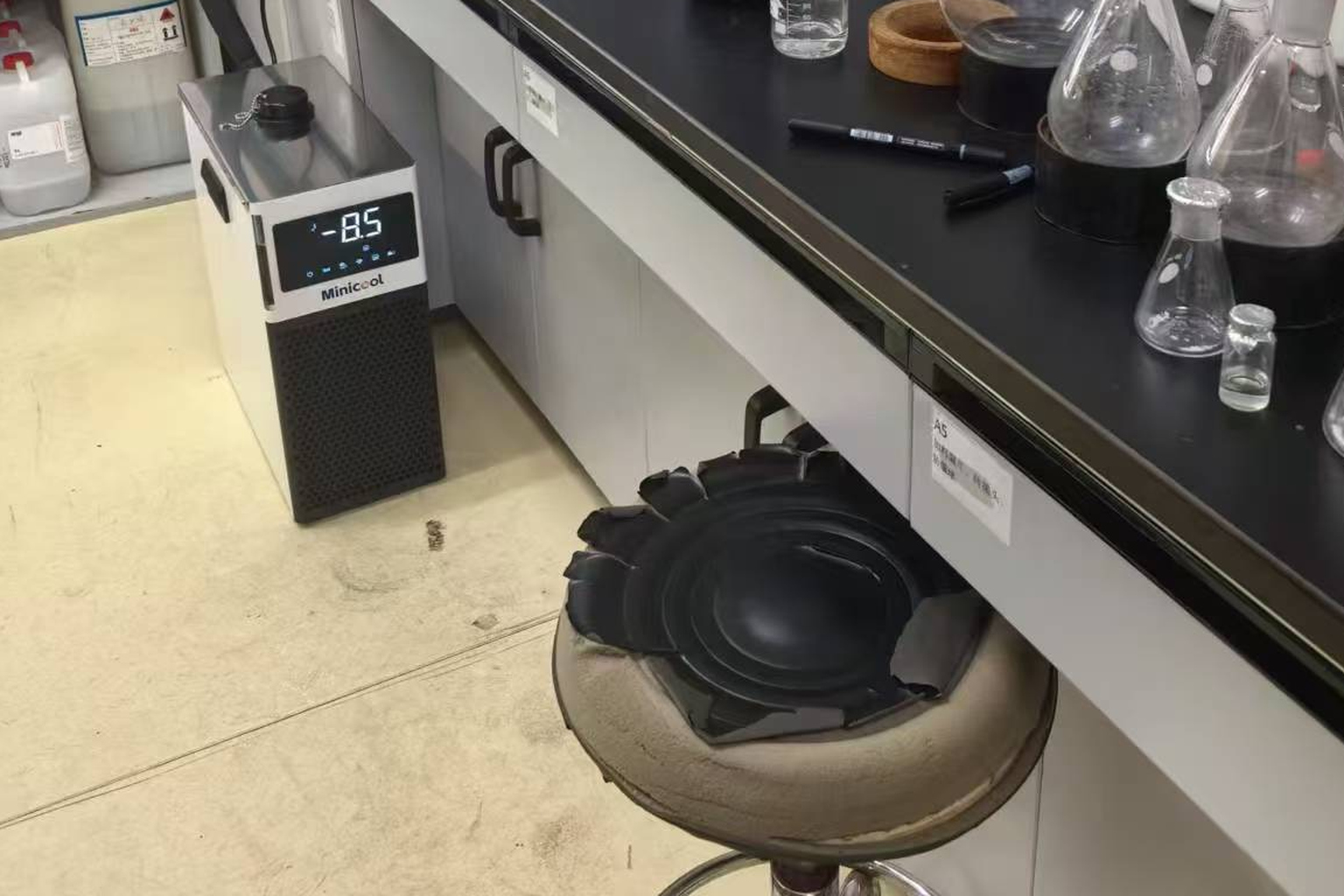
Match the Accessory’s Liquid Circuit
The circuit assessment includes the accessory, hoses, fittings, valves, and any external measuring device. Check the accessory’s flow requirement together with pressure loss and maximum permitted pressure. The circulation pump must deliver the required flow through that complete resistance. Two separately quoted maximum values for flow and head do not establish an operating point. Connections that physically fit are only one part of the match.
Use the existing liquid chiller loop design guide for the surrounding hydraulic task. Here the priority is the instrument accessory’s inlet conditions. Preserve its stated restrictions on flow direction, filling, venting, and orientation. An accessory containing trapped gas may transfer heat differently from its intended filled condition, while a bypass can make total circulation look satisfactory without proving the flow through the sample-temperature unit.
Select Coolant for the Complete External Loop
A tensiometer circulating bath needs a coolant approved for both the cooling source and the temperature accessory. Include hoses, seals, connectors, and measuring devices in that approval. State the product, mixture basis, and concentration where applicable. A generic reference to glycol leaves unresolved which formulation will circulate and whether its properties are appropriate at the intended negative temperature.
Freeze protection and pumpability answer different questions. A liquid that remains unfrozen can still impose a circulation requirement the selected pump cannot meet. Use supplier property data at the intended temperature and retain the accessory’s compatibility limits. Filling the loop with a new formulation also changes the basis of any earlier hydraulic acceptance. Coolant approval covers every wetted component. It is separate from approval of the sample being tested inside the vessel.
Review MiniCool as the Negative-Temperature Source
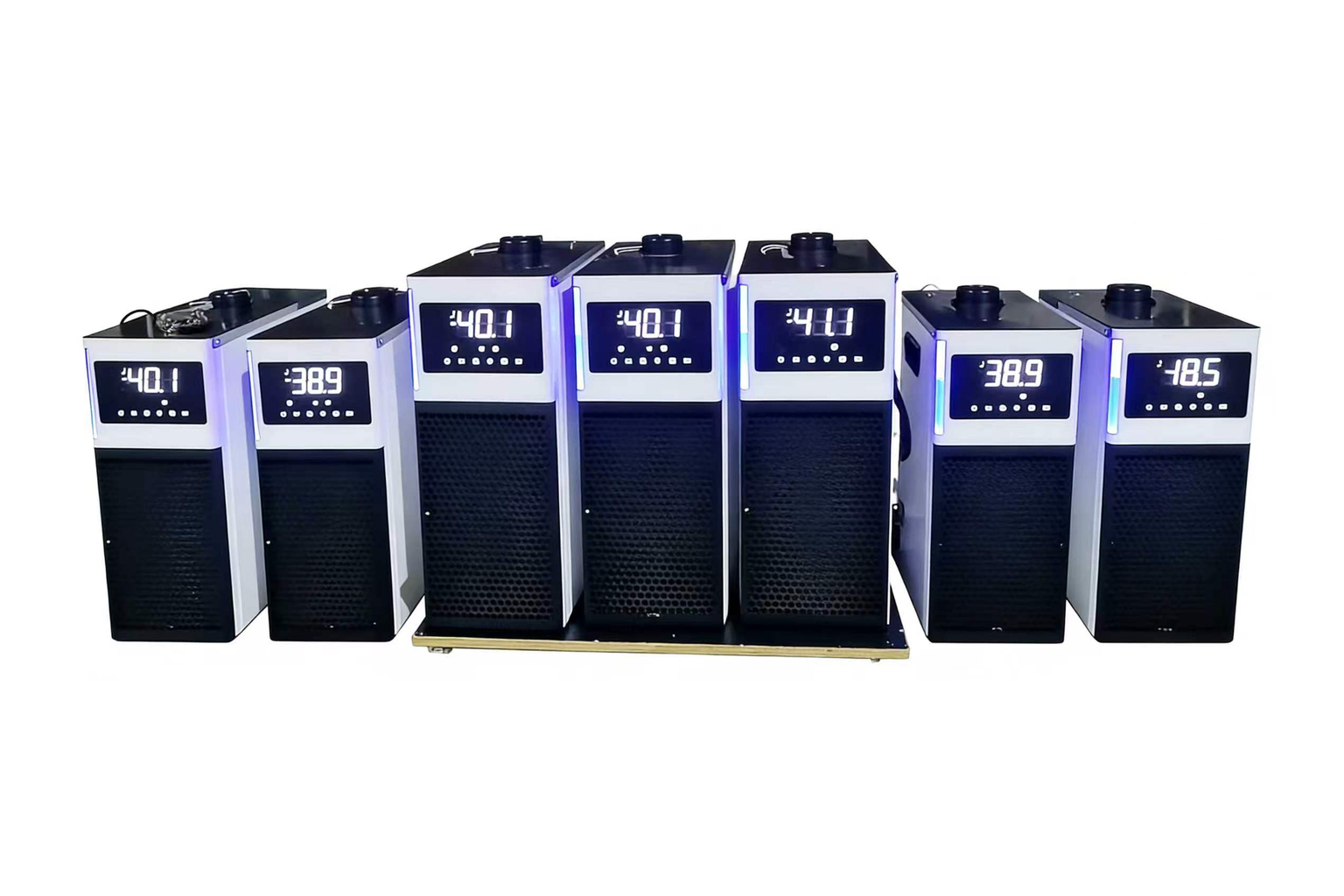
The RIGID MiniCool laboratory chiller series is published for −40°C to 0°C operation. That makes it a candidate for a verified sub-zero circulating duty, not a universal bath for every surface-tension accessory. A required positive supply temperature is outside this selection basis. An accessory that needs a different range or a heating function requires another appropriately reviewed arrangement.
The reviewed public web information does not provide the pump curve, available external head, or full conditions behind cooling-capacity claims. Obtain those details for the selected version before approving the instrument loop. The published temperature-stability statement also lacks the test conditions needed to assign a sample-level uncertainty. In tensiometer circulating bath selection, the relevant evidence is performance with the actual accessory and operating liquid; the brand’s temperature range alone does not close that requirement.
Protect the Surface Measurement From Its Environment
Cold hoses and accessory surfaces can collect moisture or frost when their temperatures and the surroundings allow it. Consider where that liquid can go, including near the sample opening, the instrument mechanism, and electrical connections. Insulation and containment should follow the accessory’s installation requirements. Do not cover a measurement opening or obstruct a moving component simply to eliminate a visible cold surface.
Also define any mechanical disturbance limits relevant to the measurement. Hose loads, a nearby pump, airflow, and mounting can affect the installed arrangement. Their effect must be assessed for the selected instrument rather than assumed from a compact cooling unit’s size. A thermal solution must preserve the measurement setup. The acceptance record should show that cooling is delivered without changing the intended vessel position or the instrument’s approved measurement environment.
Establish Readiness at the Sample
A settled circulating supply can precede a settled sample. Establish readiness using the measurement method’s temperature and time criteria, with the actual vessel and fill volume. Do not start a measurement solely because the bath display has stopped moving. Record the sample-temperature indication and the control state at the start of each measurement, especially when moving between temperature points or replacing a sample.
Keep measurement-related timing distinct from thermal settling. A dynamic surface-tension method may track surface age, while cooldown describes the sample’s thermal preparation. One does not substitute for the other. If results change after a longer hold, investigate the method, sample condition, and temperature evidence together. A more stable display does not by itself identify whether the original change came from thermal lag or from the sample’s behavior.
Accept the Installed Bath and Accessory Together
Before ordering, agree which observations will demonstrate a successful installation: accepted sample condition, accessory inlet and return conditions, branch flow, and behavior at the intended test points. Specify the final loop configuration and coolant. Include the lowest required operating point and any transition relevant to the program. A test at an easier temperature can confirm plumbing while leaving the most demanding measurement condition unresolved.
For tensiometer circulating bath selection, a useful acceptance result connects the cooling provider’s evidence with the instrument provider’s requirements. Keep the two acceptance responsibilities visible. The cooling supplier establishes the supplied source’s performance; the laboratory and instrument provider establish whether the measurement conditions are met. Preserve their agreed records so a change in vessel size, coolant, hose routing, or test program can be assessed without rebuilding the selection from an unqualified catalog rating.
Send an Accessory-Specific Cooling Inquiry
For a proposed tensiometer circulating bath, send RIGID the instrument and accessory requirements. Include the accessory drawing, sample program, required circulating supply temperature, coolant approval, flow and pressure information, and available installation space. State separately whether the inquiry includes heating, an external controller, or additional circulation equipment. This gives the provider a defined negative-temperature duty to evaluate without implying that an instrument connection or analytical result has already been validated.
Frequently Asked Questions
Does every surface-tension instrument need a circulating bath?
No. Some accessories use external liquid circulation; others use integrated temperature control. Confirm the installed accessory and its documented services before selecting a cooling source. An advertised negative sample temperature does not prove there are external liquid ports.
Can the sample temperature equal the chiller setpoint?
Do not assume that equality. The supply, accessory, and sample occupy different thermal locations and can differ during settling or under load. Verify the required sample condition using the instrument’s approved measurement arrangement.
Is MiniCool suitable for positive-temperature supply?
That is outside its published −40°C to 0°C selection range used here. Define any warm points and heating route separately. A surface-tension accessory’s broader sample range cannot extend the cooling source’s documented operating range.
What establishes tensiometer circulating bath compatibility?
The actual accessory’s temperature, liquid, flow, pressure, and connection requirements must match documented source performance. The installed setup must also achieve the sample’s measurement condition without changing its approved physical state or instrument arrangement.
Can I use the same antifreeze mixture in the sample and jacket?
Only if each use is separately permitted by the experimental method and equipment suppliers. The sample formulation determines the measured surface properties; the external coolant is selected for its own circuit. Keep them separate in the inquiry and handling procedure.