
Tap Water vs Recirculating Chiller: The Real Cost of Lab Cooling
Walk into almost any chemistry or biology lab, and you will find rubber tubing snaking from a faucet to a rotary evaporator condenser, a laser housing, or a reaction vessel jacket. Tap water cooling is the default — it is cheap to set up, requires no capital approval, and “just works.” Until one day it doesn’t.
A disconnected hose floods the bench at 2 AM. Summer heat pushes tap water above 25 °C and your distillation yield drops. The maintenance team quotes you $1,200 to descale a clogged condenser coil. Suddenly, that “free” cooling water is looking expensive.
This article breaks down the real, measurable costs of running tap water versus investing in a recirculating chiller — a practical tap water cooling alternative for laboratory applications that is gaining ground for good reason. We will look at hard numbers so you can make an informed decision for your lab and your budget.
The Hidden Costs of Tap Water Cooling in a Laboratory
When evaluating any tap water cooling alternative for laboratory operations, you first need to understand what tap water is actually costing you. Most labs never calculate this because the water bill goes to facilities, not the research budget. Let’s change that.
Water Consumption: The Numbers Are Staggering
A typical rotary evaporator condenser needs a flow rate of 2–5 liters per minute to maintain adequate cooling. Let’s use a conservative middle value of 3 L/min and assume the instrument runs 6 hours per day — a light schedule for many organic chemistry labs.
That works out to:
- Per hour: 180 liters
- Per day (6 hours): 1,080 liters
- Per month (22 working days): 23,760 liters
- Per year: roughly 285,000 liters — from one instrument
Now multiply that by every condenser, laser, and jacketed reactor in your lab that runs on tap water. A mid-size synthetic chemistry lab with three to five tap-water-cooled instruments can easily consume over one million liters of water per year just for cooling.
Water Bills Add Up Fast
Municipal water rates vary by region, but typical combined water and sewer charges in North America range from $5 to $15 per 1,000 liters (or per cubic meter). In parts of California, Australia, and Western Europe, rates can be significantly higher.
For a single rotovap using 285,000 liters per year:
- At $5/m³: approximately $1,425 per year
- At $10/m³: approximately $2,850 per year
- At $15/m³: approximately $4,275 per year
Most lab managers are surprised by these figures. The water cost is real — it is simply hidden in a facilities line item that nobody questions.
Temperature Fluctuation: The Silent Experiment Killer
Tap water temperature is not something you control. It depends on the season, the time of day, and even how many other labs in the building are drawing water simultaneously.
Typical tap water temperatures by season:
- Winter: 4–10 °C (often colder than needed, causing excessive condensation)
- Spring/Fall: 12–18 °C (reasonable for many applications)
- Summer: 20–28 °C (too warm for effective condensation in many solvent recovery applications)
That 20+ degree range across the year means your condenser efficiency, your distillation recovery rates, and your reaction temperature control all shift with the seasons. If you have ever noticed that a procedure works well in January and poorly in July, tap water temperature is likely the reason.
For research that requires reproducibility — and that should be all research — this seasonal variability is a significant problem.
Scale and Mineral Buildup: Slow Equipment Damage
Tap water contains dissolved minerals, primarily calcium and magnesium carbonates. When water flows through a warm condenser coil or cooling jacket, these minerals precipitate out and form scale deposits on internal surfaces.
Over months, this scale:
- Reduces heat transfer efficiency (a 1 mm layer of scale can reduce cooling performance by 10–15%)
- Restricts flow through narrow passages
- Corrodes metal fittings and connections
- Eventually requires professional descaling or component replacement
A condenser replacement or professional descaling service typically costs $500–$1,500 depending on the instrument. In hard-water areas, you may face this expense every 12–24 months.
Flooding Risk: Low Probability, High Consequence
Every lab that uses tap water cooling has a flooding story. A hose clamp loosens. Someone bumps the tubing. A fitting corrodes through. Water pressure spikes overnight. The result is the same: water everywhere, potentially damaging equipment, notebooks, samples, or the lab below yours.
A single flooding event can cost anywhere from a few hundred dollars in cleanup to tens of thousands in damaged instruments and lost research materials. Insurance may cover equipment replacement, but it will not recover months of lost experimental work.
Environmental and Sustainability Concerns
Sending hundreds of thousands of liters of clean drinking water straight down the drain is increasingly difficult to justify. Many institutions now have sustainability mandates, water reduction targets, or green lab certification programs that explicitly call out single-pass cooling as a practice to eliminate.
Beyond institutional pressure, there is the practical reality that water scarcity is growing in many regions. Labs that rely on tap water cooling may face restrictions or significantly higher rates in coming years.
What a Recirculating Chiller Gives You
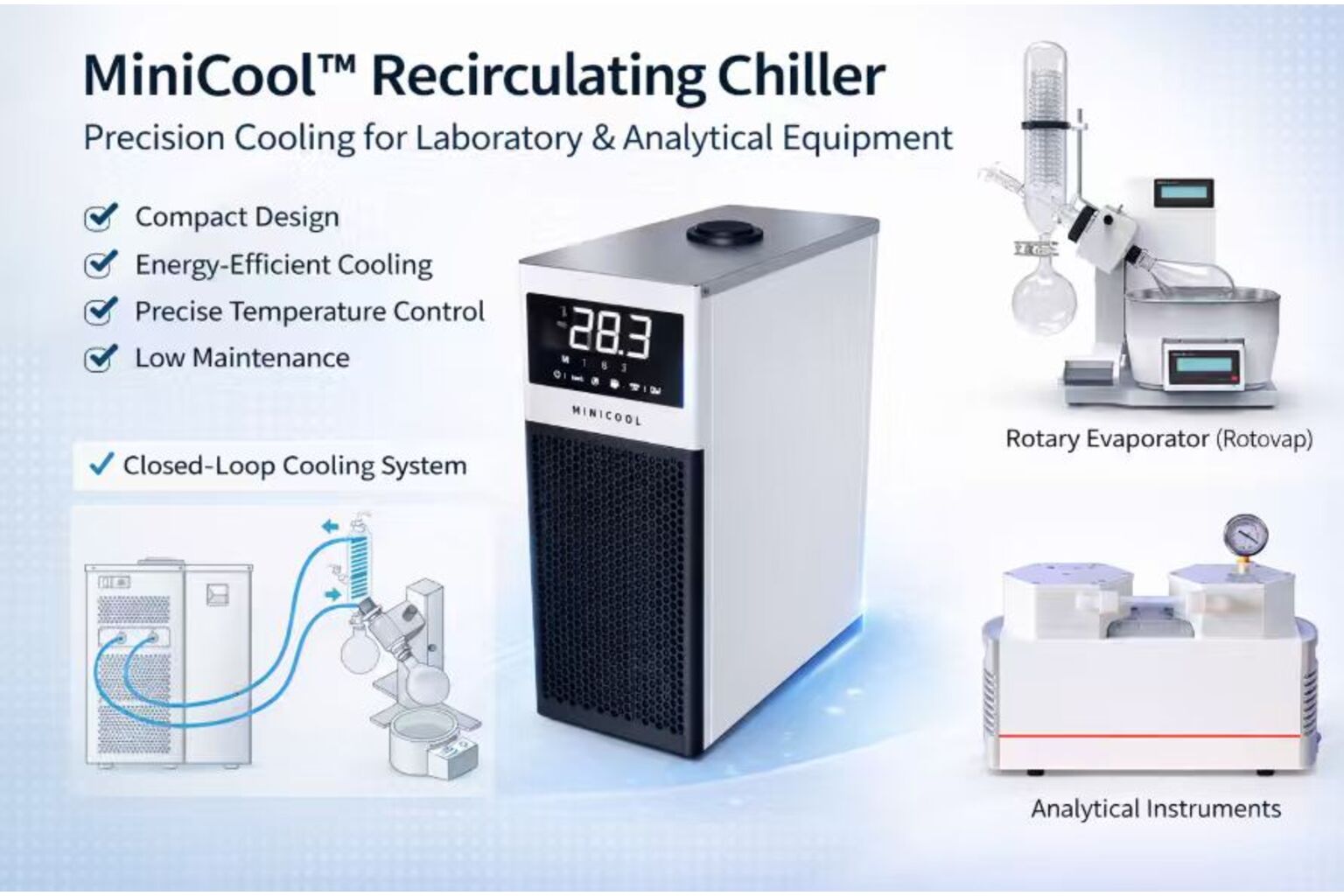
A recirculating chiller is a closed-loop system: a refrigeration unit cools a reservoir of fluid, a pump circulates that fluid through your instrument, and the warmed fluid returns to the reservoir to be cooled again. No water goes down the drain. The same fluid circulates indefinitely.
Here is what that means in practice:
Precise, Stable Temperature Year-Round
Modern recirculating chillers maintain setpoint temperatures within ±0.5 °C or better, regardless of ambient conditions. Whether it is January or August, your condenser sees the same coolant temperature. Your results stay consistent.
You also gain the ability to choose your temperature. Need 5 °C for solvent recovery? Set it. Need 15 °C for a crystallization? Adjust the dial. With tap water, you get whatever the municipality delivers that day.
Zero Water Waste
A closed-loop chiller uses the same coolant charge for months or years. You add fluid once (typically distilled water or a water-glycol mixture), and the system recirculates it continuously. Your water consumption for cooling drops from hundreds of thousands of liters per year to essentially zero.
The only ongoing utility cost is electricity to run the compressor and pump — typically $200–$400 per year for a benchtop unit, depending on local electricity rates and daily run hours.
Consistent Experimental Results
Temperature stability translates directly to reproducibility. When your cooling conditions are identical every time you run a procedure, one major source of variability disappears from your results. This matters for published research, for QC work, and for any process you need to scale up later.
Equipment Protection
Because recirculating chillers use purified or treated coolant, mineral scale buildup is eliminated. Your condenser coils stay clean. Flow paths remain unobstructed. The expensive glassware and instruments downstream of your cooling system last longer and perform better.
Typical Payback Period: 6–18 Months
When you add up the water costs, reduced maintenance, eliminated flooding risk, and improved experimental efficiency, most labs find that a recirculating chiller pays for itself within 6 to 18 months. After that, the savings continue to accumulate year after year.
Cost Comparison: Tap Water vs Recirculating Chiller
The following table summarizes typical annual costs for cooling a single instrument (such as a rotary evaporator) assuming moderate daily use. Actual figures will vary based on your water rates, electricity costs, and usage patterns.
| Cost Category | Tap Water (Annual) | Recirculating Chiller (Annual) |
|---|---|---|
| Water and sewer charges | $500–$2,000 | $0 |
| Electricity for cooling | $0 | $200–$400 |
| Equipment repairs (scale damage, descaling) | $500–$1,500 | ~$0 |
| Downtime costs (flooding, temperature issues) | Variable (potentially significant) | Minimal |
| Environmental impact | High water waste | Low (electricity only) |
| Total estimated annual cost | $1,000–$3,500+ | $200–$400 |
| Typical payback period for chiller purchase | — | 6–18 months |
These ranges represent typical scenarios. Labs with higher water rates, longer daily run times, or multiple tap-water-cooled instruments will see even larger differences. Labs in regions with very cheap water and short daily usage may fall at the lower end.
When Tap Water Cooling Is Still Acceptable
To be fair, there are situations where tap water remains a reasonable choice:
- Very short-duration use: If you only run a condenser for 15–30 minutes a few times per week, the water volume and cost are minimal.
- Low-precision work: Teaching labs doing simple demonstrations where exact temperature control is not critical.
- Temporary setups: Short-term projects where purchasing equipment is not justified.
- Situations where coolant temperature truly does not matter: Some applications only need “cooler than ambient” and have no sensitivity to the exact temperature delivered.
However, if you are running instruments daily, if your work requires reproducibility, or if you are paying significant water bills, the economics strongly favor switching to a recirculating system.
Making the Switch: What to Consider
If you have decided that a recirculating chiller makes sense for your lab, here are the practical factors to evaluate:
Cooling Capacity
Match the chiller’s cooling capacity (measured in watts) to your instrument’s heat load. For a standard rotary evaporator, 300–600 watts of cooling capacity is typically sufficient. For jacketed reactors or high-power lasers, you will need more. When in doubt, size up — a chiller running at 70% capacity will last longer and run quieter than one running at 100%.
Physical Space
Lab bench space is always at a premium. Measure your available footprint before purchasing. Some compact chillers are designed to fit on a bench beside the instrument, under a bench, or even on a cart. Larger floor-standing units offer more capacity but require dedicated floor space.
Noise Level
Compressor noise matters in a lab environment, especially in shared spaces or near sensitive instruments like NMR spectrometers. Check the manufacturer’s noise specifications (measured in decibels at a stated distance) and compare to your lab’s ambient noise level. Many modern compact chillers operate at 45–55 dB, comparable to a quiet conversation.
Budget and Procurement
Benchtop recirculating chillers suitable for single-instrument cooling typically range from $1,500 to $5,000 depending on capacity, temperature range, and features. When preparing a purchase justification, frame it as a cost-saving investment with a defined payback period rather than a pure expense. The numbers in the comparison table above provide a starting point for your business case.
A Practical Option: RIGID MiniCool™
For labs looking to replace tap water cooling on a single instrument, the RIGID MiniCool™ countertop recirculating chiller starts under $1,700 and is compact enough to fit under a standard lab bench. For most labs currently running tap water daily, it pays for itself within a year through water savings and eliminated maintenance costs alone. For facilities with higher cooling demands or multiple instruments, the MidiCool™ series offers greater capacity while maintaining the same closed-loop efficiency.
Frequently Asked Questions
How much water does a typical lab waste with tap water cooling?
A single instrument like a rotary evaporator running at 3 L/min for 6 hours per day uses approximately 1,080 liters daily, or roughly 285,000 liters per year. Labs with multiple tap-water-cooled instruments can easily exceed one million liters annually. All of this water flows directly down the drain after a single pass through the condenser.
Can I use a recirculating chiller with my existing glassware and instruments?
Yes. Recirculating chillers connect to the same hose barb fittings that your tap water lines use. In most cases, switching involves disconnecting the tap water hoses and connecting the chiller’s supply and return lines to the same ports. The changeover typically takes less than 15 minutes.
What maintenance does a recirculating chiller require?
Maintenance is minimal. Most units require periodic coolant replacement (every 6–12 months depending on usage), occasional cleaning of the condenser fins (compressed air or a soft brush), and checking fluid levels. Total annual maintenance time is typically under 2 hours. Compare this to the unpredictable downtime from scale buildup, hose failures, and flooding events associated with tap water systems.
Is a recirculating chiller worth it if I only use my rotovap a few hours per week?
For very light use (under 5 hours per week), the payback period extends beyond 18 months, and tap water may remain a practical choice — especially if your work is not temperature-sensitive. However, if you value consistent results, want to avoid scale damage, or your institution has sustainability requirements, the non-financial benefits may still justify the switch even at lower usage levels.
Conclusion
Tap water cooling works. Nobody disputes that. But when you actually calculate what it costs — the water bills, the maintenance, the inconsistent results, the environmental impact, and the occasional flood — it becomes clear why so many labs are making the switch to recirculating chillers.
The math is straightforward: for any lab running tap-water-cooled instruments on a daily basis, a recirculating chiller is not an expense. It is an investment that typically returns its cost within a year and continues saving money every year after that. Add in the benefits of temperature stability, reproducible results, and equipment protection, and the case becomes even stronger.
If your lab is still running tap water through your condensers, take 10 minutes to calculate your actual water consumption using the figures in this article. The number will likely surprise you — and make the decision much easier.