
UV-Vis Cuvette Temperature Control: Identify the Thermal Route First
UV-Vis cuvette temperature control can use a water-thermostatted cell holder, an air-cooled Peltier accessory or a water-cooled Peltier accessory. These arrangements do not all need the same external equipment. Choose the holder and its control method first, then specify a circulating-water system only if that accessory requires one. A sample-temperature range is not automatically the temperature range required from the external chiller, and a cooling-only module is not a substitute for a complete heating and cooling bath.
The practical question is which part of the temperature-control task the external water loop performs. It may establish the holder temperature directly, or it may simply remove heat from a Peltier device that controls the sample separately. That distinction affects temperature range, heat load, sensing, plumbing and the acceptance test. It also prevents buying a subzero chiller for an accessory that expects positive-temperature heat-rejection water.
Compare Three Cuvette Temperature-Control Arrangements
A water-thermostatted holder circulates temperature-controlled fluid through passages around the cell position. An external bath or circulation system establishes the fluid conditions. An air-cooled Peltier holder uses a thermoelectric device with air-side heat rejection. A water-cooled Peltier holder also uses a thermoelectric device, but its heat-rejection interface connects to a liquid circuit. External water can control the holder or serve the Peltier hot side.
| Arrangement | Role of an external water loop | First selection question |
|---|---|---|
| Water-thermostatted holder | Transfers heat to or from the holder through its fluid passages | What circulating-fluid range and heating/cooling capability does the method require? |
| Air-cooled Peltier holder | May need no external water circuit | Can the accessory meet the sample program within its ambient limits? |
| Water-cooled Peltier holder | Rejects heat from the accessory’s liquid-cooled side | What inlet temperature, heat rejection and flow does the accessory specify? |
Accessory manufacturers document these distinctions. Shimadzu describes a Peltier cell-holder option without an external water bath as well as a circulating-water constant-temperature holder. JASCO lists both air-cooled and water-cooled Peltier accessories. These examples establish that the architectures exist; they do not establish that an arbitrary holder will work with an arbitrary water-cooling unit.
Define the Sample Program Before Choosing the Cooling Equipment
Write down the sample temperatures, sequence of holds and any programmed temperature changes needed for the method. Identify whether the measurement is taken after equilibration or while temperature is changing. Also record the acceptable sample-temperature behavior during the actual measurement. A method based on equilibrated readings and a method following a temperature ramp can place different demands on the same accessory.
The liquid inside a cuvette does not necessarily reach the holder setpoint immediately. Cell construction, sample properties, fill volume, stirring and contact with the holder can affect the response. Those factors should be considered with the accessory supplier and the analytical method. A chiller display alone cannot demonstrate that the sample has reached the intended temperature or followed a programmed change.
For UV-Vis cuvette temperature control, distinguish a required sample-temperature result from an equipment setting used to achieve it. Preserve both in the specification. This makes it possible to evaluate a proposed accessory using the actual method rather than assuming that a wide catalog temperature range guarantees the desired performance with every cuvette and sample.
Understand What a Water Bath Can and Cannot Replace
With a directly water-thermostatted holder, the external circulation system is part of the sample’s thermal path. If the sample program requires heating as well as cooling, the external equipment must provide those functions or be combined with an approved arrangement that does. A cooling-only chiller does not become a heating bath because it circulates water. Check the accessory’s required supply temperature and operating instructions before treating the devices as interchangeable.
A Peltier holder can use local temperature sensing and thermoelectric control while its water loop provides a heat sink. In that case, the sample program and the external water setpoint are separate inputs. The accessory may heat and cool the cell even though its external water remains within a narrower range. Do not infer the water duty from the highest or lowest sample temperature shown on its product page.
Neither route is automatically superior for every method. Compare the accessory’s supported cuvettes, stirring, sample sensing, programmed operation and ambient restrictions. Choose the thermal architecture that meets the measurement requirements, then decide whether its external water demand fits the proposed cooling equipment. That sequence is more reliable than choosing a chiller first and adapting the method around its limitations.
Specify the Water Interface for a Water-Cooled Peltier Holder
Ask for the permissible coolant inlet range, required flow, maximum pressure and heat rejection at the intended sample program. Include the ambient conditions under which those requirements apply. If multiple cell positions or accessories share the loop, ask how the manufacturer expects their water connections to be arranged. Do not assume that putting holders in series or parallel preserves the original temperature and flow conditions.
For a Peltier device, the hot side rejects the heat transferred from the cold side plus the thermoelectric device’s dissipated electrical power. The complete accessory may have additional heat paths. Use the accessory’s water-side duty, not its sample volume or power-supply rating. A small cuvette does not prove that the external chiller’s heat load is correspondingly small.
UV-Vis cuvette temperature control also needs a clear circulation-equipment scope. Confirm who supplies the pump, reservoir if required, hoses, fittings and coolant. A component described as a liquid chiller may need integration into a complete loop. Its temperature range does not establish that its available pump pressure, flow or fluid compatibility matches a particular spectroscopy accessory.
Check Fluid and Hydraulic Requirements Together
Identify the holder’s approved coolant or water-quality requirements and the restrictions of every other wetted component. A fluid accepted by the holder may still need approval for the chiller, pump or tubing. Conversely, a chiller’s recommended fluid is not automatically appropriate inside a small instrument accessory. Document the exact fluid formulation and any required concentration rather than using the unqualified term water.
The pump must provide the required flow through the installed hoses, fittings and holder at the operating temperature. Free-flow pump capacity is not the installed flow rate. Maximum permitted pressure at the accessory is a separate limit, and should remain visible in the specification. Changing tubing diameter, adding a manifold or substituting a more viscous coolant can change the loop’s operating point.
For the wider equipment-selection sequence, the laboratory chiller buying guide provides the broader context. The additional decision here is whether circulating fluid directly controls the holder or supports a separate Peltier control system. Keep that distinction attached to the water specification when suppliers propose an alternative configuration.
Keep Water Sensing Separate From Sample Verification
A water-control sensor measures at its own installed location. A holder sensor measures another location, while an in-cuvette probe, where supported, observes the sample more directly. These readings need not be identical during temperature changes or with heat entering the sample. Verify the temperature relevant to the analytical method. Do not substitute the chiller’s display resolution for evidence of sample-temperature accuracy or uniformity.
Discuss probe suitability and placement with the accessory supplier. A probe can affect handling, stirring or the optical measurement if it is not compatible with the method. The acceptance arrangement should reflect the actual cuvette and accessory configuration rather than an improvised measurement that changes the thermal system being evaluated. Record which sensor supports each acceptance statement.
Condensation deserves a separate review when a holder, coolant line or sample surface is below the local dew point. A cold sample target does not, by itself, describe which external surfaces will become cold. Follow the instrument supplier’s provisions for the sample compartment and any accessory environmental controls. Review exposed water connections independently instead of assuming that the spectrophotometer protects the complete external loop.
Match the RIGID Product to the External Water Duty
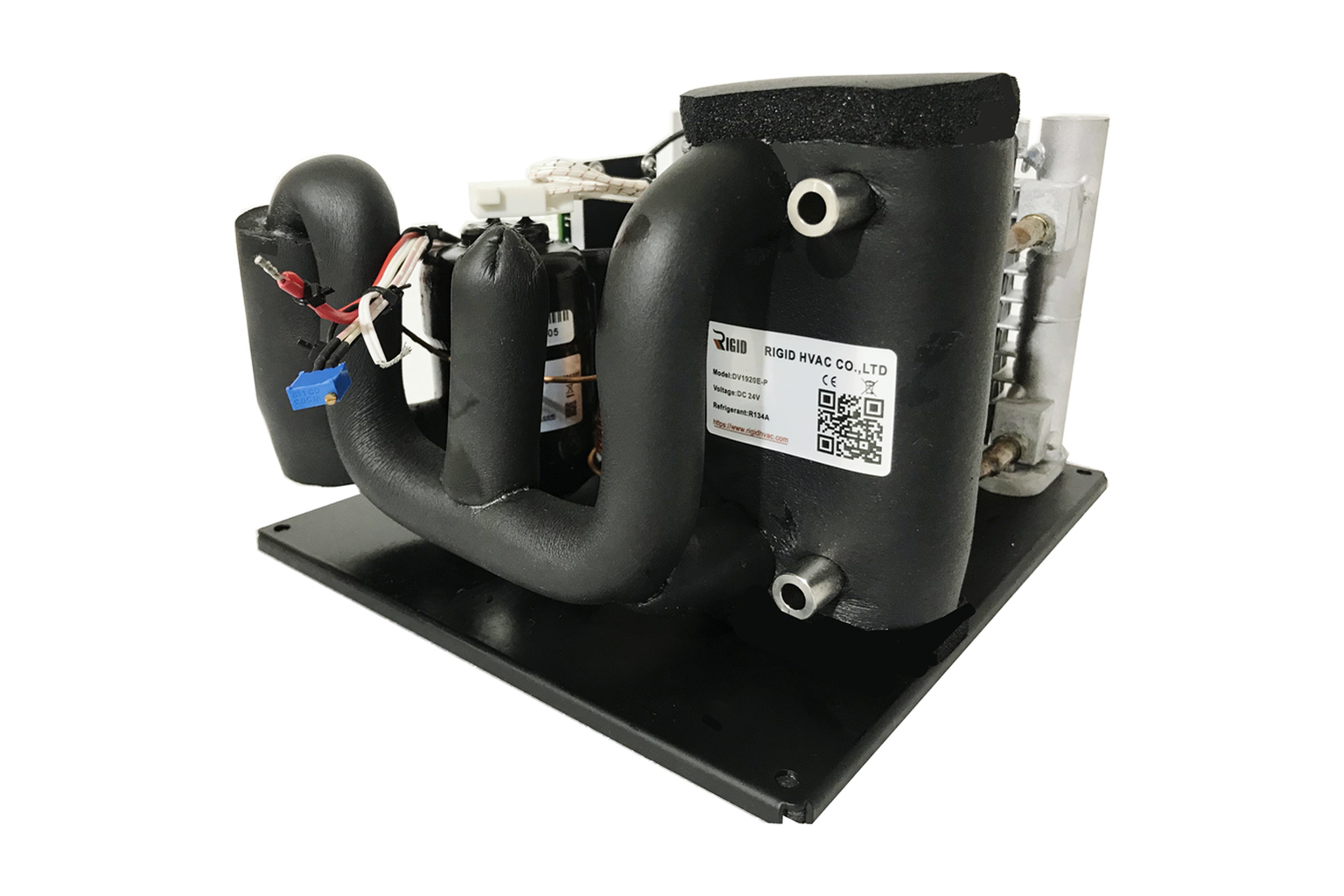
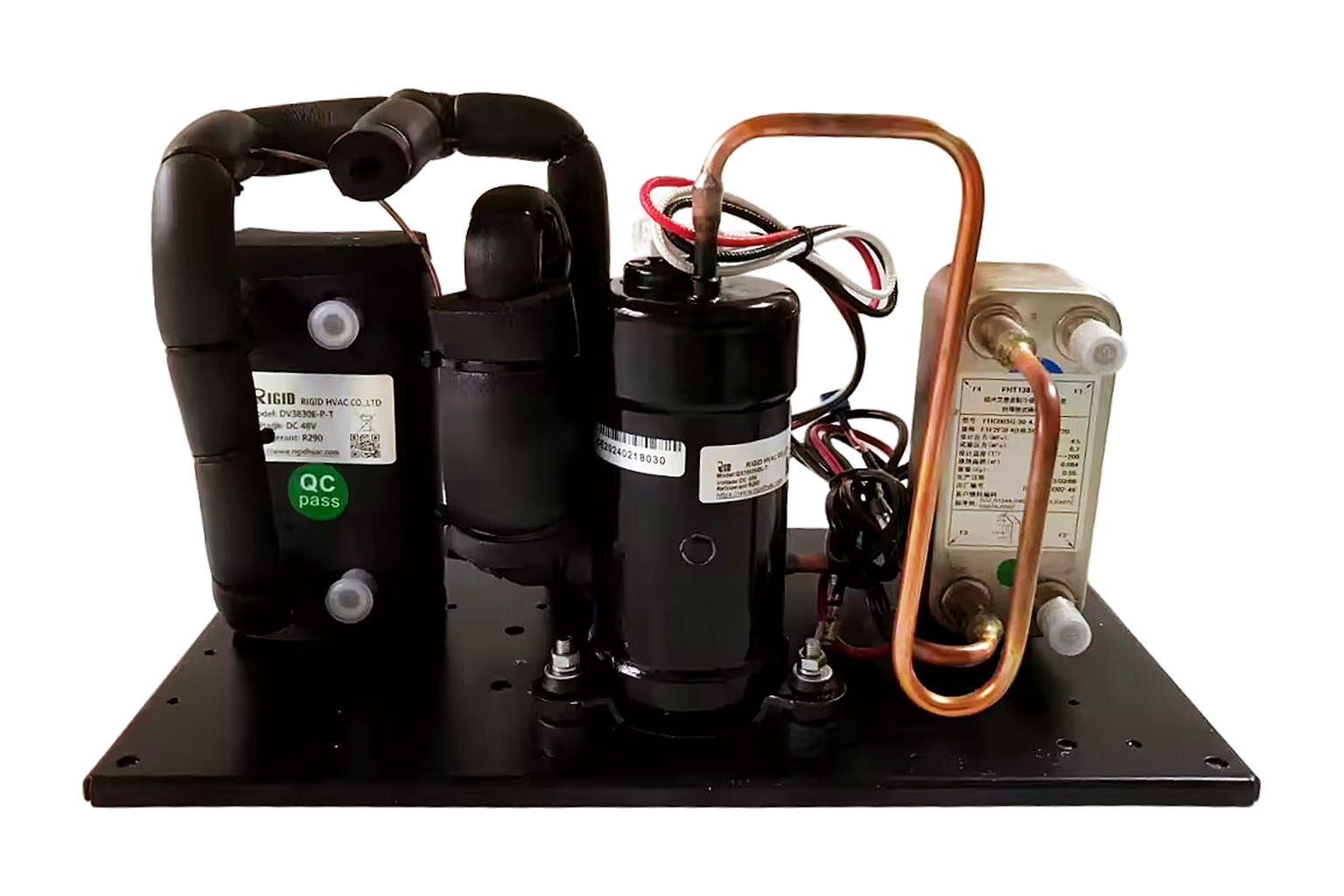
The RIGID Compact Liquid Chiller family includes Plate-series models such as DV1920E-P and DV3220E-P. Its documented family temperature range is −20 to +20°C. That makes it relevant to an external cooling-water review only when the accessory’s required inlet conditions and selected load fall within a confirmed configuration’s capability. It does not establish suitability for every UV-Vis accessory.
For UV-Vis cuvette temperature control, ask for capacity at the actual water temperature and surrounding air condition, along with the selected hydraulic and electrical details. A family-wide wattage range should not be treated as the capacity available at every temperature. The public family information does not close the accessory-specific pump, reservoir or pressure requirements.
Keep sample-temperature claims separate from RIGID product claims. A Peltier accessory’s broad sample range does not extend the chiller’s published liquid range. MiniCool’s −40 to 0°C range also does not cover a positive-temperature water specification. The photographs here show customer Plate-series products as family illustrations, not an approved complete spectrophotometer installation or a single configuration with all possible options.
Compare Proposals With a Method-Based Acceptance Plan
Request a proposal that names the holder, required water conditions, selected cooling configuration and supplied circulation components. Resolve responsibility for heating, sample sensing and any loss-of-circulation response before ordering. If an accessory includes its own circulation equipment, clarify whether the proposed external unit replaces that equipment, supplements it or should not be connected to it at all.
During acceptance, use the intended cuvette, fill, stirring arrangement and sample program. Check the water interface under the agreed ambient conditions, then verify the sample behavior using the method’s approved approach. Record the stabilization or ramp criteria before the test so that a visually stable water display does not become an accidental substitute for the actual analytical requirement.
A useful UV-Vis cuvette temperature control purchase ends with a documented thermal route and a measured result at the relevant location. To review the cooling portion, send RIGID the holder’s external water specification, sample program and proposed loop details. The resulting discussion can then address the water duty without claiming unverified instrument compatibility.
Frequently Asked Questions About UV-Vis Cuvette Temperature Control
Does every Peltier cuvette holder need a water chiller?
No. Some accessories reject heat to air and require no external water circuit. Others use a liquid-cooled heat-rejection interface. Check the exact accessory documentation rather than assuming that the word Peltier identifies its external cooling requirements.
Should the external water match the sample setpoint?
Only when the selected holder’s instructions specify that relationship. A water-cooled Peltier accessory can maintain a sample temperature different from its heat-rejection water. Use the manufacturer’s permitted water conditions and verify the sample through the analytical method.
Can a cooling-only unit replace a temperature-controlled bath?
Not automatically. A directly water-thermostatted holder may require controlled heating as well as cooling. Confirm the complete temperature program and equipment scope. A liquid-cooling module should not be represented as a heating bath without a documented heating function.
What should be supplied for a UV-Vis cuvette temperature control review?
Provide the holder model, sample program, coolant inlet range, water-side heat rejection, flow, pressure limit, fluid requirements and ambient conditions. Include the proposed pump and tubing arrangement and the intended sample-temperature verification method. Missing values should remain pending until the relevant supplier confirms them.