
A Vacuum Pump Cooling Chiller Serves Two Different Duties
Ask what chiller a vacuum system needs and the answer depends on which part you mean. Two loads sit in the same setup, they want different temperatures, and confusing them produces a machine that is wrong for both.
The pump needs modest cooling near ambient — enough to keep oil temperature and seal life reasonable. The cold trap needs to condense whatever the process is producing, at a temperature low enough to catch it, and that duty is set by the process rather than by the pump.
Getting the trap right protects the pump, the vacuum level, and often the sample. Getting it wrong is why oil turns cloudy, the vacuum level never quite arrives, and the pump needs servicing far sooner than it should.
What a Cold Trap Is Actually For
A vacuum pump moving vapor-laden gas has a problem: condensable vapors reach the pump, dissolve into the oil, and change everything about how it behaves.
Three consequences follow, and all three are avoidable.
Base pressure degrades. Contaminated oil has a higher vapor pressure of its own, so the pump can no longer reach the base pressure it is rated for. The symptom is a system that pumps down more slowly and stops short.
Oil life collapses. Water and solvent in the oil accelerate degradation and corrosion. Cloudy or milky oil is the visible stage of a process that started earlier.
Vapor reaches the exhaust. Whatever the pump does not retain leaves through the outlet, which matters where the vapor is hazardous.
The trap sits between process and pump, holds a surface cold enough for those vapors to condense or freeze on, and keeps them out of the oil. Its duty is a cooling calculation.
Setpoint: Set by What You Are Trapping
The trap must be colder than the point at which your vapor condenses at the operating pressure. Different vapors set very different requirements.
| What you are trapping | Typical trap temperature | Notes |
|---|---|---|
| Water vapor, moderate vacuum | −20 to −40 °C | The most common case; ice forms on the surface |
| High-boiling solvents | −20 to −40 °C | Usually captured alongside water |
| Low-boiling solvents | −40 °C and below | Acetone and dichloromethane are demanding |
| Deep vacuum, mixed vapors | −60 °C and below | Beyond single-stage recirculating chillers |
Two practical rules. The lower the absolute pressure, the colder the trap has to be, because vapors condense at lower temperatures as pressure falls — so a trap adequate at rough vacuum can pass everything through under a deeper one. And a trap that is not cold enough is close to useless: vapor passes through rather than being partly caught, so the difference between an effective trap and an ineffective one is sharp rather than gradual.
Which fluid the loop runs at these temperatures is a decision in its own right — see the coolant selection guide and the glycol ratio guide.
Sizing the Load
Trap duty is the latent heat of what you are condensing per unit time, plus the sensible heat of cooling it to trap temperature, plus what the trap picks up from the room.
For water: Q = mass rate (kg/h) × 2,260 kJ/kg ÷ 3.6 gives watts. Condensing 100 g/h of water is roughly 63 W of latent load.
That figure is often smaller than people expect, which leads to the wrong conclusion. The binding constraint on a vacuum pump cooling chiller is usually temperature, not capacity — you need modest watts delivered at a demanding setpoint, and capacity falls steeply as the setpoint drops.
Three additions to the latent figure:
- Sensible cooling of the incoming vapor and of the condensate once formed.
- Ambient gain through the trap’s own surface, which is significant if it is not insulated.
- Line losses along the tubing between chiller and trap, which grow as the setpoint falls and can be substantial at −40 °C on uninsulated runs.
Two to three hundred watts at the trap temperature covers most benchtop and small pilot setups. Combined with pump jacket cooling, 200–600 W is the usual band.
Ice Is Not a Fault, Until It Is
Any vacuum pump cooling chiller running a trap at sub-zero temperatures will build ice. A trap doing its job accumulates ice. That is the mechanism working — but ice is also an insulator, and it changes the trap’s behavior as it builds.
Three consequences to plan for. Heat transfer worsens as the layer thickens, so the surface gets less cold and traps less. The flow path narrows, which at some point starts affecting pump-down. And the accumulated mass has to go somewhere when the system is warmed.
The practical approach is a defrost interval based on observation rather than on the calendar: watch how quickly ice builds in your process, and clear the trap before it reaches the point where pump-down slows. Draining rather than melting into the pump line matters too — a trap defrosted carelessly delivers everything it caught straight to where it was preventing it from going.
Trap Position and Plumbing
Where the trap sits in the line decides how much of the vapor it actually sees, and it is easy to get wrong in a way that looks fine.
Between process and pump, as close to the pump as practical. Everything upstream of the trap is still carrying vapor, so a trap placed near the process leaves a long run of contaminated line before it. Close to the pump means the trap protects the maximum length of the system.
Vertical, with the outlet at the top where the geometry allows. Condensate and melt-water then collect at the bottom rather than being carried onward, and defrosting drains rather than delivering the catch straight into the pump inlet.
Full-bore connections. A trap is in the vacuum path, so any restriction costs pumping speed. This is the opposite of the water side, where a small bore merely costs flow — here it costs the vacuum performance the whole system exists for.
Insulated, including the fittings. An uninsulated trap body loses cooling to the room continuously and collects frost on its outside, which drips. The cold fittings are usually the first place condensation appears.
One arrangement worth avoiding: a trap positioned where nobody can reach it. Traps are serviced regularly by design — they fill up, and that is the point — so an installation that makes defrosting awkward is an installation where defrosting happens late.
Fluid Choice at Trap Temperatures
At −20 °C and below, the fluid decision is not incidental.
Water is out; a water/glycol mixture is the usual answer, at the minimum concentration that protects against your lowest setpoint. Beyond glycol’s practical range, a dedicated heat transfer fluid is required.
The complication is viscosity. A mixture that pumps comfortably at +10 °C becomes markedly thicker at −40 °C, and the same pump moves less of it through the same circuit. That reduces flow exactly when capacity has already derated, so both terms move against you at once.
Two consequences. Run the flow calculation with the fluid’s properties at the cold end of its range, not at room temperature. And insulate both supply and return — at a −40 °C setpoint in a 22 °C room, the temperature difference driving line losses is over 60 K, and uninsulated tubing gives that away continuously.
The same derating problem in a general sizing context is worked through in chiller sizing for lab reactors.
Pump Jacket Cooling Is the Easier Half
The second duty a vacuum pump cooling chiller may carry is far less demanding. Where the pump itself is water-cooled, that duty is modest and undemanding: typically under 200 W, at a setpoint near or slightly below ambient. On its own, that near-ambient duty sits above MiniCool’s 0 °C ceiling — as a standalone requirement it belongs on the DV-series compact liquid chiller line, up to that line’s +20 °C ceiling — a warmer target is an engineering question. It only joins this machine when it rides along on the trap’s sub-zero loop.
Because the two duties want different temperatures, running both from one loop means the loop runs at the trap’s temperature — considerably colder than the pump needs. That usually works, but it is worth checking two things: that the pump tolerates coolant that cold, and that the extra load is inside the machine’s capacity at the trap setpoint rather than at a comfortable one.
Where the pump is air-cooled, none of this applies and the trap is the whole requirement.
Sizing Example
Putting a vacuum pump cooling chiller calculation together end to end. A rotary vane pump on a freeze-drying application, trapping water vapor, trap held at −40 °C.
Latent load. Sublimating 150 g/h of water: 0.15 × 2,260 ÷ 3.6 ≈ 94 W.
Sensible and ambient. Cooling the vapor and gain through the trap surface: allow 60 W.
Line losses. Three meters of insulated tubing at a 62 K difference: allow 40 W. Uninsulated, this figure would be several times higher.
Total at the trap: roughly 195 W — required at −40 °C.
That last clause is the whole point. A machine whose headline capacity was measured at a warm condition may deliver a fraction of it at −40 °C, so 195 W at the setpoint can call for a machine rated several times that on paper. This is the calculation that gets skipped, and it is why traps run warmer than intended.
Where a Countertop Unit Fits
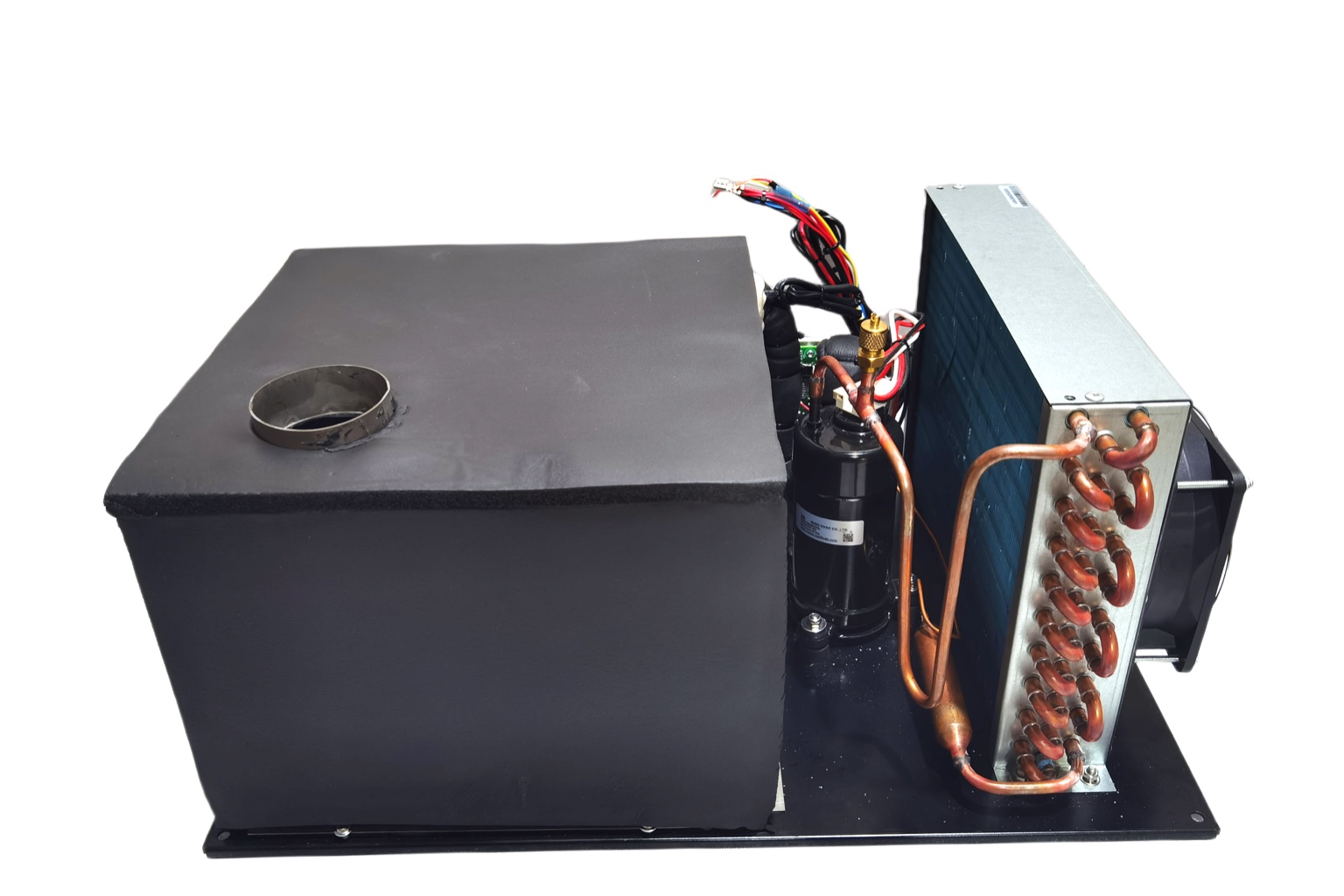
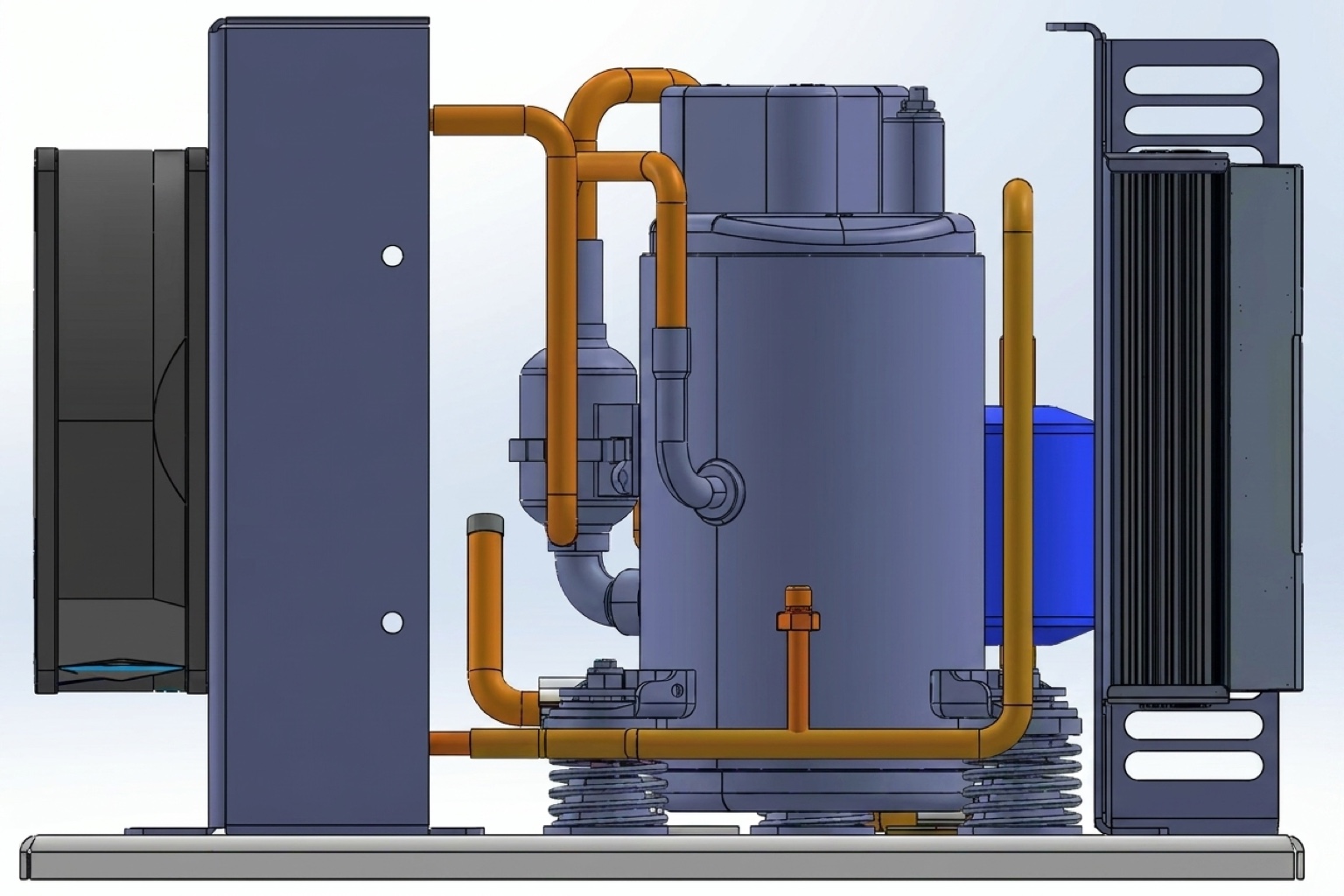
The profile — modest watts at a demanding setpoint, on a bench, running for hours unattended — matches the countertop recirculating class.
The MiniCool range spans 0 °C to −40 °C, which is the band trap duties sit in, at ±0.1 °C stability, in three models: MiniCool 450 at 450 W, MiniCool 800 at 800 W, and MiniCool 850 at 850 W. All three share a 200 × 430 × 450 mm envelope at 18–25 kg, run under 45 dB, and offer quick-connect or threaded ports with a choice of R134a, R290 or R1234yf refrigerant on AC (120–240 V) or DC supply. Small molecular pumps appear on the range’s own list of intended applications.
Two things to establish before choosing. The published capacities do not state their test temperature, and at −40 °C that distinction decides the model — ask for the figure at your trap setpoint. And if your trap needs to go below −40 °C, this class ends there and a different technology applies.
The MiniCool™ countertop recirculating lab chiller page lists the range. Contact the RIGID engineering team with what you are trapping, the mass rate, your operating pressure, and the trap temperature you need, and ask for capacity at that temperature.
Frequently Asked Questions
What temperature should a cold trap run at?
Cold enough to condense your vapor at the operating pressure. For water at moderate vacuum, −20 to −40 °C is typical; low-boiling solvents and deeper vacuum need lower. A trap that is not cold enough passes vapor through rather than partly catching it.
Why is my pump oil cloudy?
Condensable vapor is reaching the pump. Either there is no trap, or it is not running cold enough for what the process produces. Cloudy oil is the visible stage of a process that started earlier.
How much cooling capacity does a cold trap need?
Less than people expect in watts, but at a demanding temperature. Two to three hundred watts at the trap setpoint covers most benchtop work; the difficulty is that capacity falls steeply as the setpoint drops.
Can one chiller cool both the pump and the trap?
Usually, but the loop runs at the colder of the two setpoints. Check that the pump tolerates coolant that cold and that the combined load fits within capacity at the trap temperature.
Do I need to insulate the lines?
At trap temperatures, yes, and both of them. At −40 °C in a normal room the difference driving line losses is over 60 K, and uninsulated tubing gives away watts continuously while also dripping condensate.
Summary
A vacuum pump cooling chiller is usually bought for the cold trap rather than the pump, and the two duties want different temperatures. The trap’s job is to keep condensable vapor out of the oil, which protects base pressure, oil life, and the exhaust — and it only works if the surface is genuinely cold enough, because a marginal trap passes vapor rather than partly catching it. Size the load from latent heat plus sensible and ambient terms, expect a figure in the low hundreds of watts, and then remember the clause that matters: those watts are required at the trap temperature, where capacity has already fallen a long way from the headline. Insulate both lines, run the flow calculation with cold-fluid properties, and plan a defrost interval from observation rather than from the calendar.