
What Is a Water Cooled Air Conditioner and When Does It Make Sense
A water cooled air conditioner uses a liquid cooling loop to reject heat instead of blowing air across a traditional condenser coil with a fan. The compressor still runs a standard vapor compression cycle—compressing refrigerant, condensing it, expanding it, and evaporating it to absorb heat from the space. The difference is where the condensing heat goes: into a water circuit rather than directly into the surrounding air.
This distinction creates practical advantages in specific situations. In a van conversion where the condenser must sit inside the vehicle, an air cooled unit dumps its waste heat right back into the space you are trying to cool—defeating the purpose. A water cooled system pipes that heat to an external radiator mounted outside, keeping the waste heat out of your living space. In a boat cabin below deck, there is nowhere to vent hot condenser air, but raw seawater or a small external heat exchanger handles heat rejection easily. In an equipment enclosure or server rack, air cooled condensers compete with the equipment for limited airflow, while water cooling removes heat independently.
Water cooled air conditioners are not universally better than air cooled units. They add a water circuit with pump, piping, and either a reservoir or external heat exchanger. This complexity makes sense when air cooling is impractical—restricted ventilation, heat rejection into occupied space, extreme ambient temperatures, or noise restrictions that eliminate condenser fans. For applications with good outdoor airflow and no noise concerns, conventional air cooled units remain simpler and cheaper.
How Water Cooled Air Conditioning Works
The refrigeration cycle is identical to any standard air conditioner. The key difference is the condenser design:
Evaporator (indoor side): Refrigerant evaporates at low pressure, absorbing heat from indoor air blown across the evaporator coil by a small fan. This is the cooling you feel—cold air flowing into your space. A typical compact unit provides 450-700W of cooling capacity (1,535-2,387 BTU), enough for a van sleeping area, small boat cabin, or equipment enclosure.
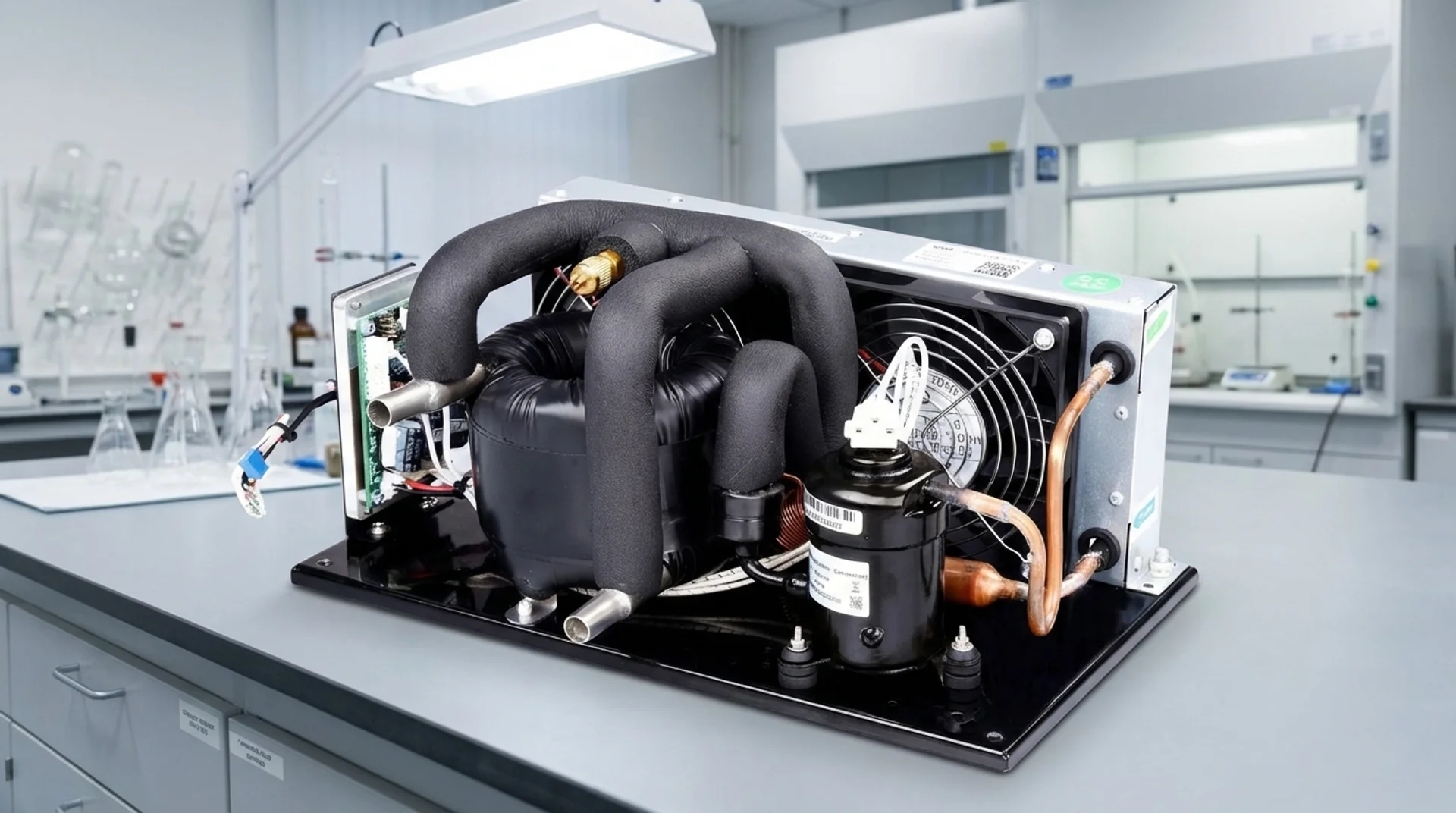
Compressor: A DC compressor (12V, 24V, or 48V) compresses the low-pressure refrigerant gas into high-pressure, high-temperature gas. DC compressors run directly from batteries or solar systems without inverters, and variable-speed operation adjusts cooling output to match the actual heat load rather than cycling on-off like fixed-speed compressors. This provides quieter operation and better temperature stability.
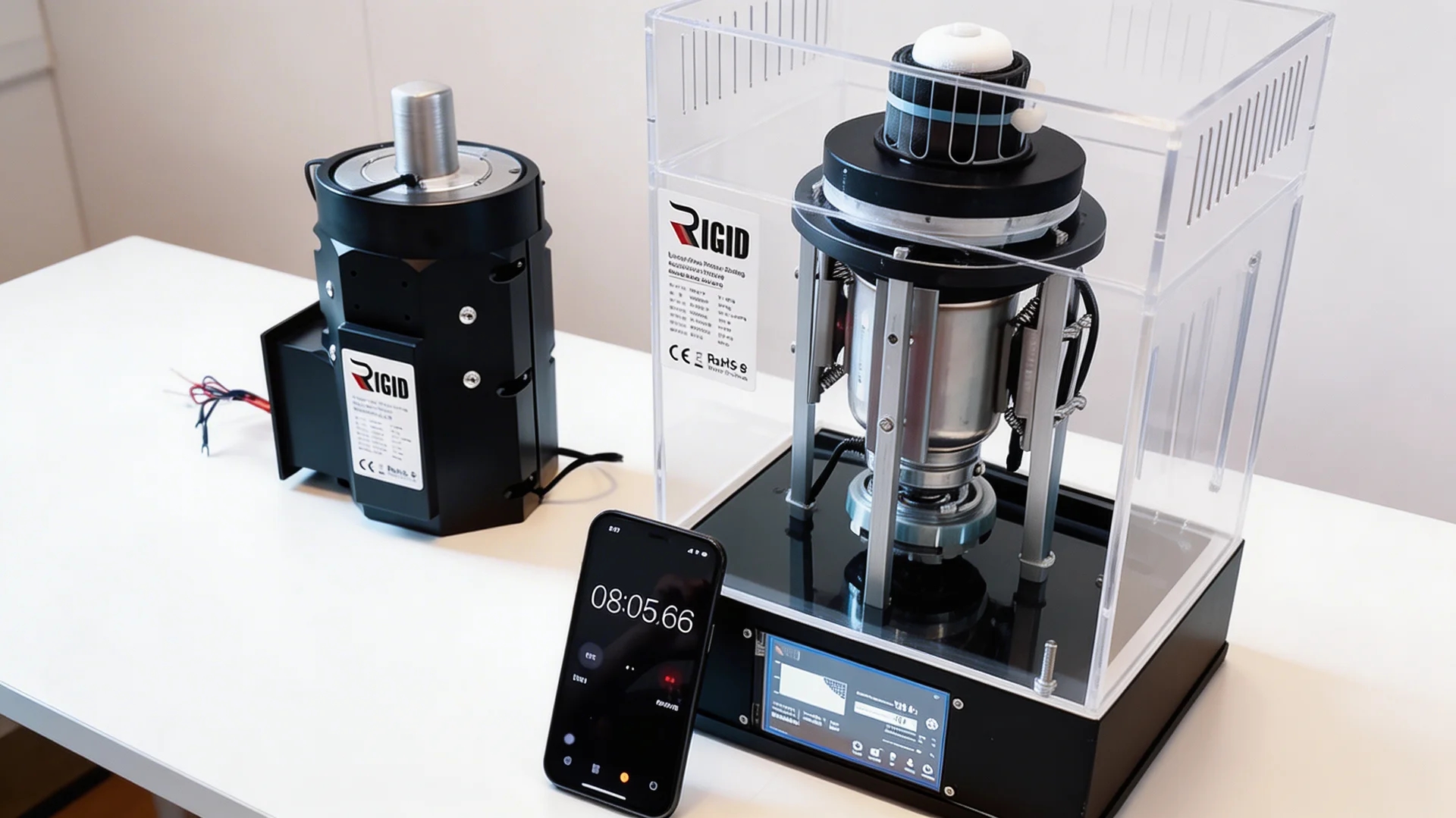
Water cooled condenser: Instead of a large finned coil with a fan, the high-pressure refrigerant passes through a compact heat exchanger—typically a coaxial (tube-in-tube) or plate type—where it transfers heat to circulating water. The refrigerant condenses from gas to liquid as it loses heat to the water stream. Because water absorbs heat roughly 25 times more effectively than air per unit volume, the condenser can be dramatically smaller than an air cooled equivalent.
External heat rejection: The heated water flows to an external point where the heat is finally released. Options include a small radiator mounted outside the vehicle or enclosure, a raw water heat exchanger (for marine applications), or connection to a building’s chilled water loop. The flexibility to separate heat absorption from heat rejection is the core advantage of water cooled systems.
Expansion device: A capillary tube or electronic expansion valve reduces refrigerant pressure before it enters the evaporator, completing the cycle.
Where Water Cooled Air Conditioners Outperform Air Cooled Units
The water cooled approach solves specific problems that air cooling cannot address:
Van and vehicle conversions: In a converted van, cargo trailer, or specialty vehicle, interior space is at a premium and venting hot condenser air outside is difficult without cutting large holes in the body. A water cooled system keeps the indoor unit compact (evaporator and fan only) while piping waste heat to a small external radiator through two water hoses. The indoor unit can mount overhead, under a bench, or behind a panel—anywhere with airflow across the evaporator. No large outdoor condenser unit required.
Below-deck marine cabins: Boat cabins below the waterline have no direct outdoor airflow for an air cooled condenser. Water cooled systems use raw seawater (through a dedicated sea cock and strainer) or a small keel cooler to reject heat. The indoor unit provides comfortable cooling in the cabin while all waste heat exits through the water system. This approach is standard in marine HVAC for good reason—it works where air cooling simply cannot.
Equipment enclosures and cabinets: Sealed or semi-sealed equipment enclosures housing electronics, instruments, or controllers cannot tolerate additional heat from an air cooled condenser inside the enclosure. A water cooled air conditioner removes heat from the enclosure air and rejects it through the water circuit to a point outside the enclosure. This maintains enclosure temperature without adding to the internal thermal load or requiring large ventilation openings that compromise IP rating.
Noise-sensitive environments: Air cooled condensers require fans that typically generate 45-60 dBA. Water cooled systems eliminate the condenser fan entirely. The remaining noise sources—compressor and evaporator fan—typically run at 35-45 dBA in compact DC units. For sleeping areas in vehicles and boats, recording environments, or medical spaces, this noise reduction is significant.
High ambient temperature operation: Air cooled condensers lose capacity rapidly as ambient temperature rises above 35°C. A water cooled system using an external radiator or water source can maintain performance because the water temperature at the condenser remains below air temperature in the condenser’s immediate vicinity. For operation in desert climates, engine compartments, or sun-exposed enclosures, water cooling provides more consistent performance.
Sizing a Water Cooled Air Conditioner for Your Space
Matching cooling capacity to heat load prevents two common problems: undersized units that run continuously without reaching comfortable temperature, and oversized units that short-cycle and waste energy.
Heat load estimation: For occupied spaces (van, cabin, tent), heat comes from solar gain through walls and windows, body heat from occupants, electronics, and cooking. A well-insulated van in 35°C ambient with two occupants typically needs 400-700W cooling. A small boat cabin below deck with moderate solar gain needs 300-500W. An equipment enclosure with 200W of electronics heat dissipation needs a chiller matching that load plus ambient gain.
Product sizing reference: RIGID’s compact water cooled systems span these heat loads:
- Micro DC Aircon series (DV19/DV32-AC): 450-700W cooling capacity, 12V or 24V DC. Suits van conversions, small cabins, and equipment cooling where the indoor unit must fit in tight spaces.
- Portable DC Air Conditioner (LC28-AC): 700W (2,387 BTU) cooling capacity, available in 12V, 24V, and 48V. Self-contained unit with higher airflow for larger spaces or higher heat loads.
Water circuit sizing: The external heat rejection system must handle the total heat rejection—cooling capacity plus compressor electrical input. A 700W cooling system with COP 2.5 rejects approximately 980W total (700W + 280W compressor power). The water flow rate depends on allowable temperature rise: at 2 L/min with 7°C rise, the system rejects about 975W. A small automotive-style radiator (200×200mm) with a fan handles this heat load when mounted in airflow.
Installation Considerations
Water cooled systems require more planning than plug-and-play air cooled units, but the installation is straightforward:
Indoor unit placement: Mount the evaporator unit where cooled air can circulate effectively through the space. Overhead mounting works well in vans and cabins—cold air falls naturally. Ensure the evaporator has unobstructed airflow on intake and discharge sides. Allow access for filter cleaning.
Water circuit routing: Run two water hoses (supply and return, typically 10-12mm ID) from the indoor condenser to the external heat rejection point. Use flexible hose for vibration isolation at the compressor. Insulate hoses if they pass through unconditioned spaces to minimize heat gain. Slope piping to allow drainage and air purging. Quick-disconnect fittings at the indoor unit simplify maintenance.
External heat rejection: For vehicles, mount a small radiator with fan in an area with airflow—under the vehicle, in a wheel well, or behind a grille. For boats, connect to a raw water strainer and through-hull fitting, or use a keel cooler. For equipment enclosures, pipe to a fan-coil unit or facility water connection outside the enclosure. The external heat exchanger must handle the full rejection load at the highest expected ambient temperature.
Pump selection: A small DC circulation pump (12V or 24V) provides 2-4 L/min flow at 0.5-1.0 bar pressure—sufficient for most compact installations with less than 5 meters of piping. RIGID’s P-67D pump-reservoir combos ($85-$105) integrate the pump and coolant reservoir into a single compact unit, simplifying installation.
Electrical: DC systems connect directly to the vehicle or vessel battery bank. Typical current draw: 8-16A at 12V for the compressor plus 1-2A for the pump and evaporator fan. Ensure wire gauge matches the total current draw and run length. A thermostat or temperature controller enables automatic on-off or modulated operation.
Maintenance and Troubleshooting
Water cooled systems add water circuit maintenance to standard air conditioner care:
Monthly: Check coolant level in reservoir. Clean evaporator air filter (dusty environments may require weekly cleaning). Inspect water hoses for chafing, kinks, or leaks. Verify pump is running and coolant is circulating (feel both hoses—supply should be warm, return should be cool).
Seasonally: Flush water circuit with fresh distilled water. Inspect external heat exchanger for debris, corrosion, or fin damage. For marine raw water systems, check sea strainer, inspect zincs, and clear any marine growth from the water intake. Check all hose clamps and fittings for tightness.
Annually: Replace coolant with fresh mixture (distilled water plus corrosion inhibitor, or water-glycol if freeze protection is needed). Inspect pump impeller for wear. Clean condenser heat exchanger (water side) by flushing with mild descaling solution if operating with hard water. Verify refrigerant charge by checking cooling performance against original specifications.
Common issues: Reduced cooling capacity usually indicates restricted airflow across evaporator (dirty filter), low coolant flow (pump wear or air in system), or fouled external heat exchanger. Noisy operation suggests air trapped in the water circuit (bleed at high point) or pump cavitation (low coolant level). Water leaks at fittings are the most common maintenance issue—check clamps at every inspection.
For complete water cooled air conditioning solutions designed for vans, boats, and compact spaces, explore RIGID’s DC air conditioning product line offering 450W to 700W cooling capacity in 12V, 24V, and 48V configurations with pre-charged refrigerant for simplified installation.