
What Is a Water Cooled Air Conditioner and How Does It Actually Work?
Most air conditioners you have seen blow hot air out one side and cool air out the other. The condenser — the part that dumps heat — uses ambient air to carry that heat away. A water cooled air conditioner does the same fundamental job, but uses liquid instead of air to move heat from where you do not want it to where you do not care about it.
The basic refrigeration cycle is identical: a compressor pressurizes refrigerant, the refrigerant releases heat through a heat exchanger, expands through a valve, absorbs heat through another exchanger, and cycles back. The difference is in that heat rejection step. Instead of a fan blowing air over hot condenser coils, a water cooled system passes liquid through a heat exchanger — either a coaxial tube-in-tube design or a plate heat exchanger — to absorb the heat. That liquid then carries the heat somewhere else: a radiator, a cooling tower, or simply a reservoir large enough to absorb it.
This sounds like an unnecessary complication. Why add water when air works fine? Because for certain applications, water cooling is not just better — it is the only option that works.
Why Choose Water Cooling Over Air Cooling?
Air cooling is simple, cheap, and works for most residential and commercial applications. But it has real limitations that water cooling solves.
Precision Temperature Control
Air-cooled systems typically hold temperatures within ±1–3°C. That is perfectly fine for keeping a room comfortable. But if you are cooling a laser that needs ±0.1°C stability, or a medical diagnostic device that drifts out of calibration with temperature swings, air cooling simply cannot deliver the precision required. Water has roughly four times the heat capacity of air, which means it absorbs and releases heat more gradually, damping temperature oscillations naturally.
RIGID’s compact liquid chiller modules achieve temperature control precision of less than ±0.1°C — an order of magnitude tighter than what air-cooled systems typically manage. For applications where thermal stability directly affects output quality or measurement accuracy, this is not a luxury. It is a requirement.
Remote Heat Rejection
An air-cooled condenser dumps heat right where it sits. If your equipment is in a sealed enclosure, a cleanroom, or a space where you cannot tolerate additional heat, that is a problem. A water cooled system lets you pipe the heat away through tubing to a remote location — a different room, an exterior wall, or a rooftop radiator. The cooling happens at the equipment. The heat goes somewhere else.
Noise
Air-cooled condensers need fans. Fans make noise. In laboratory environments, recording studios, medical examination rooms, or any space where noise matters, replacing condenser fans with a quiet liquid loop makes a meaningful difference. The circulation pump in a water cooled system is typically far quieter than condenser fans moving the same amount of heat.
Space and Form Factor
Air-cooled condensers need clearance for airflow. You cannot stack things on top of them or push them against a wall without degrading performance. A water cooled heat exchanger can be compact, flat, and tucked into tight spaces. The heat rejection happens elsewhere through the liquid loop, so the cooling module itself can be remarkably small.
Types of Water Cooled Heat Exchangers
Not all water cooled systems are built the same. The two most common heat exchanger designs each have strengths.
Coaxial (Tube-in-Tube)
A coaxial heat exchanger runs one tube inside another. Refrigerant flows through the inner tube while coolant flows through the outer tube (or vice versa) in the opposite direction (counter-flow). This design is simple, durable, and efficient for moderate heat loads. It is easy to clean and tolerates a wide range of flow rates. RIGID offers coaxial liquid chillers with straight pipe fittings for easy integration.
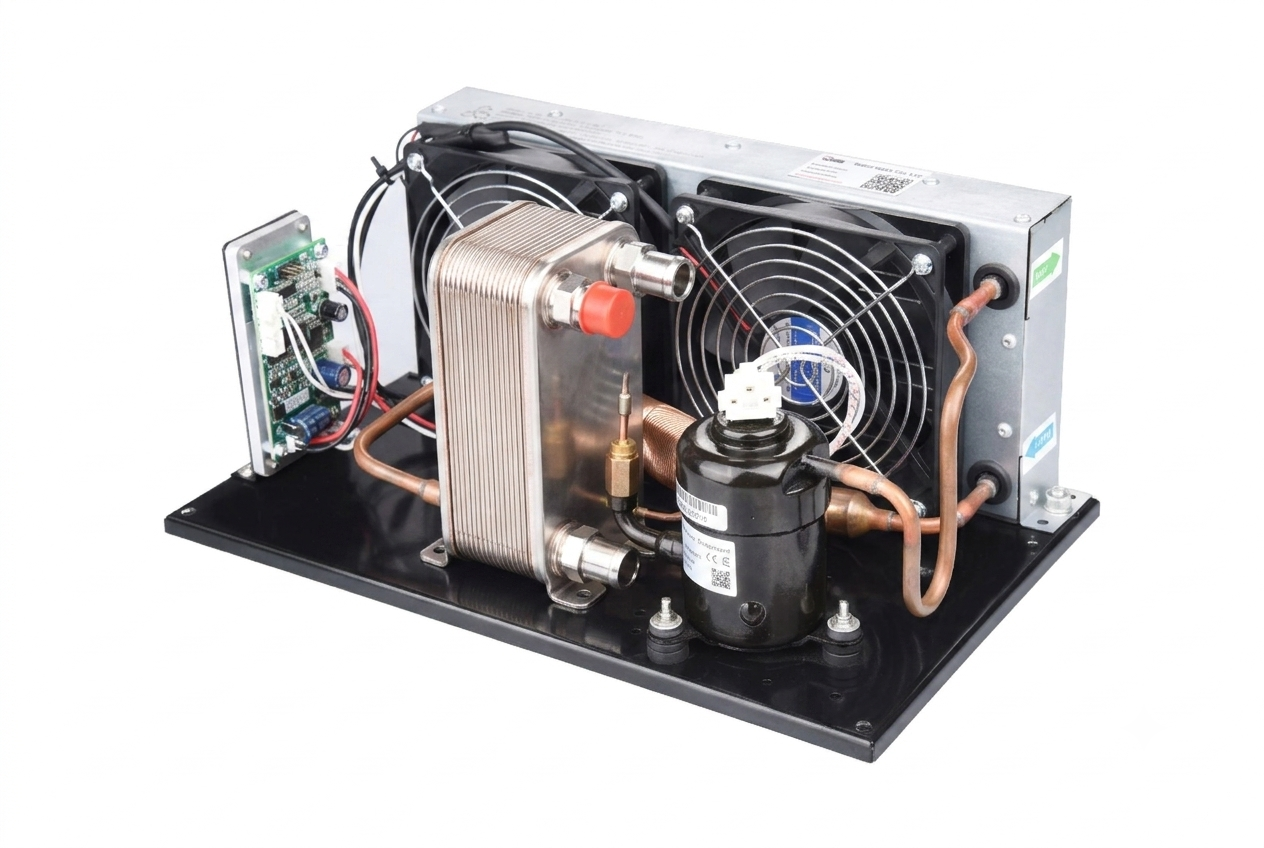
Plate Heat Exchangers
Plate exchangers stack thin corrugated metal plates with alternating channels for refrigerant and coolant. This creates a large surface area in a very small volume, making plate exchangers extremely compact and efficient. They handle higher heat flux densities than coaxial designs but can be more sensitive to water quality (particulates can clog the narrow channels). RIGID’s plate-type liquid chillers are designed for applications where space is at an absolute premium.
Copper Coil (Immersion)
Some applications use a copper coil immersed directly in the liquid being cooled — a fish tank, a chemical bath, a fermentation vessel. The coil acts as the evaporator, directly absorbing heat from the surrounding liquid. This is the simplest possible liquid cooling setup and works well for open-bath or reservoir-based cooling.
Applications Where Water Cooled Air Conditioning Excels
Laser Cooling
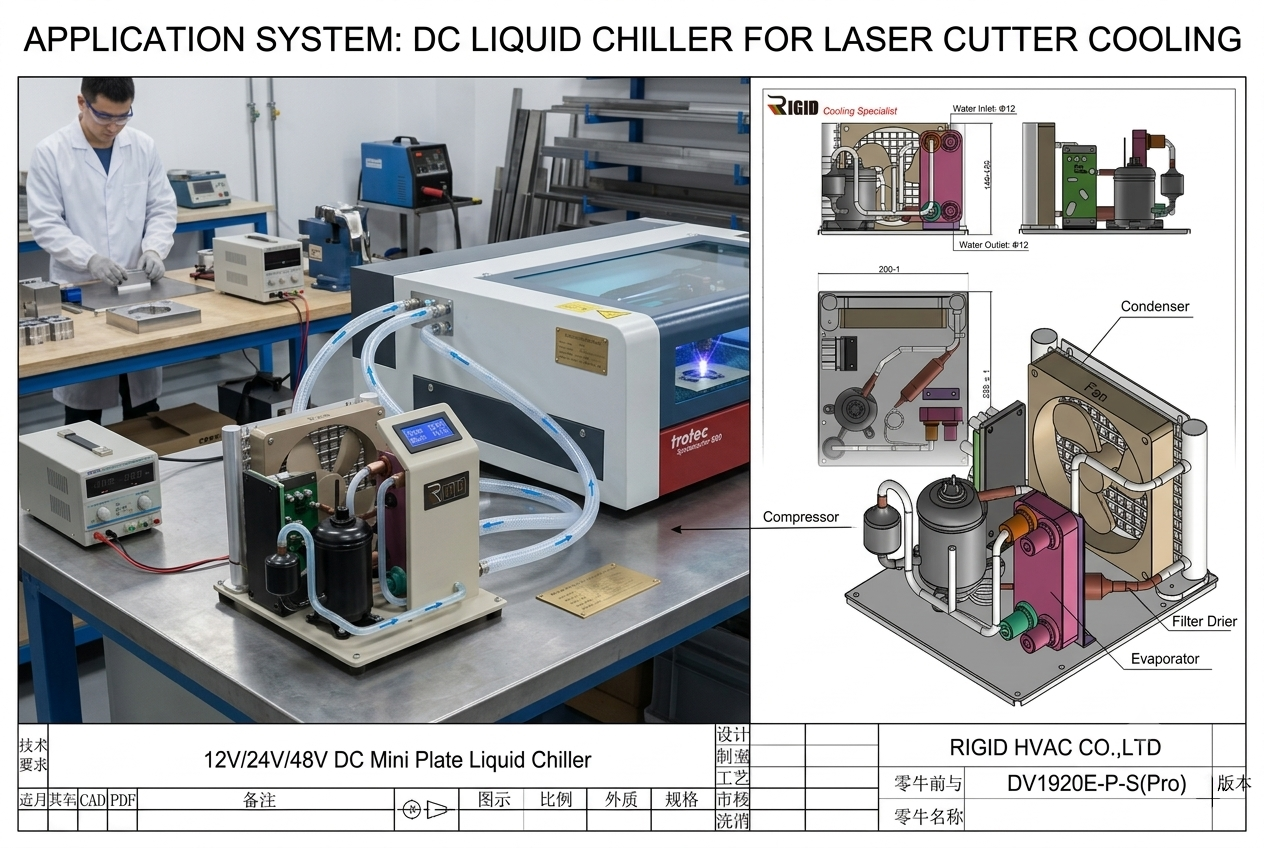
Lasers generate significant waste heat and require stable operating temperatures for consistent beam quality. A water cooled system circulates coolant through the laser head or housing, maintaining the tight temperature tolerances that air cooling cannot achieve. This is one of the largest markets for compact liquid chillers.
Medical and Laboratory Equipment
Diagnostic instruments, analytical devices, PCR machines, centrifuges, and imaging equipment all have thermal requirements. Water cooling provides the precision and quiet operation that clinical environments demand. The ability to reject heat remotely also keeps examination rooms comfortable for patients.
Personal Cooling Systems
Body cooling vests used by firefighters, military personnel, racing drivers, and industrial workers circulate chilled water through tubes in a wearable vest. A compact liquid chiller provides the cold water. These systems need to be small, lightweight, and battery-powered — exactly what DC-powered micro chillers deliver.
Electronics and Server Cooling
High-density computing generates heat faster than air can carry it away. Liquid cooling loops running through cold plates on CPUs, GPUs, and power electronics can remove heat more efficiently per unit volume than any air-cooled heatsink. Compact liquid chillers serve as the cold source for these loops in edge computing and small server deployments.
3D Printers and CNC Machines
High-performance 3D printers (particularly resin and metal sintering machines) and CNC spindles generate localized heat that affects dimensional accuracy. A small water cooled circuit with a compact chiller maintains stable temperatures without the vibration that air-cooled fans introduce.
Compact DC Liquid Chillers: Water Cooling Without the Bulk
Traditional water cooled air conditioning conjures images of cooling towers on commercial rooftops. But the same principle scales down dramatically. RIGID’s compact liquid chiller modules are integrated cooling sub-systems that fit in the palm of your hand.
Each module includes a miniature BLDC variable-speed compressor, driver board, condenser, evaporator (coaxial or plate type), and all necessary refrigerant plumbing — fully charged with R134a and ready to connect. Just add your coolant lines and power.
Key Advantages of DC Liquid Chillers
- Battery compatible. Running on 12V, 24V, or 48V DC, these chillers operate from batteries, solar panels, or vehicle power systems without an inverter.
- Variable speed. The BLDC compressor adjusts speed based on cooling demand, reducing power consumption at partial loads and extending battery life in mobile applications.
- Plug and play. Pre-charged with refrigerant, pre-assembled, and tested. Connect coolant fittings and DC power — no HVAC technician required for installation.
- Extremely compact. These are among the smallest and lightest liquid cooling modules available. They fit inside equipment housings, under vehicle seats, and in portable cases.
- Precision control. Temperature stability better than ±0.1°C when paired with appropriate controls. Suitable for laser, medical, and analytical applications.
Available Cooling Capacity
RIGID liquid chillers range from approximately 150W to 850W of cooling capacity, depending on the model and configuration. The smaller models suit personal cooling and component-level thermal management. The larger models handle laser cooling, small process chillers, and multi-device cooling loops.
Setting Up a Water Cooled System: What You Need
A complete water cooled cooling system includes more than just the chiller module:
- Chiller module. The compressor and heat exchanger unit that cools the liquid.
- Circulation pump. Moves coolant through the loop. Some RIGID modules include an integrated pump; others require an external one.
- Reservoir. A small tank that holds extra coolant, accommodates thermal expansion, and makes filling and bleeding the system easier.
- Tubing and fittings. Flexible silicone or PVC tubing connects everything. Use fittings compatible with your tubing diameter and coolant chemistry.
- Coolant. Distilled water works for many applications. For freeze protection or biological growth prevention, use a water-glycol mix or purpose-built coolant. Avoid tap water — mineral deposits will eventually clog heat exchangers.
- Heat load. The device or space you are cooling. Make sure the chiller’s capacity exceeds your heat load with some margin.
When Water Cooling Is NOT the Right Choice
Water cooling adds complexity. If your application does not specifically need what water cooling provides, air cooling is simpler and better.
- Simple room cooling. If you just need to cool a room or tent, an air-cooled DC air conditioner is simpler, cheaper, and requires no water loop maintenance.
- Dry environments where leak risk matters. Water and electronics are not friends. If a leak would destroy equipment or create safety hazards, consider whether the precision benefit justifies the risk — and plan leak detection accordingly.
- Applications with low heat loads. If you are removing less than 50W of heat, a simple heatsink and fan probably suffice. Do not over-engineer the solution.
- Situations where maintenance is impractical. Water cooling loops need periodic checks: coolant levels, water quality, pump function, and leak inspection. If the system will be installed and forgotten for years, air cooling’s simplicity is an advantage.
- Cost-sensitive applications without precision requirements. A liquid chiller module costs more than an equivalent air-cooled unit. If ±2°C is fine, air cooling saves money.
Maintenance: Keeping Your Water Cooled System Running
Water cooling is not maintenance-free, but it is not complicated either:
- Check coolant levels every few months. Top up as needed.
- Replace coolant annually or per manufacturer recommendation. Old coolant loses its corrosion inhibitors and biological protection.
- Inspect for leaks at fittings, connections, and pump seals. A small drip now becomes a big problem later.
- Clean or flush the loop if you notice reduced flow or rising temperatures. Sediment and biological growth can restrict flow over time.
- Monitor pump operation. A failed pump means no coolant flow, which means no cooling. Listen for unusual noise and check flow periodically.
Frequently Asked Questions
Is a water cooled air conditioner more efficient than air cooled?
Generally yes, because water transfers heat more effectively than air. The compressor does not have to work as hard when the condenser is water-cooled, which can improve COP (coefficient of performance). The efficiency gain is most significant in high ambient temperature environments where air-cooled condensers struggle.
Can I use tap water in a liquid cooling loop?
We do not recommend it. Tap water contains minerals that deposit on heat exchanger surfaces over time, reducing efficiency and eventually blocking flow. Use distilled or deionized water, optionally mixed with corrosion inhibitors or glycol for freeze protection.
How small can a water cooled AC system be?
Very small. RIGID’s compact liquid chiller modules weigh just a few pounds and fit within equipment housings. They are among the smallest liquid cooling systems commercially available, designed specifically for applications where space and weight are critical constraints.
Do I need an HVAC technician to install one?
Not for RIGID’s pre-charged modules. They come fully charged with refrigerant and assembled. You connect DC power and coolant fittings — standard plumbing work, not HVAC work. No refrigerant handling, no vacuum pumps, no specialized tools.
What coolant temperature can these systems achieve?
RIGID compact liquid chillers can cool liquids to approximately 5°C (41°F), depending on the model and operating conditions. The cooling range spans from about 5°C to 30°C, with temperature control precision better than ±0.1°C.
Bottom Line
A water cooled air conditioner makes sense when you need something that air cooling cannot deliver: precision temperature control, remote heat rejection, quiet operation, or compact form factor in high-heat-density applications. For laser cooling, medical equipment, personal cooling vests, electronics thermal management, and precision manufacturing, liquid cooling is often the only technology that meets the requirements.
RIGID’s compact DC liquid chiller modules bring water cooling down to a scale and simplicity that was not available a few years ago — battery-powered, pre-charged, and small enough to integrate directly into equipment. If your application needs what water cooling offers, these modules make it practical without the bulk and complexity of traditional chiller systems.
If your application just needs basic cooling and does not require precision, go with air cooling. It is simpler and cheaper. Know what you need, and choose accordingly.