
A Water Cooled Air Conditioner Is a Heat Rejection Decision
Every refrigeration circuit has to put its heat somewhere. Air-cooled equipment dumps it into the surrounding air with a fan and a finned coil; water-cooled equipment hands it to a liquid loop and lets that loop deal with it somewhere else.
That is the entire difference, and it is worth being clear about because a water cooled air conditioner does not cool better than an air-cooled one. It cools the same amount, in places where air-cooled equipment cannot work at all — and it charges you for the privilege in water, plumbing and maintenance.
So the question is never which is better. It is whether your installation is one of the three cases where the trade pays.
What Changes When the Condenser Sees Water
Condensing temperature is set by whatever the condenser is rejecting into. In an air-cooled unit that is ambient air, which on a hot afternoon in a plant room can be well above the outdoor temperature everyone quoted at design time. In a water-cooled unit it is the entering water temperature, which is far steadier and usually far lower.
Lower condensing temperature has three consequences that matter:
Capacity holds up. Cooling capacity falls as condensing temperature rises. A machine rejecting into 30 °C water behaves consistently; the same machine rejecting into air that swings from 25 °C to 50 °C does not.
Compressor work falls. Less lift between evaporating and condensing pressure means less energy per unit of heat moved.
The fan disappears. No condenser fan means no condenser fan noise, and no condenser airflow requirement in the enclosure.
Against that, you have inherited a water circuit that now has to be designed, filled, protected and maintained. That is the real subject of this article.
Three Situations Where Water Wins
In practice a water cooled air conditioner earns its place in one of three situations, and if none of them applies, air cooling is the simpler answer.
High or uncontrolled ambient. Sealed plant rooms, machine interiors, and enclosures downstream of other heat sources routinely run 15 to 20 degrees above the outdoor air. An air-cooled condenser in that space is trying to reject heat into air that is already hot, and capacity collapses exactly when it is needed. A water loop is indifferent to the local air temperature.
Nowhere to put the heat. Inside a sealed machine, a clean room, or an occupied space with no path to outdoors, an air-cooled condenser simply moves the problem a meter to the left. Water carries the heat out through a pipe instead.
Noise or airflow constraints. Laboratories, medical equipment, broadcast rooms and equipment installed near people all have limits on fan noise and on the dust an airflow path drags in. A liquid loop removes both.
There is a fourth situation that looks like a reason and usually is not: the site already has chilled water. Available water is a convenience, not a justification — the water still has to be at a usable temperature, at a usable flow, and clean enough not to foul the exchanger.
The Two Sides Compared Honestly
| Aspect | Air-cooled condenser | Water-cooled condenser |
|---|---|---|
| Heat sink | Local ambient air | Entering water temperature |
| Capacity in hot spaces | Falls sharply | Largely unaffected |
| Installation | Clearance and airflow path | Supply and return piping, isolation valves |
| Noise | Condenser fan is the dominant source | No condenser fan |
| Fouling mode | Dust on fins, visible, cleanable | Scale and biofilm inside tubes, invisible |
| Freeze risk | None on the condenser side | Real wherever the loop can go below zero |
| Ongoing duty | Clean the coil | Water treatment, flow verification, periodic descaling |
The row that catches people is fouling. A dirty air-cooled coil is visible from across the room; scale inside a coaxial condenser is not visible at all, and it degrades performance gradually enough that nobody attributes the drop to it.
The Costs You Take On With the Water Side
Four obligations arrive with the loop, and none of them are optional.
Water quality. Hardness deposits scale on the hottest surface in the circuit, which is exactly the condenser wall. Scale is a thermal insulator; a thin layer raises condensing temperature measurably and quietly undoes the advantage you bought the machine for.
Corrosion and material compatibility. Mixed metals in a wet loop with dissolved oxygen is a slow-motion failure. Decide the materials, then decide the treatment.
Freeze protection. Any part of the loop that can drop below zero — outdoor runs, unheated plant rooms, winter shutdowns — needs glycol or a reliable drain-down procedure. A frozen condenser is usually a replaced condenser.
Flow verification. Air-cooled machines fail loudly when airflow is blocked. Water-cooled machines can run for months at reduced flow with nothing more than slightly worse performance, until the day the head pressure trip finally catches it.
These are the reasons a water cooled air conditioner belongs in installations that have someone responsible for the water, and not in unattended remote cabinets where nobody will check anything for a year.
Where the Water Actually Comes From
The condenser does not care what is upstream, but you should, because the source sets the entering temperature and therefore the machine’s behavior.
Once-through mains water is simple, effective and increasingly restricted — many municipalities do not permit potable water to be run to drain for cooling. Where it is permitted, the running cost is water, not electricity, and it is rarely small.
A cooling tower loop gives low entering temperatures through evaporative cooling but adds the tower’s own water treatment, drift and legionella management obligations.
A dry cooler or closed-circuit loop rejects to outdoor air through a remote radiator. Entering temperatures are higher than a tower can achieve, but the loop stays closed and clean, and that is generally the right answer for equipment-scale systems.
An existing process chilled water circuit is convenient when it exists, provided you confirm the loop has the spare capacity and that your machine’s return temperature does not upset the rest of it.
Sizing the Water Side Without Guessing
Four numbers define the water side, and they are all negotiable at design time and expensive to change later.
Entering water temperature. This replaces ambient in every capacity calculation. Ask for capacity at your entering temperature rather than at whatever condition the datasheet used.
Flow rate. Heat rejected equals flow times temperature rise times the fluid’s heat capacity. Higher flow means a smaller rise and a lower condensing temperature, at the cost of pump energy and pressure drop.
Pressure drop through the condenser. This has to fit inside whatever head the source loop has spare. On the RIGID compact modules this figure is not published, so ask before assuming the existing pump can carry it.
Fouling allowance. Design for the loop as it will be in year three, not as it is on commissioning day.
A worked example makes the flow number concrete. Suppose a module is moving 550 W of heat out of the process and the compressor adds roughly 150 W of its own work; the condenser then has around 700 W to hand to the water. Water carries about 4.19 kJ per kilogram per degree, so a 5 K rise across the condenser needs roughly 0.03 kg per second — about 2 liters per minute.
That figure is small enough to surprise people who expect a cooling water connection to need serious pipework, and it is also small enough that fouling or a partly closed valve can halve it without anyone noticing. Both observations argue for measuring flow rather than assuming it.
If you allow a smaller rise, say 3 K, the flow requirement climbs to roughly 3.3 liters per minute and the condensing temperature falls slightly. That is the trade the water side offers: pump energy and pipe size against condensing temperature.
If the loop also serves process cooling rather than just heat rejection, our liquid chiller system design notes cover the circuit side in more detail.
The Water-Cooled Variants in the RIGID Range
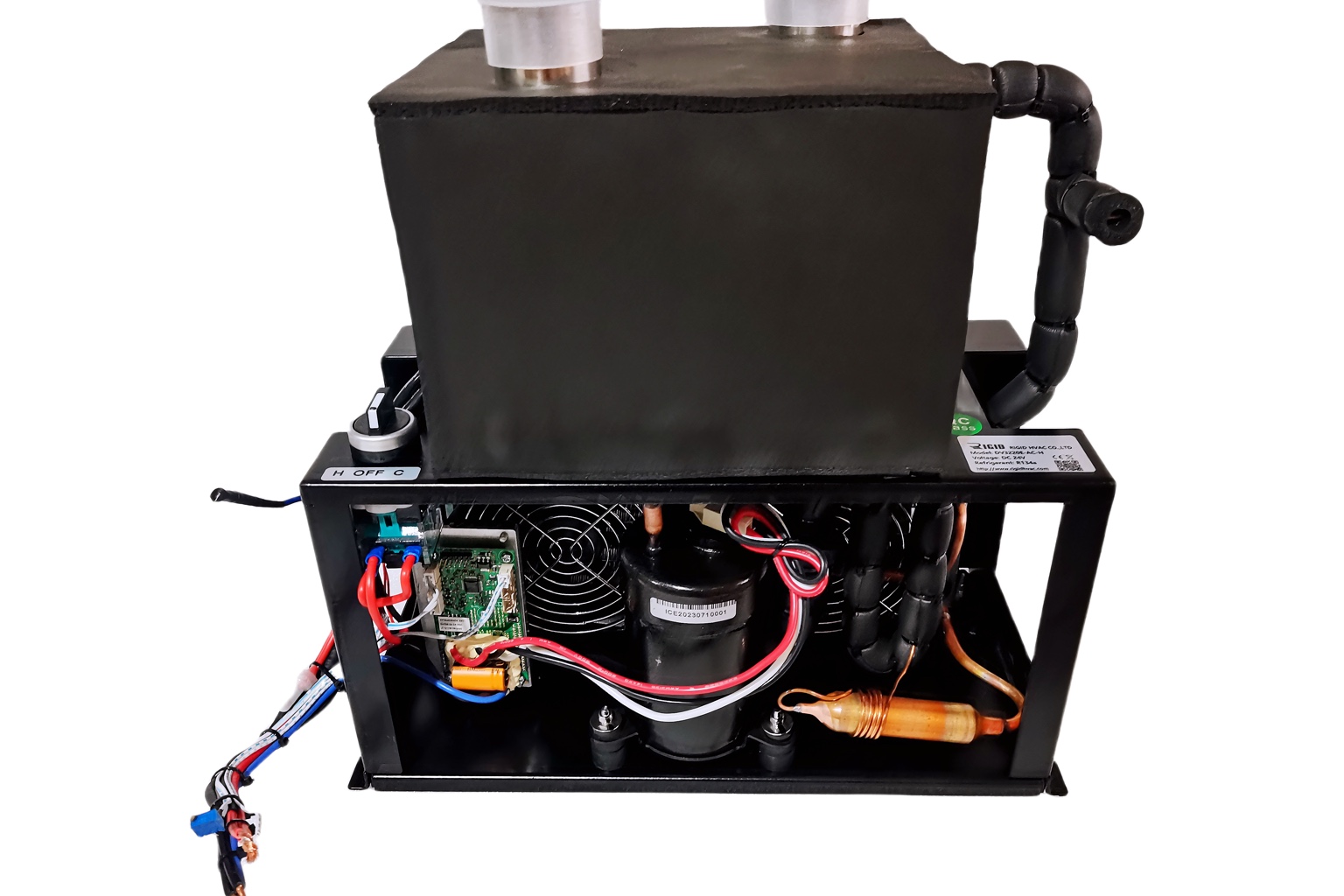
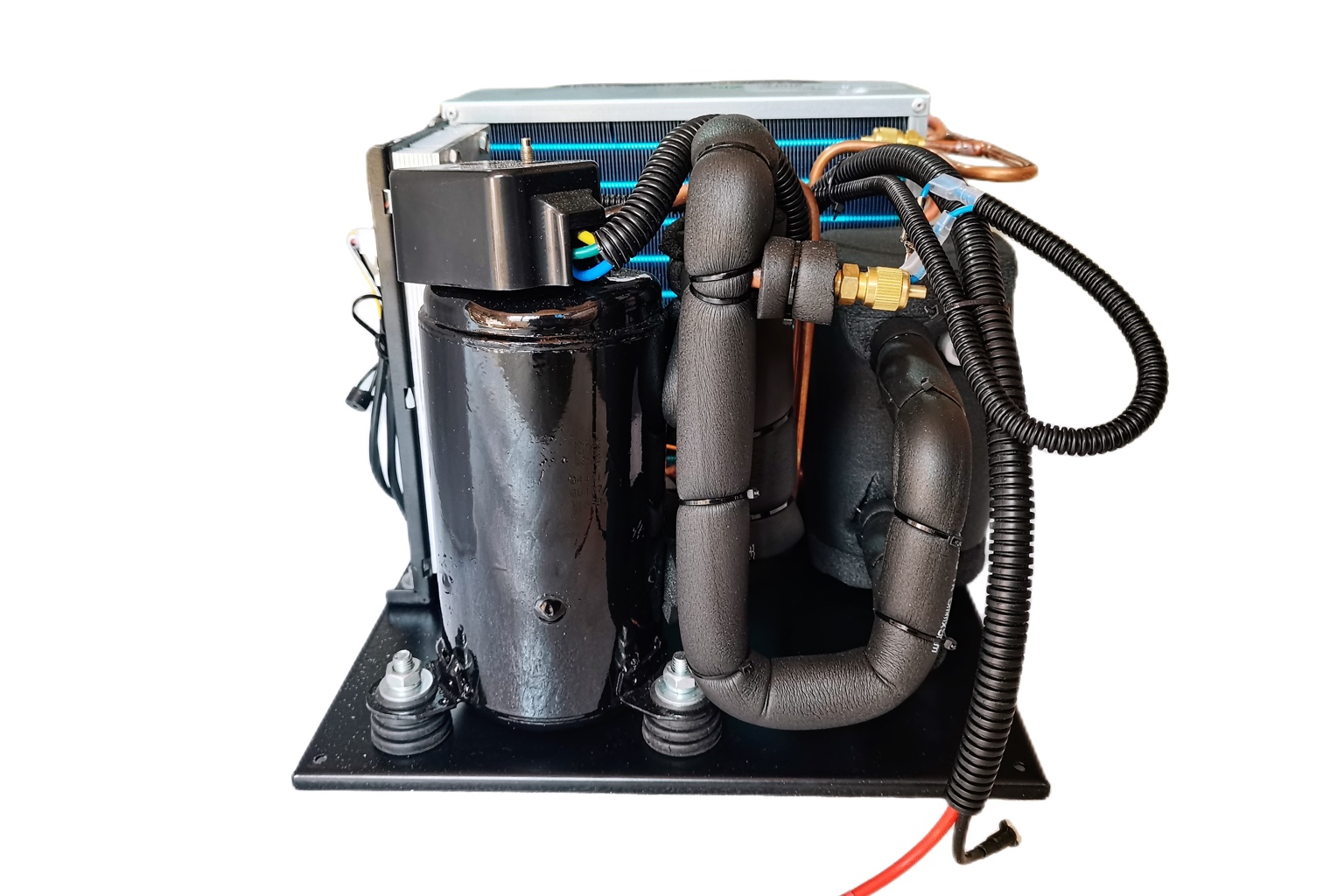
Within the compact liquid chiller family, the model suffix tells you how heat leaves the machine. The -C variants — DV1910E-C, DV1920E-C, DV1930E-C and DV3220E-C — use a coaxial water-cooled condenser in place of the finned coil and fan used by the air-cooled versions.
The published envelope for the family is 100 W to 550 W of cooling, a temperature range of −20 °C to +20 °C, supply options at 12 V, 24 V and 48 V DC, and R134a or R290 as refrigerant. The plate-style variants are around 330 × 200 × 138 mm.
Two things worth noting about that range. The upper limit of +20 °C is a ceiling, not a nominal point — duties in the 20 °C to 25 °C region need engineering confirmation rather than an assumption that the line covers them. And the capacity figures are given without a stated test condition, so for a water-cooled installation you should ask for capacity at your specific entering water temperature.
For equipment-scale duty in this class, a coaxial water-cooled module in a closed loop with a dry cooler is the arrangement that solves the most problems for the least ongoing obligation.
A Commissioning Checklist for the Water Side
Six checks that separate a loop that works from one that merely runs.
Verify flow, not just pressure. A gauge reading does not prove the water is moving. Measure it or fit a flow switch.
Record entering and leaving water temperature at commissioning. That pair is your baseline; any future performance argument is settled by comparing against it.
Confirm the freeze protection matches the site’s real minimum. Including the case where the machine is off in January.
Check the loop is actually closed. Any air ingress path brings oxygen, and oxygen brings corrosion.
Fit isolation valves and a means of descaling. The condenser will need cleaning eventually; deciding how while the machine is on the bench is much cheaper than deciding later.
Log the first fouling interval. After the first clean, you know your site’s real interval. Before that, you are guessing.
For the broader comparison between air and water rejection on laboratory equipment specifically, our note on air-cooled versus water-cooled lab chillers covers the bench-side considerations, and the water cooled air conditioner guide covers the general product background.
Frequently Asked Questions
Is a water cooled air conditioner more efficient than an air-cooled one?
Usually, but for a specific reason: it rejects heat into water that is cooler and steadier than the air an air-cooled condenser sees, which lowers condensing temperature and therefore compressor work. If the entering water is warm, the advantage narrows. The efficiency gain belongs to the heat sink, not to the machine.
Can I run mains water to drain instead of a closed loop?
Technically it works and is the simplest possible arrangement. Practically, many jurisdictions restrict single-pass cooling with potable water, and the running cost in water is often higher than the electricity saved. Check local rules before designing around it.
What maintenance does the water side need?
Water treatment appropriate to the source, periodic verification that flow is still what it was at commissioning, and descaling of the condenser at an interval your site’s water quality determines. The failure mode is gradual and invisible, so calendar-based checks beat waiting for symptoms.
Does a water-cooled condenser need freeze protection?
Wherever any part of the loop can fall below zero — outdoor piping, unheated spaces, winter shutdowns with the machine off. Glycol at a concentration matched to the site minimum, or a documented drain-down procedure. A condenser split by ice is not repairable in the field.
How do I know if scale is costing me capacity?
Compare entering and leaving water temperatures and head pressure against the commissioning baseline at a similar load. Rising condensing temperature at unchanged flow and load is the signature. Without a baseline, the comparison cannot be made, which is why recording one at commissioning matters.
Where to Take This Next
The decision reduces to one question: is the local air a usable heat sink? If it is, air cooling is simpler, cheaper and needs less attention. If it is not — because the space is hot, sealed, quiet or clean — then water is not an upgrade, it is the only option that works, and the loop obligations come with it.
If you want a specific installation assessed, including entering water temperature, available flow and whether a coaxial module fits the duty, tell us about the site and we will work through the heat rejection side with you.