
Laser Beam Dump Chiller Selection Starts With Absorbed Power
A laser beam dump chiller must remove the heat entering the actual water-cooled absorber while meeting its liquid-side requirements. Start with absorbed optical power, exposure duration, and the operating sequence. Then check inlet temperature, branch flow, pressure limits, and coolant compatibility. The beam dump’s optical rating is not the available capacity of the proposed chiller, and a matching number of watts does not establish hydraulic compatibility.
This guide concerns a small laser beam absorber with a documented water-cooling interface. It does not cover particle-accelerator beam dumps, replace a laser power detector’s cooling specification, or establish a laser safety procedure. A compact RIGID liquid module can be evaluated when the real thermal duty falls within its documented performance. Define the absorber duty before choosing the cold source. The laser system owner remains responsible for the optical installation and its protective behavior.
Distinguish the Absorber From the Laser and Power Detector
A beam dump terminates an unwanted or deliberately diverted beam. A power detector measures optical power, while the laser source has its own cooling duty. These components can occupy the same installation without sharing the same thermal limits. Identify which one is being served and whether the proposed cooling source also handles other consumers. A chiller selected for the laser head does not automatically leave sufficient capacity for a separately operated absorber.
The existing water-cooled laser power sensor guide addresses the measuring-device task. Here the interface belongs to an absorber that is not being selected to provide a calibrated power reading. Retain the beam dump model, absorber construction, and applicable optical limits in the inquiry. A module photograph cannot establish wavelength, reflection behavior, or the optical assembly’s suitability.
Start With the Beam Dump’s Approved Operating Envelope
Obtain the absorber provider’s requirements for wavelength, incident power, beam geometry, and exposure conditions. These determine whether that absorber may receive the proposed beam. The cooling provider should receive the thermal consequences of the approved operating case, not be asked to certify optical performance from a refrigeration capacity. Changing spot size or wavelength can alter the optical review even when the cooling duty appears similar.
Haas Laser Technologies lists water-cooled variants in its standard beam-dump range, including 500 W entries. This establishes a real small water-cooled application, not a RIGID compatibility result. Their ratings and connection limits remain attached to the stated absorber versions. An absorber rating is an optical-component limit. It cannot be copied into the capacity specification of a cooling module or treated as the heat load of every planned exposure.
Determine Which Operating States Deliver Heat to the Dump
List the states in which the dump receives the beam: normal beam termination, alignment, an instrument bypass, or another system-defined condition. Indicate the power entering the absorber in each state and how long it persists. A source’s maximum nameplate output can differ from the optical power delivered to this component. Conversely, a normally low-power branch can receive a larger load in a permitted alternate configuration.
Use measurements or documented system information with the laser provider’s approved method. Separate optical power arriving at the dump from other heat entering its cooling path. An unsupported reflection estimate or a guessed coupling factor can make the refrigeration requirement look smaller than it is. The review should identify the load basis and its uncertainty, including which operating state controls continuous heat rejection.
Separate Continuous Duty From Short Exposures
For sustained illumination, the cooling arrangement must continuously remove the required heat at the specified liquid condition. For intermittent exposures, average heat rejection and the absorber’s short-term temperature rise are separate issues. A low time average does not prove that the absorber can tolerate the peak exposure. The optical component’s permissible pulse or intermittent duty must come from its provider.
Describe the sequence rather than reducing it to one duty percentage. Include exposure duration, repetition, rest periods, and the permitted state between events. The thermal designer can then evaluate whether the dump, liquid inventory, and refrigeration source recover as required. Peak exposure and average cooling need separate evidence. Neither a generic capacity margin nor an arbitrary reservoir volume establishes that recovery. A laser beam dump chiller must support the actual approved program.
Specify Cooling Water at the Absorber Inlet
Write the allowed supply-temperature range and the measurement location supplied by the absorber manufacturer. Keep this distinct from the refrigeration controller’s setpoint. Hoses, mixing, shared branches, and the surrounding environment can separate a module reading from the actual inlet condition. Record any allowed outlet rise or other thermal limit that the absorber provider defines; do not infer one from a different beam dump.
The coldest available setpoint is not automatically useful. An unnecessarily cold line can create a moisture-control problem in the optical installation without improving an already acceptable absorber condition. Match the approved supply requirement and the equipment environment. If the absorber requires liquid above the proposed module’s documented range, a different reviewed cooling arrangement may be needed. Temperature overlap is a necessary selection check, but it is not proof of sufficient capacity.
Match Flow, Pressure Loss, and Working Pressure
A minimum flow requirement, a pressure drop, and a maximum working pressure describe different parts of the interface. Obtain their conditions for the actual liquid and temperature. A maximum inlet-pressure statement does not tell the designer what pump head is required, while a flow rating at another condition may not represent the installed branch. Keep differential and allowable pressures clearly labeled.
Add tubing, couplings, valves, filters, and the liquid module’s heat exchanger to the circuit assessment. Use the selected circulation pump’s curve to establish an operating point through that total resistance. The existing liquid-loop flow and pressure-drop guide covers this surrounding design task. The required flow belongs at the absorber branch. A total-flow indication cannot resolve how circulation divides between multiple loads.
Include Every Load on a Shared Source
If the proposed source also serves a laser head, a detector, or another fixture, prepare a simultaneous-load record. Identify which consumers are active together and which cooling obligations continue when the beam is no longer entering the dump. A sum of independent maximum ratings may misrepresent the program, but an assumption that only one consumer operates can understate it. The system owner should define the allowed combinations.
Also identify branch temperature and hydraulic requirements separately. Consumers can have overlapping wattages while requiring different inlet conditions or fluids. Sharing a source introduces distribution and control questions, including what a change in one branch does to another. For laser beam dump chiller selection, keep the dump’s acceptance criteria visible even when it becomes one column in a larger cooling specification.
Select Coolant for the Water-Cooled Assembly
Water-cooled does not mean that any available water or glycol mixture is approved. Obtain the absorber’s fluid-quality and material requirements and compare them with the heat exchanger, pump, hoses, seals, and service connections. Record the complete intended formulation. A liquid module with a plate exchanger does not establish compatibility for the absorber’s internal passages or every additive used elsewhere in the laboratory.
An isolation arrangement may be considered when two circuits require different liquids, but it adds thermal resistance, separate circulation, and another pressure boundary. It should be evaluated as a real component in the design rather than assumed to preserve the original setpoint and capacity. Fluid compatibility is a complete-loop requirement. Confirm maintenance and replacement responsibilities as well, because later contamination or an unapproved refill can invalidate an otherwise suitable installation.
Evaluate the DV Plate Module With Application Data
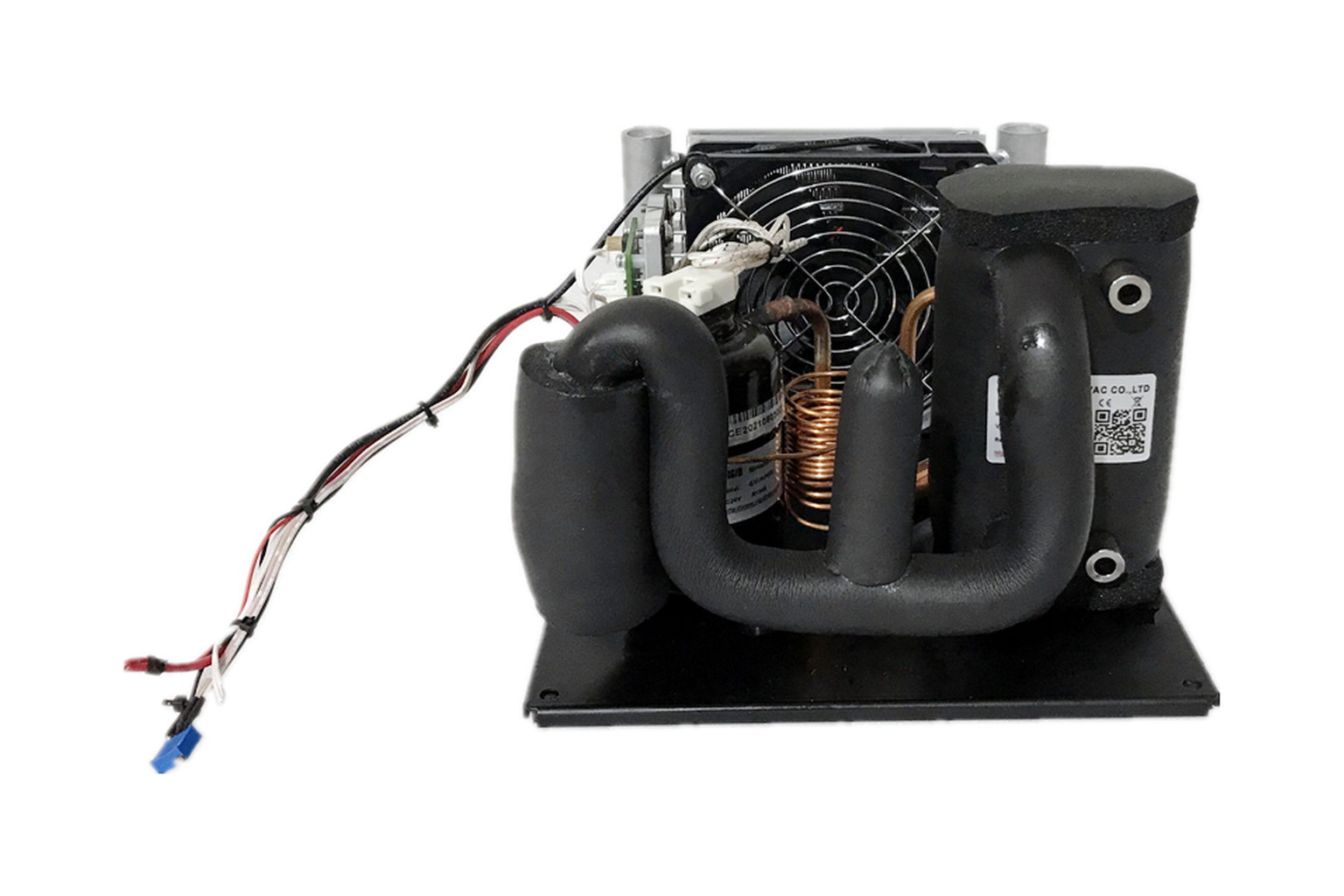
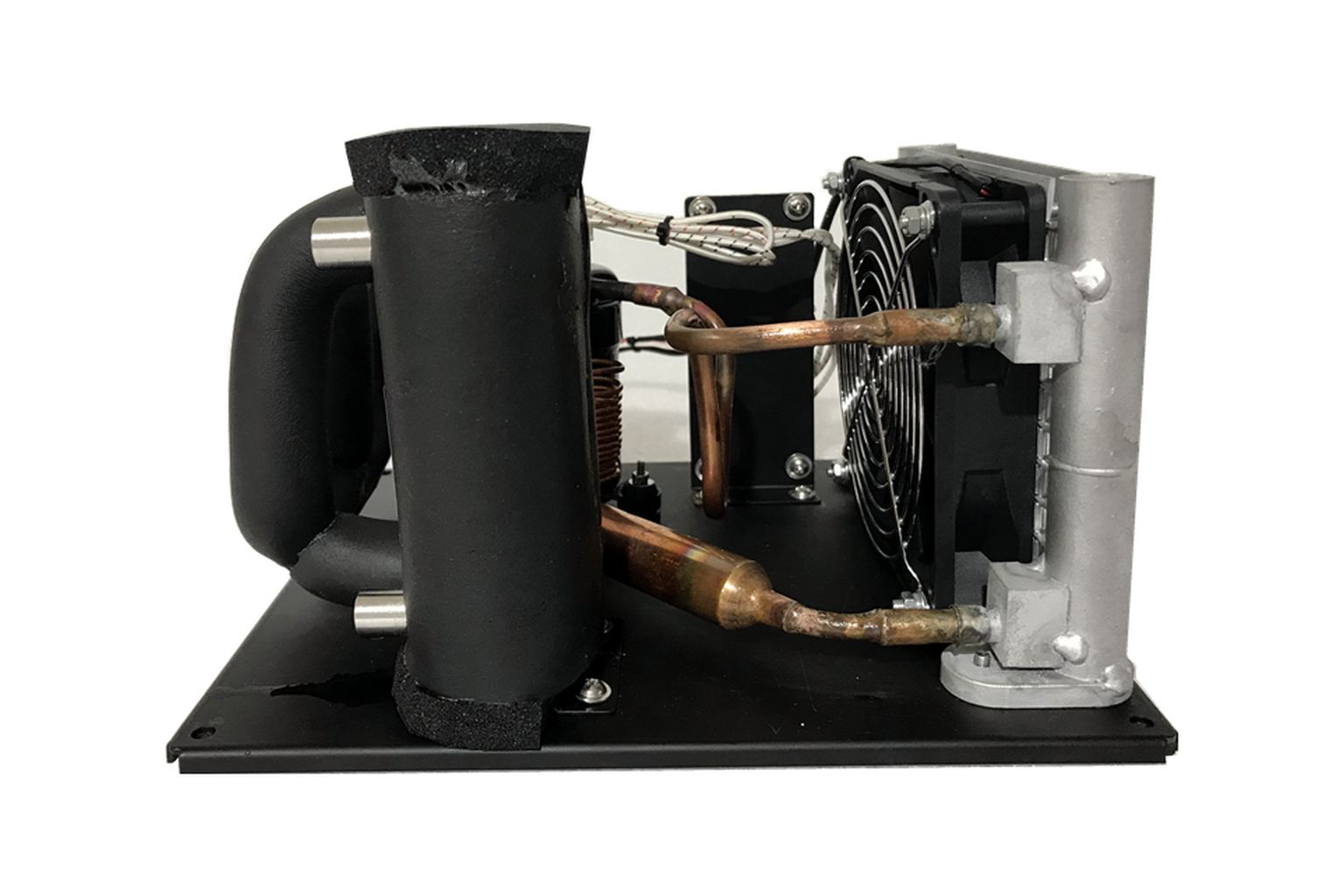
The RIGID compact liquid-chiller range includes plate configurations with a published liquid-temperature range of −20°C to +20°C. The series lists 100–550 W capacities, but does not provide the full test conditions needed to approve an absorber duty. Those numbers are an initial screening reference. They do not establish that every model supplies the same capacity at the selected coolant temperature.
A documented plate-series model such as DV1920E-P can enter a configuration review. Obtain selected-model performance at the required liquid and condenser conditions, together with the supplied circulation scope. The referenced public series facts do not establish an external pump curve, available head, or reservoir volume. A laser beam dump chiller proposal must therefore describe the complete cooling arrangement, not treat an open refrigeration module as a finished absorber-cooling package.
Plan Cooling Status and the Beam-System Response
The laser-system provider should define what happens if required circulation, liquid temperature, or refrigeration performance is unavailable. A cooling signal is an input to that design, not proof that a complete protective response exists. Identify the controller receiving it, the approved action, and the evidence needed to verify the response. Do not assume that a generic flow switch or module alarm can be wired directly into the laser equipment.
Stopping optical exposure and stopping circulation are different actions. Any continuing cooling obligation must follow the absorber and laser-system instructions. Cooling selection does not certify laser safety. This guide does not prescribe beam handling, interlock wiring, or a fault simulation involving deliberate loss of required cooling. Acceptance of the cooling arrangement and acceptance of the complete laser installation remain separate responsibilities.
Use a Duty-and-Interface Acceptance Table
The table below connects each reason for selecting a cooling source with the evidence needed to accept it. Use model-specific requirements and the intended operating program. Leave an unknown field visible until the responsible provider resolves it; a complete-looking table built from unrelated absorber values is less useful than a short list of clearly assigned open questions.
| Field | Absorber or system requirement | Cooling evidence |
|---|---|---|
| Thermal duty | Absorbed power and approved exposure sequence | Capacity and recovery at the relevant conditions |
| Temperature | Allowed inlet condition and measurement point | Verified supply behavior at that location |
| Hydraulics | Branch flow, pressure loss, allowable pressure | Pump operating point through the complete loop |
| Fluid | Quality, formulation, wetted-material restrictions | Approval across the supplied circuit |
| Shared consumers | Permitted simultaneous operating states | Combined duty and branch distribution |
| Response | Required action when cooling is unavailable | Approved signals and complete-system acceptance |
During commissioning, compare observed inlet and return temperatures, branch flow, and operating state with the agreed criteria. A cool enclosure or a stable remote display cannot replace those measurements. Preserve the loop and beam-dump identities with the results so a different absorber or revised optical program is not accepted on the basis of an earlier installation.
Submit the Actual Absorber Duty
For a laser beam dump chiller review, send RIGID the beam dump and liquid-interface requirements. Include the absorber part number, absorbed-power evidence, continuous or intermittent sequence, supply-temperature range, branch hydraulics, fluid approval, ambient conditions, and available electrical supply. State any shared loads and external pump or reservoir responsibilities. This allows a compact module to be evaluated against a defined small cooling duty without claiming compatibility with every water-cooled laser accessory.
Frequently Asked Questions
Does a 500 W beam dump require a 500 W chiller?
Not automatically. The absorber rating and actual absorbed load are different quantities. The chiller must support the real duty at its intended operating conditions, while the absorber must independently satisfy its optical and exposure limits.
Can I size an intermittent duty from its average power?
The average helps describe heat rejection, but the absorber’s peak exposure and recovery requirements still need separate review. Provide the operating sequence and the component manufacturer’s permitted conditions rather than using a universal duty-factor reduction.
Is a laser beam dump chiller the same as laser-source cooling?
No. They serve different components and can have separate temperature, hydraulic, and operating requirements. If a source is shared, define the simultaneous consumers and verify the dump’s branch separately.
Can a DV module be selected from its catalog capacity alone?
No. Obtain performance at the required coolant and ambient conditions, and establish the complete circulation arrangement. The published −20°C to +20°C range and series wattages do not prove capacity or flow for a particular absorber installation.
Does an accepted cooling loop establish laser safety compliance?
No. Optical installation, protective behavior, and complete-system verification remain with the responsible laser-system provider. Cooling evidence supports that work but is not a certification of beam handling or the finished installation.