
What Is a Refrigerated Circulator, and When Do You Actually Need One?
A refrigerated circulator is a benchtop temperature control unit that cools a working fluid and pumps it through a closed circuit, holding a target temperature within a narrow band while an instrument or process rejects heat into that fluid. The category name causes more confusion than almost any other piece of lab equipment, because manufacturers apply it to at least three physically different machines: bath circulators with an open reservoir, closed-loop recirculating chillers with no accessible bath, and combined heating/cooling units that do both.
That confusion has practical consequences. Laboratories routinely buy a bath circulator when what they needed was a closed-loop chiller, then discover the open reservoir evaporates over a weekend run, or that the bath opening is too small for the vessel they intended to immerse. Others buy a cooling-only unit and find out mid-project that their protocol also requires a controlled ramp up to 60 °C.
This guide separates the three, explains where each belongs, and gives a sizing method you can apply before you request a quote.
Three Machines Behind One Name: What “Refrigerated Circulator” Actually Covers
Every product sold under this label does the same two things: it removes heat, and it moves fluid. What differs is where the fluid goes and whether the unit can also add heat.
| Type | Reservoir | Heats? | Typical use |
|---|---|---|---|
| Bath circulator (refrigerated/heated) | Open bath, samples immersed directly | Yes | Sample conditioning, viscometry, immersed vessels |
| Recirculating chiller / cooler | Closed loop, no accessible bath | No | Continuous heat removal from an instrument |
| Dynamic temperature control system | Closed loop, external process | Yes | Reactor jackets, ramped protocols |
The first question to answer when you shop for a refrigerated circulator is not brand or capacity. It is whether anything needs to sit in the fluid. If samples are immersed, you need a bath. If the fluid only needs to travel to a condenser, a laser head, or an instrument’s cooling port and come back, a closed loop is the better fit — and usually the smaller, quieter, and less evaporation-prone one.
How the Cooling Side Works
A vapour-compression circuit does the cooling in most units above roughly 100 W of capacity. A compressor raises refrigerant pressure and temperature; a condenser rejects that heat to ambient air; an expansion device drops the pressure; and an evaporator absorbs heat from the circulating fluid. A pump then moves the chilled fluid out to the load and back.
Thermoelectric (Peltier) designs exist at the low end and are common where vibration must be eliminated entirely. They are simple and compact, but their efficiency falls away as the temperature difference widens, which is why compressor-based systems dominate once you need meaningful capacity at sub-zero setpoints.
One number deserves care here. Cooling capacity and electrical input are not the same figure and cannot be derived from one another by inspection. A unit rated at 450 W of cooling does not draw 450 W from the wall; the relationship depends on the coefficient of performance at the operating point, and COP itself changes with setpoint and ambient temperature. When you plan circuit loading, use the electrical rating printed on the nameplate, never the cooling rating.
Capacity Falls as Setpoint Drops — Plan for It
The single most common sizing error is reading a headline capacity figure and assuming it applies across the whole temperature range. It does not. Cooling capacity is quoted at a specific fluid temperature, and it declines — often steeply — as the setpoint falls.
The practical consequence: a unit that comfortably removes your heat load at 20 °C may not hold setpoint at −20 °C, even though the same machine is rated for both. Always ask the supplier for the capacity at your working temperature, not the peak figure.
A workable sizing sequence:
- Establish the actual heat load. For electrically driven equipment, the heat rejected into the coolant is bounded by the equipment’s electrical input. For a process, calculate from mass flow, specific heat, and the temperature change you need to hold.
- Fix the working setpoint — the coldest temperature the loop must sustain continuously, not the lowest the unit can reach.
- Read capacity at that setpoint from the manufacturer’s capacity curve or table.
- Add margin. A commonly used starting point is 20–30 % headroom to cover ambient swings, fouling, and future load growth. Treat this as a rule of thumb rather than a specification — the right margin depends on how stable your ambient is and how much the load varies.
- Check the hydraulics. Capacity is meaningless if the pump cannot push the required flow through your circuit’s restriction. Long runs, small-bore tubing, and narrow internal passages all consume pressure.
A Worked Sizing Example
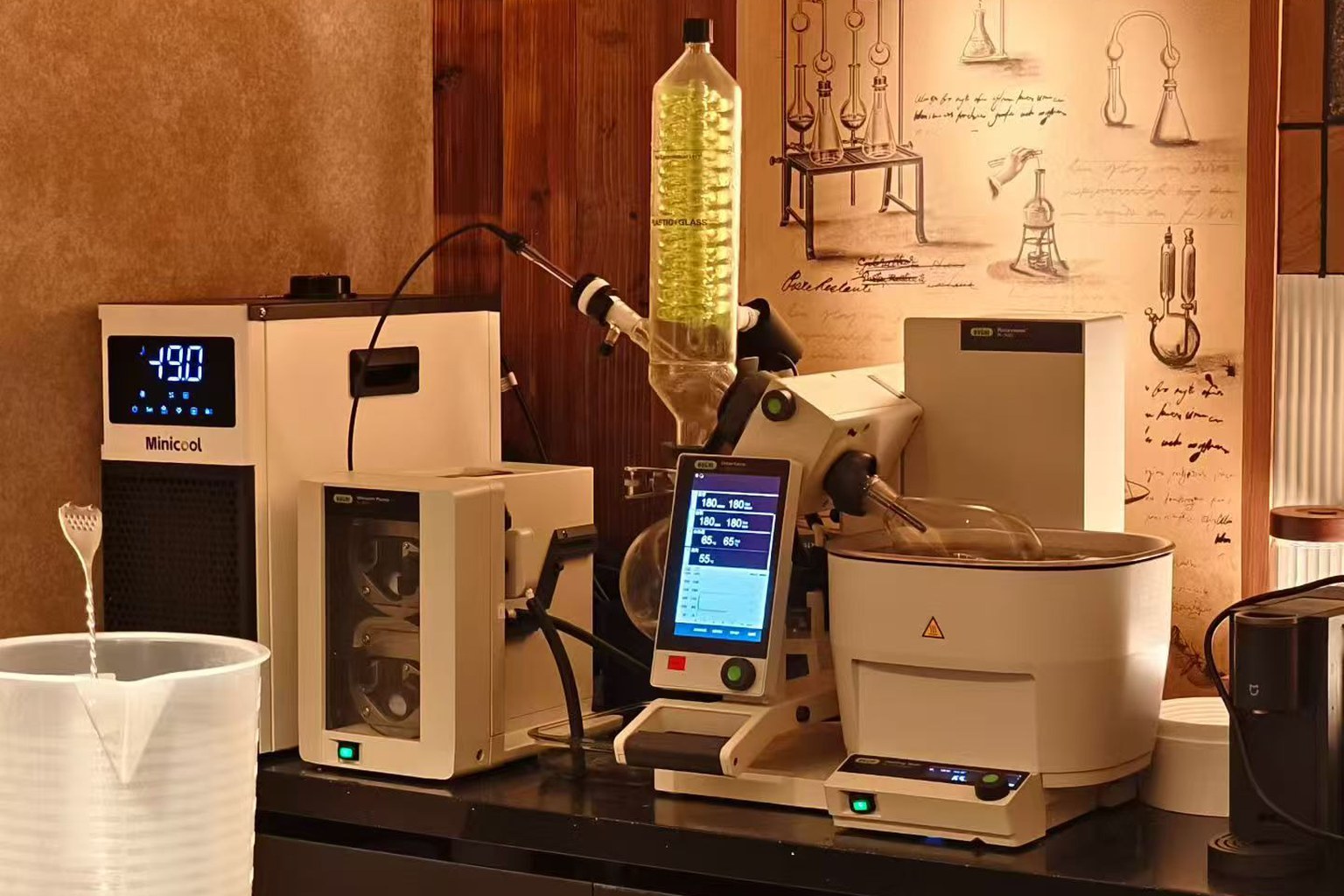
Suppose you are sizing a refrigerated circulator for a rotary evaporator condenser, and the coolant needs to hold −10 °C for solvent recovery.
Step one — bound the heat load. The heat arriving at the condenser is the latent heat of the vapour being condensed plus any sensible cooling. If the evaporation rate is known, that gives a defensible figure. If it is not, a practical bound is the heating power actually delivered to the flask, since the condenser cannot receive more heat than the bath supplies. A 1,000 W heating bath running continuously sets an upper bound near 1,000 W, and real duty is usually well below that because heating is intermittent and some heat is lost to the room.
Step two — read capacity at −10 °C, not at 20 °C. This is where undersizing happens. A unit whose headline figure looks generous may deliver substantially less once the setpoint drops below zero, because capacity declines across the range.
Step three — apply margin. Adding 20–30 % headroom to the calculated load is a widely used starting point rather than a fixed rule; a laboratory with a stable 20 °C ambient and a steady load can sit at the lower end, while a room that reaches 30 °C in summer, or a process with peaky duty, justifies more.
Step four — check flow. A condenser jacket with narrow passages and several metres of tubing can consume more pump pressure than expected. If flow falls short, the fluid leaves the loop warmer than intended and the unit appears undersized when the real constraint is hydraulic.
Working through those four steps before requesting a quote turns a vague “we need a chiller” into a specification a supplier can answer precisely.
Coolant Selection Affects Real Performance
The fluid in the loop is part of the system, not an afterthought. Plain water has excellent heat capacity but freezes at 0 °C, which rules it out for sub-zero setpoints. Water/glycol mixtures extend the usable range, and the proportion of glycol sets how low you can go — but glycol also lowers heat capacity and raises viscosity, so the same pump moves less fluid and the same fluid carries less heat per litre.
Viscosity is the effect most often underestimated. As temperature falls, viscosity climbs, and flow through a fixed restriction drops with it. A loop that circulates comfortably at 10 °C can become sluggish at −30 °C well before the fluid is anywhere near freezing. If your setpoint is deep in the negative range, size the pump for viscosity at that temperature rather than at room temperature.
Dedicated heat transfer fluids exist for the coldest work and behave better than glycol mixtures at low temperature, at higher cost. Whichever fluid you choose, confirm material compatibility with every wetted component in the circuit — the instrument’s internal passages included, not just the chiller’s.
Stability Is a Separate Specification From Range
Temperature range and temperature stability are independent, and confusing them leads to disappointment. Range tells you how cold the unit can go. Stability tells you how tightly it holds a setpoint once it gets there.
For a condenser on a rotary evaporator, stability of a degree or two is usually irrelevant — you simply need the vapour to condense. For an analytical instrument whose detector output drifts with temperature, or for a laser whose output wavelength shifts with coolant temperature, stability is the specification that determines whether your data is usable. Units built for that duty are typically specified to ±0.1 °C or tighter.
Ask which number a quoted stability figure refers to: stability at the unit’s internal sensor is easier to achieve than stability at the load, and the two can differ once long tubing and thermal mass sit between them.
Refrigerant Choice and What It Means for You
Compact laboratory cooling systems are commonly built around R134a, R290, or R1234yf, and the choice affects more than environmental paperwork.
R290 (propane) offers strong thermodynamic performance in small charges, but it is flammable, which brings charge-size limits and installation conditions that vary by jurisdiction and by the room the unit will occupy. R1234yf is a low-GWP alternative with different pressure and material compatibility characteristics. R134a remains widely available and well understood.
Regulations in this area are moving toward lower-GWP options in many markets, but the timelines, thresholds, and exemptions differ substantially by region and by application category. If refrigerant compliance matters for your site — a shared laboratory, a regulated facility, or an export destination — confirm the requirement that applies to your location before you specify, rather than assuming a single global rule.
Where Closed-Loop Cooling Fits in the Laboratory
Closed-loop recirculating cooling suits any instrument that rejects heat continuously and needs that heat removed at a controlled temperature. Typical duties include rotary evaporator condensers, distillation and short-path systems, calorimeters, coal analysers, Kjeldahl apparatus, electrophoresis units, molecular pumps, laser sources, electronics enclosures, and medical or diagnostic instruments.
The common thread is that the fluid never needs to be open to the room — which is why a closed-loop unit, rather than a bath-style refrigerated circulator, is the usual answer for these duties. That closure is what removes evaporation losses, keeps the coolant clean, and lets the unit sit on a bench rather than requiring a dedicated footprint.
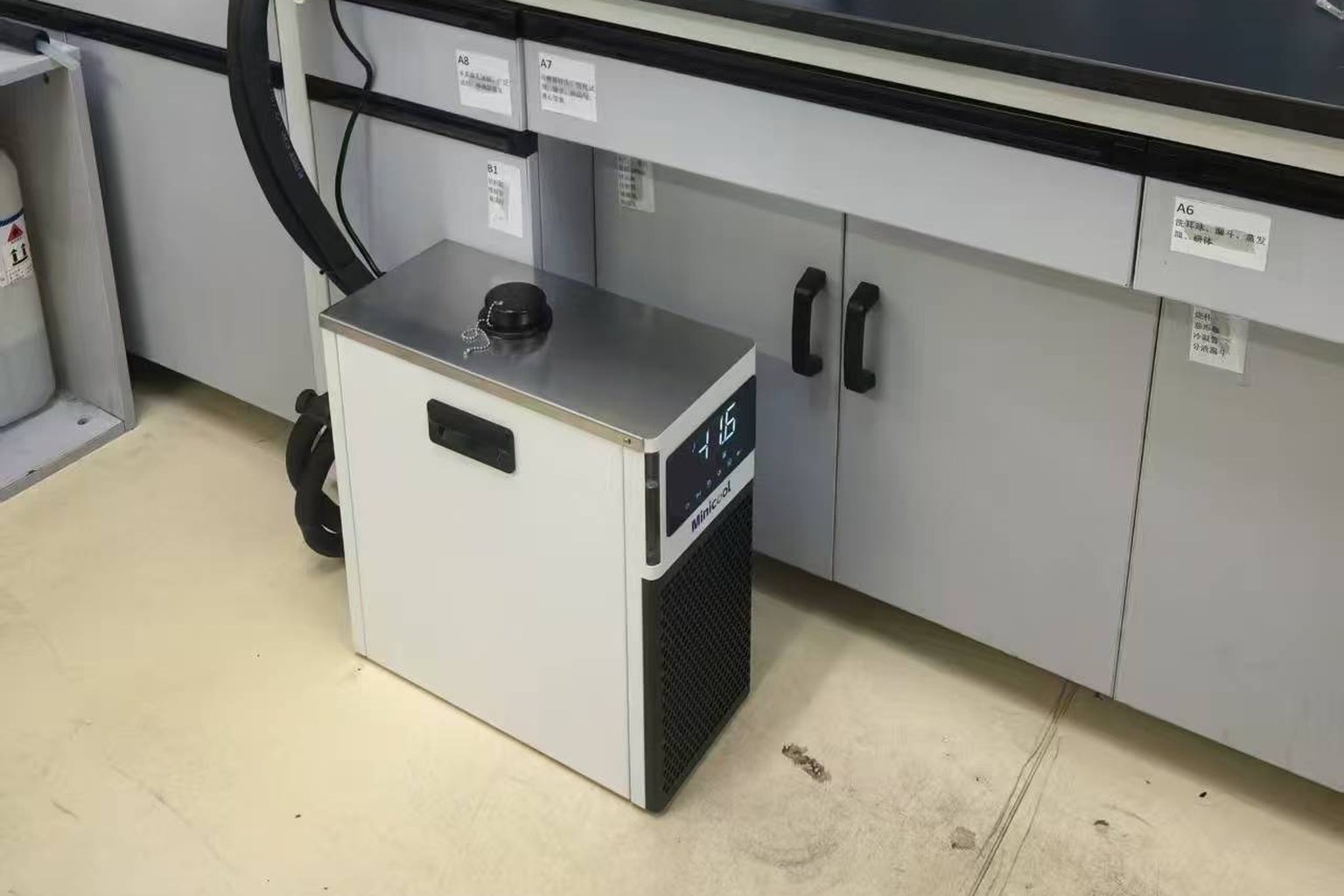
Purpose-built benchtop units address exactly this duty. The MiniCool™ countertop recirculating lab chiller is one example of the format: a closed-loop, countertop-scale system spanning 450 W to over 1 kW of cooling capacity across a 0 °C to −40 °C range, specified to ±0.1 °C stability, available with R134a, R290, or R1234yf, and offered in AC (120–240 V) or DC supply variants. Where a laboratory needs more capacity than a countertop unit provides, the MidiCool™ series covers the step up.
Where It Is Not the Right Answer
Being clear about the boundary is as useful as describing the fit.
A closed-loop chiller is the wrong choice if you need to immerse samples or vessels directly in temperature-controlled fluid — that is a bath circulator’s job, and no amount of capacity substitutes for an accessible reservoir. It is also the wrong choice if your protocol requires controlled heating as well as cooling; a cooling-only unit cannot ramp up, and retrofitting an external heater into a closed loop rarely delivers the control quality a combined unit provides.
At the other end, benchtop equipment is not a substitute for facility-scale cooling. If your heat load runs to tens of kilowatts, or you are cooling an entire suite of equipment from one source, that is a different class of machine with different installation, power, and servicing requirements.
Questions Worth Asking Before You Buy a Refrigerated Circulator
What is the capacity at my working temperature, not the headline figure? This single question resolves most undersizing problems.
What flow rate and pressure does the pump deliver against my circuit’s restriction? Ask for a pump curve, not a single maximum-flow number.
Where is stability measured? At the unit, or at the load?
What is the electrical input at my operating point? Needed for circuit planning, and not derivable from the cooling rating.
What coolant is compatible? Water, water/glycol mixtures, and other heat transfer fluids differ in viscosity and heat capacity, and viscosity rise at low temperature can reduce effective flow well before the fluid approaches its freezing point.
Frequently Asked Questions
Is a refrigerated circulator the same as a recirculating chiller? Not quite. In common usage, “refrigerated circulator” often implies a bath with an accessible reservoir and frequently a heating function, while “recirculating chiller” implies a closed loop and cooling only. Manufacturers are not consistent, so confirm the physical configuration rather than relying on the label.
Can one unit serve two instruments? Sometimes, but only if total heat load at the working setpoint fits within capacity and the hydraulic circuit can deliver adequate flow to both. Splitting a loop between devices with different temperature requirements is generally a poor idea, because a single control loop can only satisfy one setpoint.
Does the unit need to sit next to the instrument? Not necessarily, but every metre of tubing adds pressure drop and thermal lag. Longer runs need insulation and may need a pump with more head.
Why does my unit struggle in summer? Air-cooled condensers reject heat to room air, so capacity falls as ambient temperature rises. A unit sized with no margin against a 20 °C room may not hold setpoint at 30 °C.
Summary
The term “refrigerated circulator” spans open baths, closed-loop chillers, and combined heating/cooling systems, and the right choice follows from one question: does anything need to sit in the fluid? For continuous heat removal from an instrument, closed-loop cooling is usually the better format — no evaporation, cleaner fluid, smaller footprint. Size using capacity at your actual working temperature rather than the headline number, treat stability as a separate specification from range, verify the pump can deliver flow against your circuit, and confirm refrigerant requirements for your specific location before specifying.