
When people search for the smallest air conditioner unit, they usually find two categories of results: personal fans marketed as “portable ACs” that do not actually cool air below ambient temperature, and miniature split systems that are smaller than traditional units but still weigh 15-30kg and require professional installation.
There is a third category that most people do not know exists: true vapor compression air conditioners small enough to hold in one hand, light enough to mount anywhere, and powerful enough to maintain comfortable temperatures in enclosed spaces up to 3 cubic meters. These are micro DC air conditioning modules — genuine refrigeration systems miniaturized to dimensions that seem implausible until you see them running.
What Makes the Smallest Air Conditioner Unit Actually Work
A real air conditioner — one that can cool below ambient temperature — requires vapor compression refrigeration. This means a compressor, condenser, evaporator, and expansion device working together in a sealed refrigerant circuit. The laws of thermodynamics do not have a miniature exception: you need all four components regardless of size.
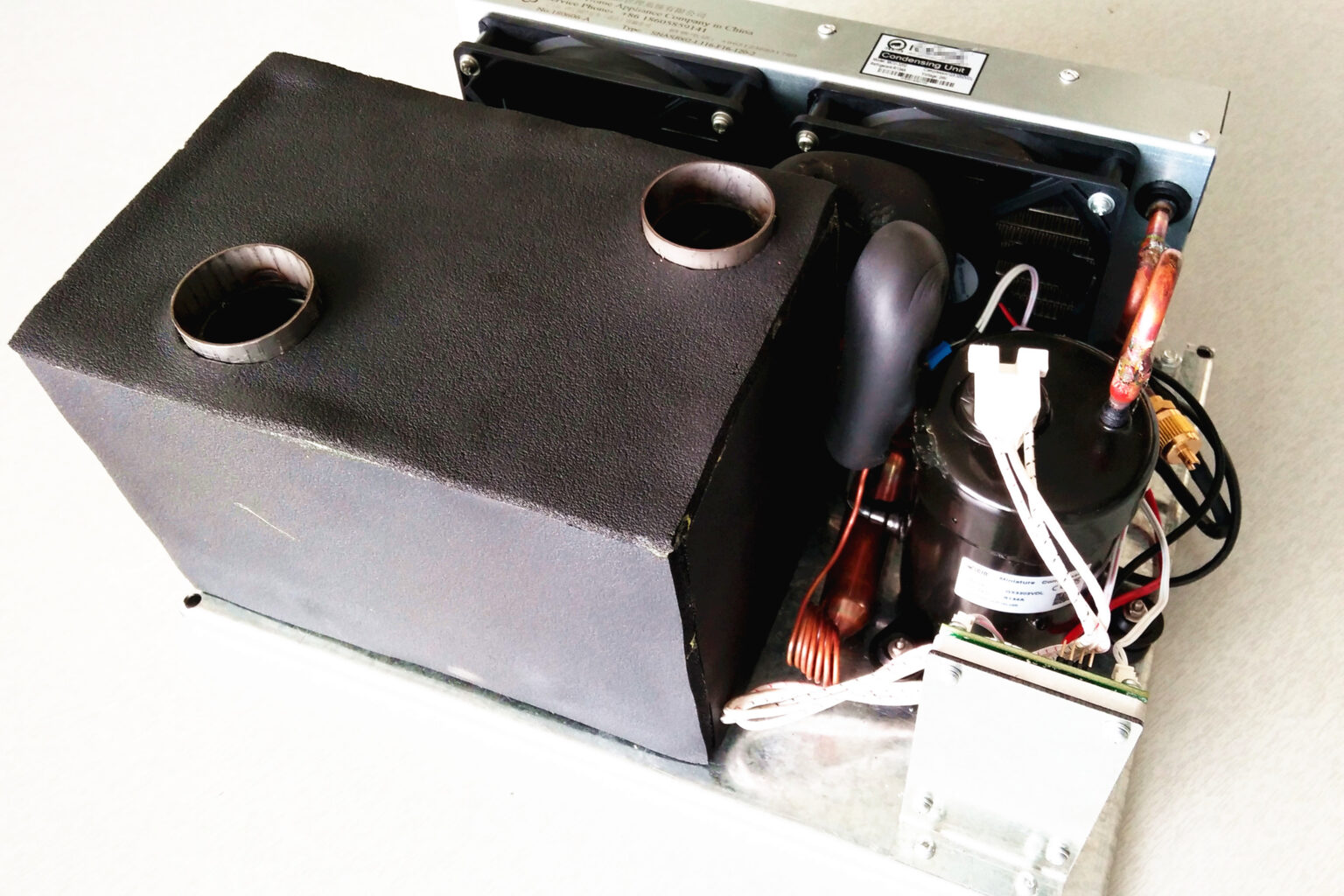
The breakthrough in micro DC air conditioning is not eliminating components. It is engineering each component small enough that the complete system fits in a package weighing approximately 5kg (11 lbs) with dimensions comparable to a large hardcover book.
How it achieves real cooling in a tiny package:
- BLDC miniature compressor: A brushless DC compressor with displacement under 2cc provides the mechanical refrigeration cycle. Variable speed from 1,800 to 6,500 RPM allows capacity modulation from minimal cooling to full 450W output. The compressor itself weighs under 1.5kg.
- Compact heat exchangers: Microchannel or mini-tube-and-fin evaporator and condenser provide high heat transfer in minimal volume. Total heat exchanger volume is under 1 liter for a 450W-rated system.
- Electronic expansion valve or capillary: Precisely meters refrigerant flow to match the variable-speed compressor output. Ensures efficient operation across the full speed range.
- DC power input: Operates directly from 12V, 24V, or 48V DC batteries without an inverter. This eliminates the size, weight, and efficiency loss of AC power conversion — critical when every gram and watt matters.
Real Cooling Performance: What 450W Actually Means
450W of cooling capacity (1,535 BTU/hr) sounds small compared to residential air conditioners rated at 2,500-5,000W. Context matters:
450W maintains comfortable temperature in enclosed spaces up to 3m³: A vehicle cab, equipment enclosure, pet crate, small tent, or electronics cabinet with reasonable insulation stays 10-15°C below ambient temperature with 450W of continuous cooling. This is not whole-room cooling — it is targeted cooling of defined spaces.
The math: Heat gain through enclosure walls depends on surface area, insulation value, and temperature difference. A well-insulated 1.5m × 1m × 1m enclosure (3m³) with 50mm insulation gains approximately 200-300W at 15°C temperature difference in 40°C ambient. The 450W system handles this load plus occupant/equipment heat generation with margin.
What 450W cannot do: Cool an entire room. Cool a poorly insulated space in extreme heat. Replace a window unit or split system for residential comfort. The micro DC aircon is not trying to do these things — it serves applications where traditional AC physically cannot fit, where DC power is the only option, or where the space being cooled is small and defined.
Size and Weight Comparison
Putting the dimensions in perspective against other cooling options:
| Type | Typical Weight | Typical Volume | Real Cooling | Power Source |
|---|---|---|---|---|
| Micro DC Aircon (DV1910E-AC) | 5 kg | ~5 liters | 450W (1,535 BTU) | 12V/24V/48V DC |
| Portable AC (consumer) | 25-35 kg | ~60 liters | 2,000-3,500W | 110/220V AC mains |
| Mini split (smallest) | 15-25 kg (indoor unit) | ~40 liters | 2,500-3,500W | 220V AC mains |
| Peltier/thermoelectric cooler | 1-3 kg | ~2 liters | 30-80W effective | 12V DC |
| Evaporative cooler (personal) | 2-5 kg | ~5 liters | 0W (no real cooling) | USB/12V |
The micro DC aircon occupies a unique position: genuine refrigeration cooling (unlike evaporative and Peltier) in a package an order of magnitude smaller and lighter than conventional AC (unlike portable and mini-split units). Nothing else in the market occupies this space.
Applications Where Size Is the Primary Constraint
The smallest air conditioner unit exists because certain applications physically cannot accommodate anything larger:
Electronics enclosures: A telecom cabinet, edge computing node, or instrument enclosure generates heat internally but cannot ventilate (sealed against dust, moisture, or explosive atmospheres). A micro DC aircon mounts inside or on the enclosure wall, maintaining internal temperature without breaking the seal. No other active cooling technology provides genuine below-ambient cooling in this form factor.
Vehicle operator positions: A forklift, excavator, or utility vehicle with a small cab and no factory AC. The micro unit mounts to the cab frame, ducting cooled air to the operator. Weight budget: under 10kg total including mounting hardware. Space budget: fits within the cab structural members. A conventional portable AC would fill half the cab volume.
Medical and laboratory equipment: Portable diagnostic devices, field laboratory instruments, and mobile medical equipment that must maintain precise temperature control. The cooling system must fit within or attach to equipment housings designed for portability. Every kilogram of cooling system is a kilogram subtracted from instrument payload.
 Battery thermal management: Lithium battery packs in EVs, marine vessels, and solar storage require active cooling to maintain safe operating temperature. The cooling module must fit within or adjacent to the battery enclosure — space that is tightly optimized for cell density. A 5kg cooling module with 450W capacity manages thermal loads for packs up to approximately 5kWh capacity.
Pet and animal transport: Airline-compliant pet crates and animal transport containers need temperature control during transit. The cooling system must be self-contained (battery-powered), lightweight (airline weight limits), and compact (fit within standard crate dimensions). A micro DC aircon with a small lithium battery provides 2-4 hours of active cooling — sufficient for most transit scenarios.
Why Thermoelectric (Peltier) Coolers Cannot Match This
Peltier modules are smaller than the micro DC aircon. So why not use those for the applications above?
Efficiency gap: A Peltier module achieves COP 0.3-0.8 under typical conditions (30-50% of input power becomes useful cooling; the rest becomes additional heat). The micro DC aircon achieves COP 1.5-2.5 (150-250% of input power as cooling, thanks to the thermodynamic cycle). For the same cooling output, Peltier needs 3-5× more electrical input power.
This matters because: In battery-powered applications, 3-5× more power consumption means 3-5× less runtime or 3-5× larger battery. A Peltier providing 450W of cooling would draw 600-1,500W of electricity. At 12V, that is 50-125A — requiring massive cables, huge batteries, and generating enormous waste heat that itself needs removal.
Temperature differential limitation: Peltier modules lose efficiency rapidly as the temperature difference between hot and cold sides increases. At the 15-20°C differential needed for comfort cooling, Peltier efficiency is at its worst. Vapor compression efficiency actually improves at moderate differentials — the exact opposite behavior.
Heat rejection problem: A Peltier drawing 1,500W to produce 450W of cooling generates 1,950W of heat (input + pumped heat) at the hot side. Rejecting 1,950W from a compact device requires a very large heatsink and powerful fans — negating the size advantage of using Peltier in the first place.
The conclusion: for cooling above 100W in any battery-powered application, vapor compression wins on every practical metric despite being physically more complex. The micro DC aircon represents the successful miniaturization of the fundamentally superior technology.
Power Consumption and Battery Runtime
For battery-powered applications — the primary use case for the smallest AC unit — runtime calculation is straightforward:
DV1910E-AC (12V model):
- Working current: 16A (maximum, at full speed in hot conditions)
- Typical current: 8-12A (partial load, moderate conditions)
- With 100Ah LiFePO4 battery: 6-12 hours runtime depending on load
- With 200Ah: 12-24 hours — sufficient for overnight cooling in most scenarios
DV1920E-AC (24V model):
- Working current: 8A (maximum)
- Typical current: 4-6A (partial load)
- With 100Ah 24V bank: 12-25 hours
Solar charging compatibility: A 200W solar panel produces approximately 10-15A at 12V during peak sun. This nearly matches the typical compressor draw, meaning the system can run indefinitely during daylight with minimal battery drain. Overnight operation draws from battery reserves charged during the day.
Installation Requirements
The smallest air conditioner unit needs minimal installation infrastructure:
- Mounting: 4 bolts or bracket (supplied). Unit mounts in any orientation — horizontal, vertical, or inverted. Total mounting area approximately 200mm × 150mm.
- Airflow: Condenser side needs access to ambient air for heat rejection (cannot be fully enclosed). Evaporator side ducts to the cooled space. Minimum 100mm clearance on condenser side for airflow.
- Electrical: DC power cable to battery or power supply. No special wiring — standard automotive-grade cable for the current rating. Inline fuse at battery.
- Drainage: Condensate water drains from evaporator. Provide a drain path (gravity or small pump for inverted mounting).
No refrigerant handling, no evacuation and charge procedure, no flare fittings, no pressure testing. The system arrives factory-sealed and pre-charged. Connect power, mount, provide airflow, done.
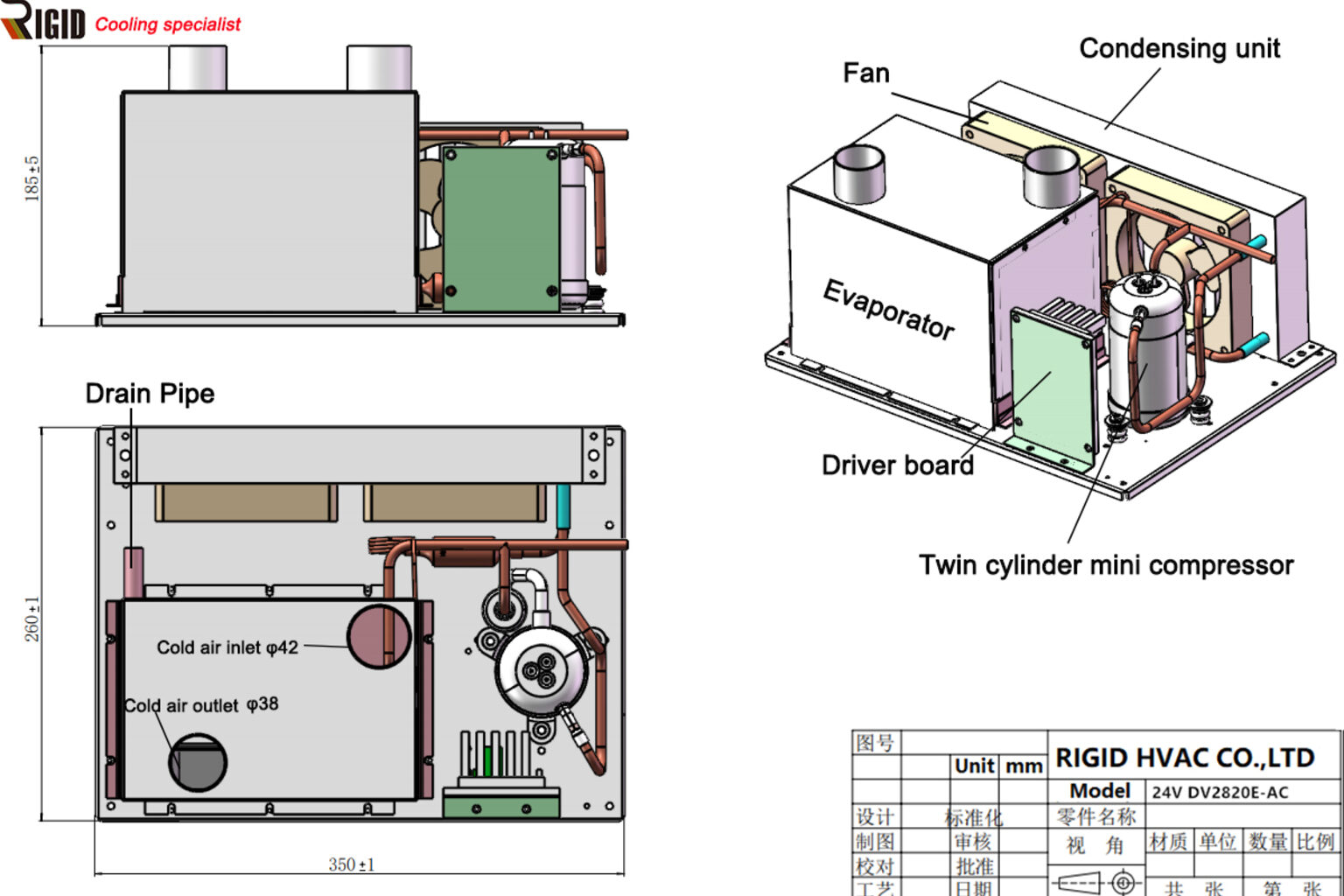 For specifications, dimensional drawings, and application support for the complete micro DC aircon range (450W through 900W), see the RIGID Micro DC Aircon product page.
Noise and Vibration: Living with the World’s Smallest AC
Any mechanical cooling system produces noise. The micro DC aircon generates noise from two sources: compressor operation and fan airflow. Understanding the noise profile helps with installation planning:
Compressor noise: The miniature BLDC compressor produces approximately 35-42 dBA at 1 meter at typical operating speeds. This is comparable to a quiet refrigerator — audible in silence but easily masked by ambient sounds in most application environments (vehicle movement, outdoor wind, equipment operation). At minimum speed (lowest cooling demand), noise drops below 35 dBA.
Fan noise: Condenser and evaporator fans contribute additional noise. Larger, slower fans produce less noise than small, fast ones. System designers can choose quiet operation (larger fans, slower speed, slightly larger package) or compact operation (smaller fans, higher speed, more noise).
Vibration: The BLDC compressor produces minimal vibration due to its balanced rotary design. Residual vibration is isolated through rubber mounting grommets. Properly mounted, no perceptible vibration transfers to the mounting structure. This is important for vehicle applications where transmitted vibration causes rattles and occupant discomfort.
For noise-sensitive applications (sleeping areas in RVs, pet transport, medical environments), the system can be configured with oversized condenser and reduced compressor speed to achieve the same cooling at lower noise. This trades package size for acoustic comfort — a worthwhile trade in many scenarios.
Environmental Operating Range
The smallest air conditioner unit operates across a wide environmental envelope:
- Ambient temperature: -10°C to 55°C. The system functions across this range but cooling capacity varies with ambient (higher ambient = higher condensing temperature = reduced capacity and efficiency).
- Humidity: 0-100% RH. High humidity increases latent load on the evaporator (moisture removal), which appears as condensate water production. In very humid conditions, a significant portion of the cooling capacity goes to dehumidification rather than temperature reduction.
- Altitude: Operates to 5,000m without performance degradation (air-cooled condenser efficiency decreases slightly at altitude due to lower air density, but the effect is minor below 3,000m).
- Orientation: Functions in any mounting orientation. Oil management in the compressor is designed for multi-position operation — unlike some larger compressors that require upright mounting.
- Vibration tolerance: Rated for continuous vibration up to 2G (vehicle and equipment mounting). Shock resistance: 10G for 11ms (transport shock specification).
Comparison With Other “Small” AC Options on the Market
Searching for small air conditioners returns many products that use the name but employ different technology. Understanding what you are actually comparing:
USB desk fans / “personal AC”: These are evaporative coolers or simple fans with ice trays. They cannot cool below ambient temperature in a sealed space. They add humidity to the air (counterproductive in many applications). They consume 5-20W and produce 0W of actual refrigeration cooling. Marketing calls them “air conditioners” but they are not.
Portable evaporative coolers: Work in dry climates by evaporating water (consuming latent heat). Effective outdoors in desert conditions but useless in sealed enclosures (humidity builds until evaporation stops). Cannot function in humid climates. Not true air conditioning.
“12V car AC” adapters: Often Peltier-based or small evaporative devices. Those that use Peltier provide genuine cooling but at 30-80W capacity with COP under 1.0 — insufficient for any meaningful cooling task and energy-wasteful.
Smallest residential mini-splits: The smallest available mini-split systems (5,000 BTU / 1,500W cooling) weigh 15-20kg for the indoor unit alone, require professional installation, refrigerant line routing, electrical circuits, and an outdoor condenser unit weighing an additional 20-25kg. They are “small” only relative to larger splits — not comparable to a 5kg self-contained module.
The micro DC aircon is the only product category that provides genuine vapor compression cooling in a package under 10kg that operates from batteries without installation complexity. It exists in a market gap that no other technology currently fills.
For the complete product range and technical specifications of the world’s smallest vapor compression air conditioners, see the RIGID Micro DC Aircon product page.