
Angle Lock: This article addresses the critical decision to move from passive or inadequate cooling to an active, closed-loop system for an outdoor electronics cabinet. We focus on two primary failure modes: premature component failure from sustained high temperatures and acute system shutdowns from thermal throttling. The dominant constraint is an extreme ambient operating temperature, specifically up to 55°C, often compounded by direct solar load.
A Framework for High Ambient Outdoor Cabinet Cooling
An outdoor electronics cabinet failing at a remote site is more than an inconvenience; it’s a cascade of operational and financial liabilities. Whether it’s a telecom base station dropping service during peak hours or a critical infrastructure control panel going offline, the consequences are severe. The common culprit is often heat, especially when ambient temperatures climb to 45°C, 50°C, or even 55°C. At these extremes, passive cooling methods like vents, shades, and even basic fans are no longer sufficient. The internal heat load from electronics, combined with external solar gain, creates an internal environment that rapidly degrades and destroys sensitive components.
This guide provides a practical, data-driven framework for engineers and system integrators to select, size, and implement an active cooling solution for these demanding scenarios. By the end, you will be able to confidently determine the right approach for maintaining optimal operating temperatures inside a sealed enclosure, even under the most extreme solar and ambient heat loads. In this article, we prioritize closed-loop vapor-compression cooling over air-to-air heat exchangers because, in high-ambient conditions, an air exchanger cannot cool the internal temperature below the external temperature, making it unsuitable for the challenge.
Deployment Context: Where Standard Cooling Fails
Theory is clean, but field deployments are not. Here are two common scenarios where the need for robust, high ambient outdoor cabinet cooling becomes undeniable.
Scenario A: Remote 5G Telecom Repeater
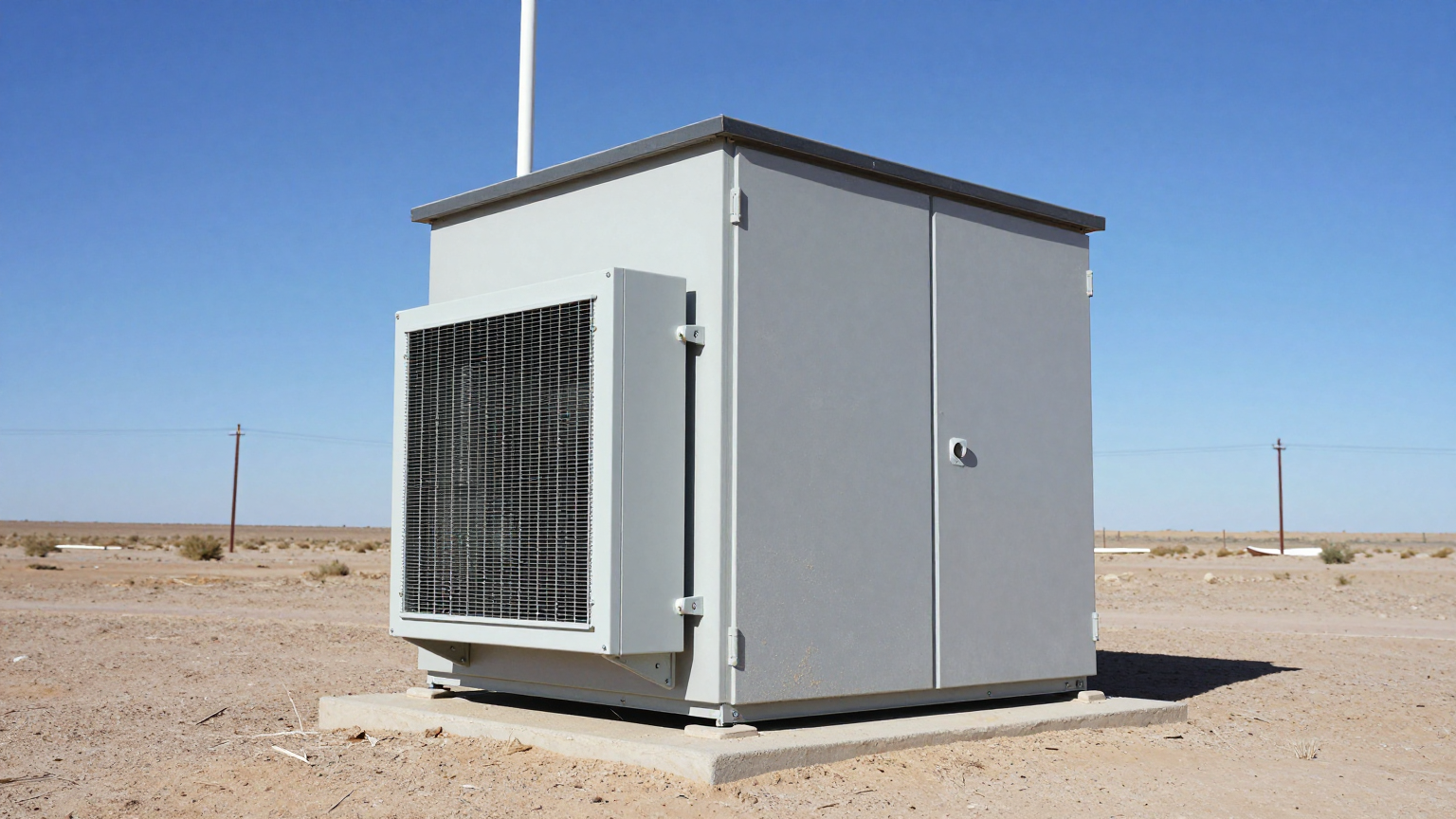
A telecom provider deployed a series of 5G repeater nodes in cabinets across a desert region. The initial design relied on passive venting and a large sun shield. However, during the summer months, with ambient temperatures hitting 52°C, the cabinets began experiencing intermittent shutdowns between 1 PM and 4 PM. A technician discovered the power supply units and radio modules were exceeding their maximum operating temperature, triggering thermal protection shutdowns. The vents, intended for cooling, were also allowing fine dust and sand to infiltrate the cabinet, coating components and acting as an insulator, worsening the problem.
Scenario B: Industrial Control Panel for a Pipeline
A control panel for a remote pipeline monitoring station was housed in a NEMA 4 enclosure to protect against moisture and dust. The system integrator used a standard thermoelectric cooler, sized for the internal heat load under normal conditions. However, the unit was installed in a location with no natural shade, and the dark-colored enclosure absorbed significant solar radiation. The combination of a 48°C ambient temperature, direct sun, and the 200W internal heat load overwhelmed the thermoelectric unit. The result wasn’t an immediate shutdown but a series of premature failures of PLCs and I/O modules over 18 months, leading to costly, unplanned maintenance and reliability concerns.
Failure Modes & Constraints in High-Heat Environments
When thermal management is insufficient, failures are not a matter of ‘if’ but ‘when’. Understanding the symptoms and their root causes is the first step in designing a resilient system. These are ranked by likely impact in a high-heat scenario.
- System Shutdown → Thermal Throttling → Critical processors or power supplies exceed their TJMax, forcing a protective shutdown to prevent permanent damage, causing total service interruption.
- Reduced Component Lifespan → Accelerated Aging → For every 10°C increase above the optimal operating temperature, the lifespan of many electronic components is halved. A cabinet running at 65°C internally instead of 40°C will see failures years ahead of schedule.
- Data Corruption → Unstable Power Rails → Overheated power supply units (PSUs) can experience voltage drops or ripple, leading to unpredictable behavior and silent data corruption in storage and transmission.
- Battery Backup Failure → Thermal Degradation → Backup batteries (especially VRLA types) are extremely sensitive to heat. Sustained high temperatures permanently reduce their capacity and ability to hold a charge, rendering them useless in a power outage.
- Loss of Sealing/IP Rating → Contaminant Ingress → Cutting improper holes for fans or using inadequate cooling solutions compromises the enclosure’s seal, allowing dust, moisture, and corrosive agents to enter and damage electronics.
- Increased Operational Costs → Frequent Site Visits → Each thermal event or premature failure requires a “truck roll”—a significant operational expense for remote sites that could have been avoided with proper initial thermal design.
Engineering Fundamentals: Closed-Loop Cooling
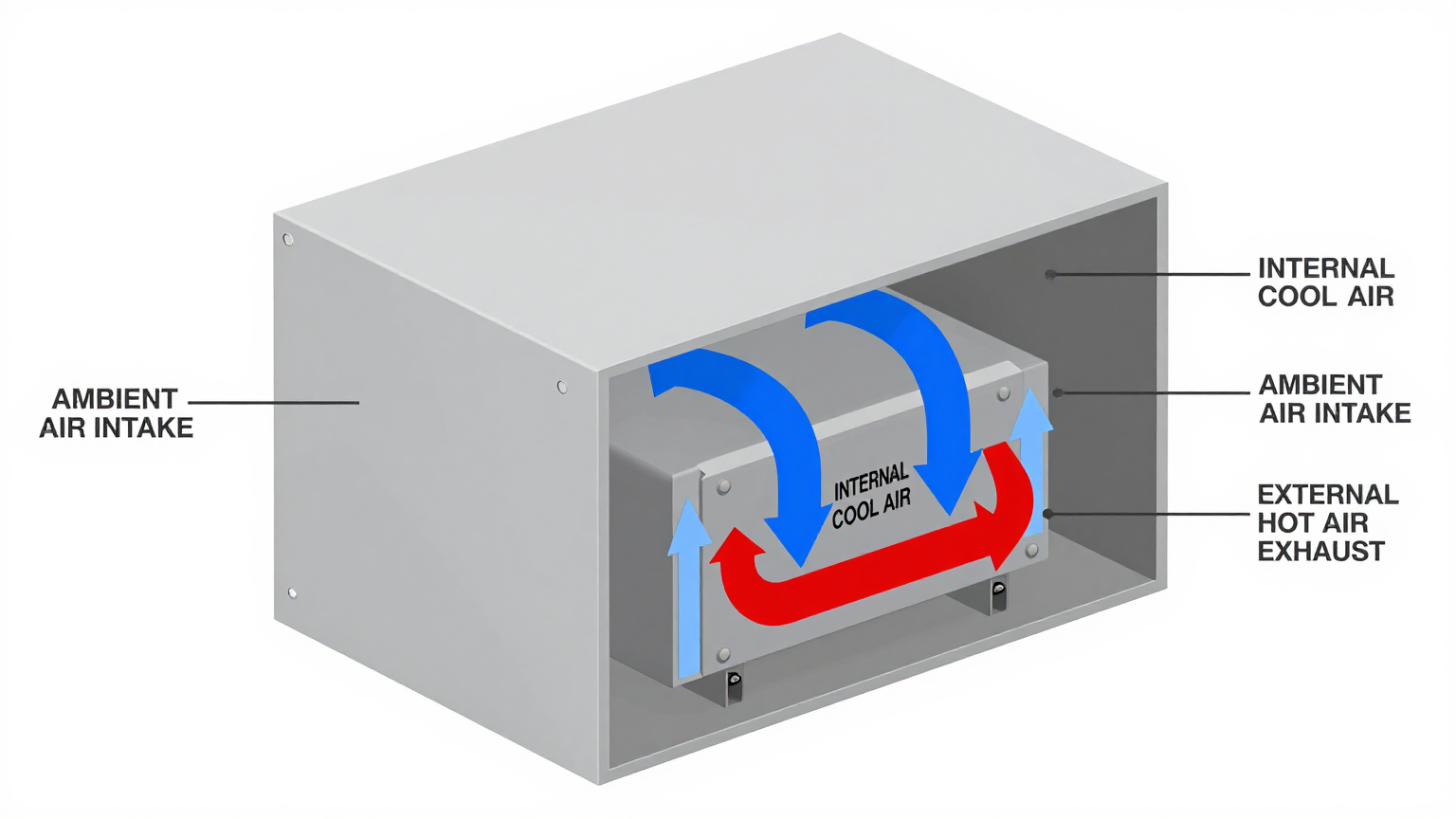
The core principle for protecting electronics in harsh environments is the sealed, closed-loop system. In this design, the cooling unit creates two separate airflow paths. The internal loop circulates and cools the air inside the cabinet, removing heat from the electronics. The external loop draws in outside air to cool the condenser of the cooling unit and exhausts the collected heat to the environment. These two air streams never mix, ensuring the cabinet’s internal environment remains free of dust, moisture, and humidity from the outside.
This is why a simple fan is often the wrong answer for a sealed outdoor enclosure. A fan requires an intake and an exhaust, breaking the seal and turning the cabinet into a crude filter that continuously pulls in environmental contaminants.
A Common Misconception: Many engineers believe that if the internal heat load is low, an air-to-air heat exchanger is sufficient. While effective in moderate climates, a heat exchanger’s limitation is that it can only cool the internal temperature to a few degrees above the *external ambient temperature*. If it’s 55°C outside, a heat exchanger can, at best, keep the inside at 58-60°C, plus the full temperature rise from the internal electronics. For enclosure cooling 55c scenarios, a vapor-compression system, like a DC air conditioner, is required because it is the only common technology that can actively cool the internal temperature well below the ambient temperature.
Key Specifications for High-Ambient Cooling Units
When evaluating active cooling solutions, certain specifications are non-negotiable for ensuring performance and reliability in extreme heat. The table below shows typical parameters for a compact, direct-current solution like the Micro DC Aircon series, designed for these applications. Focus on the cooling capacity’s relationship with voltage and how that capacity must be derated for high-ambient conditions.
Get A Sample Online


Product link: https://rigidchill.com/air-conditioning
| Parameter | Specification / Range | Why It Matters for High-Ambient Design |
|---|---|---|
| Input Voltage | 12V / 24V / 48V DC | Must match the available power source (e.g., battery bank, solar charge controller, or DC power supply) without inefficient power conversion. |
| Nominal Cooling Capacity | 100W – 900W (varies by model) | This is the baseline cooling power. It must be greater than the total heat load (internal electronics + solar gain) after derating for 55°C ambient. |
| Refrigerant | R134a / R290 / R1234yf | The choice of refrigerant affects thermal performance and regulatory compliance. R134a is a common, effective choice for these temperature ranges. |
| Control System | Integrated PCB with variable-speed control | Variable-speed compressors and fans are critical for efficiency. They run at full power to handle peak loads but ramp down to save energy once the target temperature is met. |
| Example Model (24V) | DV3220E-AC (Pro) | Provides a concrete example: 550W of nominal cooling at 24V DC, suitable for small to mid-size enclosures with significant heat loads. |
| Example Model (48V) | DV1930E-AC (Pro) | A 48V option with 450W nominal cooling, common in telecom infrastructure where 48V DC is the standard bus voltage. |
Selection Framework: A 4-Step Sizing Process
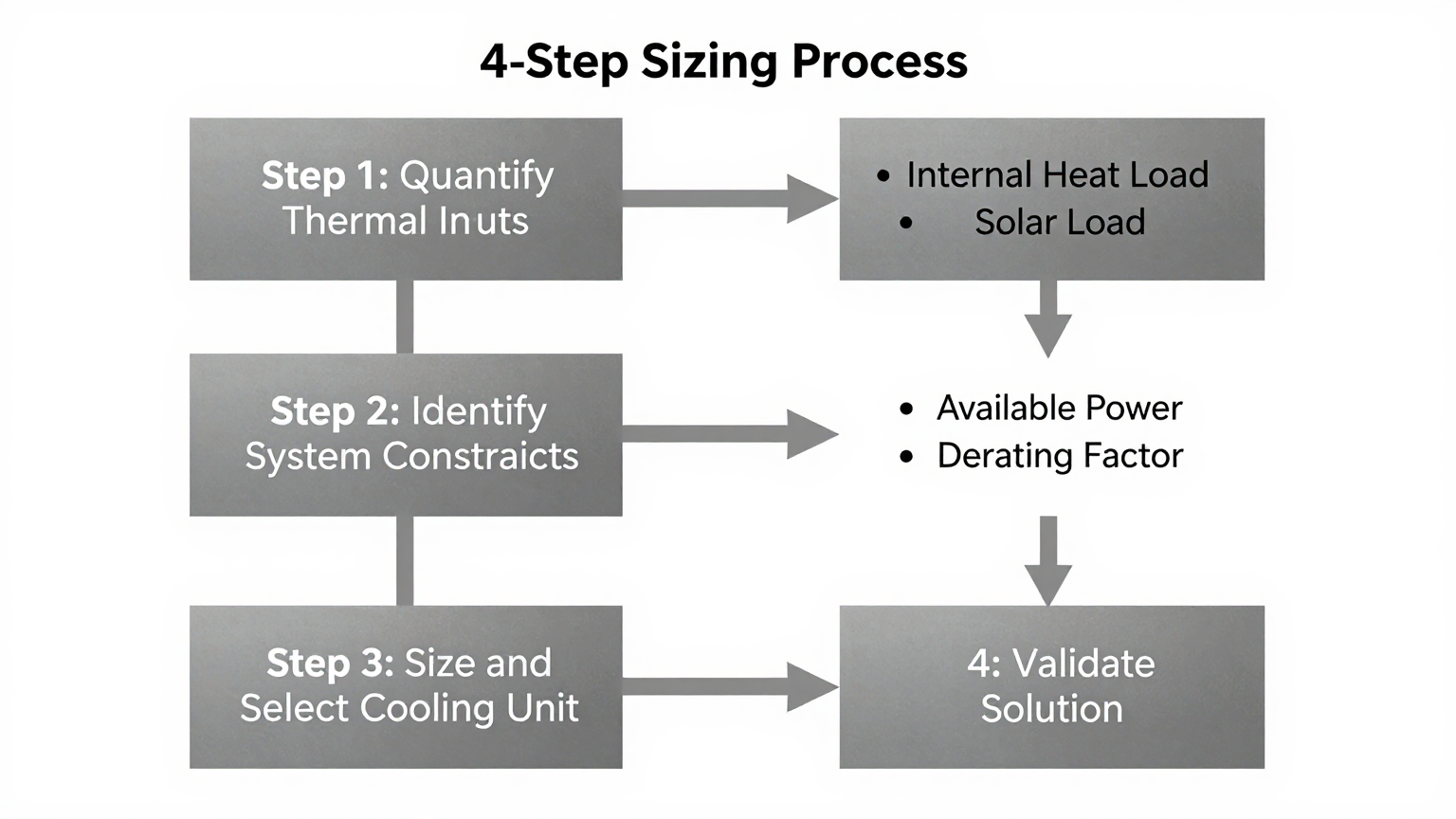
A methodical approach prevents over-sizing (wasting energy and money) or under-sizing (leading to system failure). Follow these steps to arrive at a reliable solution.
Step 1: Quantify Thermal Inputs
- Internal Heat Load: Sum the maximum power consumption (in watts) of all components inside the enclosure. A conservative estimate is to use the total wattage of the power supply, but a more accurate number is better.
- Maximum Ambient Temperature: Define the absolute worst-case ambient temperature the cabinet will experience at the installation site (e.g., 55°C).
- Solar Load: Calculate the heat gain from direct sun exposure. This depends on the enclosure’s surface area, color, material, and geographic location. Standard formulas and online calculators can provide a reasonable estimate in watts.
Output: A total heat load in watts (Internal Load + Solar Load).
Step 2: Identify System Constraints
- Available Power: Identify the DC voltage available (12V, 24V, or 48V) and the total current budget for the cooling system.
- Physical Space: Measure the available mounting surface on the cabinet (external or internal) and ensure there is adequate clearance for airflow to and from the cooling unit.
- Sealing Requirements: Confirm the required NEMA or IP rating for the enclosure. The chosen cooling unit must be able to maintain this rating after installation.
Output: A clear list of non-negotiable power, spatial, and environmental constraints.
Step 3: Size and Select the Cooling Unit
Using the total heat load from Step 1, select a cooling unit. Crucially, you must apply a derating factor. A cooling unit’s nominal capacity is rated at a standard ambient temperature (e.g., 35°C). At 55°C, its performance will be lower. Consult the manufacturer’s performance curves, but a safe practice is to choose a unit whose nominal capacity is at least 20-25% higher than your calculated total heat load. For instance, if your total heat load is 400W, you should look for a unit with at least 500W of nominal cooling capacity.
Output: A specific cooling unit model (or series) that meets the required cooling capacity and matches the constraints from Step 2.
Step 4: Validate the Solution
Before purchasing, perform a final sanity check. Does the selected unit’s power consumption fit within your power budget? Do its physical dimensions fit the available space? Does the manufacturer provide mounting gaskets and hardware that will maintain the enclosure’s IP rating? This final check prevents costly integration mistakes.
Output: Final confirmation that the chosen unit is compatible with the entire system design.
Implementation Checklist for Field Success
Proper installation is just as critical as proper selection. A perfectly sized unit can fail if installed incorrectly. Use this checklist to guide field deployment.
- Mechanical Installation
- Mounting Surface: Ensure the cabinet wall is flat, clean, and rigid enough to support the cooling unit without flexing.
- Gasket Seal: Use the supplied gasket. Apply it carefully to the cooling unit’s flange to create a continuous, watertight, and airtight seal against the enclosure wall. This is essential for maintaining the IP/NEMA rating.
- Airflow Integrity: Confirm that no cables, brackets, or other components inside or outside the cabinet are blocking the intake or exhaust of either the internal or external air loops.
- Electrical Connection
- Power Budget: Verify that the DC circuit can handle the cooling unit’s maximum (startup) current draw, not just its nominal running current.
- Wire Gauge & Protection: Use the appropriate wire gauge for the current and distance from the power source to avoid voltage drop. Install a correctly rated fuse or circuit breaker as close to the power source as possible.
- Polarity: Double-check the polarity of the DC connection. Reverse polarity can permanently damage the unit’s integrated driver board.
- Thermal Validation
- Sensor Placement: Place the thermostat sensor near the top of the cabinet, in the return air path to the cooling unit, to get an accurate reading of the hottest internal air temperature. Avoid placing it directly in the cold air stream.
- Acceptance Test: After installation, run the system with the electronics under full load. Let the cooling unit run for at least one hour and verify that the internal cabinet temperature stabilizes at or below your desired setpoint.
- Maintenance Planning
- External Coil Inspection: Schedule periodic inspections (e.g., every 6 months) to check the external condenser coils for blockage from dust, leaves, or debris. Clogged coils are a leading cause of reduced performance.
- Filter Check: If the external environment is particularly dusty, consider a model with a filter on the external air intake and check/clean it regularly.
Frequently Asked Questions (FAQ)
- Should I use one large cooling unit or multiple smaller ones?
- For a single large enclosure, one properly sized unit is typically more efficient and cost-effective. Multiple units may be considered for redundancy in mission-critical applications or for cooling separate, thermally isolated compartments within a larger cabinet.
- How do I maintain the cabinet’s IP/NEMA rating after cutting a hole for the cooler?
- The cooling unit itself must be rated for outdoor use, and it must be installed with the manufacturer-provided gasket. The gasket, when compressed between the unit and the cabinet wall, creates the seal. Proper surface preparation and correct torque on the mounting hardware are critical.
- What about condensation management inside the cabinet?
- Professional-grade cabinet coolers have built-in condensation management. Moisture that condenses on the cold internal coils is collected in a drain pan and typically evaporated into the hot external exhaust air stream, preventing any liquid from entering the electronics area.
- How much does direct sun on the cooling unit itself affect performance?
- Direct solar radiation on the cooling unit’s external casing and condenser coils adds to its heat load, slightly reducing its net cooling capacity. If possible, mounting the unit on the north-facing side of the cabinet (in the northern hemisphere) or under a sun shield can improve efficiency.
- What is the single most important measurement I need to take before selecting a cooler?
- The total internal heat load (in watts) of your electronics. Without an accurate number, any sizing calculation is a guess. If you are unsure, measuring the actual power draw of the cabinet under full load is the most reliable method.
- How can I validate that the cooling solution is working correctly after installation?
- Place a temperature logger inside the cabinet and monitor the internal temperature over a 24-hour cycle, especially during the hottest part of the day. The temperature should remain stable and well below the maximum allowable limit for your components. This provides empirical data that your high ambient outdoor cabinet cooling solution is performing as designed.
Conclusion: The Right Fit for Extreme Conditions
When faced with the challenge of enclosure cooling 55c, standard thermal solutions are no longer viable. A systematic approach, grounded in calculating the total heat load and understanding system constraints, is essential. For outdoor cabinets in high-heat environments, a closed-loop, vapor-compression system like a Micro DC Aircon offers a robust and reliable solution that can maintain a sealed, controlled internal environment, protecting sensitive electronics from both extreme heat and environmental contaminants.
This approach works best when reliability is paramount and passive methods have been proven insufficient. It may not be the lowest-cost initial solution, but it provides the lowest total cost of ownership by preventing premature equipment failure and eliminating costly service calls. If you are designing a system for a challenging thermal environment, our engineering team can assist with precise heat load calculations and help configure a cooling solution tailored to your specific enclosure geometry, power constraints, and operational demands.